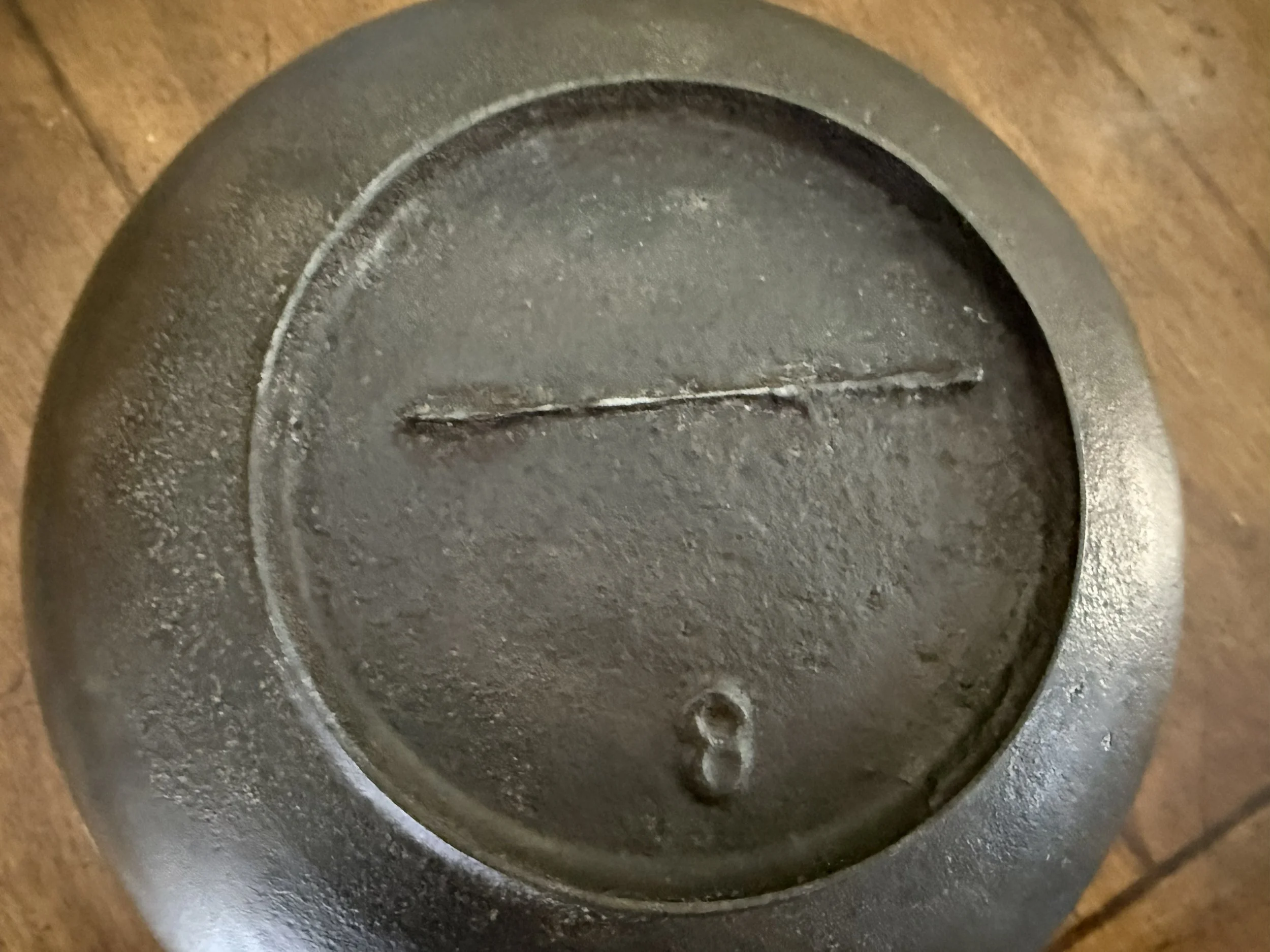
No. 8 Gate-Marked Bean Pot
This piece carries no foundry name, no city, and no patent date — and in early American cast iron, that absence is its own kind of story. SSC-UNK-KTL-8-001 is an unmarked No. 8 cast iron bean pot / kettle with a wire bail handle, a recessed base, and a clear bottom gate mark. Rather than invent an attribution, this deep-dive reads the iron itself: what the gate mark reveals about early sand-mold casting, what the cast size “8” meant on a period stove, and why bottom-gated hollow ware generally points to a 19th to early 20th century date. It also explains why unmarked kettles like this are so difficult to assign to a specific foundry and keeps the maker honestly unconfirmed pending primary-source verification — preserving a sourced record ready to meet a marked twin or catalog match if one ever surfaces.
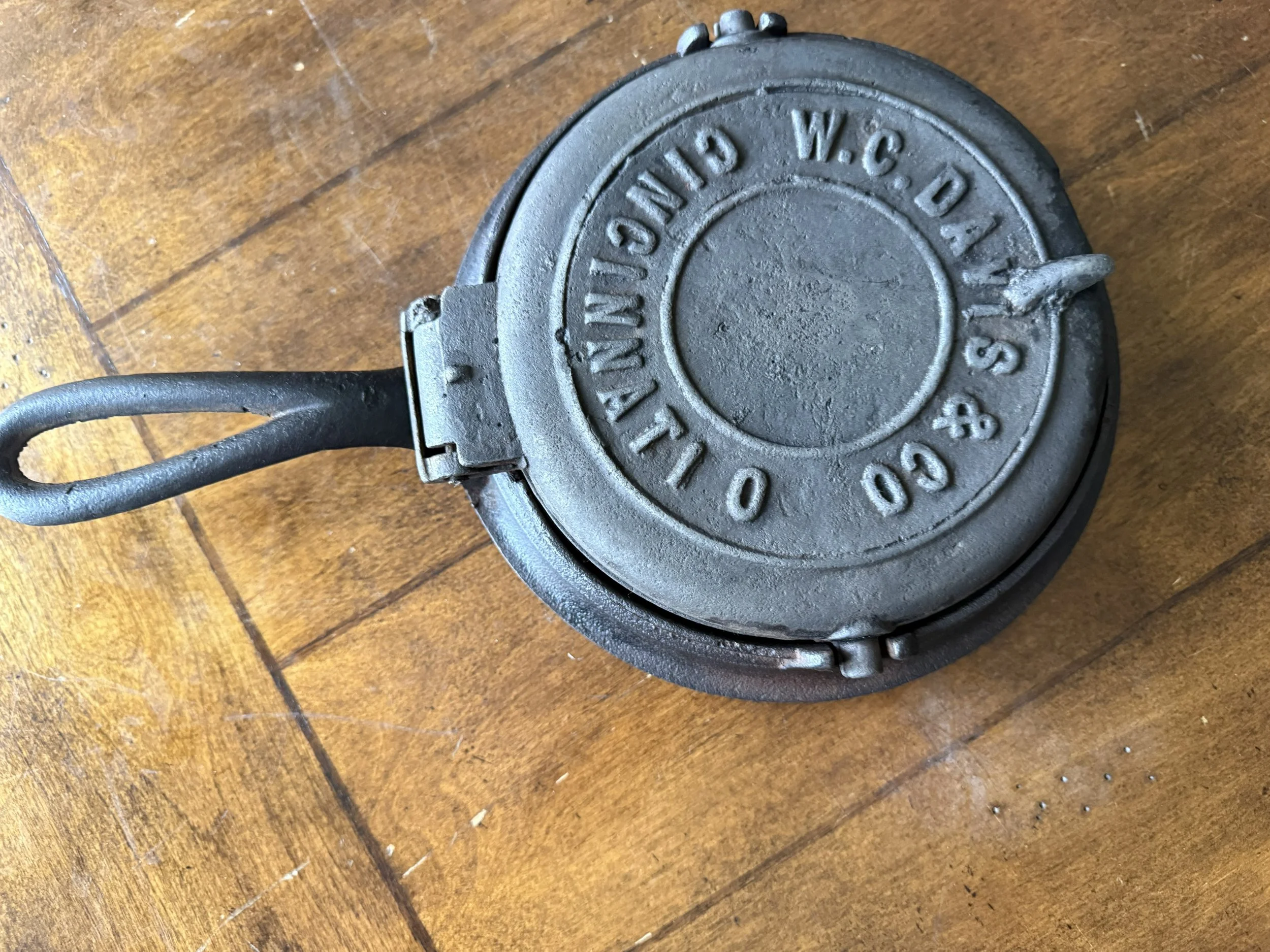
W.C. Davis & Co. Cast Iron Waffle Iron with Low Base
A complete W.C. Davis & Co. cast iron waffle iron with original low base — both paddles, both handles, functioning hinge, original base — marked W.C. DAVIS & CO / CINCINNATI O and dating to the firm's active name period, c. 1842–1880. W.C. Davis & Co. is the Cincinnati foundry from which the Favorite stove and hollow-ware line descended. This iron predates the Favorite era

Yourtee, Hollister & Co. Cast-Iron Stove-Top Kettle | Dated 1871 | Cincinnati, Ohio
Cast-iron stove-top tea kettle bearing the raised markings YOURTEE HOLLISTER & CO. / CINCINNATI O. / 1871, with a No. 6 marking at the spout. Contemporary Cincinnati directories identify Yourtee, Hollister & Co. as manufacturers of stoves, hollow ware, and castings and as proprietors of Miami Stove Works, with their foundry at California, Hamilton County, Ohio and their Cincinnati office and warerooms at 94 West Second Street.
The firm's connection to the California foundry can be traced to Nicholas Patterson & Co., whose earlier Miami Foundry manufactured stoves, hollow ware, and castings at California. Yourtee, Hollister & Co. advertised itself in 1871 as successor to N. Patterson & Co.
The partnership was dissolved effective January 1, 1874, by limitation and mutual consent. Samuel L. Yourtee, N. H. Sinclair, and T. G. Randall Jr. immediately formed Yourtee, Sinclair & Randall to continue the stove-foundry business; Hudson Hollister did not join the successor partnership.
The 1871 marking is original physical evidence on the kettle and is consistent with the documented operation of Yourtee, Hollister & Co. that year. However, no surviving catalog or production record has yet been located proving precisely what the date signified or identifying the exact production history of this particular No. 6 kettle. The evidence strongly supports manufacture within Yourtee, Hollister & Co.'s documented California, Ohio foundry operation; it does not support the former attribution to Lawrenceburg, Indiana

Greer & King Mfg. Co. No. 8 Three-Legged Bail Bean Pot Kettle
The Greer & King Mfg. Co. of Dayton, Ohio received their patent on November 3, 1868 — three years after the Civil War ended, when Reconstruction was still unfinished and the western frontier had not yet closed. The bean pot sitting on these three iron legs predates Wagner by two decades and Griswold Erie by more than twenty years. This is the oldest patent-dated piece in the SSC Museum Collection, and one of the primary surviving physical records of a Dayton foundry that the standard reference databases have never documented.
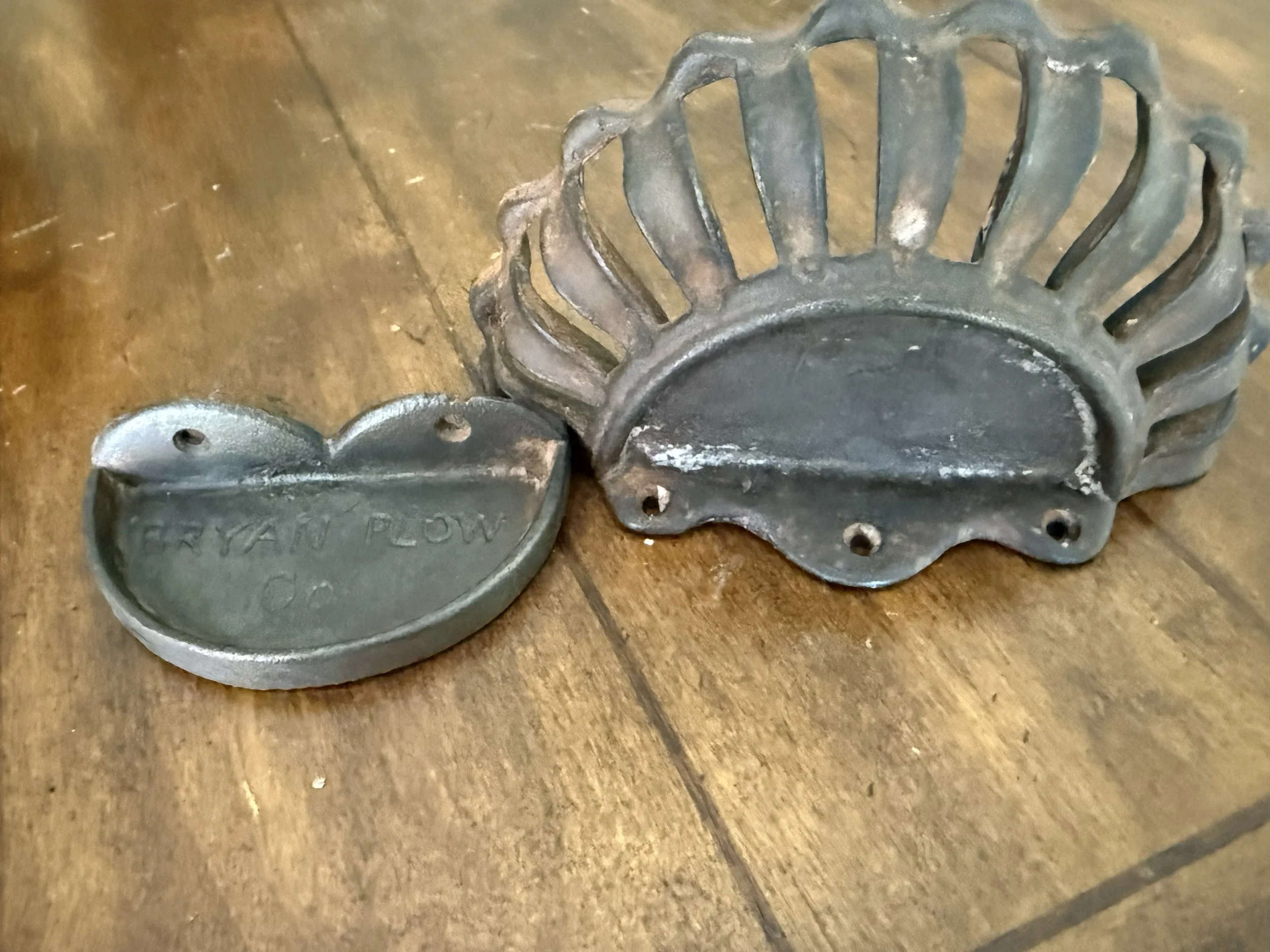
Two Small Castings, One Word I Recognized: Bryan Plow Co. and an Unsolved Piece of Home
Two small cast iron pieces marked BRYAN PLOW Co. of Bryan, Ohio, once wrongly called a plow seat and footrest. Their true identity is still unknown; the maker's history is documented.

Brooks & Patton No. 9 Tea Kettle
A rare No. 9 tea kettle from Brooks & Patton of Columbus, Ohio — the foundry whose principal, Alexander G. Patton, later acquired the Columbus Hollow Ware Company. SSC documents the piece that bridges two chapters of Columbus cast iron history.

Pre-Logo Era No. 8 Flat Skillet — Gate Scar, Unattributed
The gate scar is the oldest mark in the SSC collection. Not a logo, not a brand — the physical remnant of the casting process itself: the raised diagonal ridge left when the iron that filled the gate was broken away after the pour. American foundries of the mid-to-late 19th century tolerated visible gate scars in a way the branded era did not. By the time Favorite Piqua Ware was stamping Smiley cartouches into its bases, the gate scar was already a relic. This No. 8 flat skillet, with its fancy twist handle and figure-8 loop, predates every other piece in the SSC collection — and it belongs here.