Greer & King Mfg. Co. No. 8 Three-Legged Bail Bean Pot Kettle
SSC MUSEUM COLLECTION
Catalog No. SSC-GREER-KTL-001
No. 8 Three-Legged Bean Pot Kettle | Bail Handle | Patented Lid | Dayton, Ohio
c. 1868–1880s • Greer & King Mfg. Co. • Dayton, Montgomery County, Ohio • Pat. Nov. 3, 1868

The Greer & King No. 8 three-legged bail bean pot kettle with lidded top, showing the full form: the cylindrical body with banded foot ring, the original wire bail handle, and the domed lid carrying the Pat. Nov. 3, 1868 marking. Dayton, Montgomery County, Ohio.
This is one of the oldest pieces in the SSC Museum Collection. The Greer & King Mfg. Co. of Dayton, Ohio received their patent on November 3, 1868 — three years after the end of the Civil War, when Dayton was already a substantial manufacturing city riding the Miami and Erie Canal toward industrial expansion. The bean pot sitting on these three iron legs predates Wagner by two decades, predates the Griswold Erie by more than twenty years, and was cast in Montgomery County, Ohio at a time when Reconstruction was still unfinished and the western frontier had not yet been closed.
It is, in form, one of the oldest cooking vessel designs in the American cast iron tradition. The three-legged bail kettle — a direct descendant of the fireplace cauldron and the open-hearth cooking pot — was the workhorse of American domestic cookery before flat-top stoves became universal. It sat directly over coals, the three legs providing a stable platform, the bail handle allowing it to be lifted or hung over a fire. To hold this kettle is to hold a continuous thread of American kitchen history stretching back to the colonial hearth.
Greer & King chose to patent their version. The date — November 3, 1868 — is cast directly into the lid's dome, legible after more than 155 years. What exactly the patent covered is a subject for ongoing research; the specific patent number has not yet been definitively identified. But the act of patenting tells us something: Greer & King believed their design offered a genuine improvement, something worth protecting, worth casting in iron and marking for the world to read.
The Piece

Top view of the kettle with lid in place, showing the central knob handle, the three short cast lid-retention nubs at the rim, and the domed profile that carries the patent marking. The bail handle ears are visible at the lip of the body.
The No. 8 Greer & King kettle is a cylindrical, straight-sided iron pot with a distinct foot ring at the base and three short cast legs below that foot ring, providing a stable three-point stand. The overall form is compact and purposeful: taller than it is wide relative to many later bean pots, with a pronounced shoulder and a fitted domed lid.
The lid is the patent-bearing component. Its dome carries the full marking: GREER & KING / 8 / DAYTON, O. / PAT. NOV. 3 / 1868, cast in raised letters across the domed surface. Three short cast nubs at the lid's rim seat the lid on the pot body and prevent it from sliding; this lid-retention feature is likely what the November 3, 1868 patent addresses, though the specific claims require patent database verification to confirm. The knob handle at the lid's apex is solid and intact.
The wire bail handle is original and present, attached at two cast ear bosses on the body just below the rim. The bail is a simple round-wire loop of the type standard to the period, and it functions as intended: lifting the full pot by the bail, the three legs serve as a natural cradle, and the pot sits level.
The Casting Marks
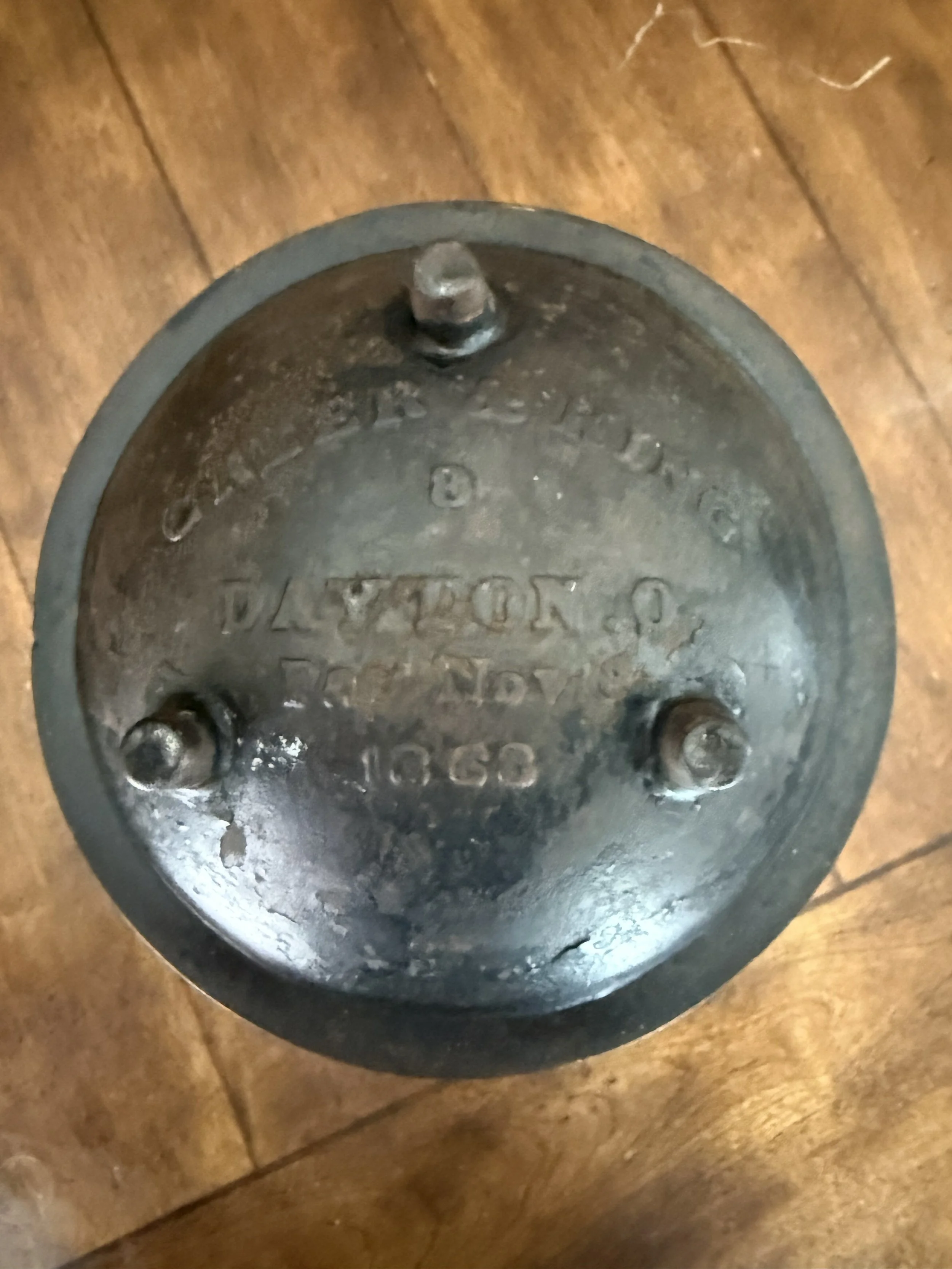
Bottom view of the kettle showing the full maker cartouche cast into the lid dome: GREER & KING / 8 / DAYTON, O. / PAT. NOV. 3 / 1868. The three short cast lid-retention nubs are visible at the rim. The three leg stubs are visible at the base of the body behind the lid in this orientation.

Close detail of the casting marks on the lid dome. GREER & KING arcs across the upper portion; 8 sits centered below the maker name; DAYTON, O. follows; PAT. NOV. 3 below; and 1868 at the bottom. All text is legible after more than 155 years, a testament to the quality of the original sand-mold casting.
The casting marks on this kettle represent a complete maker attribution, unusual in their completeness for a piece of this age. Many early post-war Ohio hollow ware pieces bear only a size number or a fragmentary maker mark; the Greer & King lid carries the full company name, size designation, city and state, the word “PAT.” (meaning the patent has been applied for or granted), the month and day, and the year. A manufacturer who cast all five elements into his lid was making a deliberate statement of identity and ownership.
The “O.” abbreviation for Ohio was standard practice in mid-nineteenth century cast iron marking — comparable to how M.H. Crane & Co. marked their Urbana, Ohio kettles as “Urbana, O.” and other Ohio makers used the single-letter abbreviation throughout the 1860s and 1870s. It is a regional idiom that places this piece firmly in its era.
The Patent: November 3, 1868

Profile view of the kettle showing the relationship between the domed lid, the cylindrical body, the banded foot ring, and the three short cast legs. The wire bail handle hangs at the body's lip. This form — three legs, bail handle, fitted lid — is the definitive American cast iron bean pot configuration of the 1860s–1880s.
November 3, 1868 falls during a busy period of American patent activity. The country was in the throes of post-Civil War industrial expansion, and the Patent Office was processing applications at a pace unmatched in prior decades. Between 1865 and 1875, thousands of patents were granted to American manufacturers seeking to differentiate their products in a rapidly nationalizing marketplace.
The specific U.S. patent number corresponding to the November 3, 1868 date on this kettle has not yet been definitively identified in available patent databases. A comprehensive search of USPTO records from that date for cast iron cooking vessel patents, kettle lid patents, and related hollow ware improvements assigned to Greer & King or to Dayton, Ohio inventors is ongoing. SSC will update this record when the specific patent is confirmed.
What can be said with confidence is this: the patent-marked element is the lid, and the most distinctive feature of the lid is the three cast nubs at the rim that seat and retain it on the pot body. This lid-locking or lid-seating mechanism — preventing the cover from rattling or sliding in use — is the most probable subject of the patent claim, consistent with the type of improvements that hollow ware manufacturers were seeking protection on in this period. A fitted, retained lid was a genuine convenience improvement over flat lids that simply rested on the pot rim.
Greer & King Mfg. Co., Dayton, Ohio
Dayton, the seat of Montgomery County on the Great Miami River, was already a significant manufacturing center by 1868. The 1889 History of Dayton specifically lists Greer & King among the city's notable manufacturing operations in its chapter on the city's industrial development — direct documentary confirmation that the company was sufficiently established to merit mention in the city's historical record.
Dayton's industrial growth in this period was driven by canal access and then by rail. The Miami and Erie Canal, completed north to Lake Erie in 1845, had connected the city to regional markets and enabled the arrival of raw materials and the departure of finished goods at costs that made manufacturing economically viable. By the time Greer & King was operating, Dayton was characterized by the 1889 History as a city where manufacturing and agriculture were “mutually dependent” — the farms of the Miami Valley providing a market for manufactured goods, the manufacturing establishments providing the tools and implements the farms required.
The iron foundry tradition in Dayton was old by 1868. The 1889 History documents the first Dayton foundry as far back as 1828, established by McElwee & Clegg near Cooper's Mill — “the first foundry in Dayton. At it nearly all kinds of castings could be obtained at reasonable cost.” By the 1860s, Dayton supported multiple foundry operations. The Philip Smith who would later found the Sidney Hollow Ware Co. (later acquired by Wagner) learned iron molding at a Dayton foundry in 1852, suggesting the city had the training infrastructure and technical expertise to produce skilled molders.
Greer & King was part of this broader Dayton foundry tradition. The company does not appear in the standard cast iron hollow ware reference databases — the Foundry Database at CastIronCollector.com does not list them, and they are absent from the Wagner and Griswold Society’s compiled foundry list. This is consistent with how many pre-1880s Ohio hollow ware producers have been treated by the collector literature: they existed, they made documented pieces, their products survive, but they were not large enough or long-lived enough to attract sustained reference attention. The three-legged bean pot and the occasional tea kettle are essentially the entire surviving documented record of their production.
Market research on currently known examples suggests Greer & King produced kettles in at least size 7 and size 8. The location of the size number on the lid dome — centered below the maker name, above the city and patent information — appears to vary by production run, with at least one collector noting that early examples (like this one) place the number above the patent information, while later examples reposition it between the name and patent text. If this observation is accurate, it would suggest a modest production run spanning at least several years following the 1868 patent date.
The Three-Legged Bean Pot in American Cooking
The three-legged bail kettle is among the oldest cast iron forms in American domestic use. Its ancestry is the European cauldron — the hanging pot of the medieval and early modern hearth — translated first into colonial American iron through Pennsylvania and Virginia foundries, then spread westward and southward with the settlement of the continent. By the 1840s, American foundries from New England to the Ohio Valley were casting three-legged pots in quantity for both domestic and camp use.
The form is precisely adapted to its original function. The three legs allow the pot to stand stably over an open fire or over coals banked in a fireplace. The bail handle allows the pot to be moved while hot, either by lifting directly or by hooking a crane or trammel in the bail and swinging it away from the heat. The fitted lid traps steam and heat, converting the pot into a slow cooker — ideal for the long, low cooking that transforms dried beans, tough cuts of meat, and root vegetables into something worth eating.
By 1868, the flat-top wood and coal stove was increasingly common in American kitchens, and the three-legged pot was beginning its transition from everyday cookware to specialized camp and outdoor equipment. The kettle in this collection sits at that transition point. It was patented in the year that three-legged pots were still being produced and sold as kitchen equipment by Ohio foundries; within another decade or two, they would primarily serve as camp cooking vessels, hunters' pots, and outdoor cauldrons. The Greer & King kettle is a document of the last years when this ancient form was still fully domestic.
Condition Notes
The kettle presents in very good condition for a piece of this age. The exterior shows appropriate surface patina and oxidation consistent with 150+ years of existence. The interior shows rust and surface oxidation consistent with period use and storage; no structural damage is visible. The casting marks on the lid dome are fully legible. The lid seats correctly on the body. The bail handle is original and present. The three legs are intact and the foot ring is sound. No cracks are visible in the body or lid.
The interior rust and patina are genuine period features of this piece, not defects. A kettle of this age that shows no interior surface variation would be the suspicious piece; the condition of this example is exactly what authentic use and honest storage over 155 years produces.
Piece Details
Manufacturer
Greer & King Mfg. Co., Dayton, Montgomery County, Ohio
Piece Type
Three-Legged Bail Bean Pot Kettle with Domed Patent Lid
Size
No. 8
Form
Cylindrical body; banded foot ring; three short cast legs; original wire bail handle with cast ear bosses; domed fitted lid with cast knob handle and three lid-retention nubs at rim
Material
Gray cast iron throughout; original wire bail
Casting Marks
GREER & KING / 8 / DAYTON, O. / PAT. NOV. 3 / 1868 — cast in raised letters on lid dome
Patent Date
November 3, 1868 — cast directly on lid dome; specific patent number subject to ongoing USPTO research
Patent Subject
Likely the lid-seating/retention mechanism (three cast nubs at rim); specific claims pending patent number identification
Handle
Original period wire bail; present and functional; attaches at two cast ear bosses below body rim
Lid
Original domed lid; fits correctly on body; three cast retention nubs at rim; solid cast knob handle at apex; fully marked
Legs
Three short cast legs integral to body casting, below banded foot ring; all three present and intact
Condition
Very Good — body structurally sound; no cracks visible; all casting marks fully legible; bail original and present; lid original and fits correctly; interior shows age-appropriate rust and patina consistent with period use; exterior patina consistent with age
Date of Manufacture
c. 1868–1880s — patent date of November 3, 1868 establishes the earliest possible production date
Place of Manufacture
Dayton, Montgomery County, Ohio
Acquisition Source
eBay — Seller: bobwes80-6
eBay Item No.
157554836402
Order No.
14-14468-48517
Acquisition Date
April 8, 2026
SSC Catalog No.
SSC-GREER-KTL-001
Collection Category
Ohio Cast Iron — Pre-1905 Hollow Ware
Why This Piece Matters
The Greer & King No. 8 bean pot kettle is the oldest patent-dated piece in the SSC Museum Collection. November 3, 1868 is not an approximation or an estimate — it is cast directly into the lid, readable today as clearly as the day the mold was poured. This piece was made before Ulysses S. Grant was elected president. It was made when Dayton’s streets were lit by gas. It was made when Ohio farmers were still cooking over open fires and hearths as often as they were cooking on stoves.
It matters as a representative of the pre-Wagner, pre-Griswold Ohio hollow ware tradition — a tradition that existed and thrived before the great Sidney and Erie names came to dominate the collector conversation. Greer & King of Dayton does not appear in the major cast iron reference databases. This kettle is, in practical terms, one of the primary physical records of the company’s existence and production. The markings tell us who made it, where, when, and that they cared enough about their design to patent it.
It matters because the three-legged bail kettle is the oldest cooking form in the American cast iron tradition, and this example preserves the form in its Ohio manufacturing context — complete, marked, dated, and from a documented Dayton operation. The SSC collection’s pre-1905 mandate exists precisely to preserve pieces like this: old enough to predate the period that collectors typically know, documented well enough to tell their own story, and rare enough that each surviving example is a meaningful fragment of an industrial record that has otherwise largely disappeared.
The iron is 157 years old. The marks are still there. The legs still stand. The story still deserves to be told.
Sources & Further Reading
Physical examination of piece: GREER & KING / 8 / DAYTON, O. / PAT. NOV. 3 / 1868 cast in raised letters on lid dome; three cast lid-retention nubs at rim; solid knob handle at lid apex; cylindrical body with banded foot ring and three cast legs; original wire bail handle at cast ear bosses; gray cast iron throughout. Five seller photographs examined prior to acquisition.
History of Dayton, Ohio. Chapter XVIII — Manufactures. Dayton History Books, 1889. Available at daytonhistorybooks.com. Primary source for the listing of Greer & King among Dayton manufacturers; confirms the company’s existence and operation as a documented Dayton manufacturing enterprise. Exact dates of founding and closure not established from this source.
U.S. Patent and Trademark Office historical records — Patent search for cast iron cooking vessel and kettle lid patents granted November 3, 1868, Dayton, Ohio. Ongoing. The specific patent number associated with the “PAT. NOV. 3 1868” marking has not yet been definitively identified. SSC collection record will be updated upon identification.
The Cast Iron Collector — Foundry Database. castironcollector.com. Greer & King not present in the standard hollow ware foundry reference database, confirming classification as a pre-reference-era Ohio producer outside the mainstream collector literature.
Wagner and Griswold Society — Foundry List (wag-society.org/guest/list.pdf). Greer & King not listed in the compiled WAGs foundry catalog, consistent with the company’s pre-reference status.
Sidney Hollow Ware Co. — The Cast Iron Collector. castironcollector.com. Documents Philip Smith learning iron molding at a Dayton, Ohio foundry in 1852; establishes Dayton’s foundry training tradition predating the Greer & King patent by sixteen years.
eBay acquisition record — Order No. 14-14468-48517, seller: bobwes80-6, April 8, 2026. Item: Cast Iron 3 Leg/Bail Bean Pot Kettle #8 Greer & King Mfg. 1868 Dayton Ohio VGC (item no. 157554836402).
SSC Internal Collection Records — Ohio Cast Iron / Pre-1905 Hollow Ware category. SSC-GREER-KTL-001 is the oldest patent-dated piece in the SSC Museum Collection; patent research ongoing; the piece represents the earliest documented Ohio cast iron hollow ware in the collection.
About Steve's Seasoned Classics
Steve’s Seasoned Classics is an online museum dedicated to preserving and documenting the heritage of American cast iron, with a singular focus on the obscure, defunct foundries of Ohio from the 19th and early 20th centuries. The SSC collection spans 130+ pieces from 50+ confirmed Ohio makers — the majority absent from standard collector references. Makers were identified through physical artifacts exhibiting gate marks, patent dates, foundry traits, and documented regional provenance, cross-checked against surviving trade directories, census records, and existing collector guides. Makers lacking representation in published guides but supported by physical evidence were flagged for first-time documentation — a core function of the SSC research mission.
