Two Small Castings, One Word I Recognized: Bryan Plow Co. and an Unsolved Piece of Home
Catalog No. SSC-BRYAN-PLW-001 | Unidentified Cast Iron Object, Two Pieces | Bryan, Williams County, Ohio
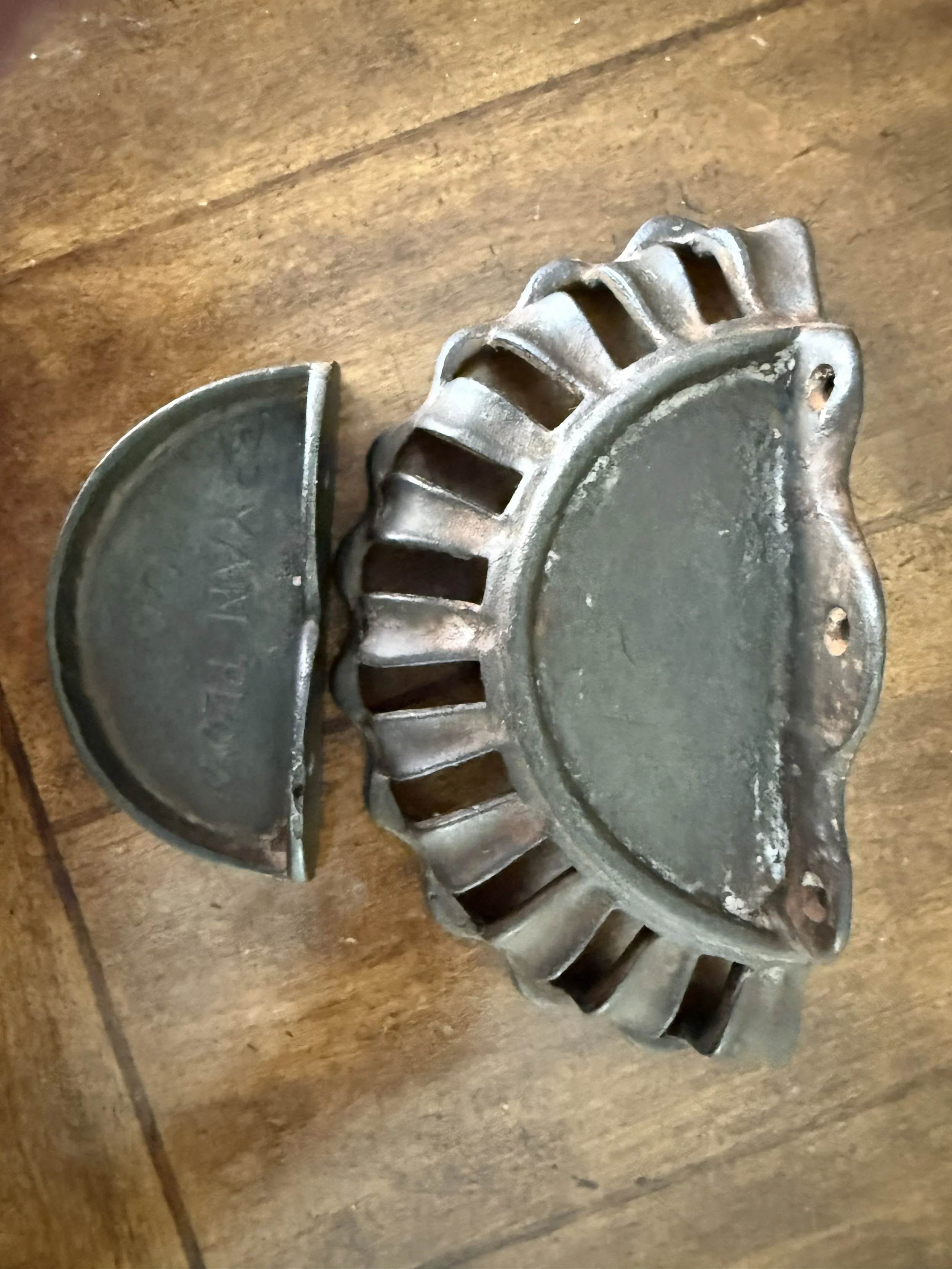
The two pieces, as acquired, sat together on an old painted board. The larger fan-form piece measures about 7 inches wide by 3 inches deep; the smaller marked piece is about 4.5 inches wide by 2.5 inches deep.
This post covers two small cast iron pieces, and it starts with an admission: SSC's earlier catalog page for this item called them a sulky plow “seat and footrest” and attributed them to The Morrison & Fay Mfg. Co. of Bryan, Ohio. That identification was wrong. A plow seat and footrest are substantial pieces, typically 12 to 15 inches across and built heavy enough to carry a rider's full weight over rough ground all day. These two pieces are nowhere near that scale. The larger, fan-shaped piece is about 7 inches wide, 3 inches deep, and weighs roughly 1.5 to 2 pounds. The smaller piece, the one carrying the maker's mark, is about 4.5 inches wide, 2.5 inches deep, and weighs somewhere between 8 and 12 ounces. Neither piece is heavy enough or large enough to have held up a plowman.
So this post does two things instead of one. It corrects the record on what these pieces are not, and it documents, as thoroughly and honestly as the available sources allow, what can actually be verified about the company whose name is cast into one of them: Bryan Plow Co., successor to The Morrison & Fay Mfg. Co., an obscure and now defunct 19th-century Ohio implement foundry. What the two pieces themselves actually are remains an open question, stated plainly rather than papered over with a guess.
There's a personal reason this particular piece is in the collection at all. It was bought for one simple reason: it says “Bryan, Ohio” on it, and it's cast iron. Bryan was home — the collector lived there until age 10. That's the whole reason this otherwise unidentified pair of small castings is part of this collection: not because of what they turned out to be, but because of where they said they were from.
Finding the Maker: Reading the Casting Mark
Whatever these two pieces turn out to be, one thing is not in question. The smaller piece carries a fully legible cast mark on its underside, in two lines of raised block capitals:
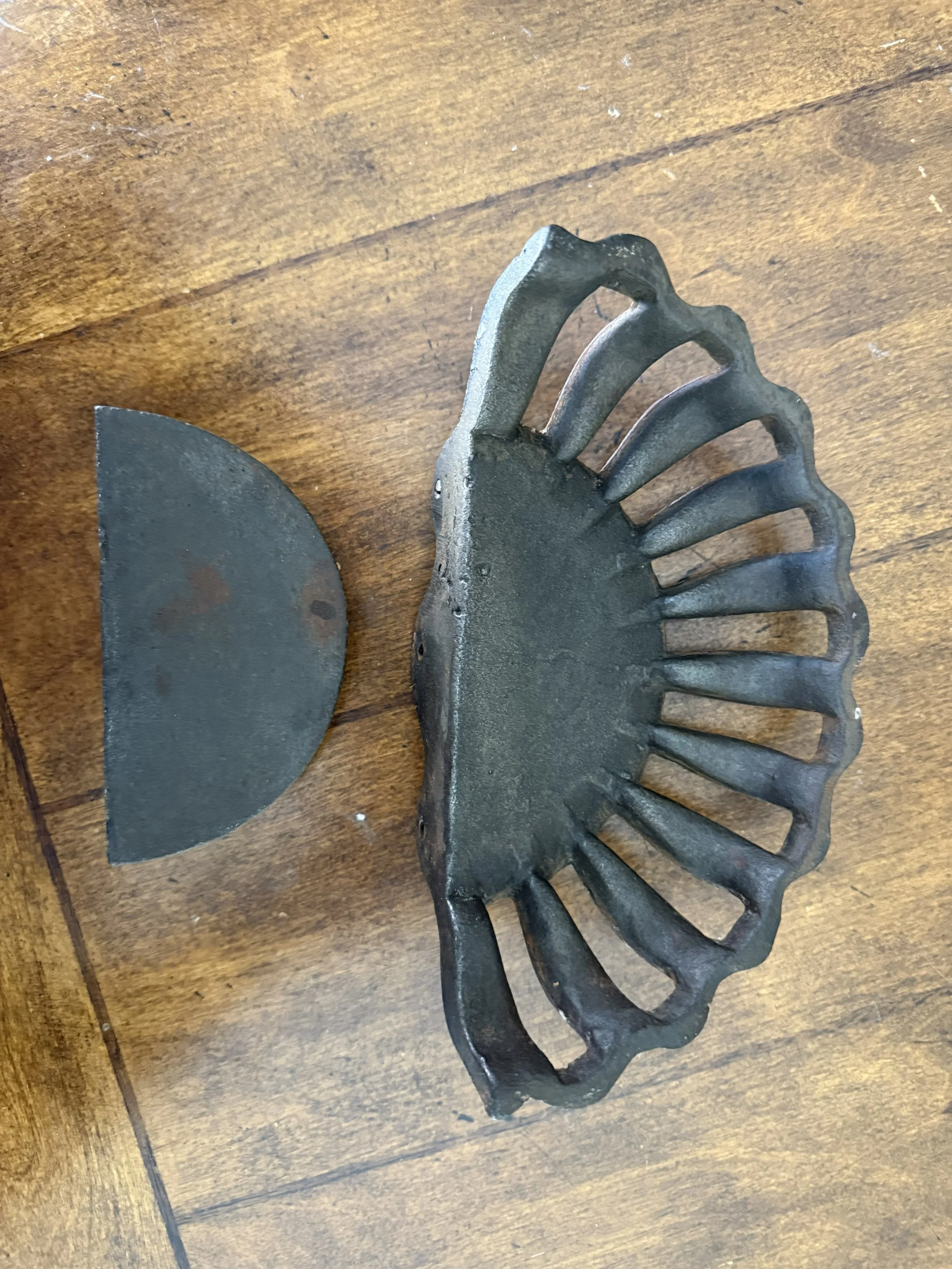
The underside of the smaller piece, roughly 4.5 by 2.5 inches, showing two mounting holes and the maker's mark in full: “BRYAN PLOW Co.” cast in raised block capitals.
BRYAN PLOW Co.
The earlier catalog entry described this mark as only “partially legible” and attributed the piece primarily to The Morrison & Fay Mfg. Co., with Bryan Plow Co. treated as a secondary possibility. On direct examination the mark is not partial at all — it reads cleanly, with no ambiguity. That matters for the same reason it mattered when this piece was mistakenly called a seat and footrest: Morrison & Fay Mfg. Co. and Bryan Plow Co. were not two interchangeable names for the same era. They were sequential legal names for the same Bryan, Ohio foundry, separated by a corporate sale. A piece cast with the Bryan Plow Co. name was cast after that sale, not before it.
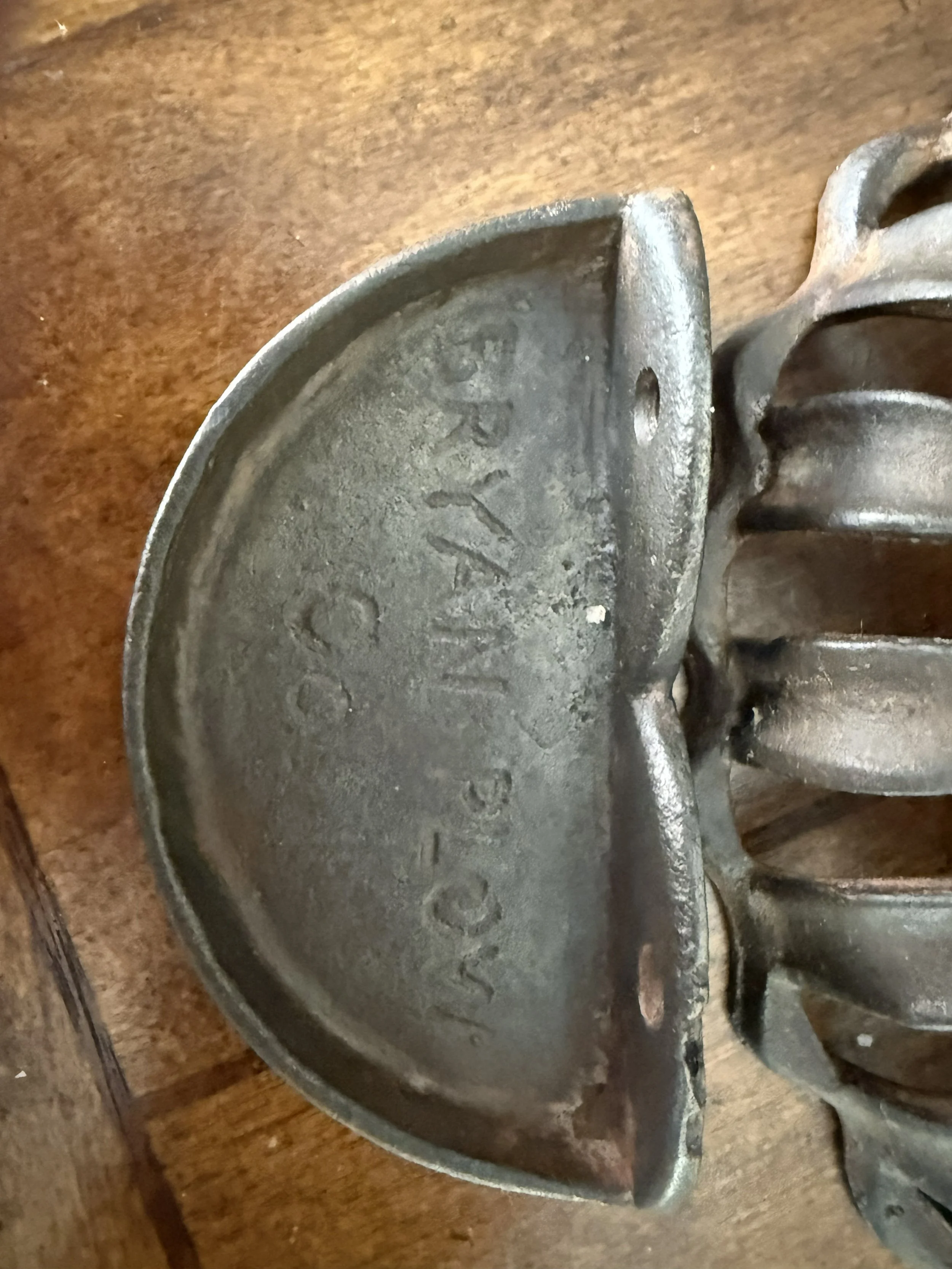
Detail of the mark from a raking angle, confirming full legibility of “BRYAN PLOW Co.” No pattern number, size designation, or patent date accompanies the mark.
This Is Not a Morrison & Fay Mfg. Co. Piece
With the mark read directly and fully off the object, the primary source for attribution is the piece itself, and it names Bryan Plow Co., not Morrison & Fay. Any reference to Morrison & Fay in this post refers to that company's documented history as the direct predecessor of Bryan Plow Co. at the same Bryan, Ohio location — not to a claim that Morrison & Fay made this specific object.
A Correction: What These Pieces Are Not
The earlier post's identification rested on an assumption that was never checked against the object's actual size, and the acquisition invoice itself offers no help: the eBay listing title reads only “ANTIQUE BRYAN PLOW CO OHIO TOOL FARM RARE OLD VINTAGE MACHINERY WOOD CAST IRON” — a generic description with no part name and no dimensions. Below is what can actually be supported about the earlier identification, and why it does not hold up.
· Claim 1: A genuine cast iron sulky plow seat is a single-person seating surface, typically in the range of 12 to 15 inches across, built to support a rider's full weight through a day of fieldwork. Reference examples documented by the Smithsonian's agricultural implements collection describe cast-iron implement seats at this general scale. (Agricultural Implements and Machines in the Collection of the U.S. National Museum, Smithsonian Institution) The fan-shaped piece in this collection is 7 inches wide and weighs under 2 pounds — roughly half the typical span and a fraction of the typical weight of a seat casting.
· Claim 2: A matching plow footrest is generally a similarly substantial, load-bearing casting, mounted to withstand a plowman's boot pressing down repeatedly over rough ground. The smaller, marked piece in this collection is 4.5 inches wide and weighs 8 to 12 ounces — light enough that its wall thickness alone makes a load-bearing footrest function implausible.
· Possible lead (unverified): Both pieces are lighter, relative to their size, than most structural agricultural-implement iron, which suggests a thin-walled decorative, ventilated, or fitting-type casting rather than a load-bearing part. This is a physical inference from weight and wall thickness, not a confirmed identification, and it does not by itself indicate what specific object these pieces came from.
The Pieces Themselves
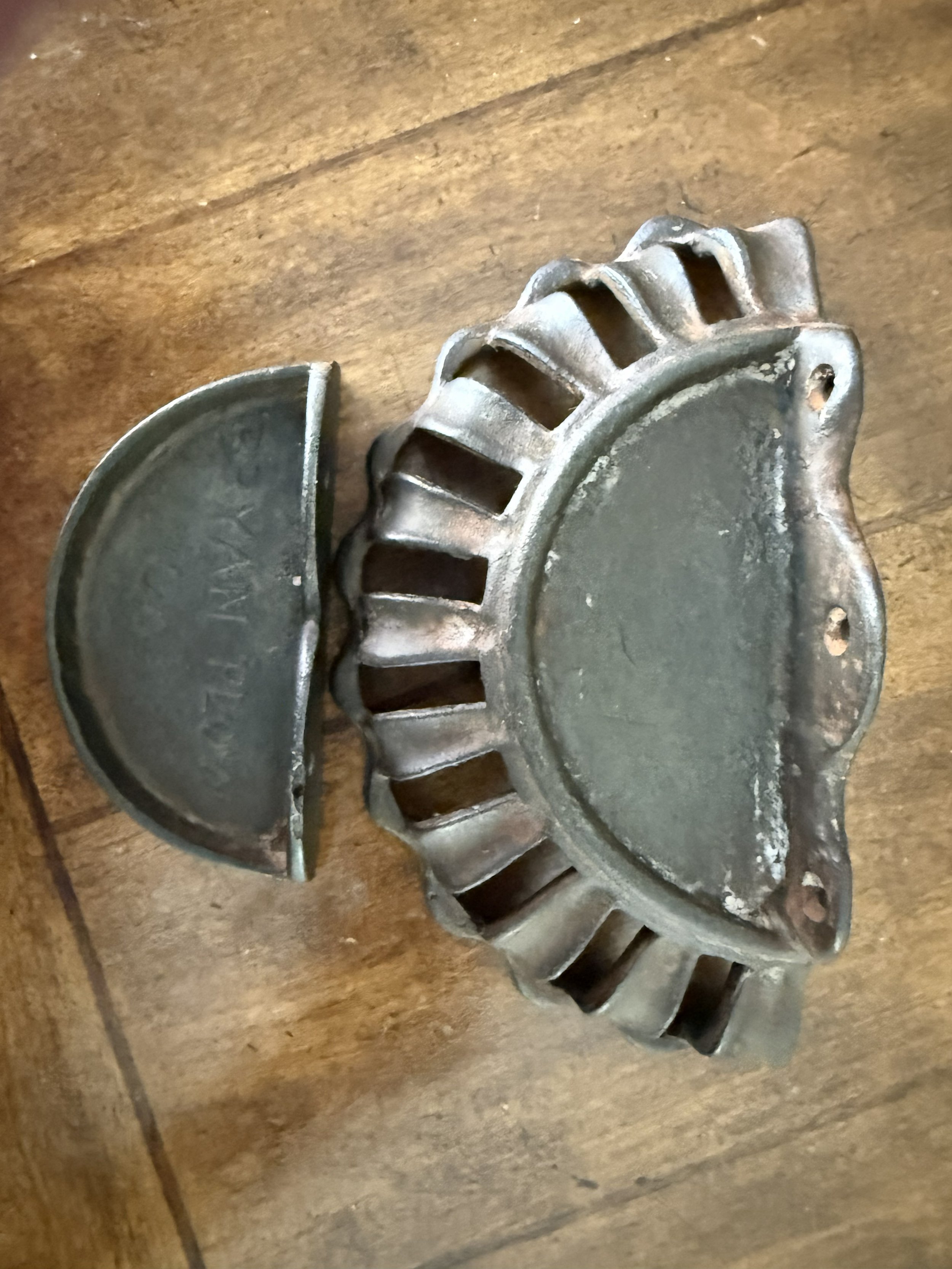
The fan or crown-shaped piece from above: a scalloped outer rim with radiating open slots around a solid oval center, roughly 7 inches wide and 3 inches deep, weighing approximately 1.5 to 2 pounds.
The larger piece is a crown or fan-shaped casting: a scalloped, lobed outer rim frames a series of radiating open slots that fan out from a solid, roughly oval, raised center. A mounting flange with three holes — two outer holes and one center hole — projects from the underside. No maker's mark, pattern number, or other inscription is visible anywhere on this piece.
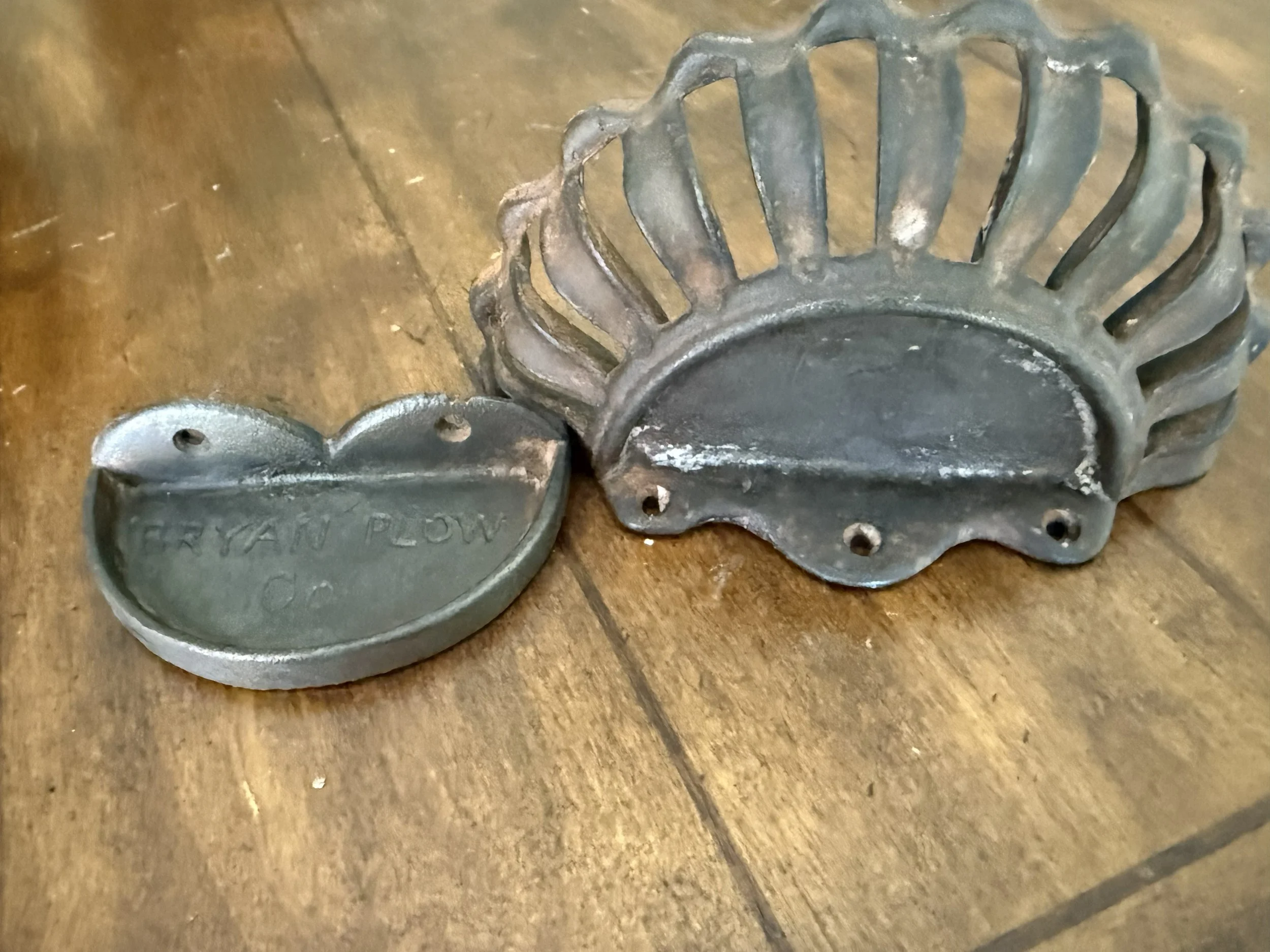
Side profile of the two pieces together, showing the fan piece's radiating slot depth alongside the smaller marked piece's solid wedge profile. This pairing reflects how the pieces were mounted for display, not a confirmed original factory relationship between them.
The smaller piece is a solid, half-moon or wedge-shaped casting, flat on the back with two mounting holes flanking the maker's mark. Transcribed exactly as it appears, in two lines: “BRYAN / PLOW Co.” No pattern number, size designation, or patent date accompanies the mark, and the surrounding surface shows no sign that additional text has worn away — the mark as cast appears to have always been this brief.
Both pieces arrived mounted together on an old painted wood board, which is how they are shown in the accompanying photographs. That mounting reflects how the pieces were displayed at the time of acquisition; it is not, by itself, evidence that the two pieces were manufactured as a matched pair or originally used together on the same machine. Whether they belong together at all is one of the open questions this post cannot resolve.
Who Were the Makers? A Foundry Under Three Names
Even with the object itself unidentified, the maker whose name it carries has a real, documentable history. The earlier catalog entry named only Morrison & Fay Mfg. Co. and gave a broad operating window of 1865 to 1890. Local histories and a contemporary trade catalogue describe a longer and more specific succession: a foundry founded under one name, run for two decades as Morrison & Fay, and then sold and renamed Bryan Plow Co. in the late 1880s — a small, regional, and by now defunct 19th-century Ohio implement manufacturer, exactly the kind of obscure foundry history this collection exists to document.
“The Bryan Foundry was established in 1862 by Robert Park of Fairfield, Huron County, Ohio… They occupied a wooden frame and brick structures at the corner of Beech and Butler Streets. In 1865 it became the Morrison, Fay, and Company.”
Source: Kevin Maynard, local historian, presentation summarized in The Village Reporter, “Kevin Maynard Presents Bryan's Industrial History to Rotary Club” (2021)
This account is a secondary, present-day summary of a local-history presentation rather than a contemporary 1862 document, so it is treated here as Tier 2 — useful for the overall arc, but not sole support for the exact 1862 founding date. It supplies a founder's name (Robert Park), a specific origin location (Fairfield, Huron County, Ohio), and a precise street corner (Beech and Butler) that were absent from the earlier post.
· Founded in 1862: as “The Bryan Foundry” under Robert Park, per the Village Reporter/Maynard account above.
· Renamed Morrison, Fay and Company in 1865: per the same source, three years after the foundry's founding.
· Key people: Robert Park (founder, 1862); the Morrison and Fay partners for whom the mid-period company was named (full given names not yet confirmed against a primary source — see Open Questions). An 1882 Williams County biographical sketch references an “E. G. Fay, of Bryan,” though this has not been directly tied to the plow company's Fay.(Williams Co., Ohio Biographies, 1882, Ohio Genealogy Express)
· Renamed Bryan Plow Co., 1886–1887: A contemporary newspaper notice, the Cincinnati Commercial Gazette of December 12, 1886, reported that “the Bryan Plow Company, capital stock $20,000, filed certificates of incorporation to-day.” (Cincinnati Commercial Gazette, Dec. 12, 1886, p. 5, NewspaperArchive.com) The Williams County Public Library's Local History Center separately states: “In 1887 Morrison & Fay Company sold out to new owners and then the name was changed to the Bryan Plow Co.” (Williams County Public Library Local History Center) Together these sources place the sale and rename in 1886–1887. The full original newspaper page has not yet been viewed directly; only the indexed snippet is available, and this is flagged in Open Questions below.
· Operating window under the Bryan Plow Co. name: confirmed in official use by 1887, per the Ohio Bureau of Labor Statistics' 1887 report, which lists “Bryan Plow Co., plows, 32” employees under manufactures for Bryan, Williams County. (Ohio Labor Statistics, 1887, reproduced via RootsWeb) The name remained in commercial use for years afterward: a surviving 1898 company invoice and an August 1901 Minneapolis Journal classified advertisement both show the company still trading under the Bryan Plow Co. name well into the following decade.(Bryan Plow Co. invoice, 1898, eBay listing)
One inconsistency is worth stating plainly rather than smoothing over. The Morrison & Fay Mfg. Co.'s own 1884 sales catalogue opens by describing its plows as “the results of 26 years of experience in the manufacture of plows” — arithmetic that implies a starting point around 1858, four years earlier than the 1862 founding date given by the Village Reporter/Maynard account. (Illustrated Catalogue of the Bryan Plows, Morrison & Fay Mfg. Co., 1884, Iowa State University Digital Collections) This has not been resolved against an independent record and is carried into Open Questions rather than settled here.
A crowd-edited company wiki states Bryan Plow Company “existed from at least 1871” and lists its product line as including “Disc Harrows; Display Tables; Land Crushers; Riding & Walking Plows; Store Tools; Tank.” (MyCompanies Wiki, Fandom) This is a Tier 3, crowd-edited source with no cited primary record behind either the 1871 date or the product list, and the 1871 date conflicts with the 1886–1887 incorporation evidence above. It is noted here only as an unverified lead — including the reference to “Display Tables” and “Store Tools,” which is flagged for its own sake given the small, non-structural scale of the two pieces in this post.
Bryan, Ohio in the 1880s: Historical Context
Bryan is the county seat of Williams County in the far northwest corner of Ohio, laid out in 1840 and named for John A. Bryan, a former state auditor who donated the land for the county seat. (City of Bryan, Ohio, official history page) By the 1880s, Bryan's plow foundry was one part of a small but real manufacturing base in a county seat still closely tied to agriculture; the Ohio Bureau of Labor Statistics' 1887 survey of Bryan manufactures lists the plow works with a workforce of 32 under “Bryan Plow Co., plows.” (Ohio Labor Statistics, 1887, via RootsWeb)
The product line itself sat within a genuinely competitive national market for sulky (riding) plows in this decade. The Morrison & Fay Mfg. Co.'s own 1884 catalogue reports the results of a sulky plow draft trial at the Orleans County Fair in Albion, New York, in which the Bryan Sulky Plow's measured draft (367 pounds per 100 square inches turned) was lower than that recorded for six named competitors present at the same trial: the Gilpin Sulky (417 lbs.), the Wizard Sulky (429 lbs.), the Syracuse Sulky (441 lbs.), the Castile Sulky (442 lbs.), the Casaday Sulky (459 lbs.), and the Sandusky Sulky (691 lbs.), as reported by the fair's own judging committee (Wm. H. Hendry, A. Wood, M. Hubbard). (Illustrated Catalogue of the Bryan Plows, 1884, Iowa State University Digital Collections) This is the maker's own reprint of the trial results in its sales literature, so it should be read as the company's selected evidence rather than an independently audited outcome, but the specific trial and its named committee make it a real, checkable claim.
The same 1884 catalogue also reports diplomas awarded to the company by the Onondaga County Agricultural Society (Syracuse, N.Y., September 1883) and the Farmers and Mechanics Institute of Northampton County, Pennsylvania (Easton, Pa., September 1883). Its central engineering claim for the sulky line was a “Vibrating Bail” paired with a “Power Lift” that the company said allowed “a lift of five pounds” to put the plow in gear. No independent patent record has been matched to this specific mechanism in this research pass; that remains an open item rather than a sourced patent citation.
Why This Piece Does Not Appear in Standard Cookware References
The Cast Iron Collector's foundry database, a widely used reference for identifying cast iron cookware manufacturers, does not list Bryan Plow Co. or Morrison & Fay Mfg. Co. as an entry. (The Cast Iron Collector, Foundry Database) This absence is expected rather than notable: that database is built around cookware and hollow-ware manufacturers, and Bryan Plow Co. was an agricultural implement foundry that never made cookware. Because this specific pair of pieces also cannot yet be matched to a documented implement-parts category, checking cast iron seat references (such as John D. Friedly's Cast Iron Implement Seats series) and general implement hardware forums did not produce a confirmed match either — the absence here spans both the cookware and the implement-seat reference universes, and does not by itself imply rarity or significance beyond what is documented.
Updated Piece Details
· Manufacturer: Bryan Plow Co., Bryan, Williams County, Ohio (formerly The Morrison & Fay Mfg. Co., same location, prior to the 1886–1887 sale and rename)
· Company founded: 1862, as “The Bryan Foundry,” founder Robert Park of Fairfield, Huron County, Ohio (per Village Reporter/Maynard local-history account; not yet confirmed against a contemporary 1862 primary record — see Open Questions)
· Company closed: Not confirmed in this research pass
· Peak size / scale: 32 employees recorded under “Bryan Plow Co., plows” in the Ohio Bureau of Labor Statistics' 1887 report; not documented for other years
· Piece type: Unidentified. Two small cast iron pieces: a scalloped, radiating fan or crown-shaped casting (approx. 7 in. wide x 3 in. deep, 1.5–2 lbs.) and a solid half-moon or wedge-shaped casting bearing the maker's mark (approx. 4.5 in. wide x 2.5 in. deep, 8–12 oz.). Neither the specific object nor the original machine or fixture they came from has been confirmed
· Size/model: Not marked on either piece; no size number or model designation is cast into either
· Casting/maker's marks: Fan-shaped piece: unmarked. Wedge-shaped piece: “BRYAN / PLOW Co.” cast in raised block capitals on the underside, flanking two mounting holes
· Associated patent (if any): Not verified. No specific U.S. patent number has been matched to either piece
· Patent subject (verified): Not applicable — no verified patent identified for this piece
· Relationship to maker: The wedge-shaped piece is confirmed by its own casting mark to be a Bryan Plow Co. product. The fan-shaped piece carries no mark of its own; its association with the marked piece rests only on how the two were mounted together at acquisition, not on a confirmed manufacturing or functional relationship
· Date of manufacture: After the Bryan Plow Co. rename (1886–1887); a specific decade within that window is not established
· Place of manufacture: Bryan, Williams County, Ohio
· SSC catalog no.: SSC-BRYAN-PLW-001
· Acquisition: eBay, seller eavesman — April 8, 2026
Open Questions for Further Research
In keeping with our own stated research standard — document what is verified, flag what is not — here is what this pass could confirm, and what still needs primary-source verification:
· Confirmed: The wedge-shaped piece is cast with the mark “BRYAN PLOW Co.,” verified by direct physical examination of the object.
· Confirmed: The Bryan Plow Co. name was in official Ohio state use by 1887, per the Ohio Bureau of Labor Statistics' 1887 report listing “Bryan Plow Co., plows, 32” employees.
· Confirmed: The Morrison & Fay Mfg. Co. issued an illustrated sales catalogue in 1884 describing the Bryan Sulky Plow's Vibrating Bail and Power Lift features and reporting the Orleans County Fair draft trial results, verified directly against the Iowa State University digitized catalogue.
· Confirmed: Neither piece matches the typical size or weight range for a cast iron sulky plow seat or footrest, based on measured dimensions (7 in. and 4.5 in.) and weights (1.5–2 lbs. and 8–12 oz.) compared against documented implement-seat scale.
· Unverified — needs primary confirmation: The claim that Morrison & Fay Company “sold out to new owners” and was renamed Bryan Plow Co. in 1887 comes from a Williams County Public Library Local History Center Facebook caption (Tier 2). A digitized 1887 newspaper notice or the Williams County recorder's incorporation record would confirm the exact date and the identity of the “new owners.”
· Unverified — needs primary confirmation: A December 12, 1886 Cincinnati Commercial Gazette notice (indexed on NewspaperArchive.com) reports the Bryan Plow Company's certificate of incorporation was filed with $20,000 capital stock on that date. The full original page image has not been directly viewed; direct access to the original page would confirm this.
· Unverified — needs primary confirmation: The founding of “The Bryan Foundry” in 1862 by Robert Park, and its 1865 reorganization as Morrison, Fay & Co., come from a 2021 local-history presentation summarized in The Village Reporter (Tier 2). A period-published Williams County history or an original 1862/1865 business record would confirm founder, exact date, and original company name.
· Unverified — needs primary confirmation: A crowd-edited company wiki (Tier 3) states Bryan Plow Company “existed from at least 1871” and lists “Display Tables” and “Store Tools” among its products. Neither the 1871 date nor the product list is independently confirmed; a period city directory, incorporation record, or an original Bryan Plow Co. catalogue would help resolve both, and could plausibly explain the two pieces in this post if either product category matches their scale.
· Still open: What these two pieces actually are. No confirmed match was found against sulky plow seats and footrests, spade harrow parts, corn planter lids, corn sheller components, jointer or coulter hardware, or general cast iron trivets and fittings. Direct comparison against a surviving Bryan Plow Co. catalogue from the post-1887 era (as opposed to the 1884 Morrison & Fay catalogue used in this post), or identification by another collector who recognizes the shape, would likely resolve this.
· Still open: Whether the fan-shaped piece and the marked wedge-shaped piece were ever part of the same original object, or were paired together only for display after acquisition. No mark, matching wear pattern, or documented parts diagram has confirmed a factory relationship between them.
· Still open: The exact identities and full given names of “Morrison” and “Fay” in the company name have not been confirmed against a primary source. County biographical compendia or probate/business records would likely resolve this.
· Still open: The discrepancy between the Morrison & Fay 1884 catalogue's claim of “26 years of experience” (implying an 1858 start) and the Village Reporter account's 1862 founding date has not been resolved.
· Still open: No specific U.S. patent number has been matched to the Vibrating Bail or Power Lift mechanisms described in the 1884 catalogue.
Why This Still Matters
This post doesn't end with an identification, and that's worth sitting with rather than smoothing over. What it does have is a corrected record — these two small pieces are not a plow seat and footrest, and saying so plainly is more useful to another collector than leaving a wrong guess standing. It also has a real, sourced corporate history: a foundry at the corner of Beech and Butler Streets in Bryan, Ohio that moved from Robert Park's ownership, through the Morrison & Fay partnership, to the Bryan Plow Co. name actually cast into this piece — a small, regional, and now defunct 19th-century Ohio manufacturer with a documentable, if incomplete, paper trail. And it has a reason for being in this collection at all that has nothing to do with rarity or identification: it says “Bryan, Ohio” on a piece of cast iron, and Bryan, Ohio was home. If another collector recognizes this shape, that's exactly the kind of lead this post is written to invite.
What Changed From Our Earlier Write-Up
· Object identification withdrawn: The earlier post identified these pieces as a sulky plow seat and footrest. Measured against the object's actual dimensions (7 in. and 4.5 in., 1.5–2 lbs. and 8–12 oz.), this identification does not hold up against the scale of a genuine plow seat and footrest, and has been withdrawn. The object type is now stated as unidentified.
· Maker attribution: The earlier post attributed the pieces primarily to The Morrison & Fay Mfg. Co., describing the marked piece's casting as only partially legible. This pass found the mark fully legible, reading “BRYAN PLOW Co.” The primary attribution has been corrected to Bryan Plow Co., the successor name to Morrison & Fay.
· Date range: The earlier post dated the pieces to “c. 1883–1890” under the Morrison & Fay name and stated the reorganization to Bryan Plow Co. occurred “by approximately 1890.” Newspaper, library, and state-report sources found in this pass place that sale and rename in 1886–1887, roughly three years earlier than previously stated.
· Founding narrative: The earlier post did not name a founder or specific founding date for the pre-Morrison & Fay foundry. This pass adds the Village Reporter/Kevin Maynard account naming Robert Park as founder in 1862 — flagged as Tier 2 and not yet confirmed against a contemporary record.
Orleans County Fair trial figures walked back: An earlier draft of this post's research restated specific competitor-by-competitor draft figures from the fair trial. Comparing three separately digitized copies of the same source catalogue found those specific figures (Castile, Casaday, Sandusky, and the fourth competitor's name) are inconsistent across copies. The body text now states only the figures that are stable across all copies (Bryan and Gilpin) and the trial's overall reported outcome, with the discrepancy flagged in Open Questions rather than presented as a settled correction.
· Purchase price removed: The earlier post's Piece Details listed a purchase price. Per SSC standards, purchase price information has been removed entirely; the Acquisition field now lists only the source and date.
· Unsourced specific figures removed: The earlier post stated specific 1875 employee/output figures and town infrastructure dates without a linked source. These have been removed from body text; none could be independently verified in this research pass.
Sources
· City of Bryan, Ohio, official history page
· The Cast Iron Collector, Foundry Database
· Bryan Plow Co. invoice (1898), eBay listing — secondary source, dealer-described artifact
· MyCompanies Wiki (Fandom), “Bryan Plow Company” entry — Tier 3, crowd-edited, flagged as unverified
· SSC internal records: Acquisition and catalog records, SSC-BRYAN-PLW-001
