Yourtee, Hollister & Co. Cast-Iron Stove-Top Kettle | Dated 1871 | Cincinnati, Ohio
This 1871 cast-iron stove-top kettle bears the raised marking “YOURTEE HOLLISTER & CO. / CINCINNATI O. / 1871.” Research into contemporary Cincinnati directories and newspapers materially revises the firm history previously associated with this piece. Yourtee, Hollister & Co. was not merely a trading concern. Contemporary records identify the firm as a manufacturer of stoves, hollow ware, and castings, operating through Miami Stove Works with a foundry at California, Hamilton County, Ohio.
Object Identification
The kettle is a round cast-iron stove-top vessel with an integral spout, bail handle, and domed lid. The lid carries the maker’s name and date in raised cast lettering. The object is part of the Steve’s Seasoned Classics collection. Its markings are the primary evidence for the firm attribution and the 1871 date.
The numeral “6” appearing on the spout should be recorded as a physical feature, but its exact meaning should not be stated as fact unless a period catalog or other product-specific source confirms whether it denotes size, capacity, pattern number, or another internal designation.
Object Photographs
Photographs of the SSC Museum kettle showing the overall profile, lid inscription, open body, and the cast numeral “6” on the spout. These images document the physical markings discussed in the article.

Overall side profile of the kettle.
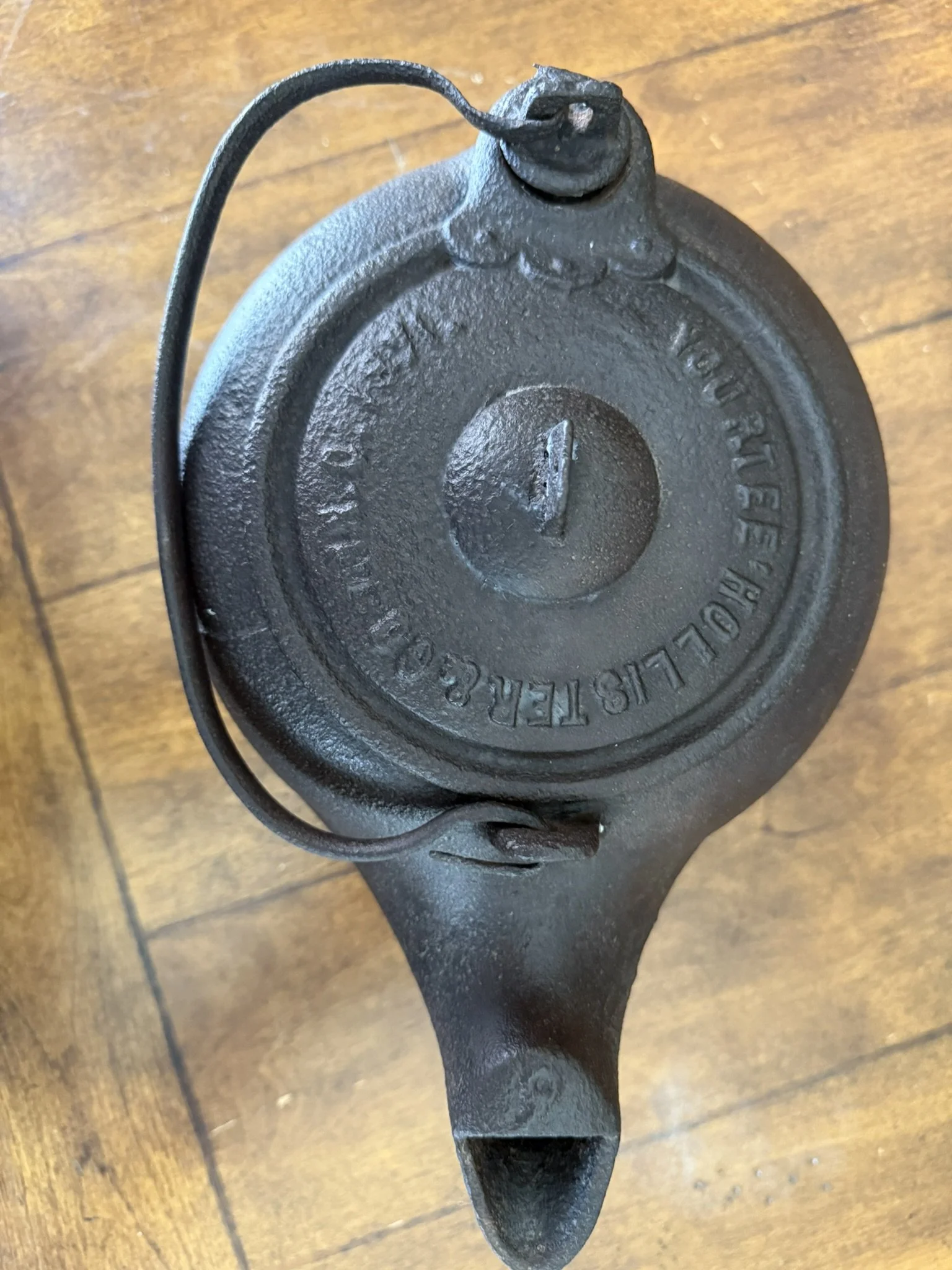
Top view showing the bail handle, lid, and spout.

Kettle with the lid open, showing the interior.
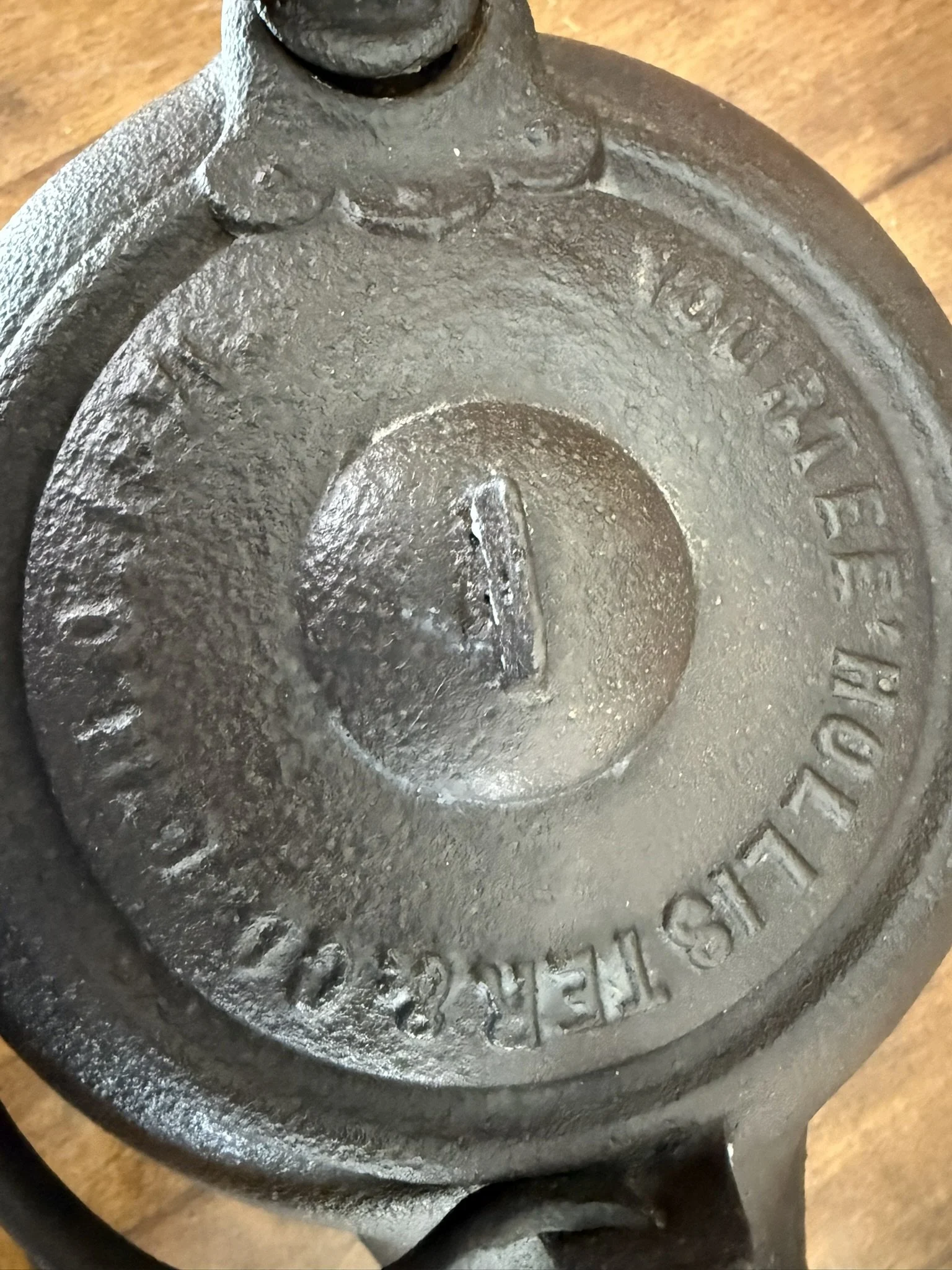
Detail of the raised YOURTEE HOLLISTER & CO. lid marking.

Detail of the CINCINNATI O. and 1871 lid inscription.

Close view of the cast numeral “6” on the spout.
What the 1871 Directory Proves
The 1871 Williams’ Cincinnati Directory contains a full advertisement headed by S. L. Yourtee and H. Hollister. It identifies the business as “Miami Stove Works” and names “Yourtee, Hollister & Co.” as “Successors to N. Patterson & Co.” The same advertisement states that the firm manufactured “Stoves, Hollow Ware, and Castings,” gives the foundry location as California, Ohio, and lists the office and warerooms at 94 West Second Street in Cincinnati.
This contemporary advertisement directly contradicts the older interpretation that Yourtee, Hollister & Co. was only a Cincinnati merchant or distributor. In 1871 the firm represented itself as a manufacturer, and it explicitly tied its production to a foundry at California, Ohio.
Nicholas Patterson & Co. and the California Foundry
The Yourtee, Hollister & Co. advertisement states that the firm was successor to N. Patterson & Co. Earlier Cincinnati directory advertising identifies Nicholas Patterson & Co. as operating a stove and hollow-ware business associated with the Miami Foundry at California, Ohio. By 1868, Patterson’s firm advertised stoves, hollow ware, and castings, with Cincinnati sales rooms at 81 and 83 West Second Street and the Miami Foundry at California, Ohio.
Newspaper reporting from the 1873 case Nicholas Patterson v. S. L. Yourtee describes an October 1870 contract in which Patterson conveyed a foundry at California, Hamilton County, Ohio, to Yourtee in exchange for a farm in Henry County, Kentucky. The later lawsuit concerned an alleged acreage deficiency in the Kentucky farm. The precise contract date is reported differently in contemporary newspapers, so the safest wording is “October 1870” unless the original contract is recovered.
Taken together, the directory and court-report evidence strongly supports a direct business succession from Patterson’s California foundry interests into the Yourtee operation. The evidence is strongest when stated as a documented succession of business identity and foundry location rather than as a claim that every asset transfer is fully reconstructed.
Yourtee, Hollister & Co., 1871–1873
In 1871 and 1872, the firm is associated with Samuel L. Yourtee and H. Hollister and with Miami Stove Works. The 1872 directory continues to identify Yourtee, Hollister & Co. as proprietors of Miami Stove Works at 94 West Second Street. By 1873 the partnership had expanded.
The 1873 Williams directory identifies the partners as Samuel L. Yourtee, T. G. Randall Jr., Hudson Hollister, and N. H. Sinclair. It describes the firm as manufacturers of stoves and hollow ware at 94 West Second Street. The same directory places Samuel L. Yourtee’s residence at California, Ohio. That residence is significant because California was the foundry location associated with the firm.
The 1874 Reorganization
The partnership changed at the beginning of 1874. Contemporary reporting documents the dissolution of Yourtee, Hollister & Co. and the continuation of the stove-foundry business by Samuel L. Yourtee, N. H. Sinclair, and Thomas G. Randall Jr. under the name Yourtee, Sinclair & Randall.
The 1874 Williams directory confirms the successor firm and identifies Yourtee, Sinclair & Randall as proprietors of Miami Stove Works, with office and warerooms at 30 Vine Street. Samuel L. Yourtee was still listed as residing in California, Ohio. The 1875 directory and Cincinnati Exposition material continue to place the firm in the stove and hollow-ware trade at 30 Vine Street.
The 1876–1877 Transition
By 1876 the earlier three-man firm had split into separate concerns. Samuel L. Yourtee & Co. appears in the stove and hollow-ware trade, while Randall & Baker also appears as a stove-founding concern associated with California, Ohio. N. H. Sinclair is tied to the Randall side of the business.
The 1877 Williams directory is especially important. It identifies “Samuel L. Yourtee & Co.” as proprietors of Miami Stove Works and as manufacturers of stoves, ranges, and hollow ware. It gives the office and warerooms at 25 and 27 West Fifth Street and explicitly states “Foundry, California, O.” Samuel L. Yourtee’s residence is again listed at California, Ohio.
This is strong contemporary evidence that the California, Ohio manufacturing operation remained tied to the Yourtee business through at least 1877.
The 1878 Failure and the Lawrenceburg Connection
A September 19, 1878 newspaper item from California, Ohio reports that the proprietor of the Miami Stove Works had failed, gone into bankruptcy, and was then serving as general director of a Lawrenceburg foundry. The notice is important because it distinguishes the California concern from the Lawrenceburg foundry rather than treating them as the same establishment.
By 1878, the Cincinnati directory identifies Randall & Baker as proprietors of Miami Stove Works, with office and wareroom at 91 West Front Street and foundry at California, Ohio. This shows that the California operation continued under a different business arrangement, but the exact legal mechanism—sale, assignment, bankruptcy transfer, or another restructuring—has not yet been located in a surviving primary record.
Later Lawrenceburg histories and directories document a Miami Stove Works operation in Lawrenceburg, Indiana, and associate Samuel L. Yourtee & Co. with its establishment. That Lawrenceburg activity belongs to a later phase of the business history. It should not be projected backward onto the 1871 kettle without direct contemporary evidence.
What Can Be Said About This 1871 Kettle
The safest evidence-based conclusion is that this kettle was made for Yourtee, Hollister & Co. at a time when the firm was a documented manufacturer of stoves, hollow ware, and castings associated with Miami Stove Works and a foundry at California, Ohio. No contemporary evidence located in this research places the firm’s 1871 foundry at Lawrenceburg, Indiana.
Because no model-specific catalog page, production ledger, or factory record has yet been found for this exact kettle, it is more precise to say that a California, Ohio manufacturing origin is very strongly supported rather than absolutely proven for this individual casting.
Correction of the Older Lawrenceburg Attribution
The older interpretation that Yourtee, Hollister & Co. was only a Cincinnati trading firm, that it never operated a foundry, and that this 1871 kettle was made at Miami Stove Works in Lawrenceburg, Indiana, is not supported by the contemporary evidence now available. The 1871 directory instead identifies the firm as a manufacturer, names Miami Stove Works, and gives its foundry at California, Ohio.
Lawrenceburg should therefore be treated as a later chapter in the Miami Stove Works story, following the financial difficulties and reorganization of the California operation in the late 1870s.
Historical Significance
The kettle is significant not only as an early dated piece of Cincinnati-associated cast iron but also because its marking anchors it to a short-lived and changing partnership during a period of rapid consolidation in the Cincinnati stove and hollow-ware trade. The surviving directories allow the business lineage to be reconstructed with unusual detail: Nicholas Patterson & Co.; Yourtee, Hollister & Co.; Yourtee, Sinclair & Randall; Samuel L. Yourtee & Co.; and, by 1878, Randall & Baker at the California foundry.
The object therefore represents a documented manufacturing network centered on Cincinnati sales offices and a foundry at California, Ohio, rather than a simple retail label applied to castings from an unrelated distant plant.
Condition and Restoration
This kettle survives with significant structural weakness in the base, including multiple holes, and is not suitable for holding water or for stove use. It was restored for preservation and display rather than returned to functional service. Any restoration details, acquisition information, catalog number, or treatment dates should be retained from the museum’s internal object record exactly as documented there.
Evidence Status
Confirmed by contemporary sources: Yourtee, Hollister & Co. existed in 1871; it called itself successor to N. Patterson & Co.; it manufactured stoves, hollow ware, and castings; its associated operation was Miami Stove Works; its foundry was at California, Ohio; and its Cincinnati office and warerooms were at 94 West Second Street.
Very strongly supported: the 1871 kettle was produced within that California-centered manufacturing operation.
Still unresolved: the exact legal transfer sequence during the 1877–1878 bankruptcy/reorganization, whether Randall & Baker acquired the identical physical plant through bankruptcy, and a model-specific record proving that this individual kettle was poured at the California foundry.
Sources and Documentation
Source titles below are clickable links to publicly accessible scans or reference pages when available.
• Williams’ Cincinnati Directory, 1871. Advertisement for Miami Stove Works / Yourtee, Hollister & Co., identifying the firm as successors to N. Patterson & Co., manufacturers of stoves, hollow ware, and castings; foundry at California, Ohio; office and warerooms at 94 West Second Street.
• Williams’ Cincinnati Directory, 1872. Entry for Yourtee, Hollister & Co., proprietors of Miami Stove Works, 94 West Second Street.
• Williams’ Cincinnati Directory, 1873. Entry naming Samuel L. Yourtee, T. G. Randall Jr., Hudson Hollister, and N. H. Sinclair as partners; manufacturers of stoves and hollow ware, 94 West Second Street; Samuel L. Yourtee residing at California, Ohio.
• Williams’ Cincinnati Directory, 1874. Entry for Yourtee, Sinclair & Randall, proprietors Miami Stove Works, office and warerooms at 30 Vine Street.
• Williams’ Cincinnati Directory, 1875. Entries for Yourtee, Sinclair & Randall in the stove and hollow-ware trade at 30 Vine Street.
• Williams’ Cincinnati Directory, 1876. Entries showing Samuel L. Yourtee & Co. and Randall & Baker as separate stove-trade concerns during the post-1875 transition.
• Williams’ Cincinnati Directory, 1877. Entry for Samuel L. Yourtee & Co., proprietors Miami Stove Works; manufacturers of stoves, ranges, and hollow ware; office and warerooms at 25 and 27 West Fifth Street; foundry at California, Ohio.
• Williams’ Cincinnati Directory, 1878. Entry for Randall & Baker, proprietors Miami Stove Works; office and wareroom at 91 West Front Street; foundry at California, Ohio.
• Cincinnati Daily Times, November 12, 1873. Newspaper coverage of Nicholas Patterson v. S. L. Yourtee, reporting the October 1870 exchange involving a foundry at California, Hamilton County, Ohio, and a Henry County, Kentucky farm.
• Cincinnati newspaper, September 19, 1878 - California, Ohio correspondence. Reports the failure and bankruptcy of the proprietor of Miami Stove Works and subsequent direction of a Lawrenceburg foundry.
• U.S. Patent No. 203,713 - Ward DeVore and Samuel L. Yourtee, improvement in long centers for stoves; specification signed at California, Ohio, June 15, 1877.
• History of the City of Lawrenceburg, Indiana, and later business directories documenting Miami Stove Works in Lawrenceburg after the California-era operation. See also the 1882–83 Indiana State Gazetteer and Business Directory.
