No. 8 Gate-Marked Bean Pot
SSC MUSEUM COLLECTION
Catalog No. SSC-UNK-KTL-8-001
Reading an Unmarked Kettle: A No. 8 Gate-Marked Bean Pot and What Its Casting Scar Can Tell Us
No. 8 Bean Pot / Kettle | Wire Bail Handle | Bottom Gate Mark | Maker Unconfirmed | Probably American, 19th–Early 20th Century

Top view of the No. 8 bean pot / kettle showing the deep open interior, seasoned walls, and opposing wire-bail ears. No lid accompanies the piece in the supplied set.
This piece carries no foundry name, no city, and no patent date — and in the world of early American cast iron, that is its own kind of story. The identification of older unmarked pieces, particularly those with bottom gate marks, is one of the most frequently asked questions in cast iron collecting, and the honest answer is usually “we may never know” the exact maker. (CastIronCollector, “Identifying Unmarked Iron”) Rather than invent an attribution, this deep-dive does what the object allows: it reads the iron closely and follows the one strong physical clue it does carry — the gate mark.
The acquisition record described the piece as an “Antique CAST IRON 10" BEAN POT DUTCH OVEN Vintage Wire handle,” and the photographs confirm a rounded, bail-handled vessel with a recessed, gate-marked bottom and a cast size mark “8.” Those details, combined with published dating conventions, let this post go considerably deeper than a simple “unknown maker” note — even while keeping the maker itself honestly unresolved.
The Kettle: Form and Condition
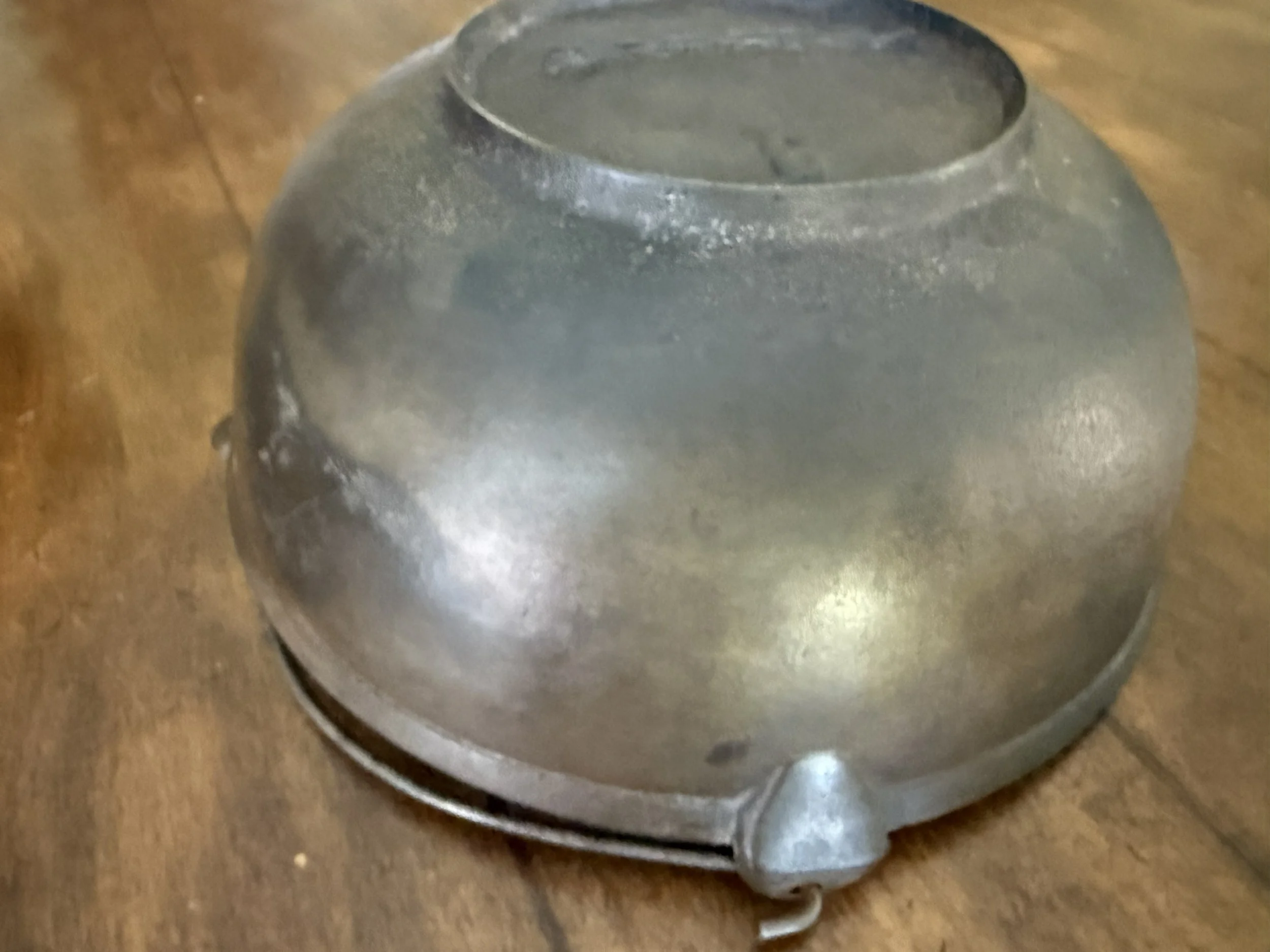
Profile view showing the bulbous body, recessed base, and wire bail handle — the classic hanging-and-hearth kettle silhouette.
This is a rounded, flat-bottom cast iron bean pot or kettle with a wire bail handle passing through opposing cast ears. In collector usage, a number 8 bean pot of this type is also called a footed or stove-top kettle, and the shape sits squarely in the family of 19th- and early-20th-century utility hollow ware. (collector discussion, cast iron ID group)
The supplied photographs show the piece in stable display condition with a dark seasoned interior and no visible cracks, breaks, or repairs. No lid is present, the bail is intact, and the ears are heavy and functional rather than decorative — all consistent with a genuine working vessel rather than a later ornamental reproduction.
Reading the Iron: The Bottom Gate Mark
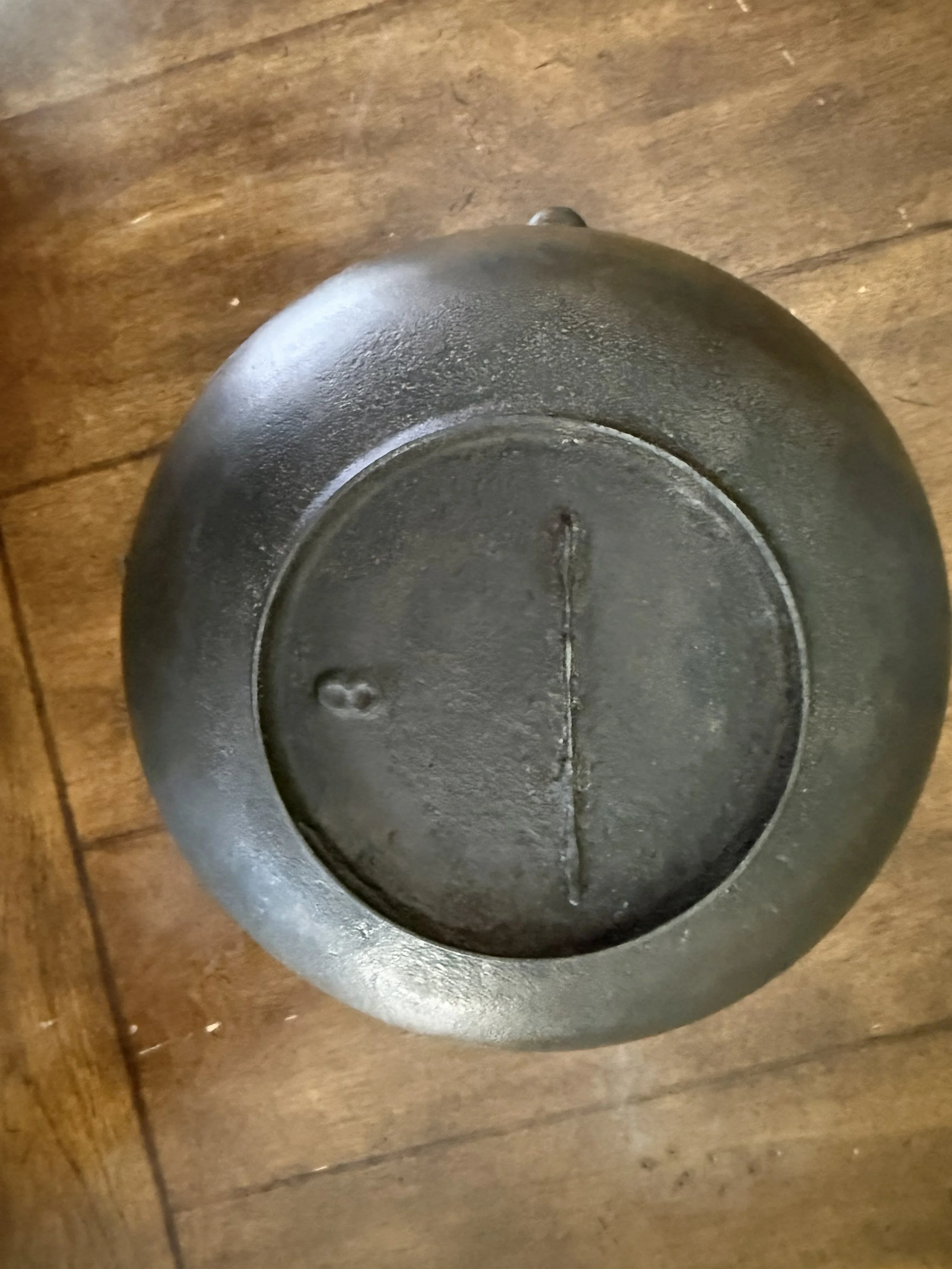
Bottom view documenting the recessed base, the long raised gate mark running across the center, and the cast size mark “8” — the piece’s primary identifying features.
The single most informative feature is the raised line running across the bottom: a gate mark. When molten iron was poured into an early sand mold, it entered through a channel called the gate; after cooling, the iron that solidified in that channel remained attached as a raised scar. (Steve’s Seasoned Classics, Ohio Foundry Gate Marks Reference) On this kettle, that scar survives as a clear linear ridge across the base — the classic “bottom gate” form.
The size “8” cast into the bottom refers to the nominal stove-eye size the vessel was made to fit, a common sizing convention on period hollow ware rather than a maker-specific pattern number. (collector reference, gate-marked ware) No company name, city, or patent notation is visible in any supplied view, which is exactly why the maker cannot be stated as fact.
What the Gate Mark Suggests About Age

Close detail of the base showing the gate mark and size mark. The bottom-gate scar is the strongest surviving dating evidence on the piece.
Bottom gate marks are associated with earlier casting practice. As American foundries industrialized through the 1880s and 1890s, most shifted to “side gating,” moving the scar to the rim where it could be ground off, so bottom gate marks on standard hollow ware generally indicate pre-1890s production. (SSC Gate Marks Reference)(CastIronCollector)
An important caution belongs here, and it is well documented: the technology did not vanish overnight. Bottom gating continued into the 20th century on large-format pieces such as kettles and sugar kettles long after most cookware moved to side gating. (CastIronCollector, “In Summary”) Because this is a deep kettle rather than a thin skillet, the gate mark supports a broad “19th to early 20th century” estimate rather than a single decade. The field itself warns against dating a piece too precisely from a gate mark alone. (analysis, “The Gate Debate”)
Why an Unmarked Kettle Is So Hard to Attribute
Many small 18th- and 19th-century foundries simply did not mark their ware: they served local markets where everyone already knew the maker, and some deliberately left pieces unmarked. (CastIronCollector) For older unmarked hollow ware, the only distinguishing clues are usually molder’s initials, a decorative handle detail, or the shape of the bail-ear attachment — none of which, on this piece, currently points to a single documented foundry.
This is also why the SSC methodology treats the gate mark as primary evidence in its own right: on a piece where no maker mark survives, the gate mark may be the clearest physical record of how and roughly when it was made. (SSC Gate Marks Reference)
Piece Details
Catalog Number
SSC-UNK-KTL-8-001
Designation
Unmarked No. 8 Bean Pot / Kettle
Maker
Unknown; not verified against any primary source
Piece Type
Cast iron bean pot / kettle with wire bail handle
Material
Cast iron
Markings
“8” size mark on recessed base; no maker name or patent notation visible
Bottom
Recessed base with a clear linear bottom gate mark across the center
Patent
None visible; not applicable
Date of Manufacture
Estimated 19th to early 20th century, based on the bottom gate mark and vessel form; not tied to a named foundry or catalog
Place of Manufacture
Unknown; probably American
Acquisition
eBay seller mek_9916, June 27, 2026
Open Questions for Further Research
Confirmed: The piece is an unmarked cast iron bean pot / kettle with a wire bail handle, a recessed base, a clear bottom gate mark, and a cast size mark “8,” documented in the supplied photographs. The gate mark is a scar from early sand-mold casting, per published references. (SSC Gate Marks Reference; CastIronCollector)
Unverified — needs primary confirmation: Whether the bail-ear shape, body proportions, or bottom treatment can be matched to a specific foundry. Resolving this needs a period catalog, trade advertisement, or a securely marked twin with identical construction.
Still open: The exact manufacturer, the exact production window within the broad gate-mark era, and the maker’s own term for the vessel (bean pot, kettle, or Dutch oven). Regional hardware catalogs, foundry price lists, and additional marked examples are the most likely records to help.
Why This Still Matters
Unmarked iron can look anonymous, but the gate mark on this kettle is a genuine document of 19th-century American foundry practice, and the size “8” records how it was meant to be used on a period stove. Preserving and describing those details now gives the piece a stable, sourced paper trail inside the SSC collection — so that if a marked twin or catalog match ever surfaces, this record is ready to meet it.
Sources
· Steve’s Seasoned Classics — Ohio Foundry Gate Marks Reference.
· CastIronCollector — Identifying Unmarked Iron.
· “The Gate Debate” — on the limits of dating by gate mark.
· Cast iron collector discussion — gate-marked skillets and casting-method dating. (secondary / crowd-sourced — flagged as unverified)
· Cast iron ID group — No. 8 bean pot / footed kettle terminology. (secondary / crowd-sourced — flagged as unverified)
· SSC internal records — acquisition (eBay, June 27, 2026) and catalog number SSC-UNK-KTL-8-001.
