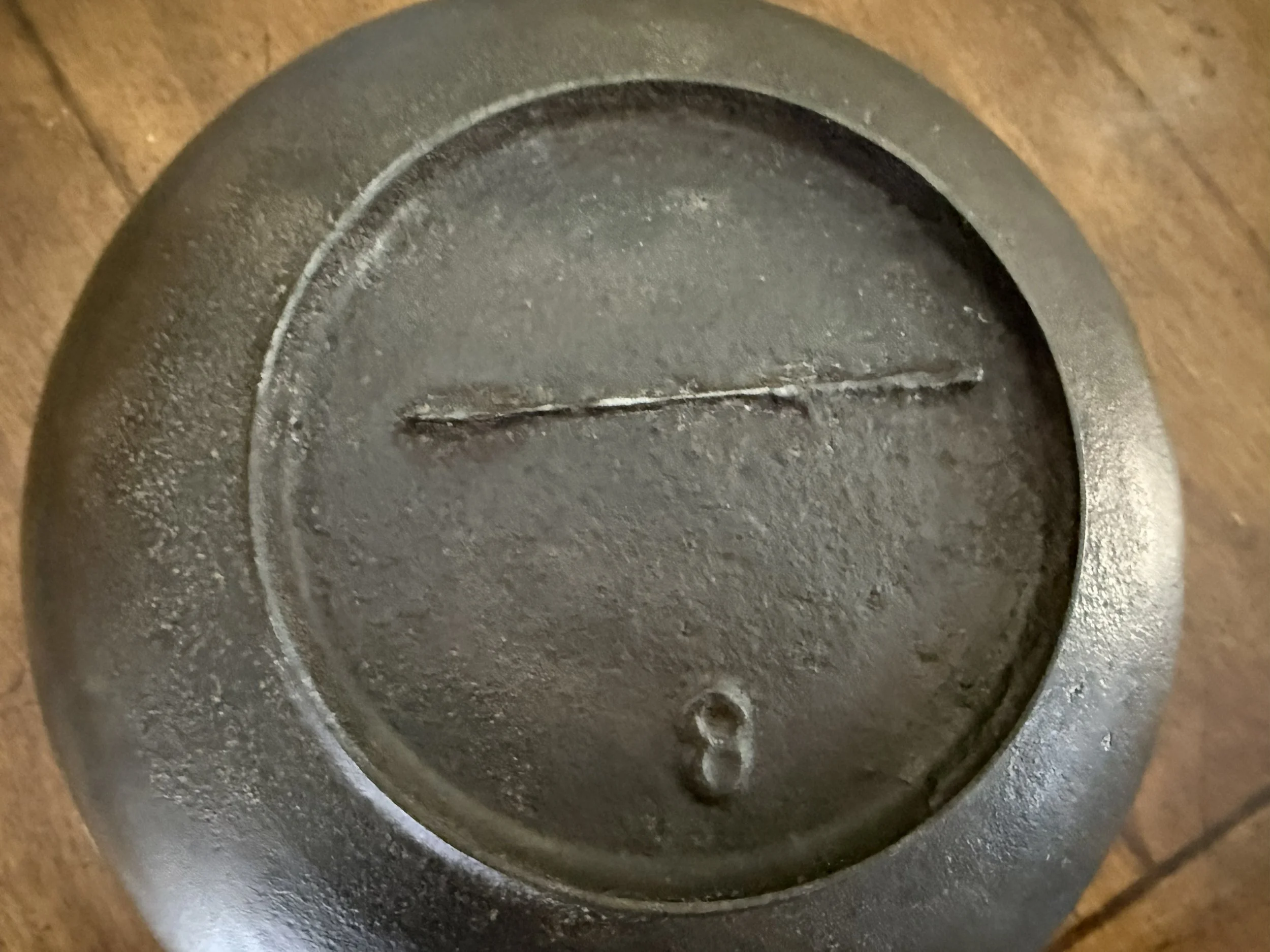
No. 8 Gate-Marked Bean Pot
This piece carries no foundry name, no city, and no patent date — and in early American cast iron, that absence is its own kind of story. SSC-UNK-KTL-8-001 is an unmarked No. 8 cast iron bean pot / kettle with a wire bail handle, a recessed base, and a clear bottom gate mark. Rather than invent an attribution, this deep-dive reads the iron itself: what the gate mark reveals about early sand-mold casting, what the cast size “8” meant on a period stove, and why bottom-gated hollow ware generally points to a 19th to early 20th century date. It also explains why unmarked kettles like this are so difficult to assign to a specific foundry and keeps the maker honestly unconfirmed pending primary-source verification — preserving a sourced record ready to meet a marked twin or catalog match if one ever surfaces.

American Wooden Ware Mfg. Co. — Toledo, Ohio
A six-and-a-quarter-inch cast iron disc carrying the mark of a Toledo manufactory that no major cast iron collector database has documented. The American Wooden Ware Mfg. Co. enters the SSC archive and the Ohio Foundry Directory for the first time.

The Bedrock: Arcole Iron Works Gypsy Pot
In 1834, the Arcole Iron Works in Madison Township, Ohio was the largest industry in the state — producing 1,500 tons of iron annually, sustaining a port community larger than Cleveland. This gypsy pot carries the W.S. & Co. mark of the Wilkeson and Seeley partnership that ran the foundry during those peak years. The mark has worn with 190 years of honest existence. It is still there. Most people who collect cast iron will never hold one of these in their lifetime.

J.H. Day & Co. Patented Safety Kettle with Fire Shield
MADE ONLY BY. Four words cast into a hinged iron door mounted on the front of a Cincinnati hearth kettle, backed by two patents filed three years apart — 1874 and 1877. J.H. Day & Co. was not a stove works. They were an industrial machinery manufacturer who also invented a new way to manage fire around a kettle, protected it twice, and put their exclusivity claim in iron on every piece. This is the most complete example known: fire shield intact, hinged, latched, and operational after 150 years.