The Bedrock: Arcole Iron Works Gypsy Pot
SSC MUSEUM COLLECTION
Catalog No. SSC-ARCOLE-GPT-001 — The Bedrock
Wilkeson, Seeley & Co. | Three-Footed Hearth Gypsy Pot | Bottom Gate Mark | Madison Township, Lake County, Ohio
c. 1832–1845 • Arcole Iron Works, Wilkeson, Seeley & Co. • Madison Township, Lake County, Ohio • Western Reserve • Pre-Civil War

SSC-ARCOLE-GPT-001 — The Bedrock. The Arcole Iron Works gypsy pot bearing the Wilkeson, Seeley & Co. partnership mark — cast at the furnace that was the largest industry in Ohio in 1834. The circular W.S. & Co. cartouche is visible on the body wall. Three cast feet. Wire bail handle. Bottom gate mark on base. Andrew Jackson was President of the United States when the iron for this pot was poured. The United States had 24 states. Madison Township, Lake County, Ohio. SSC-ARCOLE-GPT-001.
Put your hand on this pot. Feel the weight of it — the density of iron that has been solid for nearly two centuries. Look at the marking on the body wall: a circular cartouche, worn at the edges by 190 years of honest existence, reading ARCOLE around the outer arc and W.S. & Co. in the center field. Those letters identify not just a foundry and a partnership, but a specific moment in American history when a furnace on the shore of Lake Erie in the Western Reserve of Ohio was the largest industrial enterprise in the entire state.
W.S. & Co. stands for Wilkeson, Seeley & Co. — the partnership of Samuel Wilkeson and Uri Seeley, who acquired the Arcole furnace in 1831, expanded it with a second blast stack in 1832, and drove it to produce between 1,000 and 1,500 tons of iron annually at its peak. Before Wagner. Before Griswold. Before the cast iron collector era was even imaginable. When Andrew Jackson was President and the United States had only 24 states, Samuel Wilkeson and Uri Seeley were running two blast furnaces on the banks of Arcola Creek in Madison Township, pouring iron into molds that became stoves and kettles and hollowware for the households of the Western Reserve. This gypsy pot is one of those castings. It is the Bedrock of the SSC Museum Collection.
“This pot was cast before the Civil War. Before the transcontinental railroad. Before the telegraph reached Ohio. It was in daily use when the population of the United States was 13 million people.”
What You Are Looking At
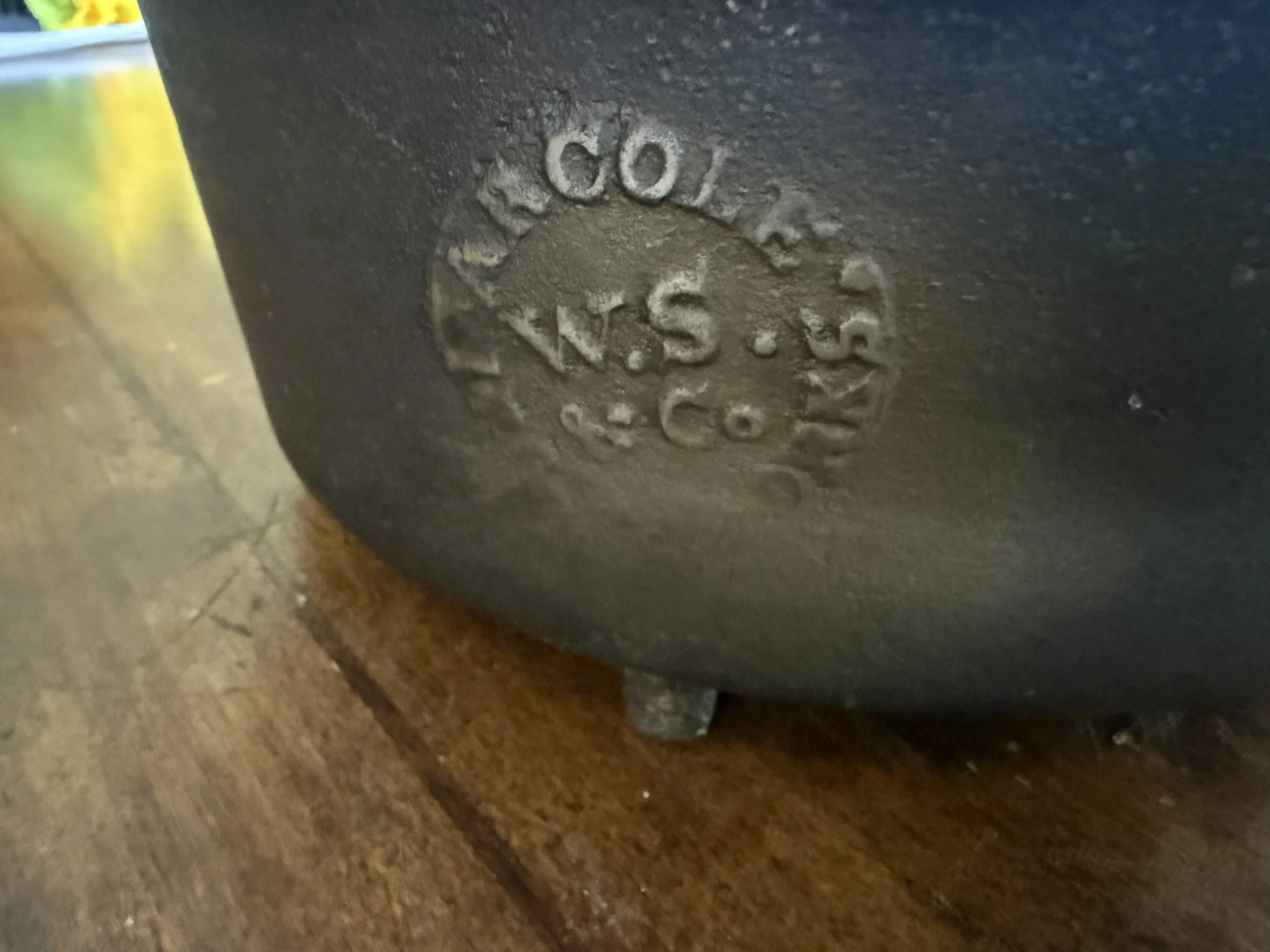
The W.S. & Co. cartouche on the body wall of SSC-ARCOLE-GPT-001. The circular oval reads ARCOLE [IW] on the outer arc and W.S. & Co. in the center field. The lettering has softened with 190 years of age — the raised iron worn at its edges, the surface of the cartouche blending into the surrounding body wall with the micro-texture of iron that has lived through nearly two centuries of temperature change, handling, and time. This is not damage. This is the physical record of a piece that has existed since before the American Civil War.
What you are looking at is a three-footed hearth gypsy pot — a round-bodied cast iron cooking vessel designed for the open fire, the kitchen hearth, and the outdoor cookfire of antebellum American domestic life. It measures approximately 11.5 inches across the top rim and approximately 4 inches inside height. The three integral cast feet project from the base, lifting the pot above the coals or grate surface so that fire and air can circulate beneath. The wire bail handle pivots at two cast ear mounts at the rim, allowing the pot to be hung from a hearth crane or trammel, or carried by hook or hand.
The marking is the piece’s most important feature. On the lower body wall, cast in iron in an oval cartouche with a raised border, the text reads: ARCOLE around the outer arc, and W.S. & Co. in the center. ARCOLE = Arcole Iron Works. W.S. & Co. = Wilkeson, Seeley & Co. — the partnership of Samuel Wilkeson and Uri Seeley, who acquired the Arcole furnace in 1831 and operated it through the mid-1840s, during which time it became the single largest industrial enterprise in the state of Ohio.
The marking’s wear is authentic and significant. After 190 years, the raised lettering of an iron casting does not retain factory-day sharpness. The edges of the individual letters have rounded with age. The cartouche border has softened. The surface has developed the complex micro-texture of iron that has aged through generations. This is not poor condition. This is what nearly two centuries looks like on iron. The SSC preservation protocol — lye tank treatment, short vinegar rinse, SSC Archival Black™ museum seasoning — stabilized and sealed the piece without erasing a single layer of that authentic age.
The Bottom Gate Mark: A Physical Timestamp

Bottom view of SSC-ARCOLE-GPT-001 showing the bottom gate mark — the elongated linear scar running across the base where molten iron’s flow was cut off at the gate during the casting process. This scar is the definitive physical confirmation of pre-1880s bottom-pour casting technology. Three cast feet project from the base perimeter. The surface character shows nearly two centuries of natural aging — iron that has never been stripped, that has simply lived. The gate mark is physical evidence independent of any marking: this pot was not made after 1880.
Turn this pot over. Running across the flat bottom is an elongated linear scar — slightly raised, with the texture of iron that was cut while still cooling. This is the bottom gate mark, and it is one of the most important physical details on any pre-Civil War cast iron piece.
In iron casting before approximately 1880, molten iron was introduced into the mold from the bottom — a technique called bottom-pour casting. The iron entered through a gate in the base of the mold, rose through the cavity filling the form from the bottom up, and was cut off at the gate when the mold was full. When the casting cooled and was removed from the mold, the gate was broken away, leaving a characteristic linear scar on the base. That scar is what you see on this pot.
After approximately 1880, foundry technology shifted. Top-pour and side-gate techniques became dominant as industrial casting processes modernized. The presence of a classic bottom gate mark on this pot is therefore physical confirmation, independent of any marking, that this piece predates the 1880s substantially. Combined with the W.S. & Co. cartouche — which places production between 1831 and the mid-1840s when the Wilkeson and Seeley partnership was active — the gate mark locks this pot into the pre-Civil War era with high confidence. Both lines of evidence converge on the same window: c. 1832–1845.
The World When This Pot Was Cast
WHEN THIS POT WAS CAST
THE WORLD IT ENTERED
President of the United States
Andrew Jackson — 7th President (1829–1837); re-elected 1832, defeating Henry Clay with 56% of the popular vote and 219 electoral votes. “Old Hickory” was the dominant political figure of his era — fighting the Bank War, confronting South Carolina’s nullification, signing the Indian Removal Act.
States in the Union (1832)
24 states. Missouri (admitted 1821) was the most recent. Arkansas would not be admitted until June 1836. Michigan not until January 1837. The continental United States as we know it did not yet exist.
U.S. Population
Approximately 13 million people — roughly 4% of today’s population. The entire country was smaller than modern-day metropolitan Los Angeles.
Abraham Lincoln
A 23-year-old store clerk and postmaster in New Salem, Illinois. He would not be elected to the Illinois state legislature until 1834. He was 16 years from being elected to Congress, and 29 years from the Emancipation Proclamation.
The American Frontier
The frontier ran roughly through central Indiana, Illinois, and Missouri. Ohio was a settled state but still heavily rural. The Pacific coast was foreign territory. The Republic of Texas did not exist.
Transportation
The Erie Canal (completed 1825) was the technological marvel of the age. Fewer than 1,000 miles of railroad track existed in the entire United States. Arcole’s iron was shipped by boat on Lake Erie.
American Kitchen
The cast iron stove was only beginning to penetrate American households in the 1830s. Most cooking was done over open hearths and open fires — exactly the environment this pot was designed for. This form of cooking remained dominant in rural America until the 1850s and beyond.
Ohio in 1834
Ohio had been a state for 31 years. Cleveland had a population of approximately 5,000. The community of Ellensburg at the Arcole furnace’s Lake Erie port was larger than Cleveland.
Arcole Iron Works, 1834
The largest industry in the state of Ohio. Producing 1,000–1,500 tons of iron annually. Two blast stacks, 30 feet tall. Weekly capacity of 30 tons. A company store inventorying over $150,000 of stock annually. A workforce community of 200+ log cabin households.
The American Flag
24 stars when this pot was cast in 1832. A 25th star for Arkansas was added June 15, 1836. A 26th for Michigan in January 1837.
Arcole Iron Works: The Rise and Fall of Ohio’s Greatest Furnace

Profile view of SSC-ARCOLE-GPT-001, showing the complete form: round body, three cast feet at the base, wire bail handle at the rim, and the body wall with the W.S. & Co. cartouche visible at lower left. This is the form of a pre-stove-era cooking vessel — designed to stand in coals, hang from a hearth crane, or be carried over an open fire. It is a tool designed for a world where cooking meant fire management, not temperature knobs.
The story of Arcole Iron Works begins with bog iron — the raw material that built the Western Reserve’s first industrial era. Bog iron is a naturally occurring deposit that forms in the sediment of swamps and wetlands over geological time. It is not the high-grade ore of the Great Lakes mines that would fuel Cleveland’s steel industry later in the century. It is lower-grade and more accessible — easily mined from the swamps of Madison Township near North Ridge Road, where it was discovered in 1812. The ore was abundant, the surrounding forests provided charcoal for the furnace, and Lake Erie provided a transportation route to markets across the region.
The first furnace to refine Madison Township’s bog iron was built in 1826 by the Erie Furnace Company, founded by Philander Raymond on 52 acres at the corner of Dock Road and North Ridge Road, south of the mouth of Arcola Creek where it empties into Lake Erie. By 1825 three additional furnaces had been built in the surrounding area; four more followed in 1833. The Western Reserve was in the early stages of an iron boom.
In 1831 the furnace was renamed Arcole and sold to Samuel Wilkeson and Uri Seeley. Wilkeson and Seeley expanded immediately. A second blast stack was added in 1832, identical to the first — each stack standing 30 feet in height with a 9-foot-wide bosh. Combined weekly production capacity reached 30 tons. By 1834, Arcole Iron Works was the largest industry in the entire state of Ohio, producing between 1,000 and 1,500 tons of iron annually. Iron stoves, kettles, hollowware, and other heavy castings were made alongside pig iron production.
The community that grew around Arcole’s shipping port on Dock Road at the mouth of Arcola Creek was called Ellensburg. By 1835 it was the second most populous settlement in Lake County, Ohio — ranked just behind Painesville, and larger than Cleveland. More than 200 log cabin workers’ houses were built. A company store inventoried over $150,000 of stock annually. Ships loaded with iron kettles, stoves, and hollowware left Arcola Creek for markets across Ohio, Pennsylvania, Michigan, and beyond. This pot was among those castings.
Twenty years of prosperity followed the expansion. Then the industrial geography shifted. Bog iron in the Madison Township swamps was becoming exhausted by the demands of the furnace. New iron ore deposits discovered elsewhere in the Great Lakes region yielded far superior material. The charcoal required to fuel the furnace became harder and more expensive to obtain as the surrounding forests were cleared. Arcole Iron Works was sold in 1851 to the Geauga Furnace and ceased operations. The community of Ellensburg, larger than Cleveland just sixteen years before, became a ghost town before 1850 had ended. The iron industry’s first great era in the Western Reserve was over.
The Gypsy Pot: What It Was For and How It Was Used

Top view of SSC-ARCOLE-GPT-001 showing the open interior after lye treatment and SSC Archival Black™ museum seasoning. The wire bail handle spans the rim at its pivot mounts. The interior step ring seating ledge near the rim would have held a lid during cooking. This is the interior of a pot that fed people before the Civil War.
The gypsy pot is one of the oldest and most universal cooking vessel forms in the history of cast iron. The name evokes its essential character: a pot that travels, that works over any fire, that asks nothing of the cook except iron and flame. In antebellum America — the decades before enclosed wood and coal stoves transformed the American kitchen — the three-footed hearth kettle was the workhorse of domestic cooking.
The three cast feet served a specific purpose: they lifted the bottom of the pot above the fuel surface, allowing air and flame to circulate beneath the vessel. This made the pot stable in a bed of coals — no grate, no trivet, no additional support required. The wire bail handle at the rim served the complementary function: it allowed the same pot to be hung from a hearth crane or trammel when direct coal heat was not the method. The cook managed heat through the position of the pot relative to the fire, not through any control on the vessel itself.
What went into this pot? Everything. Soups and stews were the primary product of the antebellum hearth kettle — one-pot meals assembled from preserved meats, root vegetables, dried legumes, and whatever fresh ingredients were available. Salted and smoked pork was the most common protein in American frontier and farming diets. Corn appeared in every form: hominy, cornmeal mush, succotash with beans and summer vegetables. Potatoes, turnips, onions, and dried beans provided substance through the winter months. Apple butter was made in large iron kettles over outdoor fires in the fall. Maple syrup was boiled from sap in early spring. Water for washing, bathing, and dyeing cloth was heated in iron kettles over the hearth fire. The gypsy pot was not a specialized implement. It was the fundamental cooking vessel of its age.
Cast iron stoves did not become standard fixtures in the American kitchen until the 1840s. Before that — and in many rural households for decades after — cooking was done at the fireplace. The pre-industrial way of cooking this pot was built for survived the Civil War largely unchanged, remaining dominant in rural America until approximately 1875. This pot fed that world.
The Worn Mark: 190 Years of Evidence
One of the most important things a collector can understand about pre-Civil War cast iron is what authentic age actually looks like on a marking. A freshly stripped and re-seasoned piece will show its casting marks at their sharpest. A piece that has lived for 190 years without stripping tells a different story: the raised letters soften at their edges, the cartouche border rounds from the crisp geometry of a new casting to a more organic, time-rounded profile.
The W.S. & Co. cartouche on this pot carries exactly the age you would expect from a piece cast in the 1832–1845 window. The outer arc of ARCOLE lettering is present and readable but softened. The center field W.S. & Co. remains fully legible to a careful reader. The oval cartouche border has rounded with time. The surrounding body wall carries the complex micro-texture of iron that has never been stripped — the layered surface character that only accumulates over generational timespans.
The SSC preservation decision was deliberate: lye tank treatment to remove accumulated grime and surface contamination without destroying the patina beneath; a short vinegar rinse to neutralize and stabilize; SSC Archival Black™ museum seasoning to seal the iron against further oxidation and bring the surface character to its fullest visual expression. The worn mark is the authentic mark. The age on this pot is the record of this pot’s existence. SSC keeps the record.
Piece Details
SSC Designation
The Bedrock — SSC-ARCOLE-GPT-001
Manufacturer
Arcole Iron Works, Wilkeson, Seeley & Co. — Madison Township, Lake County, Ohio, Western Reserve
Partnership Identity
W.S. & Co. = Samuel Wilkeson and Uri Seeley; acquired Arcole furnace 1831; added second blast stack 1832; operated through c. mid-1840s; produced 1,000–1,500 tons annually at peak; largest industry in Ohio in 1834
Piece Type
Three-Footed Hearth Gypsy Pot — open-fire cooking and utility vessel; definitive pre-stove-era form
Form
Round cast iron body; three integral cast feet at base perimeter; wire bail handle at two cast pivot ear mounts at rim; interior step ring seating ledge near rim; smooth cooking interior
Dimensions
Approximately 11.5 inches top edge to edge; approximately 4 inches inside height
Body Marking
Circular oval cartouche on body wall: ARCOLE [IW] on outer arc; W.S. & Co. in center field; original casting; lettering worn with 190 years of authentic age; fully legible to careful reading
Bottom Gate Mark
Classic linear bottom gate mark scar on base — definitive physical confirmation of pre-1880s bottom-pour casting technology; physical timestamp independent of body marking
Date of Manufacture
c. 1832–1845 — W.S. & Co. partnership era; peak production years of Arcole Iron Works; pre-Civil War confirmed by both marking and gate mark evidence
President at Casting
Andrew Jackson (7th President, served 1829–1837) during early production; Martin Van Buren (8th President, 1837–1841) possible for later castings in this window
States in Union
24 states at time of earliest casting (1832); Missouri was the 24th (admitted 1821); Arkansas became the 25th in June 1836; Michigan the 26th in January 1837
American Flag
24 stars at earliest casting; 25 stars from June 1836; 26 stars from January 1837
U.S. Population
Approximately 13 million people (1830 census) — roughly 4% of today’s U.S. population
Foundry Scale
Largest industry in Ohio in 1834; two 30-foot blast stacks; 30-ton weekly capacity; shipping port at Arcola Creek/Lake Erie; Ellensburg community larger than Cleveland in 1835
Foundry Closure
Sold to Geauga Furnace 1851; bog iron exhausted; charcoal supply depleted; Ellensburg ghost town by 1850
Restoration
Lye tank treatment; short vinegar rinse to neutralize and stabilize; SSC Archival Black™ museum seasoning applied; original age patina preserved throughout; no electrolysis; no stripping
Condition
Excellent for age — structurally sound; no cracks; no repairs; three feet intact; wire bail handle present and functional; interior clean and seasoned; W.S. & Co. mark worn with authentic age but legible; gate mark clear
Database Status
Arcole Iron Works / W.S. & Co. absent from CastIronCollector foundry database and WAGs compiled foundry list; SSC-ARCOLE-GPT-001 is first-time collector documentation of this piece
Acquisition Source
eBay — Seller: davidincal
eBay Item No.
147248468444
Order No.
10-14489-22537
Acquisition Date
April 11, 2026
SSC Catalog No.
SSC-ARCOLE-GPT-001
Collection Category
Ohio Cast Iron — Pre-1905 Hollow Ware / Western Reserve / Pre-Civil War / The Bedrock
Why This Piece Matters
Most people who spend their entire collecting lives pursuing American cast iron will never hold an Arcole Iron Works piece. The foundry operated for twenty years, ceased production in 1851, and left no successor company, no continuing brand, no catalog entry in the standard collector references. What it left was the iron it made — kettles and stoves and hollowware cast from the bog ore of Madison Township, shipped from the Ellensburg port on Lake Erie, distributed across the Western Reserve and the Great Lakes region during the 1830s and 1840s. Those pieces survive in small numbers. They do not advertise themselves. They carry a circular cartouche with worn lettering from a foundry most collectors have never heard of, in a town that ceased to exist before the Civil War started.
This piece carries the W.S. & Co. mark — the Wilkeson and Seeley partnership mark from the foundry’s peak years. In 1834, when this pot was most likely cast, Arcole Iron Works was the largest industry in Ohio. Andrew Jackson was President. The United States had 24 states. The community that surrounded this foundry’s shipping port on Lake Erie was larger than Cleveland. Samuel Wilkeson and Uri Seeley had built something genuinely significant — and they put their partnership’s initials on every piece of hollowware that came out of their furnace.
The mark has worn. 190 years of existence will do that to a casting. The lettering is softer than it was in 1834. The cartouche border has rounded with age. The surface of the pot carries the complex, layered patina of iron that has lived through the antebellum era, the Civil War, Reconstruction, two World Wars, and everything since — without being stripped back to bare metal and made to look new again. It is what it is: an authenticated pre-Civil War Ohio hearth gypsy pot from the most significant iron foundry in the Western Reserve, documented for the first time in the SSC Museum Collection.
“The mark is worn because the piece is old. After 190 years, the iron still holds. After 190 years, the letters are still there. The history is still readable to anyone willing to look carefully enough.”
The SSC collection exists for pieces like this one. Not the famous makers. Not the well-documented foundries. The ones that were significant in their own time and then forgotten by the collector record. The ones that took the raw materials of a specific place — bog iron from the swamps of Madison Township, charcoal from the Western Reserve forests, lake water from Arcola Creek — and turned them into durable iron that cooked food for American families before the Civil War, before the telegraph, before the railroad reached Ohio, before any of it. That iron is still here. It is The Bedrock of the SSC collection. It deserves to be documented.
Sources & Further Reading
Physical examination of piece: Circular cartouche on body wall reading ARCOLE [IW] / W.S. & Co.; lettering worn with 190 years of authentic age; bottom gate mark (linear scar) on base confirming pre-1880s bottom-pour casting technology; round cast iron body; three integral cast feet at base perimeter; wire bail handle at two cast rim pivot ear mounts; interior step ring seating ledge near rim; approximately 11.5 inches top edge to edge, approximately 4 inches inside height; lye tank treatment, short vinegar rinse, SSC Archival Black™ museum seasoning applied; original age patina preserved throughout.
Local Lore: Lake County, Ohio — Iron Industry Began Here. News-Herald blog, May 2015. Documents: bog iron discovered Madison Township 1812; first furnace 1826 (Erie Furnace Company); furnace renamed Arcole 1831 and sold to Samuel Wilkerson (Wilkeson) and Uri Seeley; largest industry in Ohio; production 1,500 tons annually; Madison second to Painesville in population 1835; furnace sold and ceased operations; Dock Road port ghost town by 1850.
Pig Iron Furnaces — Abandoned Online (abandonedonline.net). Documents: Arcole Furnace constructed 1825 by Root and Wheeler; 30-foot stack with 9-foot bosh; second identical stack added by Wilkeson & Company 1832; weekly production capacity 30 tons; furnace ceased operations 1851 after sold to Geauga Furnace.
Madison, Lake, Ohio — Hanksplace Wiki. Documents: Arcole Furnace largest industry in Ohio in 1834; producing 1,000–1,500 tons per year; Ellensburg port community second largest in Lake County in 1835, larger than Cleveland; over 200 log cabin workers’ houses; company store and boarding house.
Philander Raymond (1794–1868) — Find A Grave Memorial. Documents: Raymond as founder of Erie Furnace Company 1825; 52 acres at Dock Road and North Ridge Road; works at one time largest industrial site in Ohio; five tons manufactured daily; company store inventoried over $150,000 annually.
Andrew Jackson — Wikipedia; Britannica; White House Historical Association; Library of Congress Andrew Jackson Papers. Documents: Jackson as 7th President (1829–1837); re-elected 1832 defeating Henry Clay with 56% popular vote and 219 electoral votes; Bank War; Nullification Crisis; Indian Removal Act; presidency spanning the founding and peak years of the Wilkeson/Seeley partnership at Arcole.
List of U.S. States by Date of Admission to the Union — Wikipedia; Statista; Congress.gov (R47747). Documents: Missouri admitted as 24th state 1821; no new state admissions 1821–1836; Arkansas admitted as 25th state June 15, 1836 (signed by President Jackson); Michigan admitted as 26th state January 26, 1837. At time of earliest production of this piece (1832), the United States had 24 states and 24 stars on the flag.
Cuisine of Antebellum America — Wikipedia. Documents: most cooking done over open hearth or wood/coal stove; pre-industrial cooking survived Civil War unchanged until approximately 1875; one-pot meals, preserved meats, root vegetables, corn as dietary staples.
Cooking on the Hearth — Passion for the Past blog; Madison County Historical Society online exhibit. Documents: cast iron stoves did not become standard until 1840s; before that cooking done in the fireplace; three-legged kettles set directly on hearth; hearth cranes and trammels for hanging pots.
CastIronCollector — Foundry Database. Arcole Iron Works / W.S. & Co. absent; SSC-ARCOLE-GPT-001 represents first-time documented attribution in the collector record.
WAGs Compiled Foundry List. Arcole Iron Works / W.S. & Co. absent; confirmation of underdocumented status.
eBay acquisition record — Order No. 10-14489-22537, seller: davidincal, April 11, 2026. Item: Antique Arcole Ironworks Gypsy Pot Cast Iron Gate Mark Wilkeson Seeley Ohio (item no. 147248468444).
About Steve's Seasoned Classics
Steve’s Seasoned Classics is an online museum dedicated to preserving and documenting the heritage of American cast iron, with a singular focus on the obscure, defunct foundries of Ohio from the 19th and early 20th centuries. The SSC collection spans 130+ pieces from 50+ confirmed Ohio makers — the majority absent from standard collector references. Makers were identified through physical artifacts exhibiting gate marks, patent dates, foundry traits, and documented regional provenance, cross-checked against surviving trade directories, census records, and existing collector guides. Makers lacking representation in published guides but supported by physical evidence were flagged for first-time documentation — a core function of the SSC research mission.
