J.H. Day & Co. Patented Safety Kettle with Fire Shield
SSC MUSEUM COLLECTION
Catalog No. SSC-JHDAY-KTL-001
No. 8 Cast Iron Safety Kettle | Hinged Fire Shield | PAT. 74 & 77 | Cincinnati, Ohio
c. 1874–1877 and After • J.H. Day & Co. • Cincinnati, Hamilton County, Ohio • Original Patina Preserved
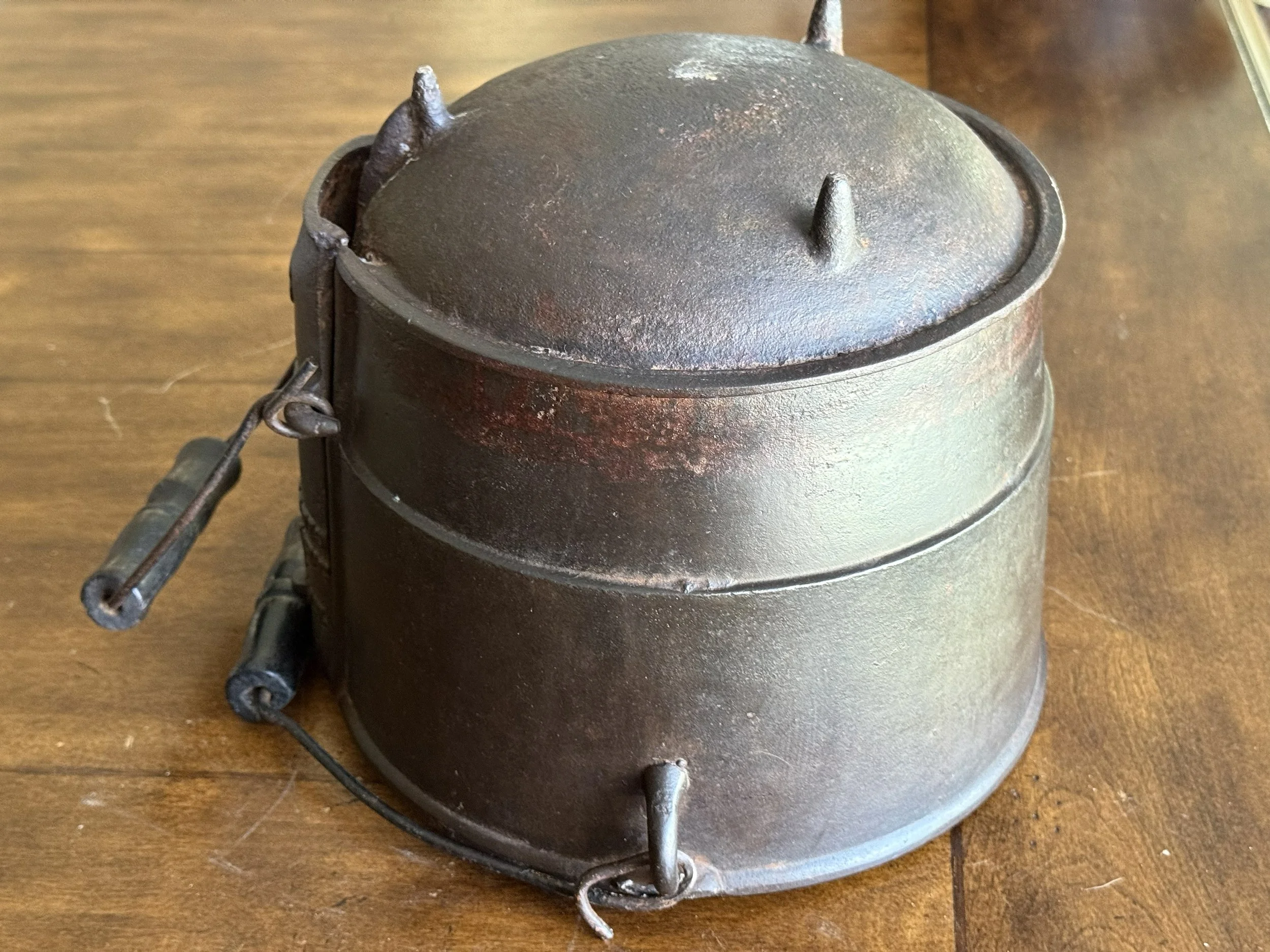
The J.H. Day & Co. No. 8 Patented Safety Kettle, showing the full form: the round-bodied cast iron kettle on three cast feet, the hinged fire shield panel with its wire-link latch and cast iron cylindrical handle at the front, and the wire bail handles at the rim. The fire shield — the defining patented feature — is the pivoting hinged door mounted on the front of the kettle body. MADE ONLY BY / J.H. DAY & CO. / CINCINNATI, O. / PAT. 74 & 77. Size 8. Cincinnati, Hamilton County, Ohio.
Read the fire shield carefully. Four lines of raised lettering, cast into a hinged iron panel mounted on the front of the kettle body: MADE ONLY BY. J.H. DAY & CO. CINCINNATI, O. PAT. 74 & 77. And below the patent line, cast into the body itself: 8. Those two patent years — 1874 and 1877 — mean this kettle was not just a piece of hollow ware. It was a protected invention. Someone in Cincinnati sat down and designed a new way to manage fire around a kettle, filed a patent application, received formal protection twice in three years, and then cast the phrase MADE ONLY BY onto every piece they produced. That phrase is not marketing language. It is a legal statement. The fire shield on this kettle was protected by United States patent, and J.H. Day & Co. wanted everyone who looked at it to know it.
The fire shield is the piece’s defining feature and its central mystery. It is a hinged rectangular panel, mounted on the front of the kettle body with a wire pivot system, latched by a wire hook-and-loop mechanism, and operated by a cast iron cylindrical handle with a turned wood grip. It swings open like a door. It latches shut. It was designed to be opened and closed repeatedly during use — while the kettle was hot, while the fire was burning beneath it, while the contents were at temperature. The specific function of the fire shield — whether it directed heat, shielded the user from flame, protected the contents from draft, or regulated combustion in some way — is described in the patents of 1874 and 1877, which are the definitive record of J.H. Day & Co.’s intent.
This is the SSC Museum Collection’s second J.H. Day & Co. Safety Kettle documented — and the first with the complete fire shield assembly intact and functional. It is one of the rarest configurations of a rare piece. It was acquired in exceptional preserved condition, treated with a light Dawn wash and a light brass brush to clarify the casting marks, and seasoned with SSC Archival Black™ museum seasoning. The original patina — decades of surface character built by age, heat, and use — is preserved in full.
The Fire Shield: What It Is and How It Works

Front detail of the fire shield panel and its mounting hardware. The raised lettering is clearly legible: MADE ONLY BY / J.H. DAY & CO. / CINCINNATI, O. on the upper panel, PAT. 74 & 77 on the lower register, and the size numeral 8 below. The hinged panel is mounted to the kettle body by two flanged cast iron extensions. The wire latch hook is visible at the top of the panel. Below the panel, the cast iron cylindrical handle with turned wood grip serves as the operating handle for the shield.
The fire shield is not a lid. It is not a pour spout cover. It is a hinged door mounted on the exterior wall of the kettle body — a separate iron panel, riveted or pinned to the kettle at two pivot points on the body wall, that swings open and shut on a wire hinge assembly. The panel carries the complete patent marking on its outer face. The wire latch at the top holds it closed against the kettle wall. The cast iron cylindrical handle below the panel allows the user to open the shield without touching the hot iron of the kettle body directly.
The fire shield addresses a specific problem of hearth and open-fire cooking: the management of heat and flame around a vessel. In the era before enclosed cooking stoves became universal, kettles were suspended over open fires, set on hearth grates, or placed on brick or iron trivets above burning fuel. Managing the heat meant managing the fire — adding fuel, reducing draft, shifting the vessel, or accepting whatever the fire gave. The J.H. Day & Co. safety kettle with its patented fire shield offered a different approach: a movable barrier, integral to the kettle itself, that could be opened to expose the bottom of the vessel to more direct heat, or closed to shield the contents and the surrounding area from the fire below and in front.
The specific mechanical claim of the patents — what exactly is protected by the 1874 and 1877 filings — is contained in the USPTO records for those years. Both patents predate the September 24, 1877 Patent Office fire that destroyed 80,000 models and 600,000 drawings, though unlike the 1871–72 records, the 1874 and 1877 patent text records themselves were preserved — only the physical models and drawings were lost in the 1877 fire, not the registered patent documentation. The patents of 1874 and 1877 are therefore recoverable from USPTO records, and future research will aim to retrieve the specific claim language. What the physical piece tells us unambiguously is that J.H. Day & Co. filed twice, received protection twice, and was confident enough in their design to cast MADE ONLY BY onto every piece.
The phrase MADE ONLY BY is itself significant. It is not simply MADE BY or MANUFACTURED BY. It is MADE ONLY BY — an exclusivity claim cast in iron. J.H. Day & Co. was asserting that no one else could make this kettle with this fire shield. The patent gave them that right, and they exercised it with full confidence on every casting.
The Kettle: Form, Feet, and Function

Top view of the kettle body with the domed lid in place, showing the three-leg configuration from above and the wire bail handle across the top. The domed lid with its single central knob handle rests within the rim of the kettle body. Three cast iron nub feet are visible at the base — one at top center and two at lower left and right — providing stable trivet-like support over an open fire or hearth grate. The lid shows the deep rich patina of a piece that has been well-used and well-aged.
The kettle body is a round-bodied, straight-sided cast iron vessel of generous capacity. The form is the standard configuration for a mid-19th-century American cooking kettle: a cylindrical body with a flat base — or in this case, a slightly rounded bottom — supported on three cast iron feet that allow the vessel to stand stably over a fire or on a hearth grate without tipping. The three-footed configuration is the definitive hearth kettle form of the pre-stove era, and its presence here confirms the J.H. Day safety kettle’s design context: this was not a stove-top piece. It was a hearth piece, designed to stand over open fire.
The three feet are cast integrally with the kettle body — small, blunt nub projections at the base of the body that raise the bottom of the vessel above the fuel or grate surface, allowing air and flame to circulate beneath. They also carry the weight of the full kettle — kettle body, contents, lid, and fire shield hardware together — without flexing or separating. The integral casting ensures no joint failure under the thermal and mechanical stress of active hearth use.
The domed lid fits within the rim of the kettle body and carries a single cast iron central knob handle. It is the standard period configuration for a lidded hearth kettle — the dome sheds drips and condensation back into the pot, the knob handle allows the lid to be lifted with a hook or tongs without skin contact. The wire bail handle at the rim spans the full diameter of the kettle and pivots at two cast iron ear bosses on the body wall, allowing the kettle to be lifted and carried by hook or crane over a fire.
The interior of the kettle, visible in the top-open photograph, shows the deep blue-black of a well-seasoned iron surface that has been restored to stable display condition. The original patina of the interior has been preserved. No stripping, no electrolysis, no abrasive treatment was applied to the interior surface. The Dawn wash and light brass brush treatment were applied to the exterior and the fire shield panel only — to bring the casting marks to legibility and stabilize the exterior surface. The interior is exactly as acquired.
Original Patina: The SSC Preservation Decision
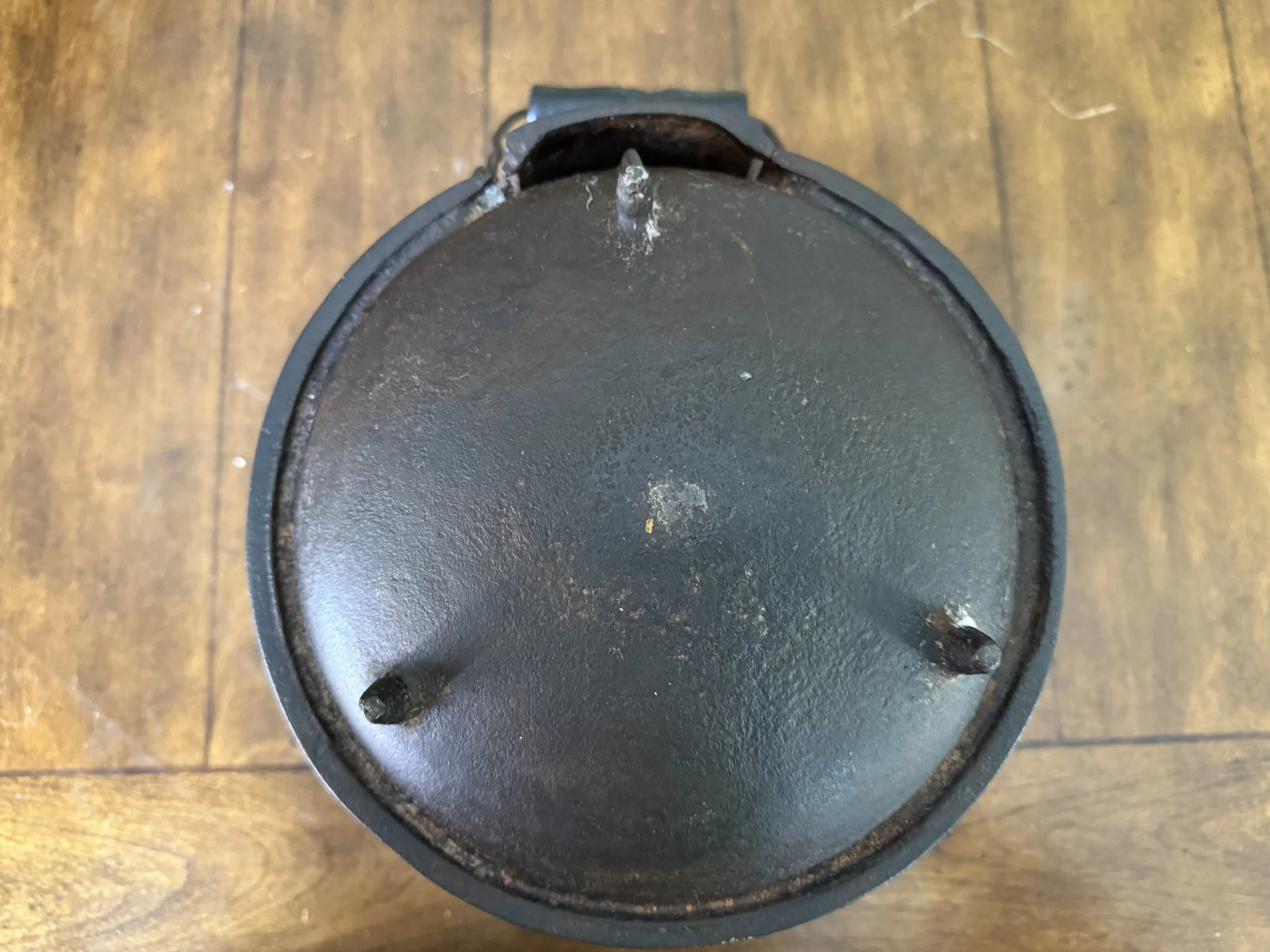
Bottom view of the kettle showing the three cast feet projecting from the base, the wire bail handle pivot ears at the body wall, and the overall surface character of the piece after SSC Archival Black™ museum seasoning. The surface carries the layered patina of a piece that has aged for over 150 years — the warm brown-black of iron that has lived near heat and changed with time. This surface was not stripped, not electrolyzed, not lye-treated. It was light-washed with Dawn, lightly brushed on the fire shield panel only, and sealed with SSC Archival Black™.
The J.H. Day & Co. safety kettle arrived in exceptional preserved condition for a piece of this age and rarity. The exterior surface carries the rich, layered patina that only 150 years can produce — warm brown tones where heat and oil and time have worked together on the iron, deeper blacks where the surface is protected, complex variation across the body that no restoration process can replicate. This surface is the piece’s original skin. It is exactly what J.H. Day & Co.’s casting looked like after a century and a half of honest existence.
SSC’s preservation decision for this piece was deliberate and specific. The kettle received a light wash with Dawn dish soap — gentle enough to remove surface dust and handling residue without stripping the original patina beneath. The fire shield panel received a light brass brush treatment on the raised lettering only, sufficient to bring the casting marks to full legibility without abrading the surrounding iron. No lye tank. No electrolysis. No stripping of any kind. The original patina — all of it — stays with the iron.
SSC Archival Black™ museum seasoning was then applied to the full exterior and interior surfaces, sealing the iron against further oxidation and deepening the visual contrast of the surface character. The result is a piece that presents in its authentic historical state — original patina intact, casting marks legible, fire shield hardware functional — sealed for museum display without compromising a single layer of the original surface.
The reasoning is the same as with every industrial or historically significant surface in the SSC collection: the original patina of a 150-year-old piece is not a condition problem to be corrected. It is the physical record of the piece’s existence. Removing it would produce clean iron and erase history. SSC keeps the history.
J.H. Day & Co.: Cincinnati’s Industrial Inventor

Three-quarter profile view of the complete kettle showing the relationship between the kettle body, the fire shield assembly at front, the domed lid, and the wire bail handles. The fire shield handle — the cast iron cylinder with turned wood grip — is visible projecting from the front of the body below the latched panel. The two wire bail handles span the rim at the bail mounts. The three-footed base lifts the body above the surface for hearth fire or grate use.
J.H. Day & Co. of Cincinnati, Ohio was not primarily a hollow ware foundry. It was an industrial machinery manufacturer — a Cincinnati firm that by 1890 was producing a comprehensive line of commercial mixing, sifting, grinding, and processing equipment for bakers, millers, grocers, druggists, chemists, and perfumers. The company was identified in its 1890 catalog as the successor to The Hunter Manufacturing Co., confirming a corporate lineage rooted in Cincinnati’s 19th-century industrial manufacturing tradition. The same company that patented the safety kettle in 1874 and 1877 was, by 1890, producing the Hunter’s Lightning Sifter and Mixer, Giant Dough Mixer, Egg Beater, Improved Pneumatic Sponge Beater, Pill Mass Mixer, Drug Disintegrators, Paint Mixers, Electric Motors, and Engines — a product line that tells the story of a company growing from specialty hollow ware into full industrial machinery production.
This context reframes the safety kettle entirely. J.H. Day & Co. was not a stove works producing kettles as their primary line. They were industrial inventors and machinery manufacturers who also produced patented specialty hollow ware — the safety kettle among them. The phrase MADE ONLY BY reflects not just legal protection but corporate pride: this was not a generic kettle sold by a stove distributor. It was a patented product of a Cincinnati engineering firm that took its innovations seriously enough to apply for patent protection twice and to cast an exclusivity claim in iron on every piece.
The firm’s Cincinnati location places it squarely in the commercial and industrial ecosystem documented throughout the SSC collection. Cincinnati in the 1870s was one of the great manufacturing cities of North America — the stove trade, the hollow ware trade, the machinery trade, the iron foundry ecosystem that produced Yourtee Hollister & Co.’s kettles, Greer & King’s bean pots, and the entire Cincinnati iron trade district centered on West Second Street. J.H. Day & Co. was one node in that larger network: a Cincinnati industrial firm with the engineering capacity to patent a safety improvement to a traditional hearth vessel and the manufacturing capacity to produce it as a marked, numbered, exclusive product line.
By 1942, the J.H. Day Company was still operating in Cincinnati as a manufacturer of equipment for the process industries — mixers, mills, screens, and related industrial machinery. The Ohio company registration records note the company as a Foreign Corporation with the Ohio company number 215176, incorporated October 31, 1949. The trajectory from safety kettle manufacturer in the 1870s to industrial process equipment company in the 1940s traces a long arc of Cincinnati industrial history, and the safety kettle with its fire shield sits at the beginning of that arc.
Piece Details
Manufacturer
J.H. Day & Co., Cincinnati, Hamilton County, Ohio
Company Context
Industrial machinery manufacturer; successor to The Hunter Manufacturing Co.; also produced commercial mixers, sifters, and processing equipment; active from at least 1874 through mid-20th century
Piece Type
No. 8 Safety Kettle with Patented Fire Shield — hearth cooking kettle with integral hinged iron fire shield panel on the kettle body exterior
Size
8 — cast into kettle body below fire shield panel
Body Form
Round cylindrical cast iron body; rounded/bellied bottom; three integral cast feet for hearth / open-fire support; wire bail handles at two cast ear bosses; domed cast iron lid with central cast knob handle
Fire Shield
Hinged rectangular cast iron panel mounted on exterior body wall at two flanged pivot points; wire hinge and latch assembly; latches closed against kettle wall; wire hook-and-loop latch at top of panel; cast iron cylindrical operating handle with turned wood grip below panel; opens/closes for heat regulation during use
Casting Marks
MADE ONLY BY / J.H. DAY & CO. / CINCINNATI, O. / PAT. 74 & 77 — raised lettering on outer face of fire shield panel; 8 cast into kettle body below shield mounting
Patent Dates
1874 and 1877 — two separate patents referenced on fire shield; 1874 = initial design protection; 1877 = second patent (improvement or updated design); both patents predate September 24, 1877 Patent Office fire; text records preserved; specific patent numbers subject to ongoing archival research
Patent Significance
MADE ONLY BY is an exclusivity claim in iron — J.H. Day & Co. held legal monopoly on this specific fire shield design; two patents in three years indicates iterative development and active commitment to protection
Not in Databases
J.H. Day & Co. does not appear in the CastIronCollector foundry database or the WAGs compiled foundry list; this piece is first-time documented in the SSC collection
Restoration
Light Dawn dish soap wash; light brass brush on fire shield lettering only; NO lye, NO electrolysis, NO stripping; original patina fully preserved
Preservation Method
SSC Archival Black™ museum seasoning applied to exterior and interior surfaces; original surface character sealed for display
Condition
Exceptional for age — original patina intact throughout; fire shield hardware complete and functional (hinge, latch, handle); casting marks fully legible; three feet intact; lid present; wire bail handles present; interior surface seasoned and stable; no cracks; no breaks
Date of Manufacture
c. 1874 and after — earliest production after first patent (1874); fire shield panel references both 1874 and 1877 patents; production continued through at least the late 1870s
Acquisition Source
eBay — Seller: ogdenalf1984
eBay Item No.
287095595977
Order No.
11-14492-27418
Acquisition Date
April 12, 2026
SSC Catalog No.
SSC-JHDAY-KTL-001
Collection Category
Ohio Cast Iron — Pre-1905 Hollow Ware / Cincinnati / Patented Specialty Hollow Ware
Why This Piece Matters
J.H. Day & Co. does not appear in the CastIronCollector foundry database. They do not appear in the WAGs compiled foundry list. They are not in the standard collector reference guides for American cast iron hollow ware. And yet they cast MADE ONLY BY onto every safety kettle they produced — an exclusivity claim in iron that has survived 150 years in legible condition, asserting their patent rights to anyone who reads it.
This piece matters because the fire shield changes everything. Most J.H. Day safety kettles documented in collector records have a simpler pour-spout cover — a panel that swings out to form a spout, held by a cotter pin. The SSC piece has a full hinged fire shield: a door that opens and closes against the body of the kettle, latched by a wire hook, operated by a cast iron handle, designed to be used actively during cooking. This is the more complex, more functional, more fully realized version of the J.H. Day patented safety system. It is the piece that demonstrates what the 1874 and 1877 patents were actually protecting.
It matters because Cincinnati in the 1870s produced this. Not a stove works, not a hollow ware foundry — an industrial machinery company with the engineering capacity to imagine a new approach to hearth fire management, patent it twice, and manufacture it as a branded, numbered, exclusive product. J.H. Day & Co. was successor to the Hunter Manufacturing Co., producer of commercial mixers and sifters and grinding mills, and also the maker of the most sophisticated patented hearth kettle in the SSC collection. That combination of industrial engineering and specialty hollow ware is exactly the kind of underdocumented Cincinnati manufacturing story the SSC collection exists to preserve.
The original patina is intact. The fire shield is functional. The casting marks say MADE ONLY BY. After 150 years, that claim is still true — because no one has ever documented it the way SSC is documenting it now.
Sources & Further Reading
Physical examination of piece: MADE ONLY BY / J.H. DAY & CO. / CINCINNATI, O. / PAT. 74 & 77 cast in raised lettering on outer face of hinged fire shield panel; 8 cast into kettle body below shield mounting; round cylindrical cast iron body; three integral cast feet; wire bail handles at two cast ear bosses; domed cast iron lid with central knob handle; hinged fire shield panel with wire hinge assembly, wire hook-and-loop latch, and cast iron cylindrical handle with turned wood grip; five seller photographs examined prior to acquisition.
WorthPoint — Antique Cast Iron Safety Kettle J.H. Day & Company (item #171587814). Documents another example of the J.H. Day safety kettle marked MADE ONLY BY J.H. DAY & CO. CINCINNATI. O PAT. 74 & 77; 8.75 inches tall, 10 inches diameter; approximately 3 gallon capacity; two swing bail handles with wooden turned grips; three legs; front safety cover holds approximately the same marking as the SSC piece.
WorthPoint — Antique Cast Iron Safety Kettle J.H. Day & Company (item #347553635). Documents a variant marked J H DAY & Co, CINTI’ OHIO, Pat 74 & 78 — confirming that some examples reference 1874 and 1878 (not 1877); the SSC piece clearly reads 74 & 77, placing it in a specific patent year variant.
WorthPoint — Antique Cast Iron Footed Kettle Bucket 8 J.H. Day & Co. 1875. Documents additional J.H. Day hollow ware, confirming active production through 1875 and beyond.
Catalog and Price-List of Special Machinery, J.H. Day & Co., Cincinnati & New York, 1890. Documented via WorthPoint (item #1720900509). Identifies J.H. Day & Co. as successors to The Hunter Manufacturing Co.; product line for bakers, millers, grocers, druggists, chemists, and perfumers; confirms the company’s industrial machinery identity beyond hollow ware production.
Wikipedia — 1877 U.S. Patent Office Fire. The September 24, 1877 fire destroyed 80,000 models and 600,000 drawings but did not destroy patent text records; patents of 1874 and 1877 are therefore recoverable from USPTO records, unlike the 1871–72 patents destroyed in the earlier fire.
CastIronCollector — Foundry Database. J.H. Day & Co. is absent from the CastIronCollector foundry database; SSC-JHDAY-KTL-001 represents a first-time documented attribution of this maker.
WAGs Compiled Foundry List. J.H. Day & Co. is absent from the WAGs compiled foundry list; further confirmation of underdocumented status in the collector record.
eBay acquisition record — Order No. 11-14492-27418, seller: ogdenalf1984, April 12, 2026. Item: Rare Antique Cast Iron Hearth Kettle W/Fire Shield J.H. Day Co Cincinnati, O Pat (item no. 287095595977).
About Steve's Seasoned Classics
Steve’s Seasoned Classics is an online museum dedicated to preserving and documenting the heritage of American cast iron, with a singular focus on the obscure, defunct foundries of Ohio from the 19th and early 20th centuries. The SSC collection spans 130+ pieces from 50+ confirmed Ohio makers — the majority absent from standard collector references. Makers were identified through physical artifacts exhibiting gate marks, patent dates, foundry traits, and documented regional provenance, cross-checked against surviving trade directories, census records, and existing collector guides. Makers lacking representation in published guides but supported by physical evidence were flagged for first-time documentation — a core function of the SSC research mission.
