Brooks & Patton No. 9 Tea Kettle
SSC MUSEUM COLLECTION
Catalog No. SSC-BP-KTL-09-001
“Brooks & Patton” Lid Mark | No. 9 Size | Columbus, Ohio
Circa 1874–1900 • Brooks & Patton / Patton Mfg. Co.

Lid view showing the full maker’s mark: “BROOKS & PATTON” arched at 12 o’clock, “COLUMBUS OHIO” arched at 6 o’clock, and the size numeral “9” centered within a concentric ring pattern. The wire bail handle and center lid knob are original. This is one of the clearest Brooks & Patton lid marks SSC has documented.
This is a piece that connects two chapters of Columbus, Ohio’s cast iron history in a single artifact. The No. 9 tea kettle marked “Brooks & Patton / Columbus Ohio” on its lid is a product of one of the city’s lesser-known but historically significant foundry operations—a firm whose principal, Alexander G. Patton, would later acquire the naming rights to the Columbus Hollow Ware Company itself. For SSC, a collection already deeply invested in documenting Columbus Hollow Ware’s “The Favorite” branded cookware, the acquisition of a Brooks & Patton piece is not merely an addition to the catalog. It is a bridge between the broader Columbus foundry ecosystem and the specific CHW lineage that SSC has worked to preserve.
The kettle itself is a beautifully preserved example of late 19th-century American cast iron hollow ware. The bulbous, pot-bellied form with integral goose-neck spout, wire bail handle, and fitted lid with concentric ring decoration represents the standard tea kettle design that served American households from the hearth era through the cookstove revolution. What elevates this specimen above the anonymous is the lid marking: “BROOKS & PATTON” arched in bold raised letters at 12 o’clock, “COLUMBUS OHIO” at 6 o’clock, and the size numeral “9” centered within the ring pattern. The mark is crisp, legible, and complete—a level of preservation that is exceptional for a piece of this age.
The rarity of Brooks & Patton marked pieces in collector circulation is genuine. The Wagner and Griswold Society’s foundry database cross-references Brooks & Patton with Patton Mfg. Co. of Columbus, Ohio (c. 1874–1900), noting production of waffle irons, tea pots, kettles, and griddles. Surviving specimens surface infrequently on the secondary market, and when they do, they tend to be waffle irons rather than kettles. A No. 9 tea kettle with original lid, intact bail handle, and fully legible maker’s mark is a significant find by any measure of Ohio foundry collecting.
Piece Details

Interior view with lid open, showing the inside of the kettle bowl and the underside of the lid. The “BROOKS & PATTON” and “COLUMBUS OHIO” markings are visible in reverse from this angle. Some interior surface oxidation is present—typical for a kettle of this age that has held water over its working life.
Manufacturer
Brooks & Patton (later Patton Mfg. Co.)
Brand
Brooks & Patton
Piece Type
Tea Kettle
Size Number
No. 9
Lid Marking
“BROOKS & PATTON” arched at 12 o’clock; “COLUMBUS OHIO” arched at 6 o’clock; “9” centered with concentric ring pattern
Body Marking
None visible on body exterior
Bottom Configuration
Rounded bottom with visible gate mark; recessed base with raised outer rim
Spout
Integral cast goose-neck spout
Handle
Wire bail handle with pivoting attachment ears
Lid
Original fitted lid with concentric ring decoration and center finial/knob
Date of Manufacture
Circa 1874–1900
Place of Manufacture
Columbus, Franklin County, Ohio
Condition
Very Good to Excellent for age — intact bail handle; original lid present; no cracks or structural damage; some interior surface oxidation; legible lid markings; gate mark visible on base
Acquisition Date
March 1, 2026
Acquisition Source
eBay — Seller: jnknw8r9y
eBay Item Number
335221124416
Order Number
09-14306-66796
SSC Catalog Number
SSC-BP-KTL-09-001
The Company: Brooks & Patton / Patton Mfg. Co.
The history of Brooks & Patton is the history of one man’s career arc through the American cast iron industry in the final quarter of the 19th century. Alexander G. Patton—identified in U.S. Patent Office records as “a resident of the city of Columbus, county of Franklin, and State of Ohio”—was an inventor, manufacturer, and iron industry entrepreneur whose work spanned at least three decades and multiple corporate entities.
Patton’s earliest documented connection to the iron trade places him as an assignor for the Detroit Iron & Brass Manufacturing Company in the late 1870s, working on waffle iron designs. By 1881, he had relocated to Columbus, Ohio, where he filed U.S. Patent No. 246,194 (August 23, 1881) for an improved waffle iron mechanism. The patent document identifies him explicitly as a Columbus resident and describes an innovative combined hinge-and-journal design for waffle iron pans. Two years later, he secured U.S. Patent No. 287,713 (October 30, 1883) for additional waffle iron improvements, this time under the Patton Mfg. Co. name.
The firm operated under two names during its active years: “Brooks & Patton” and “Patton Mfg. Co.,” both based in Columbus, Ohio. The WAG Society’s foundry database dates the operation to approximately 1874 through 1900 and notes production of waffle irons, tea pots, kettles, and griddles. The identity of “Brooks”—presumably a business partner—has not been confirmed in available records, though the dual-name marking pattern suggests either a partnership evolution (Brooks & Patton as an earlier incarnation, Patton Mfg. Co. as a later one) or concurrent branding for different product lines.
What makes the Brooks & Patton story extraordinary for SSC’s purposes is the direct, documented connection to the Columbus Hollow Ware Company. According to collector research published by BoonieHicks.com, A.G. Patton obtained the Columbus Hollow Ware Company naming rights in 1897—the same A.G. Patton who had been manufacturing cast iron cookware in Columbus under the Brooks & Patton and Patton Mfg. Co. names for two decades. Under Patton’s leadership, the reconstituted Columbus Hollow Ware Company entered into arrangements with the Ohio State Penitentiary for cast iron production. The ironware produced under these arrangements is believed to have been unmarked—distinct from the earlier “THE FAVORITE” branded production of the original CHW period (1882–1886).
This means that the Brooks & Patton tea kettle in the SSC collection represents a piece of the same Columbus foundry ecosystem that produced “The Favorite” marked Columbus Hollow Ware. A.G. Patton was not an outsider who purchased a defunct company name—he was an established Columbus iron manufacturer with his own foundry operation, his own patents, and his own product line, who then absorbed the CHW corporate identity into his existing business. The Brooks & Patton kettle and the CHW skillets in the SSC collection are products of overlapping industrial histories in the same city, connected by the same individual.
Physical Characteristics & Condition Assessment
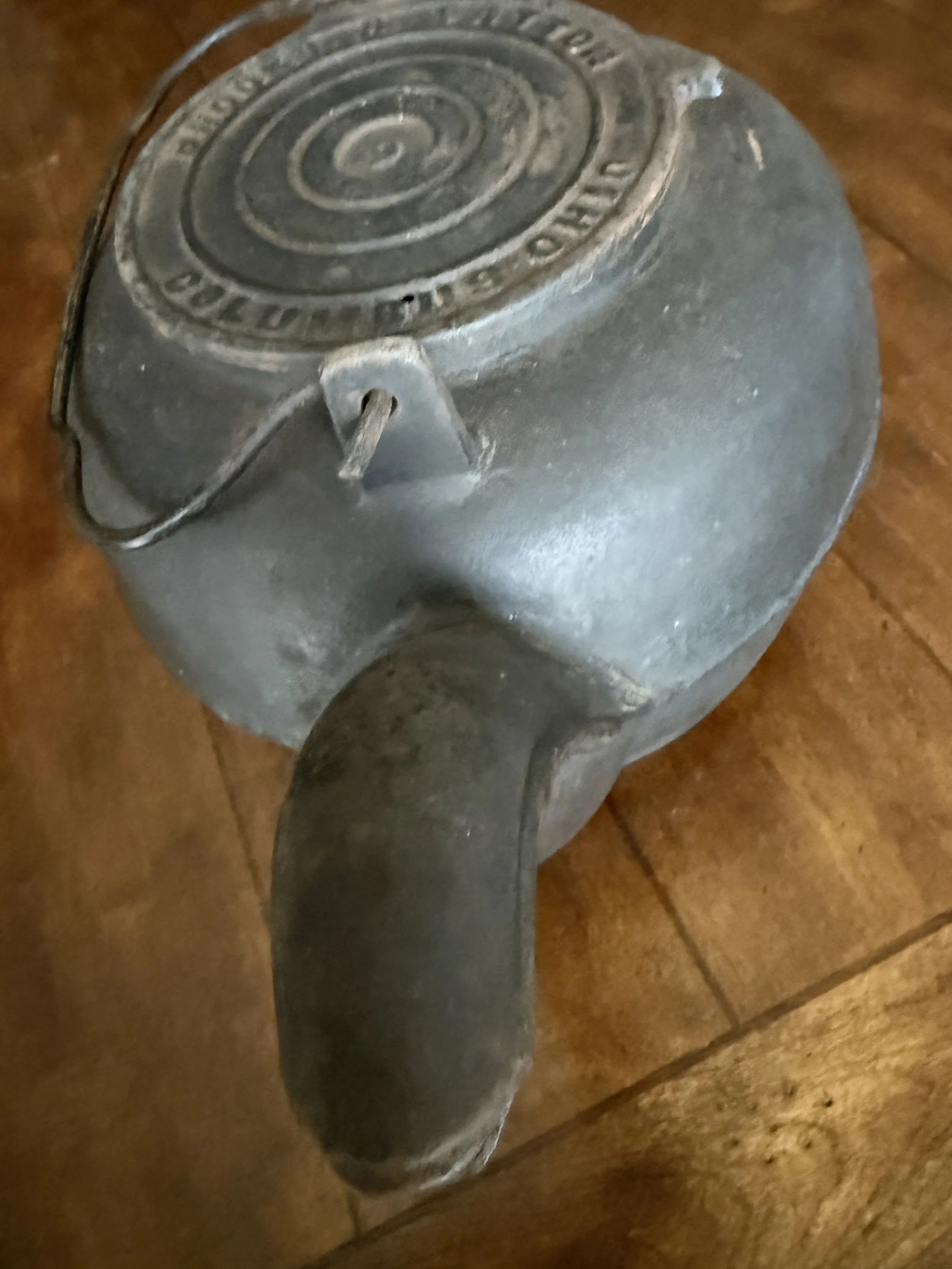
Spout and profile view showing the bulbous pot-bellied body, integral cast goose-neck spout, and the “BROOKS & PATTON / COLUMBUS OHIO” lid markings from an oblique angle. The bail handle attachment ears are visible on either side of the lid opening.
The No. 9 tea kettle is a substantial piece of hollow ware—the bulbous, pot-bellied body form that was standard for American cast iron tea kettles throughout the 19th century. The body tapers from a wide midsection to a narrower base, with a recessed bottom that shows a visible gate mark—the linear casting scar that indicates sand-mold production typical of the period. The integral goose-neck spout extends from the upper body, cast as a single piece with the kettle body rather than attached separately.
The lid is the centerpiece of the piece from a documentation standpoint. It features the full maker’s mark in raised lettering around the perimeter: “BROOKS & PATTON” arched above center and “COLUMBUS OHIO” arched below, with the size numeral “9” centered within a decorative pattern of concentric raised rings. The center of the lid carries a small finial or knob. The quality of the casting on the lid—sharp lettering, clean ring definition, precise centering—reflects a well-maintained pattern and competent foundry practice.
The wire bail handle is original, attached to the kettle body through integral cast ears on opposing sides of the lid opening. The bail pivots freely and shows the slight irregularity of hand-formed wire consistent with 19th-century manufacture. The handle functions properly and shows no signs of replacement or repair.
Condition is assessed as Very Good to Excellent for a piece of this age. The exterior is structurally sound with no cracks, chips, or repairs. The kettle sits stable on its base. The lid fits properly in the opening. The spout is complete and unbroken. The interior shows some surface oxidation—a brown patina visible through the lid opening—which is entirely expected and typical for a cast iron vessel that has held water over decades of use. The exterior retains a dark gray iron finish with some surface variation consistent with age. The lid markings are the best-preserved element of the piece: fully legible, with every letter of “BROOKS & PATTON” and “COLUMBUS OHIO” clearly readable. This is a display-quality specimen.

Bottom view showing the recessed base with raised outer rim and visible gate mark running across the center—evidence of sand-mold casting consistent with 19th-century production methods. No maker’s mark appears on the base; all identification is carried on the lid.
The Columbus Connection: Patton, CHW, and the Prison Foundry
The significance of this tea kettle for SSC’s collection narrative extends well beyond the piece itself. It establishes a tangible link between the Brooks & Patton commercial foundry operation and the Columbus Hollow Ware Company—two entities that the collector community has long recognized as connected but that are rarely represented in the same private collection with documented provenance for both.
The timeline as currently understood places Brooks & Patton / Patton Mfg. Co. as an active Columbus foundry from approximately 1874 through 1900, producing a range of domestic cast iron under their own name. During this same period, the Columbus Hollow Ware Company operated in two phases: the original Hatcher-era company (c. 1882–1886), which produced “THE FAVORITE” branded cookware, and the reconstituted Patton-era company (from 1897), which contracted with the Ohio State Penitentiary for cast iron production. A.G. Patton is the documented bridge between the two enterprises.
This raises questions that the SSC collection is now uniquely positioned to explore. Were Brooks & Patton and Columbus Hollow Ware operating simultaneously out of the same facilities, or did Patton’s acquisition of the CHW naming rights represent a corporate consolidation? Did the Brooks & Patton product line continue after 1897, or was it folded into the reconstituted CHW operation? Were there shared patterns, shared production techniques, or shared distribution channels between the two branded lines? The answers may never be fully recoverable from surviving artifacts alone—but the artifacts themselves, carefully documented and cross-referenced, generate exactly the kind of comparative evidence that can narrow the field of possibilities.
The SSC collection now contains documented specimens from both sides of the A.G. Patton story: the Brooks & Patton commercial kettle and the Columbus Hollow Ware “The Favorite” skillets. Together, they represent a more comprehensive picture of Columbus, Ohio’s cast iron heritage than either would alone.
Collector’s Context
Brooks & Patton pieces are genuinely rare in the cast iron collecting market. The firm operated for roughly a quarter-century in a city that was home to multiple competing foundries, and it left no surviving corporate records, product catalogs, or advertising accessible to modern researchers. The WAG Society’s foundry database—the most comprehensive listing of American cast iron producers available—offers only a brief cross-reference entry. Surviving specimens that surface on the secondary market are predominantly waffle irons; tea kettles with intact lids and legible marks are considerably less common.
At $140.00 plus shipping and tax, this acquisition represents strong value for a marked Columbus, Ohio piece of this quality and rarity. Comparable tea kettles from better-known Ohio foundries—Sidney, Wagner, Griswold—command higher prices but carry far less historical intrigue. The Brooks & Patton kettle’s value to SSC lies precisely in its rarity, its Columbus provenance, and its documented connection to the CHW corporate lineage that forms the backbone of the SSC collection.
Provenance & Acquisition
This No. 9 tea kettle was acquired on March 1, 2026, via eBay from seller jnknw8r9y, under eBay item number 335221124416 (order 09-14306-66796). The listing described the piece as “RARE ANTIQUE #9 BROOKS AND PATTON COLUMBUS OHIO CAST IRON TEA KETTLE ~ POT.” The piece was purchased at $140.00 plus $14.70 FedEx Ground Economy shipping and $13.11 in sales tax, for a total acquisition cost of $167.81.
Physical examination on receipt confirmed the condition as described: structurally sound, original lid and bail handle present, legible maker’s marks, no cracks or structural damage, gate mark visible on base. The piece has been logged into the SSC collection as a permanent collection specimen under catalog number SSC-BP-KTL-09-001, representing the first Brooks & Patton piece in the SSC museum and a significant expansion of SSC’s Columbus foundry documentation.
Corporate Timeline: Brooks & Patton / Patton Mfg. Co.
Late 1870s — Alexander G. Patton serves as assignor for the Detroit Iron & Brass Manufacturing Company, working on waffle iron designs. His earliest documented involvement in the cast iron trade.
c. 1874 — Brooks & Patton / Patton Mfg. Co. is established in Columbus, Franklin County, Ohio. Production of domestic cast iron hollow ware including waffle irons, tea kettles, griddles, and tea pots.
1881 — A.G. Patton files U.S. Patent No. 246,194 (August 23, 1881) for an improved waffle iron with combined hinge-and-journal mechanism. Patent identifies him as a Columbus, Ohio resident.
1883 — Patton secures U.S. Patent No. 287,713 (October 30, 1883) for additional waffle iron improvements under the Patton Mfg. Co. name.
1885 — Patton Mfg. Co. issues an illustrated product catalog featuring the Patent Revolving Waffle Iron and other cast iron products.
1892 — Patton is involved in a patent suit (vs. Griswold) regarding waffle iron designs. The suit is decided in Patton’s favor.
1897 — A.G. Patton obtains the Columbus Hollow Ware Company naming rights. The reconstituted CHW enters into production arrangements with the Ohio State Penitentiary.
c. 1900 — Brooks & Patton / Patton Mfg. Co. production ceases. The Columbus Hollow Ware Company under Patton’s leadership continues briefly before also ceasing operations by 1902.
2026 — Steve’s Seasoned Classics acquires the No. 9 tea kettle, establishing the first Brooks & Patton documentation in the SSC online museum and connecting the Patton foundry lineage to the existing CHW collection.
Why This Piece Matters
The Brooks & Patton No. 9 tea kettle matters because it makes visible an industrial connection that has been known to cast iron scholars but rarely documented through actual artifacts in a single collection. A.G. Patton’s career trajectory—from Detroit assignor, to Columbus manufacturer under his own name, to acquirer of the Columbus Hollow Ware Company identity—represents a thread that runs through three decades of Ohio’s cast iron history. This kettle is a physical artifact of that trajectory.
For SSC specifically, the acquisition transforms the collection’s Columbus narrative. The CHW “The Favorite” skillets now have a documented corporate predecessor and successor relationship represented in the same museum. The Brooks & Patton kettle predates or overlaps with CHW’s original production period; the Patton-era reconstituted CHW postdates it. Together with the existing five-piece CHW skillet set, SSC now holds artifacts spanning the full arc of A.G. Patton’s Columbus foundry operations—from his independent manufacturing years through his absorption of the Columbus Hollow Ware brand.
That kind of documentary continuity—the ability to tell a manufacturer’s story through actual surviving artifacts, documented with full provenance and cross-referenced across a single collection—is what transforms a group of old pans and kettles into a genuine research resource. SSC is building that resource, one piece at a time.
The iron endures. The markings tell the truth. The story deserves to be told.
Sources & Further Reading
U.S. Patent Office — Patent No. 246,194 (August 23, 1881): Alexander G. Patton, Columbus, Ohio. Waffle iron improvement. Full patent text establishes Patton as a Franklin County resident and cast iron inventor.
U.S. Patent Office — Patent No. 287,713 (October 30, 1883): A.G. Patton, Patton Mfg. Co., Columbus, Ohio. Additional waffle iron improvement.
Wagner and Griswold Society (WAG Society) — Foundry Database: Cross-reference entry for Brooks & Patton, Columbus, OH and Patton Mfg. Co., Columbus, Ohio (1874–1900). Product line includes waffle irons, tea pots, kettles, griddles.
BoonieHicks.com — “The Favorite, Vintage Cast Iron By The Columbus Hollow Ware Co.”: Documents A.G. Patton’s 1897 acquisition of Columbus Hollow Ware naming rights and subsequent Ohio State Penitentiary production arrangements.
CastIronCollector.com — Foundry Database and Forum: “A.G.P. — Columbus, OH” entry and collector discussion of Patton Mfg. Co. waffle iron identification.
Banterings.com — “Master List of Cast Iron Waffle Irons”: Timeline documenting Patton’s career from Detroit Iron & Brass Mfg Co. assignor through Columbus manufacturing, including 1885 illustrated catalog and 1892 patent suit.
About Steve’s Seasoned Classics
Steve’s Seasoned Classics is an online museum dedicated to preserving and documenting the heritage of American cast iron, with a singular focus on the obscure, defunct foundries of Ohio from the 19th and early 20th centuries. The SSC collection spans 130+ pieces from 50+ confirmed Ohio makers — the majority absent from standard collector references. Makers were identified through physical artifacts exhibiting gate marks, patent dates, foundry traits, and documented regional provenance, cross-checked against surviving trade directories, census records, and existing collector guides. Makers lacking representation in published guides but supported by physical evidence were flagged for first-time documentation — a core function of the SSC research mission.
