Cast Iron Posnet — “D.O.-52” Marking
SSC MUSEUM COLLECTION
Catalog No. SSC-UNK-POS-DO52-001
“D.O.-52” Incised Mark | 5” Diameter | Maker Unknown
Date Unknown • Manufacturer Unidentified

Bottom view showing the incised “D.O.-52” marking on the base exterior, three short legs, and the flat handle with teardrop hanging loop. No gate mark or sprue mark is visible on the bottom surface.
This small cast iron posnet is one of the most intriguing acquisitions in the SSC collection—not for what it reveals, but for what it conceals. The piece carries a single marking on its base exterior, “D.O.-52,” incised into the iron in a clean, deliberate hand. No foundry name, no city, no state, no patent date. Just five characters and a hyphen. The seller could not identify the maker. The collector community has offered no confirmed attribution. And yet the piece itself—a three-legged cooking pot in the classic posnet form, with a long flat handle and a hanging loop—speaks clearly of a tradition that stretches back centuries in American and European hearth cooking.
The posnet is among the oldest continuously produced forms in cast iron cookware history. The term originated in 14th-century England to describe a “small pot,” and the three-legged, long-handled form was standard hearth equipment from the colonial era through the mid-19th century. These pots were designed for one purpose: to sit directly over a bed of hot coals drawn from the main hearth fire, their legs elevating the cooking vessel just enough to allow airflow beneath while keeping the contents at a steady, controllable heat. Posnets served as sauce pots, butter melters, and small-batch cooking vessels—the precision instruments of hearth cuisine in an era before stovetop burners.
What makes this particular specimen unusual is the marking itself. “D.O.-52” does not correspond to any known foundry abbreviation, brand name, or pattern code in the published cast iron reference literature. The “D.O.” could represent a maker’s initials, a foundry code, a geographic abbreviation, or a product line designation. The “-52” could denote a pattern number, a mold identifier, or conceivably a date—though a 1952 manufacture date would make this an unusually late production of a hearth-era form. The marking remains an open research question, and SSC documents it here in full detail precisely because unresolved questions deserve careful preservation rather than speculative closure.
Piece Details
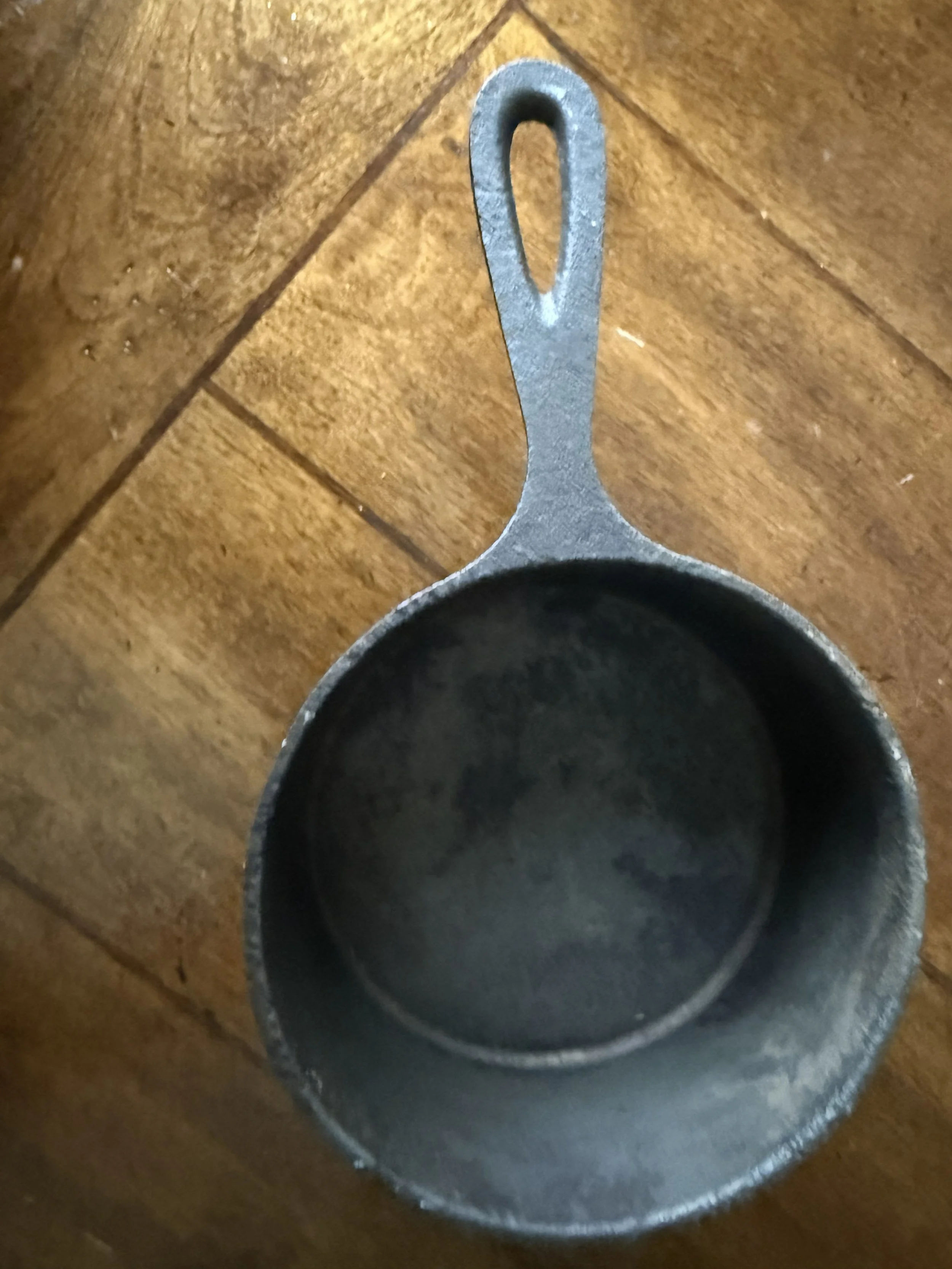
Top view showing the interior cooking surface, deep bowl profile, and the long flat handle. The three legs are visible at the base. The pebbly surface texture is consistent with sand-mold casting. Some interior casting irregularities are present, including a raised bump with a sharp point—a manufacturing flaw rather than damage.
Manufacturer
Unknown — Unidentified (see “D.O.-52” marking discussion below)
Brand
None identified
Piece Type
Posnet / Spider (three-legged cooking pot)
Size
5” diameter
Base Marking
“D.O.-52” incised on bottom exterior
Bottom Configuration
Flat bottom with three short legs (~¾” each); no gate mark visible
Pour Spouts
None
Handle Style
Long flat cast handle with teardrop/keyhole hanging loop
Handle Junction
Integral cast junction at body-handle join
Surface Texture
Pebbly / rough-cast finish consistent with sand-mold casting
Date of Manufacture
Unknown — form suggests late 19th to mid-20th century
Place of Manufacture
Unknown — no confirmed provenance; Ohio origin not established
Condition
Good — structurally sound; no cracks or chips; seasoned by previous owner; some casting flaws including interior bump with sharp point; sits level on three legs
Acquisition Date
January 20, 2026
Acquisition Source
eBay — Seller: bowal_4557
eBay Item Number
136952093803
Order Number
19-14112-48082
SSC Catalog Number
SSC-UNK-POS-DO52-001
The Posnet Form: A History in Three Legs
The word “posnet” first appeared in English records around 1327, describing a small cooking pot. By the 17th century, the form had become standardized: a round-bottomed or flat-bottomed bowl on three legs, with a long handle extending from the rim for safe manipulation near an open fire. The earliest posnets were cast in bell metal—an alloy of copper and tin—before cast iron became the dominant material for hearth cookware in the 18th century.
In American usage, posnets and their close cousins the “spiders” (three-legged skillets with shallower profiles) were standard equipment in every colonial and early republic kitchen. They were designed for the specific thermal environment of hearth cooking: coals raked from the main fire onto the stone or brick hearth surface, with the three-legged vessel set directly over the coal bed. The legs served a critical engineering function—they created an air gap between the heat source and the cooking surface, moderating the temperature and preventing the sudden scorching that direct contact with coals would produce.
The transition from hearth to cookstove in American kitchens, which accelerated through the 1830s and 1840s, gradually eliminated the need for legged cookware. Flat-bottomed pots and pans replaced the three-legged forms as the cast iron cookstove’s flat cooking surface became standard. By the late 19th century, legged cookware had largely retreated to rural, frontier, and camp cooking applications—though some foundries continued producing “country hollow ware” with legs well into the 20th century for customers who still cooked over open fires or on raised hearths.
The “D.O.-52” Marking: What We Know and What We Don’t
The marking on this piece is incised—cut into the pattern or mold rather than raised in relief—and reads “D.O.-52” in a straightforward, sans-serif lettering style. The characters are evenly spaced and clearly deliberate, ruling out any interpretation as accidental casting artifact or post-manufacture scratching. This was a mark placed intentionally by the maker or foundry.
Several hypotheses present themselves, none of which can be confirmed without additional specimens or documentary evidence. First, “D.O.” could be the initials of the foundry operator or pattern maker—a common practice at small regional foundries that served local markets and saw no need for elaborate brand marks. Second, “D.O.” could abbreviate a product designation: “Dutch Oven” is the most obvious candidate, though the posnet form is distinct from a Dutch oven and the abbreviation would be unusual. Third, “D.O.” could be a geographic code, though no standard foundry geography abbreviation matches. The “-52” suffix most plausibly represents either a pattern or mold number within a product line, or—less likely given the form’s antiquity—a year of manufacture.
SSC makes no attribution claim for this piece. The marking is documented here as found, photographed in detail, and presented to the collector community as an open identification challenge. If additional specimens bearing the “D.O.-52” marking surface—in any form, any size, from any source—the accumulated documentation may eventually allow an attribution. Until then, the marking stands as a genuine mystery in a field where mysteries are becoming increasingly rare.
Physical Characteristics & Condition Assessment
This is a small piece—five inches across the rim, three inches in total height including the three-quarter-inch legs. The bowl is deep relative to its diameter, giving the piece a steep-sided profile characteristic of posnets designed for liquid cooking (sauces, melted butter, small-batch boiling) rather than the shallower profile of a spider designed for frying or searing. The handle is long, flat, and terminates in a teardrop-shaped hanging loop, consistent with hearth-era design conventions that prioritized both safe handling near open flames and convenient storage on a peg or hook.
The surface texture is distinctly pebbly—rough to the touch in a way that reflects the sand-mold casting process and suggests the piece was not subjected to the machining or polishing that became standard at larger foundries in the late 19th and early 20th centuries. This rough finish is neither a defect nor a sign of age damage; it is a characteristic of the casting method and was typical of small-foundry production throughout the 19th century and into the 20th.
The piece has some manufacturing flaws, most notably an interior bump that comes to a sharp point—a casting irregularity where molten iron found an imperfection in the mold surface. This is a production-era flaw, not use damage, and is documented here as a characteristic of the individual casting rather than an indicator of poor foundry practice. Such flaws were common in small-run production where mold maintenance and quality control were less rigorous than at major commercial foundries.
Condition is assessed as Good. The piece is structurally sound with no cracks, chips, or repairs. It sits level on its three legs. The previous owner applied a round of seasoning with Crisco, and the piece shows evidence of prior cooking use. No active rust is present. The “D.O.-52” marking is legible and clearly readable. The piece is both functional and display-ready.
Collector’s Context
Posnets occupy a niche within the broader cast iron collecting universe. They are not the high-value trophy pieces that drive auction records—those honors belong to marked skillets from major foundries like Griswold, Wagner, and their Ohio contemporaries. But posnets carry a historical significance that transcends their modest market value. They represent the oldest continuously produced form in cast iron cookware, and they connect directly to the hearth-cooking traditions that defined American domestic life for two centuries before the cookstove revolution.
Unmarked and cryptically marked posnets are common in the antique market, and they present a persistent identification challenge. Most small foundries that produced these pieces left no surviving catalogs, no corporate records, and no advertising—only the iron itself. The “D.O.-52” marking on this specimen places it in a slightly more interesting category than a completely unmarked piece: someone intended this mark to mean something, and the possibility of eventual identification exists as long as the marking is documented and disseminated.
At $28.50 plus shipping and tax, this acquisition represents a low-risk addition to the SSC study collection. The piece was not purchased as a centerpiece or a showcase specimen—it was purchased as a research object and a representative example of the posnet form. Its value to SSC lies in the marking mystery it presents and in the opportunity to document and preserve a type of cast iron cookware that, despite its historical importance, receives far less scholarly attention than the branded skillets and Dutch ovens that dominate collector discourse.
Provenance & Acquisition
This posnet was acquired on January 20, 2026, via eBay from seller bowal_4557, under eBay item number 136952093803 (order 19-14112-48082). The listing described the piece as “VINTAGE CAST IRON POT 3 LEGS POSNET SPIDER 5”D D.O.-52 TRI LEG BEAN CAULDRON.” The seller disclosed that they could not identify the maker, noted the “D.O.-52” marking, and described the pebbly surface texture and interior casting flaws.
Physical examination on receipt confirmed the condition as described: structurally sound, no cracks or active rust, level on its three legs, and legible marking. The piece has been logged into the SSC collection as a study specimen under catalog number SSC-UNK-POS-DO52-001, with its unidentified maker status clearly noted. If an attribution is established through future research or community identification, the catalog record will be updated accordingly.
A Note on SSC Collection Scope
SSC’s permanent collection focuses on marked pieces from defunct Ohio foundries of the 19th and early 20th centuries. This piece does not currently meet that standard—its maker is unknown, its place of manufacture is unconfirmed, and no evidence currently links it to an Ohio foundry. It is included in the SSC catalog as a study piece and documented here in full detail because the marking presents a genuine identification question that may eventually be resolved through community research.
If the “D.O.-52” marking is eventually attributed to an Ohio foundry, this piece will be reclassified as a permanent collection specimen and its catalog record updated. If the marking is attributed to a non-Ohio source, the piece will be noted as a study reference and may be deaccessioned. In either case, the documentation preserved here—photographs, measurements, marking details, acquisition records—retains its research value regardless of the eventual attribution outcome.
Why This Piece Matters
The cast iron posnet marked “D.O.-52” matters not because of what it is—a small, inexpensive, cryptically marked three-legged pot—but because of what it represents. It is an artifact of a manufacturing tradition that predates the branded-foundry era by centuries. It carries a mark that someone intended to identify it, and that mark has so far resisted identification. It connects to hearth-cooking practices that were central to American domestic life from the colonial period through the Industrial Revolution. And it demonstrates that responsible collection documentation applies not only to high-value, well-attributed pieces but also to the humble, the mysterious, and the unresolved.
Every piece of cast iron that carries a marking carries a story. Some stories are well known—Wagner, Griswold, Lodge, Columbus Hollow Ware. Others are still waiting to be told. The “D.O.-52” posnet is waiting. SSC will keep the record open until the story finds its voice.
The iron endures. The markings tell the truth. The story deserves to be told.
Sources & Further Reading
WorthPoint.com — Historical listing for “Cast Iron Pot 3 Legs Posnet Spider 5”D D.O.-52 Tri Leg Bean Cauldron”: original seller description and condition notes.
CastIronCollector.com — Cast Iron Collector Forums: discussion of footed skillets, posnet identification, and early hearth-era spider forms.
Historic Deerfield — “What’s for Dinner?: Examining the Tools of Hearth Cooking”: historical context for posnet and spider forms in 18th- and 19th-century American kitchens.
Encyclopedia.com — “Hearth Cookery”: scholarly overview of hearth cooking implements including posnets, spiders, and their transition to cookstove-era flat-bottomed ware.
New Acquisition Militia — “18th Century Cooking Vessels”: reference guide for dating and identifying hearth-era cast iron forms by construction characteristics.
Ramblings on Cast Iron (blog) — “What’s a Posnet?”: collector discussion of the posnet form, Lodge “water skillet” equivalents, and historical uses.
About Steve’s Seasoned Classics
Steve’s Seasoned Classics is an online museum dedicated to preserving and documenting the heritage of American cast iron, with a singular focus on the obscure, defunct foundries of Ohio from the 19th and early 20th centuries. The SSC collection spans 130+ pieces from 50+ confirmed Ohio makers — the majority absent from standard collector references. Makers were identified through physical artifacts exhibiting gate marks, patent dates, foundry traits, and documented regional provenance, cross-checked against surviving trade directories, census records, and existing collector guides. Makers lacking representation in published guides but supported by physical evidence were flagged for first-time documentation — a core function of the SSC research mission.
