Pre-Logo Era No. 8 Flat Skillet — Gate Scar, Unattributed
SSC MUSEUM COLLECTION
Catalog No. SSC-UNK-SKL-08-GS-001
Gate Scar Base | Fancy Twist Handle | No. 8 Size | Unattributed
Circa 1860s–1890s • Manufacturer Unknown — American Foundry, Pre-Logo Era

Bottom view showing the defining features of this pre-logo era piece: the wide heat ring at the perimeter, the raised diagonal gate scar crossing the base interior from lower left to upper right, and a small triangle/arrow mark near 12 o’clock. No brand name, no logo cartouche, no manufacturer identification of any kind. The gate scar is the primary dating evidence.
The gate scar is the oldest mark in the SSC collection. Not the oldest logo, not the oldest brand—the oldest physical artifact of the casting process itself. The diagonal raised line crossing this skillet’s base is the remnant of the iron that filled the gate: the channel through which molten metal entered the mold cavity during casting. When the piece came out of the mold, that extra iron—the sprue—was broken or cut away, leaving a scar on the base surface. American foundries of the mid-to-late 19th century tolerated visible gate scars in a way that the branded, quality-competitive foundries of the early 20th century did not. By the time Favorite Piqua Ware was stamping Smiley cartouches into its bases, the gate scar was already a relic of an earlier production era.
This piece predates every other item in the SSC collection. The CHW skillets date from 1882 to 1902. The Favorite Piqua Ware pieces date from 1905 onward. This No. 8 flat skillet, with its gate scar, its undecorated unmarked base, and its fancy twist handle with the figure-8 hanging loop, belongs to the generation of American cast iron that came before the branded era—before foundries invested in logo design, before the Smiley and the “THE FAVORITE” arc, before cast iron cookware became a marketed consumer product rather than a functional commodity produced by any ironmonger who had the capacity to make it.
The manufacturer cannot be identified from the physical evidence. No mark, no logo, no city of origin, no foundry name appears anywhere on this piece. What can be established is the era—the gate scar and the fancy twist handle together place this piece firmly in the pre-logo period of American cast iron production, broadly the 1860s to 1890s—and the size, which corresponds to the standard No. 8 at approximately 10 inches. Beyond that, the iron is silent on its origins, and the SSC collection documents it honestly as unattributed.
Piece Details
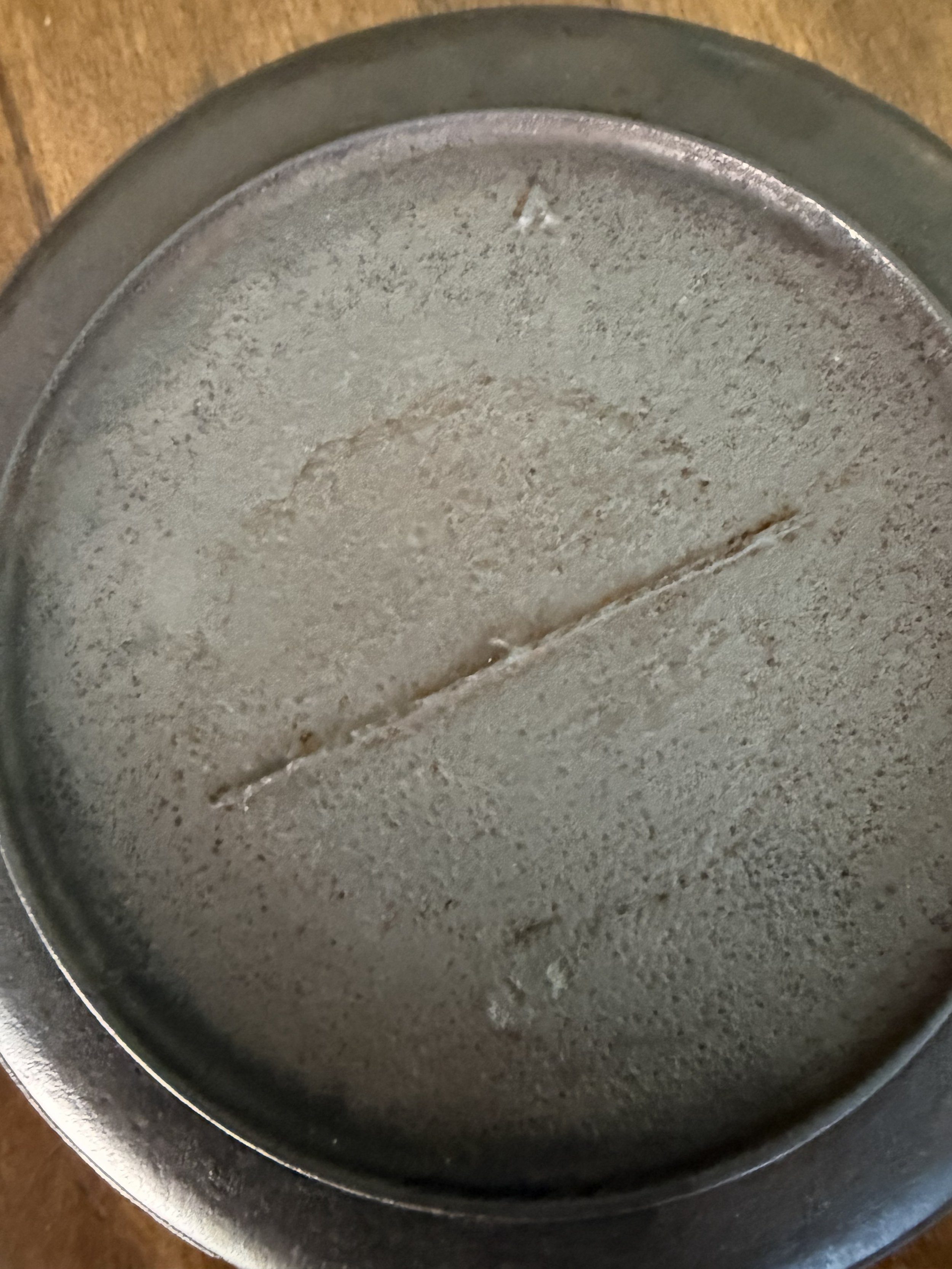
Detail of the base showing the gate scar in close focus: a raised diagonal ridge crossing the base from lower left to upper right, the remnant of the iron that filled the casting gate during the original pour. The small triangle/arrow mark near 12 o’clock is also visible. The granular base surface texture is characteristic of pre-logo era sand-cast iron without post-casting surface finishing.
Manufacturer
Unknown — unattributed; American foundry, pre-logo era
Brand
None — completely unmarked
Piece Type
Flat Skillet (shallow sidewall; wider rim flange than standard skillet)
Size
No. 8 equivalent (approximately 10 inches cooking surface diameter)
Base Marking
Gate scar: raised diagonal ridge crossing base; small triangle/arrow mark near 12 o’clock; no brand, no logo, no size numeral
Gate Scar
Diagonal raised ridge from lower left to upper right across base interior; remnant of casting gate sprue; primary dating indicator for pre-logo era production
Triangle Mark
Small raised triangle/arrow near 12 o’clock position on base; function unresolved — possible pattern mark, gate positioning indicator, or mold identifier
Bottom Configuration
Wide heat ring at perimeter; smooth base inside ring; gate scar crosses base interior
Handle Style
Fancy twist handle — two twisted iron bars forming decorative handle shaft; figure-8 hanging loop at terminus; characteristic of pre-logo era American cast iron
Pour Spouts
None visible
Date of Manufacture
Circa 1860s–1890s (pre-logo era, based on gate scar and handle style)
Place of Manufacture
Unknown — American foundry; region unidentifiable from physical evidence
Condition
Good — structurally sound; sits flat; no cracks or chips; gate scar intact and clearly defined; interior surface worn smooth from use; honest working condition for a 130–160-year-old piece
Acquisition Date
February 2, 2026
Acquisition Source
eBay — Seller: attictreasuresestates
eBay Item Number
376403141733
Order Number
26-14163-86784
SSC Catalog Number
SSC-UNK-SKL-08-GS-001
The Gate Scar: What It Is and Why It Dates the Piece
Sand casting—the process by which virtually all antique American cast iron was produced—requires a channel through which molten iron enters the mold cavity. This channel is called the gate. The iron that fills the gate solidifies along with the piece itself, and when the casting is removed from the mold, the solidified gate iron is still attached to the piece as a raised protrusion called the sprue. In production, the sprue was removed—broken off or cut away—but the point of attachment left a mark on the surface of the piece: the gate scar.
In the earliest period of American cast iron production, gate scar management was not a priority. The pieces were functional commodities, the market was not yet brand-conscious about cooking vessels, and the investment required to place the gate in a location where the scar would be invisible or minimal was not commercially necessary. Gate scars were accepted as a normal feature of the casting. They appear on the bases of pre-logo era skillets with regularity, often as raised diagonal lines or ridges crossing the base interior—exactly as on this piece.
By the late 19th century, as American foundries began competing on quality and brand identity, gate scar management became standard practice. Foundries moved the gate to the handle junction or the rim—locations where the scar would be less visible on the cooking surface—or developed gating systems that minimized the scar to a small mark or slight texture variation rather than a prominent raised ridge. The prominent base gate scar, like the one on this No. 8, is almost exclusively a pre-logo era feature. When a collector or researcher encounters it, they are looking at a piece that almost certainly predates the branded cast iron era—placing it before the 1880s–1890s emergence of the major Ohio and New York foundry brands that dominate the antique cast iron collector market.
The small triangle or arrow mark near the 12 o’clock position on this base may be related to the gating system—a pattern mark indicating gate placement, a mold alignment indicator, or a foundry production code. Its presence alongside the gate scar is consistent with the pre-logo production context, though its specific function cannot be determined from the physical evidence alone.
The Fancy Twist Handle: A Pre-Logo Era Design Signature
The handle on this piece is as distinctive as the gate scar, and tells the same chronological story. The fancy twist handle—two parallel iron bars twisted around each other to form a decorative handle shaft, terminating in a figure-8 hanging loop—is characteristic of American cast iron production from the mid-to-late 19th century and is rarely found on pieces from the branded era that followed. It is a design that required more complex pattern work than a simple flat handle, and its prevalence in the pre-logo period reflects both the craft traditions of early American foundry work and the competitive dynamics of an era when functional differentiation—rather than brand identity—was the primary way a foundry distinguished its products.
The figure-8 hanging loop at the handle terminus is a specific design variant within the fancy handle tradition. The standard teardrop loop, which appears on the CHW and FPW pieces throughout the SSC collection, was the dominant hanging loop design of the branded era. The figure-8 loop—two oval openings stacked vertically—is more commonly associated with the earlier pre-logo period and with the regional foundry tradition that preceded the large-scale Ohio and New York branded producers. Its presence on this piece reinforces the pre-logo era dating established by the gate scar.
Together, the gate scar and the fancy twist handle with figure-8 loop provide a two-element dating argument that is consistent and mutually reinforcing. Neither feature alone would be definitive—gate scars can persist on later pieces if a foundry was using older patterns, and decorative handles appear in some branded-era production. But both features on the same piece, combined with the complete absence of any brand marking, makes a strong case for pre-logo era American cast iron from approximately the 1860s to 1890s.

Profile view showing the distinctive pre-logo era characteristics of this piece: the wide, nearly flat cooking profile with minimal sidewall depth, the wide heat ring and raised base platform, and the fancy twist handle with figure-8 loop. The gate scar is visible on the base at left. The shallow sidewall configuration distinguishes this as a flat skillet rather than a standard deep-sided cooking skillet.
The Flat Skillet Form: Griddle Characteristics in a Handle-Pan Format
This piece occupies a form category between the standard deep-sided skillet and the classic griddle. Its cooking surface is wide and nearly flat with minimal sidewall depth—more than a flat griddle plate but significantly shallower than the standard skillet sidewall depth documented in the CHW and FPW pieces elsewhere in the SSC collection. This shallow configuration was suited to specific cooking tasks: pancakes and flatbreads, where a deep sidewall was an obstacle to flipping; thin cuts of meat where maximum surface contact with the cooking surface mattered; and egg cookery where a flat, wide surface gave the cook control over the entire spread of the egg without the confining geometry of a deep sidewall.
The wide rim flange on this piece—broader than the rim on a standard skillet of equivalent cooking surface diameter—adds thermal mass at the perimeter and provides a stable gripping surface when moving the hot pan. The overall diameter including rim is larger than the cooking surface diameter would suggest, giving the piece a visual presence that exceeds its cooking capacity in the way characteristic of pre-logo era cast iron, which was often cast heavier and with more material in the structural elements than the leaner, machine-finished pieces of the early 20th century.
Physical Characteristics & Condition Assessment
The piece is physically imposing for a No. 8 equivalent—heavier than a comparable branded-era skillet, with the additional wall thickness and rim mass that characterizes pre-logo era sand-cast production. The base is flat and the piece sits without wobble. The heat ring is well-defined at the perimeter with a clear step down to the cooking base surface inside the ring. The gate scar—the raised diagonal ridge crossing the base—is intact, clearly defined, and photogenic: it is the primary documentary feature of the piece and it presents well.
The handle is structurally sound with no cracks at the body junction and no bending or deformation in the twist shaft. The figure-8 loop at the terminus is complete and undamaged. The cooking surface interior, visible in the top view photograph, shows the smooth, worn character of a piece that was genuinely used—not the granular untouched texture of an uncleaned piece, but the smooth patina of iron that has seen heat and fat over many decades. Some surface variation and age-consistent tonal marking are present and are appropriate to a piece of this age.
Condition is assessed as Good. No cracks, chips, or structural damage. The gate scar is present and intact. The handle is sound. The piece is flat and functional. For a pre-logo era piece of estimated 130–160-year age, this condition represents a well-preserved survivor. Some surface rust patina in the base detail photograph is surface-level and consistent with storage age rather than active corrosion. Display ready with minimal conservation.

Top view showing the wide, nearly flat cooking surface of the pre-logo era No. 8 flat skillet—smooth and worn from genuine period use, with the shallow sidewall configuration and wide rim flange visible at the perimeter. The fancy twist handle with figure-8 loop is clearly visible at right, one of the most visually distinctive pre-logo era handle designs in the SSC collection.
The Pre-Logo Era in American Cast Iron History
The branded era of American cast iron—the period most collectors focus on, the era of Wagner, Griswold, Columbus Hollow Ware, and Favorite Piqua Ware—had a before. Before the Ohio and New York foundries developed their distinctive brand identities, before the Smiley cartouche and the Erie spider and the “THE FAVORITE” arc, American cast iron cookware was produced by hundreds of regional foundries operating without brand distinction, selling their output through local hardware merchants and general stores to households who chose a skillet by weight and price rather than by logo. These pieces were not inferior to what came later—many were heavier, better-made, and more durable than the production-optimized pieces of the branded era—but they were anonymous in a way that the later pieces were not.
The pre-logo era ended gradually through the 1880s and 1890s as the major branded foundries gained market share and smaller regional producers either adopted branding themselves, shifted to other iron products, or ceased operations. By 1900, the anonymous regional cast iron skillet was already a relic of an earlier commercial era. The gate scar piece in the SSC collection is a survivor from that earlier time—a piece that was made, used, and preserved before cast iron cookware became a branded consumer product, before anyone thought to put a company name on a skillet base.
The SSC collection is built around the Ohio Foundry Corridor brands—CHW, FPW, Wagner, and their kin. But the corridor had a prehistory, and documenting one pre-logo era piece alongside the branded collection is a way of acknowledging that the Ohio foundry story did not begin with brand marks. Iron was cast in American furnaces long before anyone thought to inscribe a logo on the base, and the anonymous gate scar piece is a direct connection to that earlier tradition.
Provenance & Acquisition
This pre-logo era No. 8 flat skillet was acquired on February 2, 2026, via eBay from seller attictreasuresestates, under eBay item number 376403141733 (order 26-14163-86784). The listing described the piece as “Antique 1800’s Gate Scar Mark Gate-Mark No. 8 Cast Iron Pan Griddle 10 in.” The acquisition cost was $75.00 for the item plus $14.65 USPS Ground Advantage shipping and $7.60 in sales tax, for a total of $97.25.
Physical examination on receipt confirmed the gate scar and triangle mark as described, the fancy twist handle with figure-8 loop intact, and the overall condition as Good. No cracks, no chips, base flat. The piece is cataloged as SSC-UNK-SKL-08-GS-001—the “UNK” designator indicating unattributed manufacturer, the “GS” suffix indicating the gate scar configuration that defines this piece within the SSC collection.
Why This Piece Matters
The pre-logo era No. 8 gate scar skillet matters because it represents the generation of American cast iron that predates everything else in the SSC collection. The CHW pieces, the FPW pieces, the Wagner pieces—all of them are products of the branded era, the period when American foundries developed the commercial identities that collectors now document and collect. This piece predates those identities. It was cast when the skillet was still a commodity rather than a brand, when the gate scar was an accepted production artifact rather than a quality failure to be engineered away.
It also matters because it is genuinely old. A 130-to-160-year-old piece of American cast iron, in Good condition, with intact physical features that place it confidently in the pre-logo era—the gate scar, the fancy twist handle, the figure-8 loop—is a meaningful acquisition at any price.
The SSC collection documents the Ohio Foundry Corridor. But corridors have histories, and the gate scar piece is part of that history—the part that came before the logos, before the brands, before the Smiley and the diamond and the arc. It belongs in this collection.
The iron endures. The markings tell the truth. The story deserves to be told.
Sources & Further Reading
CastIronCollector.com — Pre-logo era cast iron reference: gate mark dating, handle design chronology, and pre-brand American foundry production overview.
Griswold & Cast Iron Cookware Association (GCICA) — Gate mark and gate scar documentation in 19th-century American cast iron.
WorthPoint.com — Historical auction records for pre-logo era gate mark and gate scar American cast iron skillets.
SSC Internal Collection Records — Ohio Foundry Corridor collection overview; CHW and FPW entries for branded-era comparative reference.
About Steve’s Seasoned Classics
Steve’s Seasoned Classics is an online museum dedicated to preserving and documenting the heritage of American cast iron, with a singular focus on the obscure, defunct foundries of Ohio from the 19th and early 20th centuries. The SSC collection spans 130+ pieces from 50+ confirmed Ohio makers — the majority absent from standard collector references. Makers were identified through physical artifacts exhibiting gate marks, patent dates, foundry traits, and documented regional provenance, cross-checked against surviving trade directories, census records, and existing collector guides. Makers lacking representation in published guides but supported by physical evidence were flagged for first-time documentation — a core function of the SSC research mission.
