Wagner Ware Cast Iron Teapot
The Teapot That Fits in Your Hand: Wagner Ware of Sidney, Ohio, and the Wire Coil Bail That Kept It Cool
Catalog No. SSC-WAG-KTL-0-001 | Cast Iron Teapot/Tea Kettle | Sidney, Shelby County, Ohio
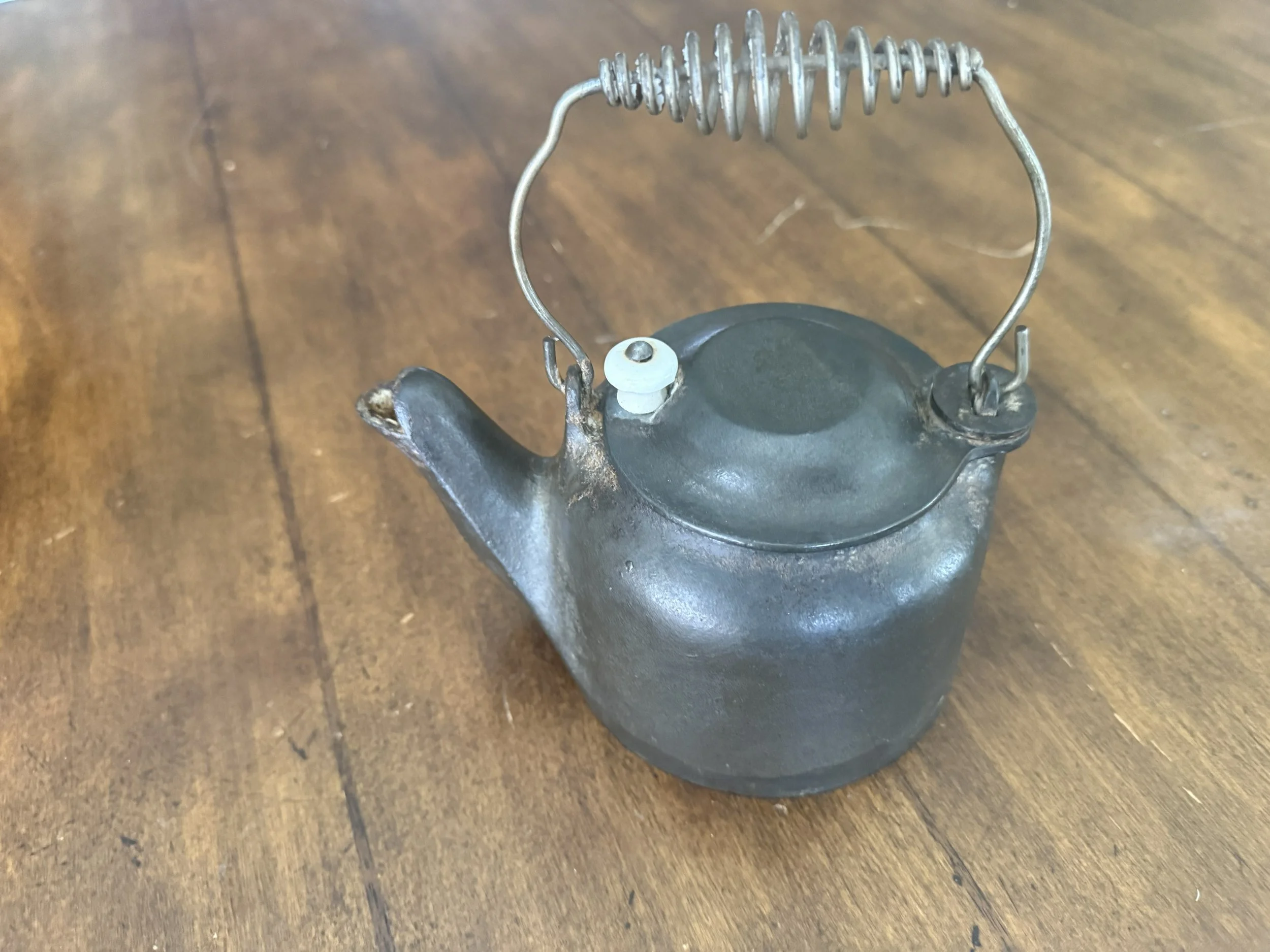
Profile view — Wagner Ware cast iron teapot, stylized logo period (c. 1922–1959). SSC-WAG-KTL-0-001.
This piece is a small cast iron teapot cast in a single round-bodied form with a short upturned spout and a separately cast domed lid. The bottom of the body carries the following incised marks, transcribed exactly as they appear on the piece: WAGNER WARE / SIDNEY / -O- in the stylized logo format, and B positioned lower on the base and separated from the trademark. The lid carries no visible inscription in the photographs. The wire bail handle is formed from a single strand of wire whose center section is wound into a tight, evenly spaced coil spring; the ends hook into two small cast lugs on opposite sides of the body. A small white porcelain knob is fitted to the center of the lid and is secured by a rivet rather than a threaded screw. The overall condition shows a well-developed dark seasoning patina on the exterior and interior with no visible cracks or repairs. The piece was acquired via eBay (seller: hemidan1) in June 2026.
This post documents what the physical markings directly confirm, traces the history of Wagner Manufacturing Company and its Sidney, Ohio, foundry, explains the function of the coil-spring wire bail design, examines the context in which small-format cast iron teapots were sold and marketed in this period, and flags clearly what this research pass could not resolve with primary sources.
Finding the Maker: What the Markings Document Directly
The starting point is the piece itself. The bottom of the body carries an incised stylized trademark in which a single large cursive W serves as the initial letter for both WAGNER and WARE, with SIDNEY on the line below and -O- (standing for Ohio) beneath that. This specific format is documented by The Cast Iron Collector, a collector reference site that has compiled trademark evolution data from physical specimens, as first appearing on Wagner pieces around 1922 (The Cast Iron Collector — Evolution of the Wagner Trademark). The same source documents that the SIDNEY -O- designation was removed from the logo after 1959, when ownership had passed from the Wagner family and casting operations were no longer confined to Sidney. On that basis, the stylized logo with SIDNEY / -O- places production of this piece within the approximate window of 1922 to 1959.
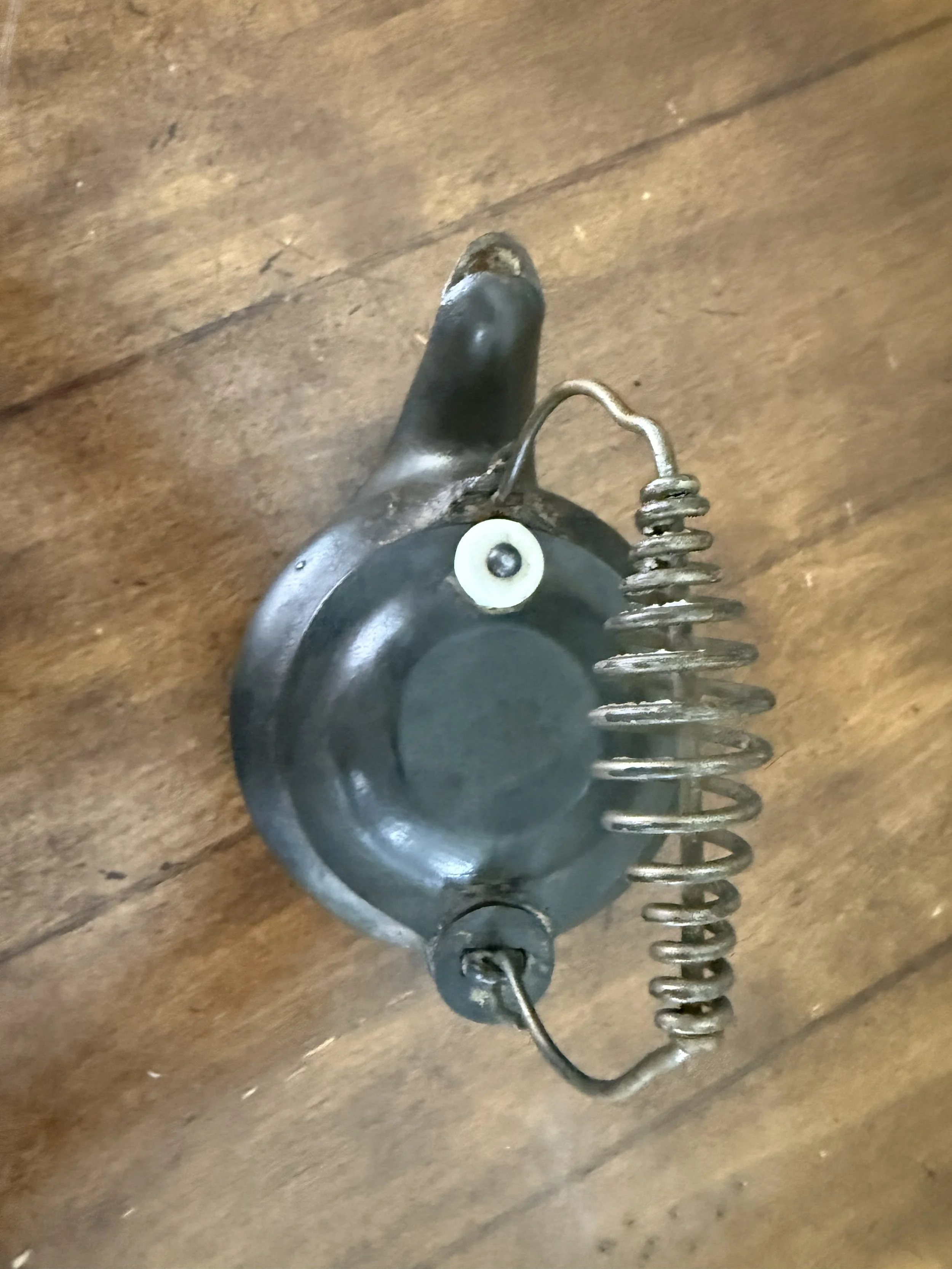
Top view — domed lid with white porcelain knob secured by rivet; coil-spring wire bail visible. SSC-WAG-KTL-0-001.
Directly below the trademark and separated from it is the single letter B. The Cast Iron Collector's reference page on numbers and letters documents that single letters appearing on Wagner cast iron are pattern letters — each working pattern in a foundry was stamped with a unique letter so that quality control could identify which mold produced a substandard casting (The Cast Iron Collector — Numbers & Letters). The letter B identifies the individual working pattern from which this piece was poured. It carries no special significance in dating or ranking the piece relative to other examples.
Who Were the Makers? Wagner Manufacturing Co., Sidney, Ohio
The Wagner Manufacturing Company was founded in Sidney, Shelby County, Ohio, by brothers Milton M. and Bernard P. Wagner. The Cast Iron Collector's foundry database, which compiles data from period sources including contemporary newspaper accounts, places the founding year at 1891 (The Cast Iron Collector — Wagner Manufacturing Co.). A footnote in that entry cites the Sidney Journal of February 20, 1891 as documenting the new venture — though that account used the name Sidney Manufacturing Co. rather than Wagner Manufacturing Co. R.O. Bingham, previously of the Marion Stove Works and the Sidney Manufacturing Co., joined the company as superintendent at the outset. The company's own history page notes that the foundry opened for business in June 1891 with 20 employees, melted 9,200 pounds of iron daily within three months, and quickly established itself in the growing hollowware market (Wagner Cast Iron — The Story Behind Wagner).
The company's product line included skillets, kettles, bean pots, Dutch ovens, roasters, griddles, waffle irons, muffin pans, and cornbread pans, as well as nickel-plated cast iron (added 1892) and cast aluminum cookware (added 1894) (Boonie Hicks — Wagner Cast Iron History). In 1897, Wagner acquired the Sidney Hollow Ware Co., a competing Sidney foundry, and ran it under the Wagner name until selling it back to founder Philip Smith in 1903 (Boonie Hicks — Sidney Hollow Ware Co.). The company remained family-owned until the Wagner heirs divested between 1946 and 1952-53, when it was sold to the Randall Company of Cincinnati. Textron, Inc. acquired Randall — and with it the Wagner rights — in 1959, the year collectors generally regard as the end of the collectible Wagner production period. The SIDNEY -O- was removed from the trademark after that date (The Cast Iron Collector — Evolution of the Wagner Trademark).
Sidney, Ohio, and the Ohio Foundry Industry: Historical Context
Wagner's founding in 1891 placed it squarely within the concentrated industrial development of western Ohio in the late nineteenth century. Abandoned Spaces documents that the Wagner company's origins trace to a German immigrant, Matthias Wagner, who moved to the United States in 1838 and initially worked on the Shelby County Canal — the infrastructure that supported early industrial settlement in the region. His sons Milton and Bernard began construction of the factory at 440 Fair Road, Sidney, in 1890, with Louis and William Wagner joining to formally incorporate the company the following year (Abandoned Spaces — Wagner Manufacturing Company, Sidney, Ohio).
Cast iron cookware was a growth industry in this period: cast iron pieces matched the wood-burning and early gas ranges then standard in American households, and the stove eye system drove the sizing conventions for skillets, kettles, and other pieces — size numbers corresponding to stove opening sizes rather than directly to measurements in inches (The Cast Iron Collector — Numbers & Letters). By 1913, Wagner had extended distribution internationally, with products selling in Europe (The Cast Iron Collector — Wagner Manufacturing Co.). Atlas Obscura describes the Sidney factory site as one of the city's largest and oldest industrial sites, noting that the factory remained operational in some form through the 1990s (Atlas Obscura — Wagner Manufacturing Company Factory in Sidney). The foundry building was finally demolished in June 2023 (Wikipedia — Wagner Manufacturing Company).
The Wire Coil Bail: Design and Function
The most visually distinctive feature of this teapot is the wire bail handle whose central section is wound into a tight helical coil. A collector group post from 2026 summarizes the functional rationale for this design: the coiled section was specifically engineered to dissipate heat quickly along the wire, allowing the user to lift the kettle when hot without a separate pot holder or grip cloth (Facebook Cast Iron Group — Vintage cast iron kettle with coiled spring grip). The coil increases the surface area of the wire at the grip point, promoting faster heat transfer away from the user's hand rather than toward it. This was a practical and functional engineering solution for a piece designed to be placed over direct heat.
The ends of the bail hook into two small cast lugs on opposite sides of the body — visible in the photographs — allowing the bail to swing freely and lie flat when not in use. Multiple secondary-market sources confirm that the coil-spring wire bail is a documented feature of Wagner Ware cast iron teapots and kettles of this period, with comparable examples in auction records (Davis Brothers Auction — Wagner Ware Cast Iron Salesman Sample Tea Kettle) and marketplace listings. A separate Etsy listing describes a full-size Wagner Ware cast iron teapot with a stylized logo as dating to circa 1922-1959 (Etsy — Vintage Wagner Ware Stylized Logo Cast Iron Tea Pot) — consistent with the logo dating for this piece. Both of those listings are secondary/marketplace sources and have not been verified against a period Wagner catalog.
The Porcelain Lid Knob: Authentication Note
The lid is fitted with a small white porcelain knob secured by a rivet — visible in the photographs as a metal pin passing through the center of the knob and lid. The Cast Iron Collector's reproductions and counterfeits page documents, in its entry on the Wagner Toy Tea Kettle, that a rivet-secured knob is a characteristic of original Wagner teapots, while known reproductions are identified in part by a knob secured with a screw rather than a rivet. That same page lists additional authentication markers: poor casting quality, bail attachment not fully looped, crude block lettering, and skewed letters in the stylized logo are each markers of known fakes. The same source notes that originals may have coil or wood handles and are made in bare iron, nickel-plated, or aluminum (The Cast Iron Collector — Reproductions & Counterfeits). Note: full authentication against all criteria in that source requires physical examination and has not been carried out in person by this writer.
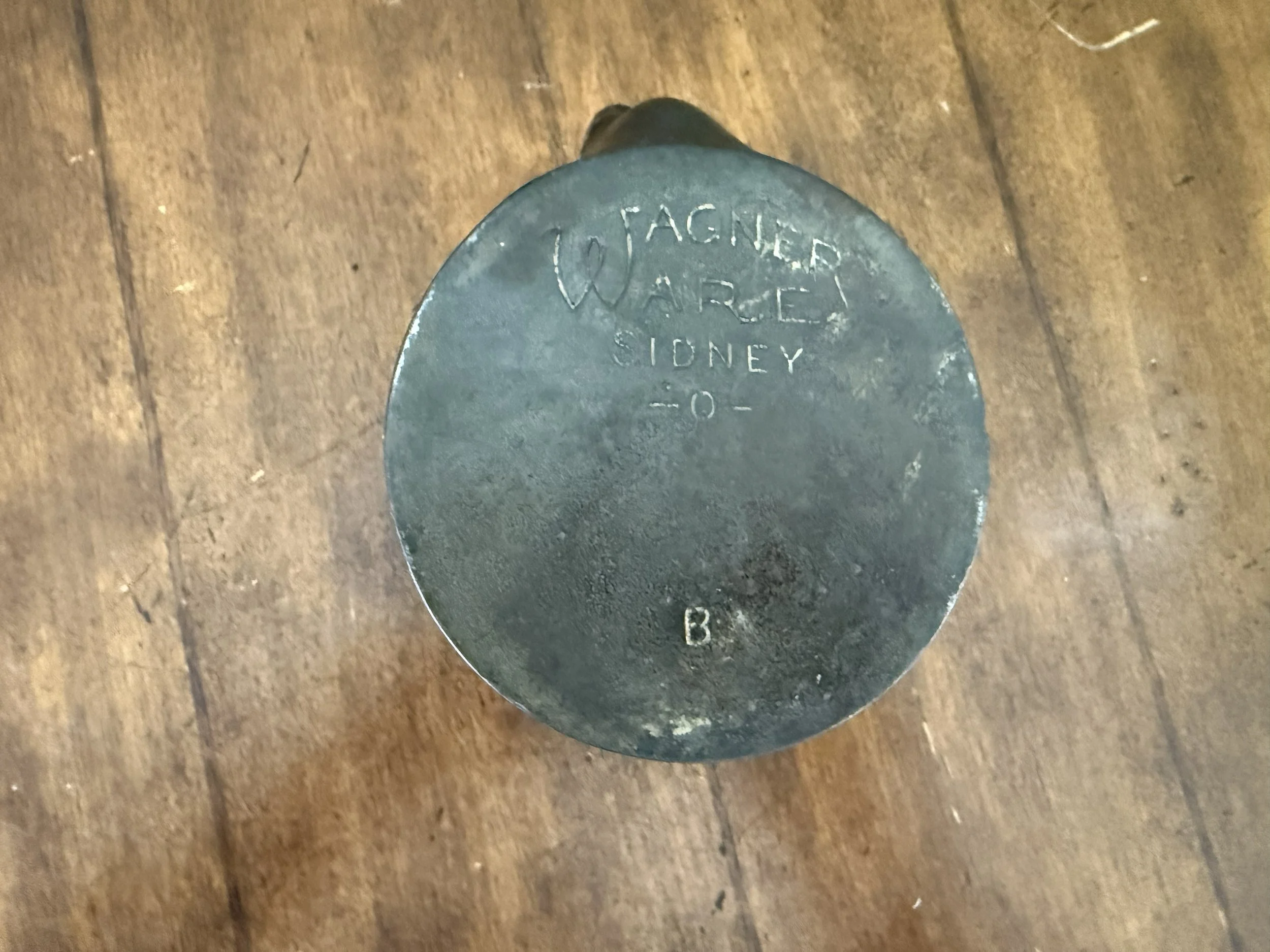
Bottom view — incised mark reads: WAGNER WARE / SIDNEY / -O- [stylized logo] / B [pattern letter]. SSC-WAG-KTL-0-001.

Detail of bottom mark — WAGNER WARE / SIDNEY / -O- stylized logo and pattern letter B. SSC-WAG-KTL-0-001.
"Salesman Sample" — What the Evidence Supports and What It Does Not
The piece was acquired with the seller's description 'Salesman Sample Wagner Ware Sidney 0 Cast Iron Teapot Vintage Original.' The Journal of Antiques documents that genuine salesman samples from the late nineteenth and early twentieth centuries were reduced-scale working replicas of full-size manufactured goods, produced in small quantities and used by traveling commercial representatives to demonstrate product lines to retailers and homeowners who would then place orders for full-size units to be shipped later. Salesman samples generally carried the manufacturer's name or logo and were made to function as the full-size product did (Journal of Antiques — Salesman Samples: Exploring Miniature Antiques & Collectibles). This aligns with what this piece shows: full Wagner Ware branding, a functional lid and bail handle, and casting quality consistent with production-grade work.
However, the collector community and reference sources draw an important distinction. The Cast Iron Collector's reproductions page notes explicitly that small novelty-sized cast iron pieces, including miniature skillets and waffle irons, were originally made as toys and are only often described as salesmen's samples — meaning the salesman sample label is frequently applied to pieces that were manufactured as toys or children's play items rather than as trade demonstration tools (The Cast Iron Collector — Reproductions & Counterfeits). A Reddit thread on cast iron stove miniatures echoes this, with a commenter noting that authentic stove salesman samples tend to be very finely cast and finished, usually plated and enameled, while pieces commonly labeled as salesman samples were often originally made as doll house or play toys (Reddit r/castiron — Cast iron stove salesman sample — secondary source, flagged as needing verification). No primary source — Wagner catalog, period advertisement, or company record — has been located in this research pass that documents whether Wagner Manufacturing specifically produced this teapot form as a traveling trade sample, a production-scale small-size item, or a toy/novelty piece. That question remains open.
Absence from Standard Reference Sources
The Cast Iron Collector's Wagner Manufacturing Co. foundry page and its Numbers & Letters reference do not include a specific catalog number entry for a small cast iron teapot of this form. The Boonie Hicks Wagner cast iron reference page lists kettles as part of the documented Wagner product line but does not give per-item catalog numbers for teapots of this size range. Neither the Book of Griswold & Wagner (the blue book) nor the Book of Wagner & Griswold (the red book) — the two standard collector reference volumes — were directly consulted for this research pass. Both are cited as authoritative resources by the Southern Cast Iron collector community (Southern Cast Iron — How To Find Out Who Made Your Cast Iron). Those volumes may contain catalog number documentation for this teapot form and should be the first resource consulted to pursue identification further. Absence from the online sources checked here does not indicate absence from the blue or red book.
Updated Piece Details
· Manufacturer: Wagner Manufacturing Co., Sidney, Shelby County, Ohio
· Company founded: 1891, by Milton M. and Bernard P. Wagner (The Cast Iron Collector, citing the Sidney Journal, Feb. 20, 1891)
· Company closed (family ownership): Sold to Randall Company, Cincinnati, OH, 1952-53; collectible production period ends 1959 (Textron acquisition)
· Peak size / scale: Not documented in sources consulted for this pass
· Piece type: Cast iron teapot / tea kettle with domed lid
· Size/model: Size 0 (as described by seller; no size number was visible in the photographs reviewed — see Open Questions)
· Casting/maker's marks: Bottom of body: WAGNER WARE / SIDNEY / -O- [stylized logo, double-W format] / B [pattern letter, lower position on base]. Lid: no inscription visible in photographs.
· Associated patent (if any): None identified in this research pass
· Patent subject (verified): N/A
· Relationship to maker: N/A
· Date of manufacture: Approximately 1922-1959, based on stylized logo with SIDNEY -O- (The Cast Iron Collector). Cannot be narrowed further without catalog number documentation.
· Place of manufacture: Sidney, Shelby County, Ohio (documented by trademark; Wagner manufacturing at this location confirmed through 1959)
· SSC catalog no.: SSC-WAG-KTL-0-001
· Acquisition: eBay, seller hemidan1, June 2026
Open Questions for Further Research
In keeping with the SSC research standard — document what is verified, flag what is not — here is what this pass could confirm and what still needs primary-source verification:
· Confirmed: Wagner Manufacturing Co. was founded in Sidney, Shelby County, Ohio, in 1891 by Milton M. and Bernard P. Wagner. Source: The Cast Iron Collector foundry page, citing the Sidney Journal, Feb. 20, 1891.
· Confirmed: The stylized logo with the double-W format and SIDNEY / -O- was used by Wagner on cast iron pieces from approximately 1922 through 1959. Source: The Cast Iron Collector — Evolution of the Wagner Trademark.
· Confirmed: The letter B on the base is a pattern letter identifying the individual working pattern used for this casting, not a design revision or collector-significance marker. Source: The Cast Iron Collector — Numbers & Letters.
· Confirmed: Authentic Wagner cast iron teapots of this type are documented as having a porcelain lid knob secured by a rivet; reproductions are identified in part by a screw-secured knob. Source: The Cast Iron Collector — Reproductions & Counterfeits.
· Confirmed: The wire coil bail is a documented feature of Wagner cast iron teapots of this period; the coil design functioned to dissipate heat from the handle, allowing safe lifting when hot.
· Unverified — needs primary confirmation: The designation 'size 0.' No size number was visible in the photographs reviewed; '0' appears only in the eBay listing title. A period Wagner catalog, the blue book, or the red book would confirm whether Wagner produced a size 0 teapot, what that designation signifies, and what the catalog number for this specific piece is.
· Unverified — needs primary confirmation: The 'salesman sample' designation. This label was applied by the seller and is widely used in the secondary market for small cast iron pieces. No primary source — Wagner company records, period advertisement, trade catalog — has been located that confirms Wagner produced this teapot form specifically as a traveling trade demonstration sample.
· Still open: The specific catalog number for this teapot form. Neither the online Cast Iron Collector database nor the Boonie Hicks reference includes a catalog number for a small cast iron teapot of this form. Consulting the Book of Griswold & Wagner and the Book of Wagner & Griswold is the most direct path to resolving this.
· Still open: Whether a full-size production counterpart to this piece exists in documented Wagner catalogs, and what relationship (if any) the small-size form has to it. Resolution would require access to period Wagner trade catalogs or the blue/red books.
Why This Still Matters
A small cast iron teapot with a full Wagner Ware stylized logo, a riveted porcelain lid knob, and a functional coil-spring wire bail is a piece with a documented maker, a documented production window, and physical features that align with what the collector reference literature describes as characteristics of authentic Wagner Ware cast iron from the 1922-1959 period. The research here establishes a sourced paper trail for those facts. Two substantive questions remain open: the specific catalog identification of this teapot form and the accuracy of the salesman sample description. Adding those answers — which the blue and red books are most likely to provide — would place this entry on firmer ground and might help other collectors who encounter similar pieces connect them to documented production records.
Sources
· The Cast Iron Collector — Wagner Manufacturing Co.. Foundry database entry with timeline, citing Sidney Journal, Feb. 20, 1891.
· The Cast Iron Collector — Evolution of the Wagner Trademark. Logo and trademark dating reference.
· The Cast Iron Collector — Numbers & Letters. Reference on size numbers, catalog numbers, and pattern letters.
· The Cast Iron Collector — Reproductions & Counterfeits. Authentication reference for Wagner Toy Tea Kettle, including rivet vs. screw knob distinction.
· Wagner Cast Iron — The Story Behind Wagner. Company-maintained history page; secondary source.
· Boonie Hicks — Wagner Cast Iron History, Dates and Logos. Secondary collector reference; logo dating and product line summary.
· Boonie Hicks — Sidney Hollow Ware Co.. Secondary collector reference; Sidney Hollow Ware acquisition history.
· Wikipedia — Wagner Manufacturing Company. Secondary reference; foundry demolition date, ownership timeline.
· Atlas Obscura — Wagner Manufacturing Company Factory in Sidney. Secondary reference; factory history and closure.
· Abandoned Spaces — Wagner Manufacturing Company, Sidney, Ohio. Secondary reference; Matthias Wagner background and early factory history.
· Journal of Antiques — Salesman Samples: Exploring Miniature Antiques & Collectibles. Secondary reference on the history and characteristics of salesman samples.
· Reddit r/castiron — Cast iron stove salesman sample (secondary source, flagged as needing verification). Collector community discussion on distinguishing salesman samples from toys.
· Davis Brothers Auction — Wagner Ware Cast Iron Salesman Sample Tea Kettle (secondary source). Auction record for comparable piece.
· Southern Cast Iron — How To Find Out Who Made Your Cast Iron. Reference to the blue book and red book as standard collector references.
· Facebook — Vintage cast iron kettle with Wagner Ware branding and wire coil handle (secondary source, flagged as needing verification). Collector community description of coil-spring handle heat-dissipation function.
· SSC internal records: Acquisition and catalog records, SSC-WAG-KTL-0-001.
