Miniature Wagner Ware Cauldron
The Miniature Wagner Ware Cauldron: Sidney, Ohio Origins and What the Stylized Logo Dates It To
Catalog No. SSC-WAG-KTL-MINI-001 | Miniature Footed Cast Iron Pot / Cauldron (marketed as “Salesman Sample / Toy”) | Sidney, Shelby County, Ohio
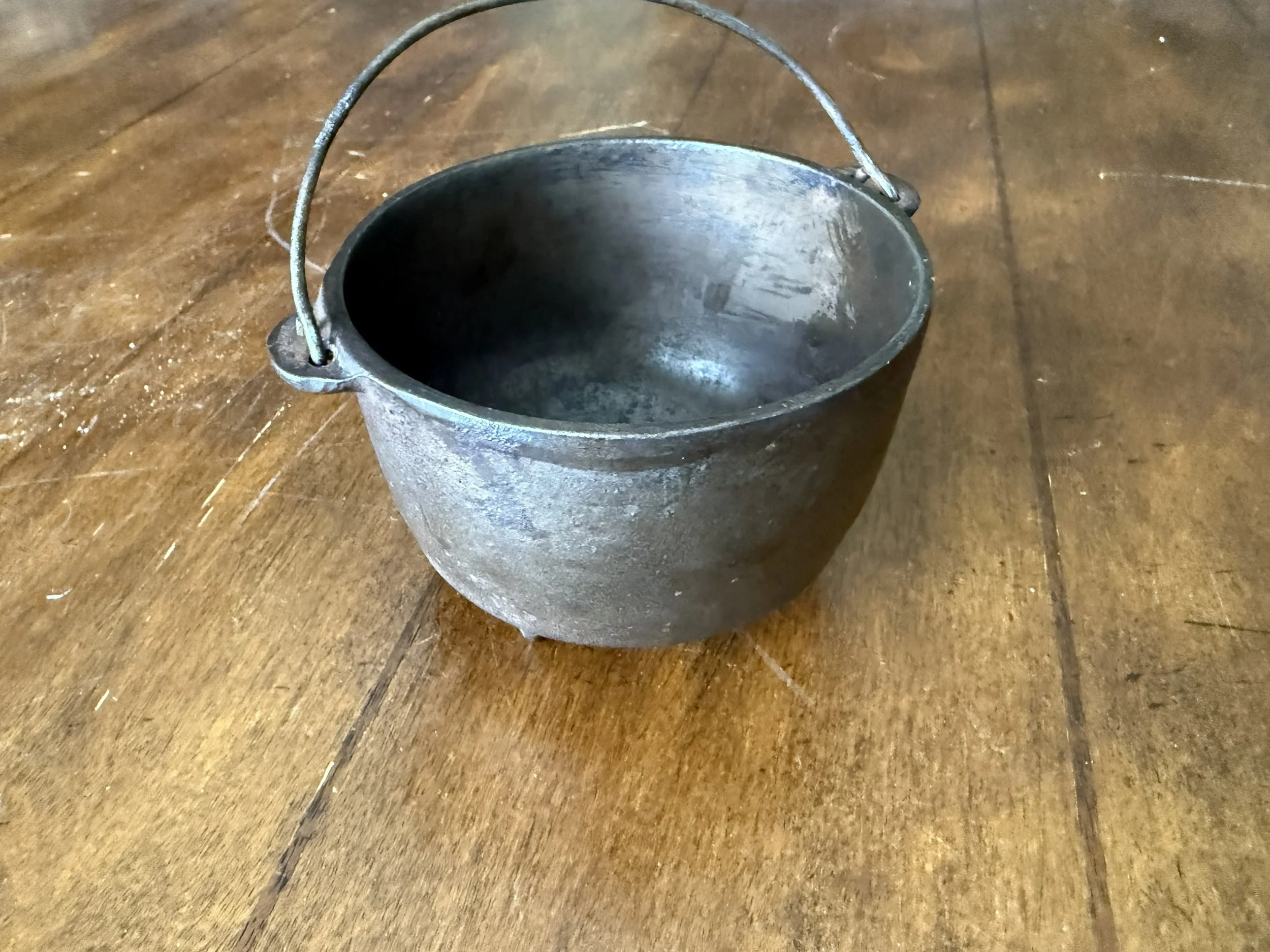
Hero image: profile of the miniature three-footed cast iron pot with wire bail handle. SSC-WAG-KTL-MINI-001.
This is a small three-footed cast iron pot, or miniature cauldron, with a rounded body, a slightly flared rim, and a thin round-stock wire bail handle that pivots in cast side lugs. The underside carries the Wagner stylized maker’s mark: a single large fancy W serving both words of WAGNER WARE, with SIDNEY and -O- beneath it, along with partial raised numerals that are difficult to read through the seasoning and casting texture. The piece rests on three short cast feet and shows an even, dark, well-used surface.
The original catalog entry recorded this piece as a “Wagner Ware Sidney O Footed Cast Iron Pot / Cauldron – Salesman Sample / Toy.” This post reports a deeper research pass: the maker and city are confirmed by the object’s own mark and by Wagner company history, the logo style gives a documented date window, and the “salesman sample vs. toy” label is examined as a description that the available sources do not settle. What changed from the earlier write-up is noted at the end.
Finding the Maker and the Date Window
Because this piece is marked, the research began with the object itself and then moved to the documented history of the Wagner trademark to place the mark in time. The relevant primary evidence is the casting on the underside; the secondary evidence is a published trademark-evolution reference maintained by cast iron researchers.

Underside showing the WAGNER WARE / SIDNEY / -O- stylized logo and three cast feet.
The mark reads as the Wagner stylized logo — the ornate shared W over SIDNEY -O-. According to The Cast Iron Collector’s trademark study, this stylized logo was first seen on pieces around 1922 and remained in use through 1959, after which the “SIDNEY -O-” was dropped from the logo (The Cast Iron Collector, “Evolution of the Wagner Trademark,” castironcollector.com — https://www.castironcollector.com/wagnertm.php).
That places manufacture of this piece within roughly 1922–1959, the active span of the stylized “SIDNEY -O-” mark. A finer date is not supported by the visible casting alone, because the partial numerals could not be read with confidence from the object.

Bottom detail: the raised lettering and partial numerals, worn and partially obscured by seasoning.
On the “Salesman Sample” vs. “Toy” label
The acquisition listing described the pot as a “Salesman Sample / Toy.” Those are two different claims, and the sources reviewed for this pass do not confirm either one as the documented purpose of this specific casting. Collector discussion treats small Wagner pieces like this variously as toys, salesman samples, or small utility vessels, and at least one collector thread notes there is disagreement about which small Wagner pots were samples versus toys (Reddit r/castiron and a cast iron Facebook group, secondary/crowd-sourced — unverified). This post therefore describes the object plainly as a miniature footed pot and treats “salesman sample” and “toy” as an unverified description rather than an established fact.
Who Was the Wagner Manufacturing Company?
The earlier catalog entry named Wagner and Sidney, Ohio. A period detail and a compiled corporate history give a fuller timeline.
“The name ‘Wagner’ is cast on the bottom of each piece of ware.”
Source: Wagner Manufacturing Company early advertising, as quoted in “Wagner Manufacturing Company,” Wikipedia — https://en.wikipedia.org/wiki/Wagner_Manufacturing_Company
This confirms the company’s own practice of casting its name on the underside of its ware — exactly what appears on this piece.
· Founded/incorporated 1891: brothers Milton M. and Bernard P. Wagner organized the company in Sidney, Shelby County, Ohio (Wikipedia, corroborated by an Appalachian Antiques history citing a July 21, 1891 partnership).
· Key people: Milton, Bernard, Louis, and William Wagner as principal owners; construction of the Sidney complex began in 1890 (Wikipedia).
· Operating window: active 1891–1952 as Wagner Manufacturing Company; sold to the Randall Company of Cincinnati in 1952, with the Sidney plant continuing under later owners until it closed in 1999 (Wikipedia).

Top view showing the rounded body, flared rim, and pivoting wire bail handle.
Sidney, Ohio in the Wagner Era: Historical Context
Wagner grew from a local Ohio foundry into a large cookware maker: it added nickel-plated ware in 1892, was among the early makers of aluminum cookware in 1894, acquired the Sidney Hollow Ware foundry in 1897 (selling it back in 1903), and was distributing globally by 1913 (Wikipedia). Its product line included skillets, kettles, bean pots, Dutch ovens, and roasters, and the company reported a large share of the U.S. cookware market during its peak (Wikipedia). This miniature footed pot sits within that broad hollow-ware output rather than being tied to any single documented product line in the sources reviewed.
A Note on References Checked
The Cast Iron Collector trademark study documents the logo and its date range but does not catalog this specific miniature pot. Wagner’s own advertising and the compiled corporate histories confirm the company, city, and dates but do not describe this exact casting or confirm a “salesman sample” purpose. Noting this absence does not imply the piece is rare or significant — only that these specific sources do not document this exact item.
Updated Piece Details
· Manufacturer: Wagner Manufacturing Company (Wagner Ware), Sidney, Shelby County, Ohio
· Company founded: 1891, by Milton M. and Bernard P. Wagner (complex construction began 1890)
· Company closed: Sold to the Randall Company, 1952; Sidney plant operated under later owners until 1999
· Peak size / scale: Reported large U.S. cookware market share at peak (Wikipedia); exact figure not independently verified here
· Piece type: Miniature three-footed cast iron pot / cauldron with wire bail handle
· Size/model: Not verified — raised numerals on the underside are partially obscured and could not be read with confidence
· Casting/maker’s marks: Stylized “WAGNER WARE” shared-W logo over “SIDNEY” and “-O-”; partial raised numerals (transcribed as visible)
· Associated patent (if any): None identified on the piece or in this research pass
· Patent subject (verified): Not applicable
· Relationship to maker: Direct — the maker’s mark is cast into the piece itself
· Date of manufacture: Approximately 1922–1959, based on the stylized “SIDNEY -O-” logo date range (The Cast Iron Collector)
· Place of manufacture: Sidney, Shelby County, Ohio
· SSC catalog no.: SSC-WAG-KTL-MINI-001
· Acquisition: eBay, seller paula11-paula; June 14, 2026
Open Questions for Further Research
In keeping with our own stated research standard — document what is verified, flag what is not — here is what this pass could confirm, and what still needs primary-source verification:
· Confirmed: Maker and city (Wagner Ware, Sidney, Ohio) from the cast mark on the object itself; company founding (1891) and the 1952 Randall sale (Wikipedia); the stylized “SIDNEY -O-” logo dates to circa 1922–1959 (The Cast Iron Collector).
· Unverified — needs primary confirmation: Whether this pot was made and sold as a “salesman sample” or a “toy.” This comes from the sale listing and collector discussion (Tier 3, crowd-sourced). A period Wagner catalog, advertisement, or company price list showing this miniature vessel would confirm its intended purpose.
· Still open: The exact model/size number and a tighter manufacturing date. The underside numerals are partially obscured; cleaning/re-photographing the mark, or matching it to a Wagner catalog number list, would likely resolve both.
Why This Still Matters
Even a small, worn pot carries a verifiable paper trail: a cast maker’s mark ties it to a specific Ohio foundry, and a documented trademark timeline places it in a defined date window. Sharing that sourced record — and being honest about what the “salesman sample / toy” label does and does not prove — gives another collector something concrete to compare their own piece against.
What Changed From the Acquisition Listing
· Purpose label: The listing stated “Salesman Sample / Toy” as fact; this post reclassifies that as an unverified description pending a period Wagner catalog or advertisement.
· Date: Added a sourced circa 1922–1959 window based on the stylized logo, which the listing did not provide.
· Maker context: Added founding date, founders, and corporate timeline from published history.
Sources
· The Cast Iron Collector, “Evolution of the Wagner Trademark” — https://www.castironcollector.com/wagnertm.php
· “Wagner Manufacturing Company,” Wikipedia (tertiary/background) — https://en.wikipedia.org/wiki/Wagner_Manufacturing_Company
· Appalachian Antiques, “Wagner Cast Iron Cookware” (secondary) — http://appalachianantiquemall.blogspot.com/2012/08/v-behaviorurldefaultvmlo.html
· Reddit r/castiron and cast iron collector Facebook group discussions of small Wagner pots (secondary/crowd-sourced, flagged as needing verification) — https://www.reddit.com/r/castiron/comments/1o85zr6/wagner_sidney_o_without_number/
· SSC internal records: acquisition and catalog records, SSC-WAG-KTL-MINI-001
