The Little Bail-Handle Pot Marked Only "Wagner"
The Little Bail-Handle Pot Marked Only "Wagner": A Script Mark That Points to the Sidney, Ohio Foundry’s Earliest Years
Catalog No. SSC-WAG-KTL-2-001 | Cast Iron Bail-Handle Pot / Cauldron |

Profile of the 6.25-inch cast iron bail-handle pot as received.

Interior, flared rim, cast side ears, and wire bail handle
This is a small cast iron pot with a rounded, bulbous body, a flat-ish bottom, a flared rim, and a wire bail (swing) handle mounted between two cast side ears. It measures roughly 6.25 inches across at the rim as listed at acquisition. The finish is dark and even with light surface texture; there is no visible cracking, and the piece presents as clean and well-kept ("looks like new") despite its age. The only casting on the underside is a word in a flowing cursive/script hand that reads "Wagner", accompanied by a script size numeral that reads as "2". There is no "Ware," no "Sidney, O.," no "Made in USA," and no stylized single-"W" logo anywhere on the piece.
The original listing described it simply as a "VTG Wagner Ware Cast Iron Bailed Handle 6.25\" Pot Cauldron – Antique." This post reports a deeper research pass. The short version: the mark itself is "WAGNER" only — not "Wagner Ware", and that distinction is exactly what a trademark-dating framework uses to place a Wagner piece in the foundry’s earliest decades rather than its more common 20th-century "Wagner Ware" era. What follows separates what the mark can actually establish from what it cannot.
Finding the Maker: Reading the Mark Itself

Underside of the pot showing the incised script "Wagner" and a script size numeral.
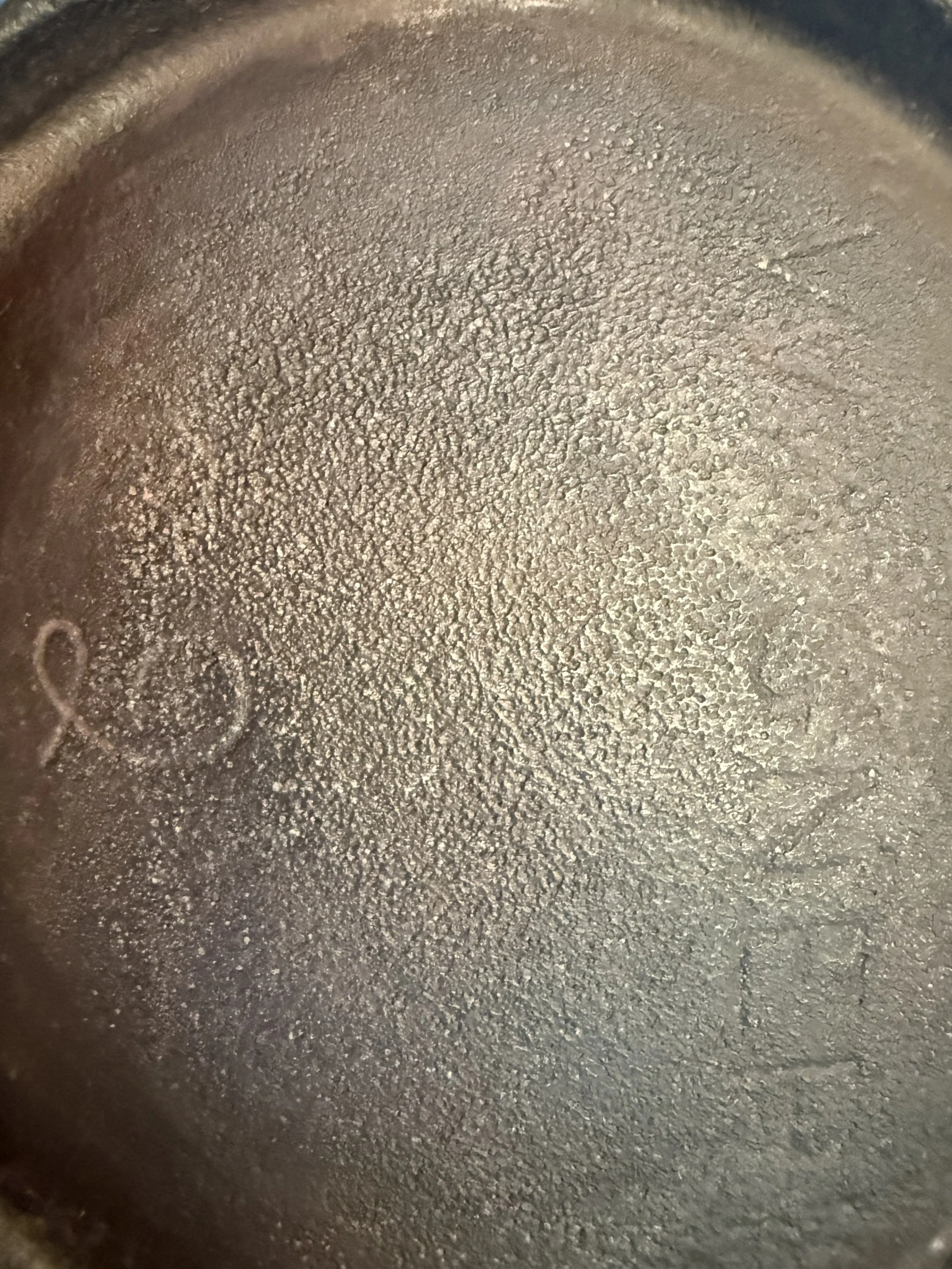
Close detail of the casting mark — a flowing cursive "Wagner" with a script "2".
The first and strongest source here is the object itself. Under magnification the underside carries a single incised word in a looping, connected script — "Wagner" — with a separate script numeral. On this piece there is no maker city, no "Ware," and no pie-slice or single-"W" emblem. Because the goal of these write-ups is to help other owners recognize their own pieces, the mark is transcribed here exactly as it appears: a cursive "Wagner" and a script "2."
To date a Wagner-marked piece from the mark alone, collectors rely on a published trademark-evolution framework maintained by The Cast Iron Collector, which lays out how Wagner’s markings changed over time (The Cast Iron Collector, "Evolution of the Wagner Trademark").
That framework documents the following: for the first roughly thirty years of the company’s history the trademark "consisted solely of the word \"WAGNER\"", later adding "SIDNEY, O." beneath it; and it was only "About 1914" that the company began branding cookware as "Wagner Ware," with the iconic single-large-"W" stylized logo first appearing on pieces "around 1922" (castironcollector.com). By that framework, a piece marked "WAGNER" with no "Ware" and no stylized logo sits in the earlier "WAGNER"-only lettering window rather than the later "Wagner Ware" era.
The listing said "Wagner Ware" — the piece says "Wagner"
The acquisition listing called this a "Wagner Ware" pot. On the piece, the mark reads "Wagner" only, in script, with no "Ware." Under the same published dating framework, that single word is the more telling detail: "Wagner Ware" as a brand is documented as beginning about 1914, so a "WAGNER"-only mark is consistent with the earlier lettering period (The Cast Iron Collector). The owner’s instinct that the piece "is really old" lines up with what the mark shows; the exact year, however, is not something the mark alone can pin down (see Open Questions).
Who Was the Wagner Manufacturing Company?
The Wagner Manufacturing Company was a family-owned maker of cast iron and, later, aluminum cookware based in Sidney, Shelby County, Ohio.
A standard reference summary records the company as founded in 1891 in Sidney, Ohio, by brothers, producing frying pans, casseroles, kettles, and baking trays, and remaining active under the family into the early 1950s before being acquired (Wikipedia, "Wagner Manufacturing Company").
· Founded 1891, Sidney, Ohio: incorporated by members of the Wagner family; the Sidney, Ohio location is the anchor point for dating and attribution.
· Key people: the founding is attributed to Wagner brothers (commonly given as Milton M. and Bernard P. Wagner in reference summaries).
· Operating window: active under family ownership from 1891 into the early 1950s, after which the brand passed through successive corporate owners; the Sidney plant is reported to have continued operating for decades afterward.
The brand name itself was later revived: as of 2022 a newly formed Wagner Cast Iron began producing reissues of historic Wagner designs with guidance from the Wagner family (Wikipedia).
Sidney, Ohio in the Wagner Era: Context
Wagner was one of the Ohio-region foundries that came to dominate American cast iron cookware, selling in both the U.S. and Europe at its peak (Wikipedia). In its earliest years the company is documented as having "borrowed" existing pans to create its own patterns — "ghost" traces of an Erie trademark are noted on some older Wagner skillets — a detail from the same trademark study that underscores just how early and formative the plain "WAGNER" lettering period was (The Cast Iron Collector). That early-pattern context is the backdrop against which a "WAGNER"-only script mark should be read.
A Note on What the Mark Can and Can’t Confirm
Most published Wagner dating guidance is built around skillets — heat rings, catalog numbers, pour spouts, and logo position. This piece is a bail-handle pot, not a skillet, so the skillet-specific timing cues do not directly apply. What the framework does support is the broad reading of the "WAGNER"-only script lettering as belonging to the earlier, pre-"Wagner Ware" period. A specific decade or year for a pot of this exact form has not been located in a primary source and is left open below.
Updated Piece Details
· Manufacturer: Wagner Manufacturing Company, Sidney, Shelby County, Ohio (attribution based on the script "Wagner" casting mark).
· Company founded: 1891, Sidney, Ohio (Wagner family).
· Company closed: Family ownership ended early 1950s (acquired); brand later revived as Wagner Cast Iron, 2022.
· Peak size / scale: Not documented here beyond reference note that the company at one time dominated the market and sold in the U.S. and Europe.
· Piece type: Cast iron pot / cauldron with wire bail (swing) handle on cast side ears.
· Size/model: Approx. 6.25 in. rim diameter (per acquisition listing); script size numeral reading as "2."
· Casting/maker’s marks: Script "Wagner" and a script "2" on the underside; no "Ware," no "Sidney, O.," no "Made in USA," no stylized logo.
· Associated patent (if any): None identified.
· Patent subject (verified): Not applicable.
· Relationship to maker: Attribution to Wagner is based on the casting mark; specific form/model not matched to a cataloged Wagner pattern in a primary source.
· Date of manufacture: Best current reading: within Wagner’s earlier "WAGNER"-only lettering period (pre-"Wagner Ware," which the trademark study dates to about 1914). A precise year is not established.
· Place of manufacture: Sidney, Shelby County, Ohio (inferred from maker; not independently confirmed for this specific piece).
· SSC catalog no.: SSC-WAG-KTL-2-001.
· Acquisition: eBay, seller jonahsonlinesales; ordered June 12, 2026.
Open Questions for Further Research
In keeping with our own research standard — document what is verified, flag what is not — here is what this pass could confirm and what still needs primary-source verification:
· Confirmed: The piece carries an incised script "Wagner" mark (the object itself). Wagner Manufacturing Company was founded 1891 in Sidney, Ohio; "Wagner Ware" branding began about 1914 and the stylized logo about 1922 (The Cast Iron Collector; Wikipedia).
· Unverified — needs primary confirmation: That this specific bail-handle pot form dates to a particular decade or year. The trademark framework used to read the "WAGNER"-only lettering is a collector reference keyed mainly to skillets, not pots. A period Wagner catalog, patent, or company record showing this pot pattern and its production dates would confirm it.
· Still open: Whether the script "2" is a size number, a pattern/mold number, or both; the exact production years for Wagner bail-handle pots of this size; and whether "looks like new" reflects light historical use or later restoration. Access to Wagner factory catalogs/pattern records or a specialized Wagner registry would likely resolve these.
Why This Still Matters
A small pot marked only "Wagner" in flowing script is a tidy example of how the mark itself carries the story. The absence of "Ware," "Sidney, O.," and the stylized logo is not a gap — it is the evidence, tying the piece to the Sidney, Ohio foundry’s earlier lettering period and adding a sourced paper trail to a well-kept survivor. The precise year stays an open question, and that’s exactly the kind of honest lead worth publishing for the next collector who finds the same script on the bottom of their own pot.
What Changed From the Acquisition Listing
· Mark wording: Listing said "Wagner Ware"; the piece is marked "Wagner" only, which — per the trademark framework — points to the earlier, pre-"Wagner Ware" lettering period (The Cast Iron Collector).
· Maker context added: Wagner Manufacturing Company founding (1891, Sidney, Ohio), operating window, and brand revival (2022) documented from a reference source.
· Dating hedged appropriately: No specific year asserted; the pot form is not matched to a dated Wagner pattern in a primary source.
Sources
· The object itself — casting marks and physical construction (SSC photographs, catalog SSC-WAG-KTL-2-001).
· The Cast Iron Collector, "Evolution of the Wagner Trademark" (castironcollector.com) — collector reference; trademark dating framework.
· Wikipedia, "Wagner Manufacturing Company" (en.wikipedia.org) — tertiary reference; company founding, operating window, brand revival (background/context).
· SSC internal records — acquisition source and date, catalog SSC-WAG-KTL-2-001.
