Wagner Ware Sidney ‑O‑ Nickel-Plated Double Skillet
SSC MUSEUM COLLECTION
Catalog No. SSC-WAGN-DSK-001
Catalog No. 1401-C | 12 Inch | PATENT PENDING | Sidney, Ohio | c. Late 1920s–Early 1930s
c. Late 1920s–Early 1930s • Wagner Manufacturing Co. • Sidney, Shelby County, Ohio • Original Nickel-Plated Cooking Surface Preserved

Profile view of the Wagner Ware Sidney ‑O‑ 1401-C nickel-plated double skillet showing the round cooking vessel, integral pour notches, and the slender straight handle with its distinctive small round hanging hole. The pristine original nickel-plated cooking surface glows deep black — preserved exactly as it left the Sidney foundry nearly a century ago. SSC-WAGN-DSK-001.
Two words on the bottom of this skillet stop collectors in their tracks: PATENT PENDING. Most Wagner Ware 1401-C double skillets carry actual patent numbers — USD97022 and US1554360 — cast into the underside rim. This piece carries neither. Instead it bears the marking that existed in the window between when Wagner filed its patent application and when the patent was formally granted. Patent Pending means this piece was made before the paperwork was complete, before the numbers were assigned. In the entire universe of Wagner 1401 double skillets, the Patent Pending pieces are the earliest production run. They are not common.
The piece itself is the 1401-C — the top skillet in Wagner’s double skillet system, a 12-inch nickel-plated cast iron pan that functions both as a standalone skillet and as the sealed lid of a two-piece combination cooker. Its nickel-plated cooking surface is pristine: the original factory finish, unrestored, unstripped, carrying the deep black patina of original use and age. SSC Archival Black™ museum seasoning has been applied to stabilize and protect what is already there. Nothing else has been touched. What you see is original Wagner.
This piece joins the SSC Museum Collection as an intentional exception to the collection’s standard focus on obscure and underdocumented Ohio makers. The specific combination documented here — Patent Pending marking, pristine original nickel-plated cooking surface, early small-round-hole handle, and the full 1401-C form in exceptional condition — is a configuration that even dedicated Wagner collectors rarely encounter.
PATENT PENDING: What It Means and Why It Matters

Bottom view showing the complete marking: stylized Wagner Ware Sidney ‑O‑ logo at top, PATENT PENDING in the middle, and catalog number 1401-C below. This is the critical configuration. Later production examples of the 1401-C carry issued patent numbers (USD97022 and US1554360) in place of PATENT PENDING. The Patent Pending marking confirms this piece was made during the earliest production window for this design, before the patent was granted.
When a manufacturer marks a product PATENT PENDING, it means a patent application has been filed with the United States Patent Office and is under review — but the patent has not yet been granted. The manufacturer is legally permitted to use the marking from the moment of filing. It puts competitors on notice that protection is being sought: copying a Patent Pending design carries legal risk even before the patent issues, because once granted the protection applies retroactively to the filing date.
For a cast iron manufacturer the practical sequence was this: Wagner designed the double skillet system, filed a patent application, and immediately began production — casting PATENT PENDING into the molds so that every piece made during the application review period carried the marking. This could span months or longer. Once the patent was granted and numbers were assigned, Wagner updated the casting patterns to reflect the issued numbers instead. Pieces made before that update carry Patent Pending. Pieces made after carry the patent numbers.
This means the Patent Pending 1401-C is definitively from the earliest production run of this design. Every piece marked Patent Pending was made before any piece marked with issued patent numbers. These are Wagner’s first castings of the double skillet system — produced while the paperwork was still moving through the Patent Office in Washington.
Most collectors never see one. The issued-patent-number version is the standard form encountered at antique shows, flea markets, and online auctions. Patent Pending is what came before it, made in smaller numbers during the review window. If you have handled a hundred 1401-C double skillets, the overwhelming majority will carry the issued numbers. Finding a Patent Pending example in pristine nickel condition is rarer still.
The Issued Patents and the Griswold Connection
The two patent numbers on later versions of the 1401-C — USD97022 and US1554360 — have an intriguing history. Both are Griswold patents. USD97022 is a design patent; US1554360 is a utility patent. Both were used by Griswold on their own double skillet designs. And both also appear on Wagner’s 1401 series — the same two numbers on competitors’ cookware simultaneously.
This cross-use of Griswold patent numbers on Wagner production points to a licensing arrangement between the two companies. The details are not fully documented in surviving records. What is certain is that the design elements protected by those patents were considered significant enough that Wagner either licensed them from Griswold or the companies reached a cooperative arrangement. The Patent Pending piece in the SSC collection predates all of this. It was made before those numbers were resolved and cast into the production patterns. It sits at the origin point of the story.
Understanding the 1401 System: A, C, and D

Top view of the 1401-C cooking surface: the original pristine nickel-plated interior, deep mirror-black, showing the four pour notches at the rim (two large, two small) and the two integral handle-tab ears that lock the 1401-C into the deeper bottom piece to form the sealed double-skillet cooker. The inner positioning lip is the subtle raised step inside the lower rim. This cooking surface is original and unrestored.
The catalog number 1401 designates Wagner’s double skillet product line — a system of interlocking cast iron pieces designed for use together as a sealed combination cooker, or separately as individual pans. The letter suffix identifies which piece in the system you have.
The 1401-A is the deep bottom piece — a deep-walled skillet with a heat ring on the base, the primary cooking vessel when the system is used as a combination cooker. It sits on the burner and holds the food. Its depth suits deep frying, braising, and stovetop roasting.
The 1401-C is what the SSC collection holds: the shallower top piece, approximately two inches deep, with a heat ring and the defining feature that makes the system work — a raised positioning lip around its outer base that seats precisely into the rim of the 1401-A or 1401-D bottom piece. When placed on top, this lip locks the 1401-C in position, creating a sealed iron-on-iron closure that turns two standalone pans into a closed combination cooker. Chicken, roasts, vegetables, and fish cook inside this sealed environment in their own juices — simultaneously frying and steaming at consistent heat with no moisture escaping. Used alone, the 1401-C is a standard 12-inch skillet with pour notches at the rim.
The 1401-D is an alternate deep bottom piece, similar in function to the 1401-A, used in a C-over-D combination sometimes called a chicken fryer in period advertising. It is the sealed cast iron environment ideally suited to frying whole chicken pieces at consistent heat, with fat and moisture cycling inside the closed vessel.
The design is elegant in its simplicity. Two skillets that each work independently. Together, with the C locked into the A or D, they become a closed cooking system that produces results no open pan can replicate. The Patent Pending marking on this 1401-C places it in the moment when this system was brand new and Wagner had not yet received formal protection for the design that made it work.
The Handle: The Small Round Hole Is the Tell
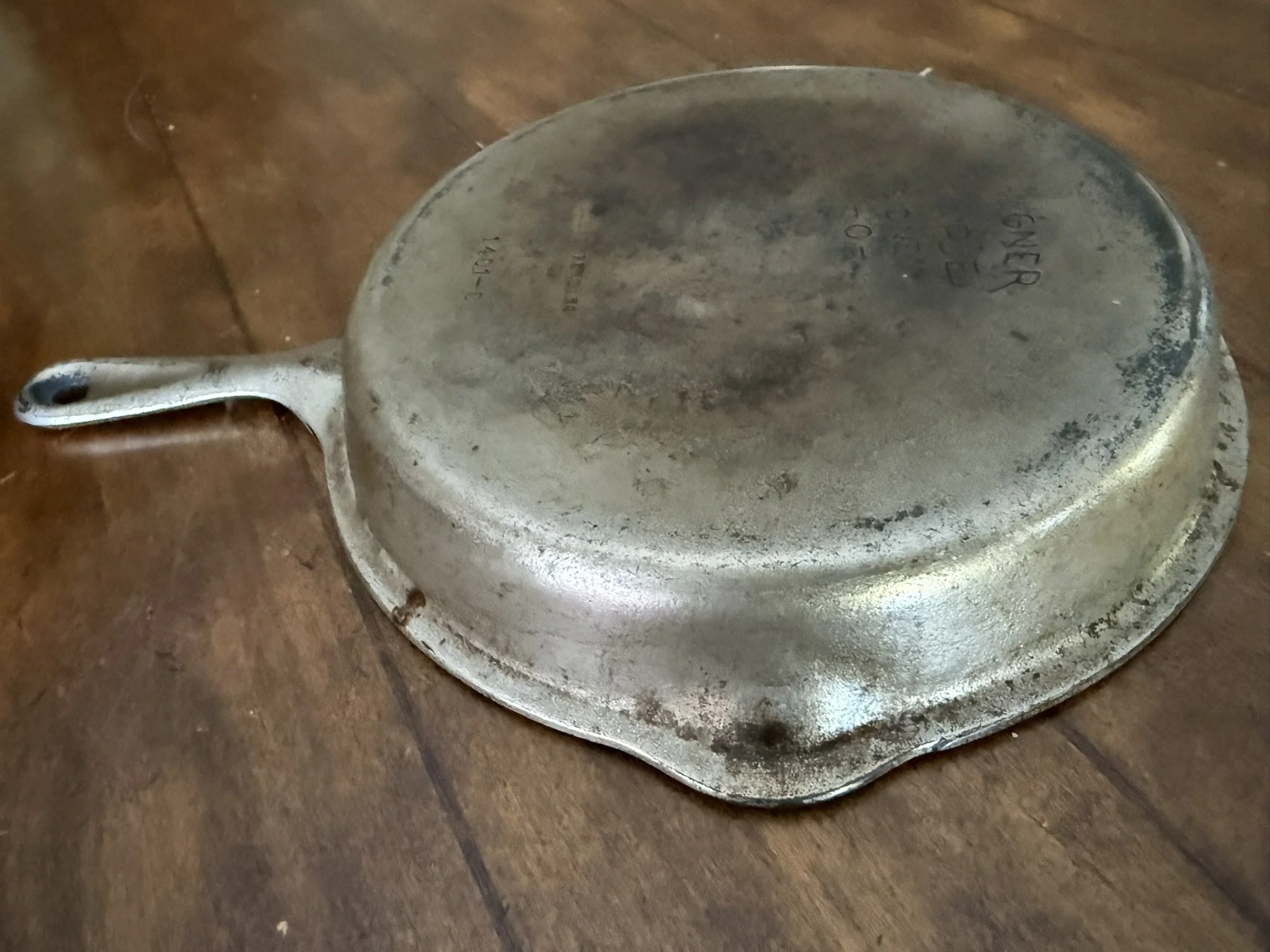
Profile view with the handle clearly visible, showing the small, round hanging hole at the handle tip — visible at left. This is one of the most reliable dating indicators for Wagner Ware Sidney ‑O‑ pieces: the small round hole is the older form. Later Wagner production shifted to a larger teardrop or oblong oval hole. The round hole on this 1401-C independently corroborates the Patent Pending marking, placing both at the earlier end of the 1924–1935 production window.
One of the most reliable ways to date Wagner Ware Sidney ‑O‑ pieces quickly is by the shape of the hanging hole at the end of the handle. It is a small detail, but it is a consistent one.
The small round hole is the older form. It appears on earlier production pieces and is associated with the 1924–1935 stylized logo era, particularly toward the earlier end of that range. Cast iron collector research confirms the correlation clearly: small round hole means older piece.
The larger teardrop or oblong oval hole is the later form, seen on subsequent production runs. Wagner’s standard Sidney ‑O‑ skillets most commonly encountered today carry the oval or teardrop hole. When you find one with the small round hole, you are looking at earlier iron.
The SSC 1401-C has the small round hole. It is visible in the profile photographs at the handle tip. Combined with the Patent Pending marking — which by definition predates the issued patent numbers of later production — the small round hole provides independent corroborating evidence that this piece belongs at the earlier end of the production range. Two separate indicators. Both pointing to the same conclusion: late 1920s to early 1930s.
Wagner Nickel Plating: Silverlite and the Original Cooking Surface
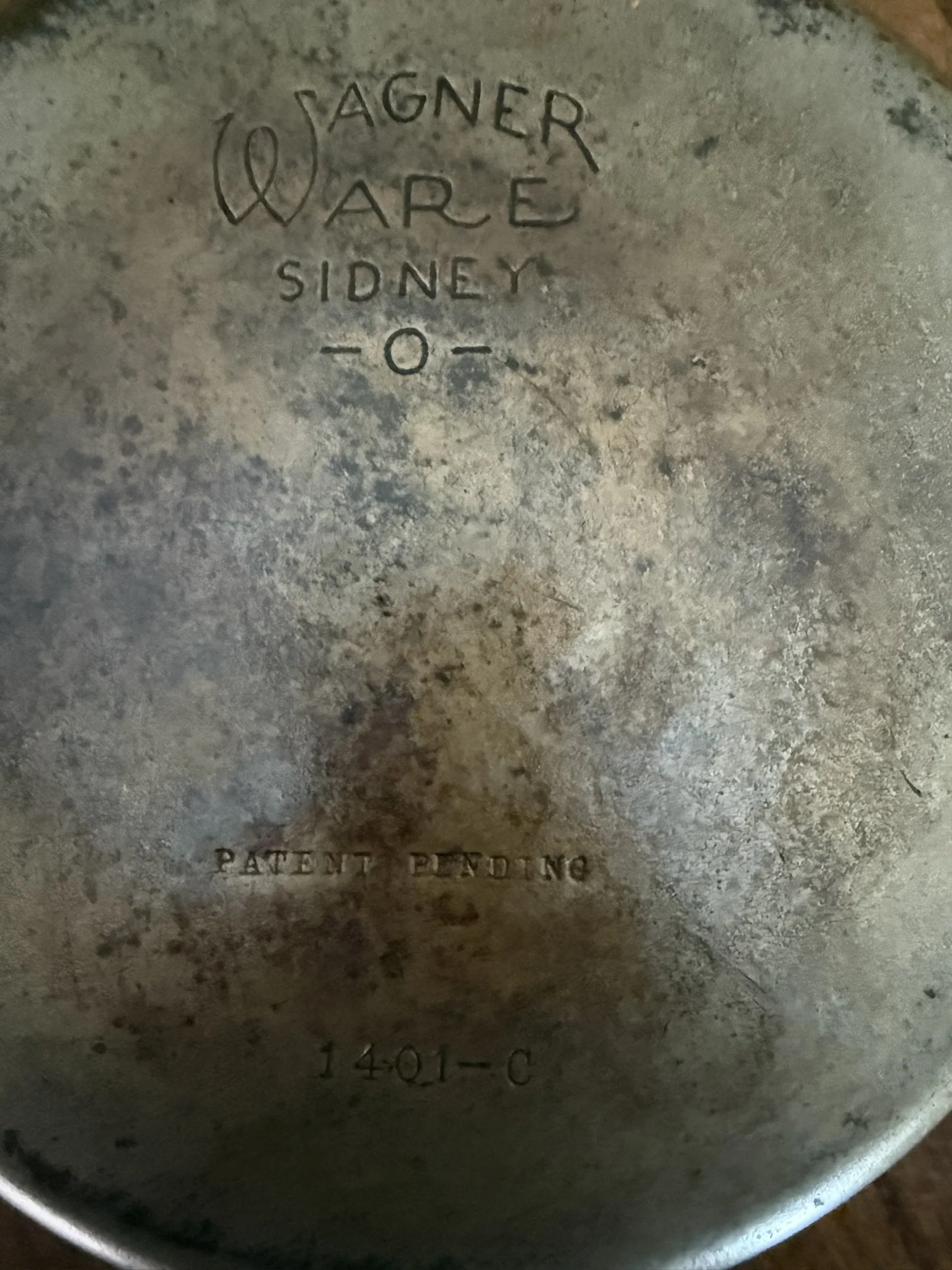
Close detail of the bottom center showing the stylized Wagner Ware Sidney ‑O‑ logo: the looped “W” serving as the shared initial for both Wagner and Ware, SIDNEY straight below, and ‑O‑ with flanking dashes for Ohio. The surrounding exterior surface shows the authentic aged nickel — its warm silvery-gray tone is characteristic of nickel plating, distinctly different from the cooler blue-white of chromium.
Wagner Manufacturing Company added nickel-plated ware to its product line in 1892 — one year after the company was founded — making Wagner one of the earliest American cookware makers to offer plated cast iron. The motivation was direct: a segment of the market wanted cast iron’s cooking performance without its rustic appearance or maintenance requirements. Nickel plating delivered a bright, attractive surface that resisted rust and, critically, did not react with acidic foods. Tomatoes, citrus, vinegar-based dishes — all of these could be problematic in bare iron. Nickel was neutral.
Wagner used only nickel in their plated wares, never chromium. This is an established collector distinction. Griswold plated its earlier pieces in nickel but transitioned to chrome beginning around the Large Block trademark era. Wagner stayed with nickel throughout its plating production. Nickel exhibits a warmer, slightly yellowish or silvery-gray tone. Chrome produces a cooler, harder, more mirror-like blue-white finish. On aged pieces, the difference is visible.
In 1928 Wagner trademarked the name Silverlite for their nickel-plated line. First appearing in advertisements that year, Silverlite was described as triple plated with nickel with a brilliant silvery finish. Silverlite advertising ceased in late 1939, and although it still appeared in a 1941 catalog, an addendum indicated it had been discontinued entirely. The SSC 1401-C, dated to the late 1920s–early 1930s, was made during the peak active years of Silverlite production.
The cooking surface of this piece is pristine. The deep, lustrous black interior visible in the photographs is the original nickel-plated cooking surface in its aged form — layered with the original patina of use from its working life. It has never been stripped, never been lye-treated, never been electrolyzed. This is what Wagner delivered from the factory, aged by nearly a century, preserved intact.
Preservation Approach: Original Surface, SSC Archival Black™
The 1401-C arrived in exceptional condition. The cooking surface — the interior nickel plating — is pristine. No significant rust, no flaking, no plating delamination. The exterior nickel shows appropriate age. Casting marks are sharp and fully legible. There was nothing to strip and nothing to restore.
SSC’s position on nickel-plated pieces is consistent with its broader preservation philosophy: do not remove original surfaces that are the artifact itself. The lye tank is a tool for pieces that will be re-seasoned. On a piece whose nickel plating is intact and whose cooking surface is original, lye offers no benefit and introduces unnecessary risk. The original surface is not contamination to be removed. It is the piece.
SSC Archival Black™ museum seasoning was applied to stabilize the iron and protect the original patina for long-term display. The result is the original Wagner nickel-plated cooking surface — sealed, stable, and presented in its fullest visual expression without any alteration to what left the Sidney foundry nearly a century ago.
Wagner Manufacturing Company: Sidney, Ohio, 1891–1952
The Wagner Manufacturing Company was founded in June 1891 by brothers Milton M. and Bernard P. Wagner in Sidney, Shelby County, Ohio, with 20 employees. Within three months it employed 41 men and was melting 9,200 pounds of iron daily. By the time this 1401-C was cast in the late 1920s or early 1930s, Wagner had grown to dominate the American cookware market with an estimated 60% share and had won international awards at world’s fairs in St. Louis, Paris, San Francisco, and Chicago.
Wagner introduced nickel-plated ware in 1892, became one of the first American companies to manufacture cast aluminum cookware in 1894, acquired competitor Sidney Hollow Ware in 1897, and introduced the Magnalite cast aluminum line in 1934. The stylized Wagner Ware Sidney ‑O‑ logo — the looped W serving as the shared initial for Wagner and Ware — was introduced around 1922 and is the trademark on this piece. Combined with the 4-digit catalog number, heat ring, and Patent Pending marking, the dating places this piece in the early portion of the 1924–1935 stylized-logo era.
The Wagner family sold the company to the Randall Company of Cincinnati in 1952. The foundry subsequently passed to Textron, then General Housewares Corporation, then the Slyman Group, and fell into receivership in the late 1990s. The plant closed permanently in 1999. After years of abandonment and decay, the Wagner foundry in Sidney was demolished in June 2023. The building where this skillet was cast no longer exists.
Piece Details
Manufacturer
Wagner Manufacturing Co., Sidney, Shelby County, Ohio
Catalog Number
1401-C — 12 inch; the shallower top piece / lid-skillet in the Wagner double skillet system
Bottom Marking
Stylized Wagner Ware Sidney ‑O‑ logo at 12 o’clock; PATENT PENDING below center; 1401-C below that
Patent Status
PATENT PENDING — pre-grant; application filed, patent not yet issued at time of manufacture; later 1401-C versions carry issued numbers USD97022 and US1554360; Patent Pending pieces are definitively the earliest production run
Handle Hole
Small round hanging hole — the older Wagner configuration; later production used a larger teardrop/oval hole; round hole independently corroborates early date range
Double Skillet System
1401-C (this piece) = shallower top / lid-skillet; positioning lip on outer base seats into rim of 1401-A or 1401-D bottom pieces; creates sealed combination cooker / chicken fryer; also functions as standalone 12-inch skillet
Plating
Nickel — Wagner used only nickel, never chrome; Silverlite trademarked 1928, discontinued by 1941; piece dates to active Silverlite production era; exterior shows warm silvery-gray of aged nickel
Cooking Surface
PRISTINE ORIGINAL — nickel-plated interior in exceptional condition; deep black original patina from period use preserved intact; never stripped, lye-treated, or restored
Preservation Method
SSC Archival Black™ museum seasoning applied to stabilize original surface; no lye treatment; no stripping; no restoration; original nickel plating fully preserved
Dating
Stylized logo = c. 1922+; 4-digit catalog number = c. 1924+; heat ring = pre-1935; Patent Pending (pre-issued numbers) = earliest production; small round handle hole = older form; estimate: late 1920s–early 1930s
Condition — Interior
Pristine — original nickel-plated cooking surface intact; deep original patina preserved; no rust, no plating damage on cooking surface
Condition — Exterior
Good for age — nickel plating with appropriate age patina; all casting marks sharp and legible; no cracks; structurally sound
Acquisition Source
eBay — Seller: jandjthriftstoreandmore
eBay Item No.
147204117789
Order No.
07-14507-19240
Acquisition Date
April 14, 2026
SSC Catalog No.
SSC-WAGN-DSK-001
Collection Category
Ohio Cast Iron — Pre-1959 Hollow Ware / Wagner Ware / Nickel-Plated Ware
Why This Piece Matters
Pick up any Wagner 1401-C double skillet at an antique show or online auction. The overwhelming majority carry patent numbers on the underside rim: USD97022, US1554360. Those numbers mean the patent was issued, production was underway in the full post-patent phase of this product’s documented life.
This one says PATENT PENDING. The application was in Washington. The numbers had not been assigned. Wagner was producing this skillet — casting it, nickel-plating it, shipping it to market — while the patent was still under review. This piece left the Sidney foundry during that window. It is, by definition, one of the earliest 1401-C double skillets ever made.
The small round hole in the handle says the same thing independently. The pristine nickel-plated cooking surface says something else entirely: this piece survived nearly a century without the restoration treatments that have stripped the original surfaces from the vast majority of its contemporaries. The original patina is there. The original plating is there. The original cooking surface is there. This is what Wagner’s nickel-plated double skillet looked like when it was new.
The Wagner foundry was demolished in 2023. The building is gone. The company is gone. The workers who cast this skillet are gone. What remains is the iron — marked Patent Pending, nickel-plated, original, exceptional, and now documented in the SSC Museum Collection.
Most collectors have never held a Patent Pending Wagner double skillet. Very few have held one in this condition.
Sources & Further Reading
Physical examination of piece: stylized Wagner Ware Sidney ‑O‑ logo at 12 o’clock; PATENT PENDING below center; 1401-C below that; heat ring on base exterior; four pour notches at rim; positioning lip on outer base; integral handle-tab ears; slender straight handle with small round hanging hole; pristine original nickel-plated interior cooking surface; nickel-plated exterior with aged patina; SSC Archival Black™ applied for museum display; no lye treatment; five seller photographs examined prior to acquisition.
Wikipedia — Wagner Manufacturing Company. Founded June 1891 by Milton M. and Bernard P. Wagner; incorporated 1891; nickel-plated ware added 1892; cast aluminum introduced 1894; Sidney Hollow Ware acquired 1897; 60% U.S. cookware market share at peak; family sold to Randall Company 1952; foundry demolished June 2023.
The Cast Iron Collector — Wagner Manufacturing Co. Corporate timeline; nickel-plated ware added 1892; stylized logo introduced c. 1922; 4-digit catalog numbers adopted c. 1924; Silverlite trademark 1928.
The Cast Iron Collector — Evolution of the Wagner Trademark. Stylized logo dating: with heat ring and c/n = 1924–1935; smooth bottom = 1935–1959; logo position variations.
The Cast Iron Collector — Plated Finish Ware. Wagner used only nickel, never chromium; Silverlite trademarked 1928, triple plated with nickel; advertising ceased late 1939, discontinued entirely by 1941; nickel tone warmer than chrome.
The Cast Iron Collector Forums — Wagner Ware 1401-C (2014). 1401 = Wagner double skillet c/n; 1401-C = lid/second skillet; ca. 1930s; Patent Pending makes it more interesting; later versions have patent numbers outside the positioning ring.
The Cast Iron Collector Forums — Plated Double Skillet (2015). Small round hole = older; teardrop/oval hole = later; Red Book dates plated 1401-C to 1930s; patent numbers 97022 and 1554360 confirmed on later versions.
The Cast Iron Collector Forums — Wagner Double Skillet (2014). USD97022 and US1554360 confirmed as Griswold patents used on both Griswold and Wagner double skillets; cross-licensing or cooperative arrangement between the two companies.
Wagner Cast Iron — The Story Behind Wagner. wagnercastiron.com. Founded June 1891; 20 initial employees; Gold Medal at St. Louis World’s Fair; pioneer in nickel-plated cast iron; Silverlite; foundry demolished 2023.
eBay acquisition record — Order No. 07-14507-19240, seller: jandjthriftstoreandmore, April 14, 2026. Item: Cast Iron Nickel Plated Wagner Ware Sidney O Double Skillet Pan 1401-C 12 inch (item no. 147204117789).
About Steve's Seasoned Classics
Steve’s Seasoned Classics is an online museum dedicated to preserving and documenting the heritage of American cast iron, with a focus on Ohio foundry pieces from the 19th and early 20th centuries. The SSC collection features over 130 pieces from 50+ confirmed Ohio makers, with detailed provenance, historical research, and photography for each item. Founded in dedication to the memory of Henry J. and Cecilia Brandewei Thaman.
