Wagner No. 8 Gypsy Bean Pot
Wagner No. 8 Gypsy Bean Pot — Maker & Date Guide — Steve's Seasoned Classics
Catalog No. SSC-WAG-KTL-008-002 | Three-Footed Cast Iron Bean Pot / “Gypsy Kettle” with Wire Bail Handle and Domed Lid | Sidney, Shelby County, Ohio
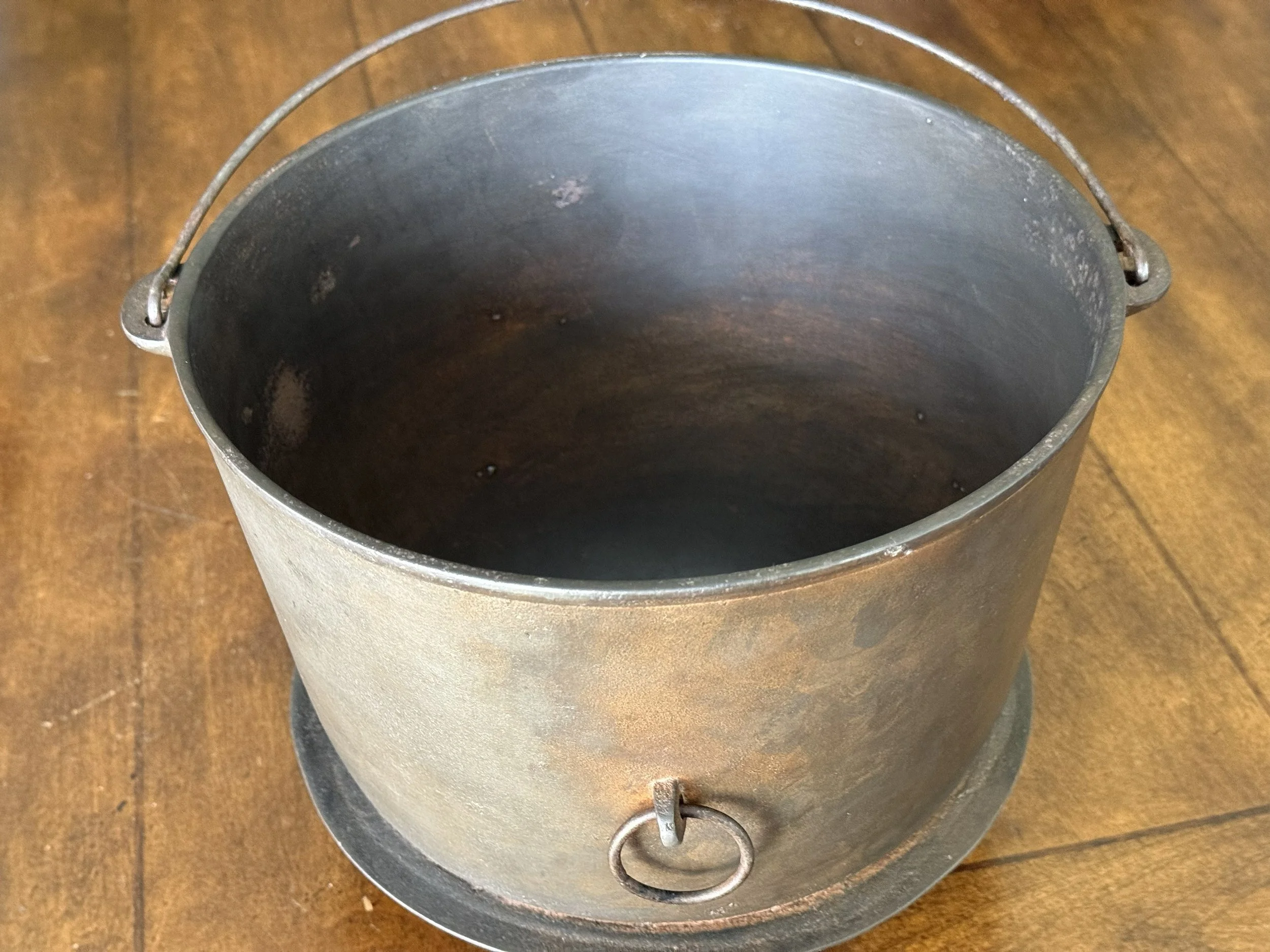
Hero image: profile of the No. 8 three-footed cast iron bean pot with wire bail handle, side hanger loop, and domed lid in place. SSC-WAG-KTL-008-002.
This is a three-footed cast iron bean pot, sometimes called a gypsy kettle, with a rounded body, a flat-fitted domed lid, a side hanger loop, and a thin round-stock wire bail handle that pivots in cast side lugs. The underside of the pot and the top of the lid both carry a plain arched maker's mark reading WAGNER — no “WARE,” no “SIDNEY,” and no “-O-” appear anywhere on the casting — alongside a raised size numeral 8. The piece rests on three short cast feet and shows an even, dark surface after restoration.
This piece came out of heavy rust rather than a shelf: it was acquired from Herndon's Antique Store as part of a multi-item deal on July 4, 2026, and arrived corroded enough that a full restoration was needed. Electrolysis alone — without a preceding lye bath — was sufficient to lift the rust down to sound iron, which is a good sign the casting underneath the corrosion was solid. The piece was then sealed with Renaissance wax. This post reports what the object's own casting and a documented Wagner trademark timeline can confirm about maker and date, and flags where the “gypsy kettle” description is a period-generic term rather than a Wagner-specific product name.
Finding the Maker and the Date Window
Because this piece is marked, the research began with the object itself and then moved to the documented history of the Wagner trademark to place the mark in time. The relevant primary evidence is the casting on the underside of the pot and the top of the lid; the secondary evidence is a published trademark-evolution reference maintained by cast iron researchers.
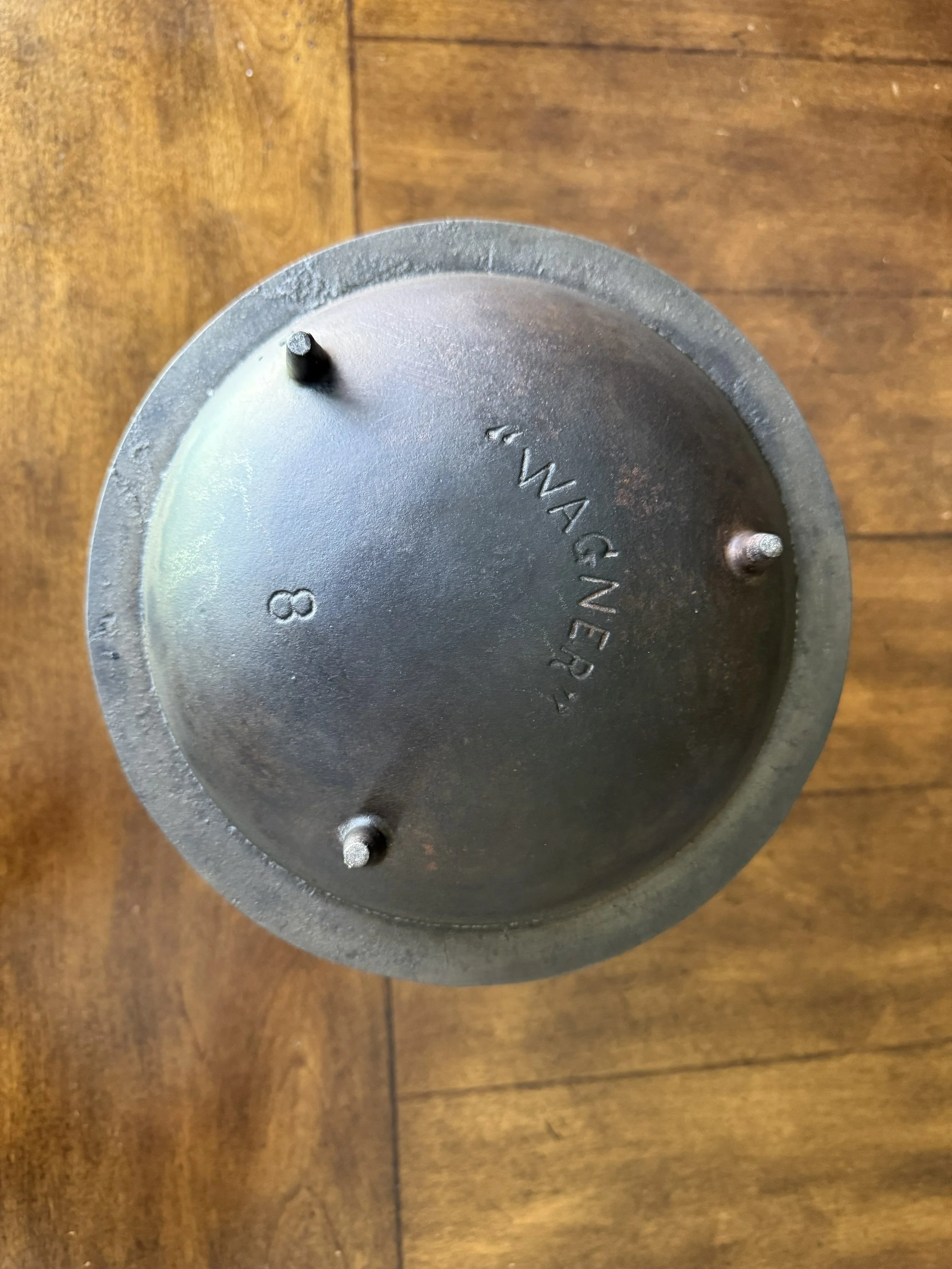
Underside of the showing the plain arched WAGNER mark, the raised size numeral 8, and the two cast alignment lugs.
The mark on this pot reads only WAGNER in an arc, with the numeral 8 centered below it — there is no “SIDNEY,” “-O-,” or “WARE” anywhere on the piece. According to The Cast Iron Collector's trademark study, Wagner's earliest marks consisted solely of the word “WAGNER,” incised either in a straight line or in an arc, before the city identifier “SIDNEY, O.” was added beneath it; the study's dating table places the arc-only “Wagner Arc” lettering, with no Sidney identifier, at 1891–1910, and the plain block “Wagner Block” lettering, also with no Sidney identifier, in the 1890s (The Cast Iron Collector, “Evolution of the Wagner Trademark,” castironcollector.com).
A separate SSC reference post on dating Wagner Ware skillets frames the same early period slightly differently, placing a “Block WAGNER, No Sidney” era at 1891–1897 and an “Arc Logo” era of 1897 through approximately 1922 during which the “SIDNEY -O-” identifier begins appearing (Steve's Seasoned Classics, “How To Date A Wagner Ware Skillet”). Both sources agree on the core point that matters for this piece: a plain “WAGNER” mark with no Sidney or Ohio identifier at all belongs to Wagner's earliest branding phase, well before the SIDNEY -O- stylized logo era of 1922–1959 seen on later Wagner pieces. Taken together, these two sources point to a date window of roughly 1891–1910 for this casting, with the sources not agreeing precisely enough to narrow it further from the mark alone.
A crowd-sourced collector report on a similar Wagner No. 8 “gypsy” bean pot with the same plain arc “WAGNER” mark and no Sidney identifier cites a narrower range of 1897–1903 for what the poster called the “straight logo” (Reddit r/castiron, “Wagner 8 ‘Gypsy’ bean pot. Garage sale find,” secondary/crowd-sourced, unverified against a primary source in that thread). This is treated here as an unverified lead, not a confirmed date, because the thread does not cite where the 1897–1903 figure came from.
On the “Gypsy Kettle” Label
This pot's original catalog entry used the name “Gypsy Kettle” alongside “Bean Pot.” Research for this pass found no evidence that “gypsy kettle” was a Wagner product name; rather, it appears to be a generic period and modern-collector term for the broader style of rounded, short-legged, cast iron cooking vessel with a bail handle — used across many makers, not specific to Wagner. The U.S. National Park Service's Fort Scott National Historic Site cooking-tools reference describes exactly this form — “the rounded, cast iron model with short legs and a bail” — and states it is “frequently referred to as gypsy or times bulge kettles today” (Fort Scott National Historic Site, National Park Service, “Cooking – Tools of the Trade”). This post therefore uses “bean pot” as the primary descriptor for the object and treats “gypsy kettle” as a period-generic style term rather than a Wagner-specific product designation.
Who Was the Wagner Manufacturing Company?
The plain, Sidney-free mark on this piece places it earlier in Wagner's history than the more commonly seen “Sidney -O-” marked pieces. A period detail and a compiled corporate history give a fuller timeline of the company at this early stage.
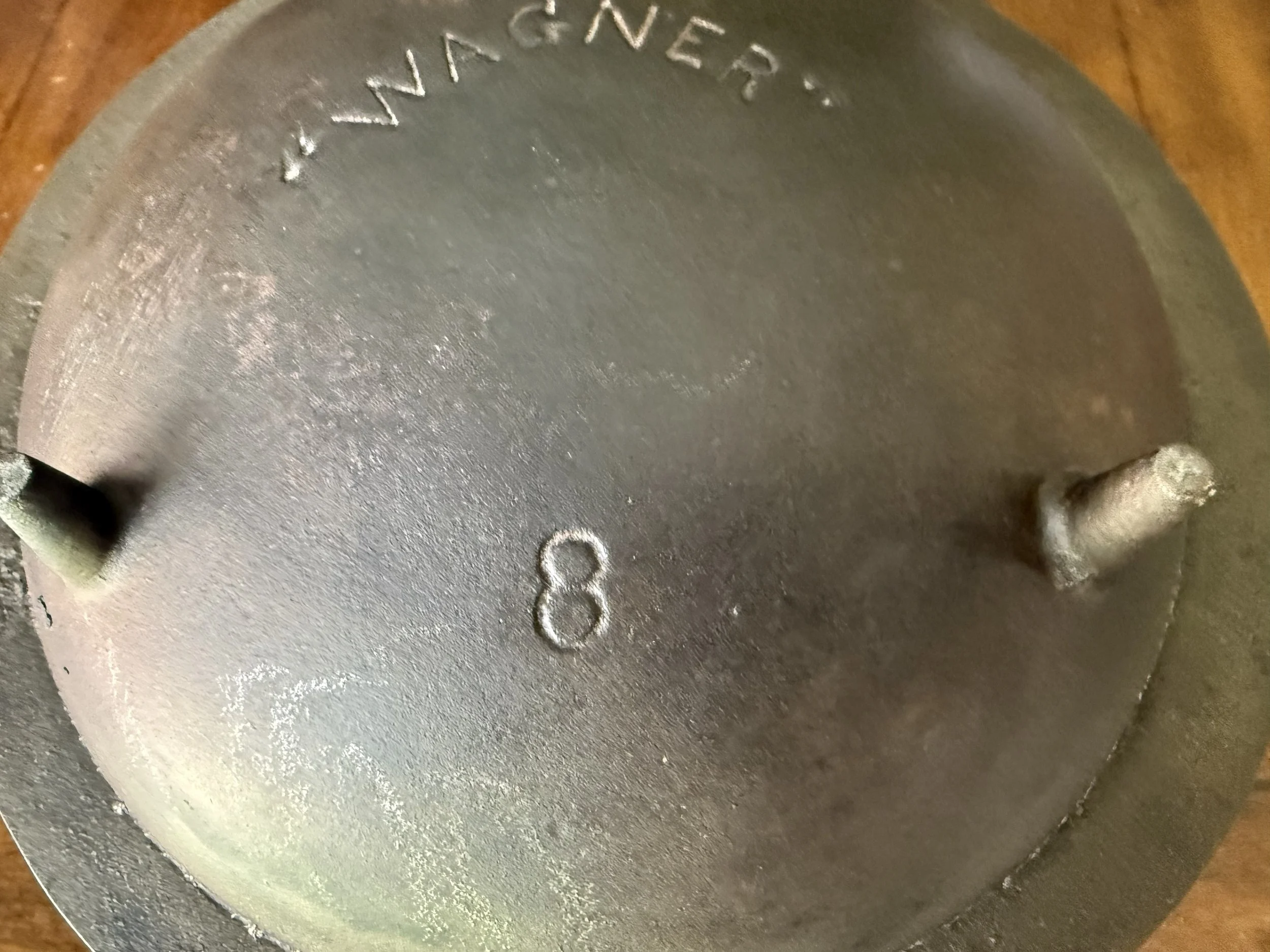
“The name ‘Wagner’ is cast on the bottom of each piece of ware.”
Source: Wagner Manufacturing Company early advertising, as quoted in “Wagner Manufacturing Company,” Wikipedia — en.wikipedia.org/wiki/Wagner_Manufacturing_Company
This confirms the company's own early practice of casting its name on its ware — exactly what appears on this piece, in its earliest, simplest form.
· Founded/incorporated 1891: brothers Milton M. and Bernard P. Wagner organized the company in Sidney, Shelby County, Ohio; the company opened for business in June 1891 with 20 employees (Wagner Cast Iron, “The Story Behind Wagner”, corroborated by Wikipedia).
· Key people: Milton and Bernard Wagner as founders; brother William H. Wagner joined the firm around 1897 and was put in charge of the recently acquired Sidney Hollow Ware foundry (The Cast Iron Collector, “Wagner Manufacturing Co.”).
· Early expansion: nickel-plated ware added in 1892; cast aluminum ware added in 1894, among the earliest in the industry; the Sidney Hollow Ware foundry acquired in 1897 and sold back to its original owner in 1903 (Wikipedia).
· Operating window: active 1891–1952 as Wagner Manufacturing Company; sold to the Randall Company of Cincinnati in 1952, with the Sidney plant continuing under later owners until it closed in 1999 (Wikipedia).
Sidney, Ohio in Wagner's Early Era: Historical Context
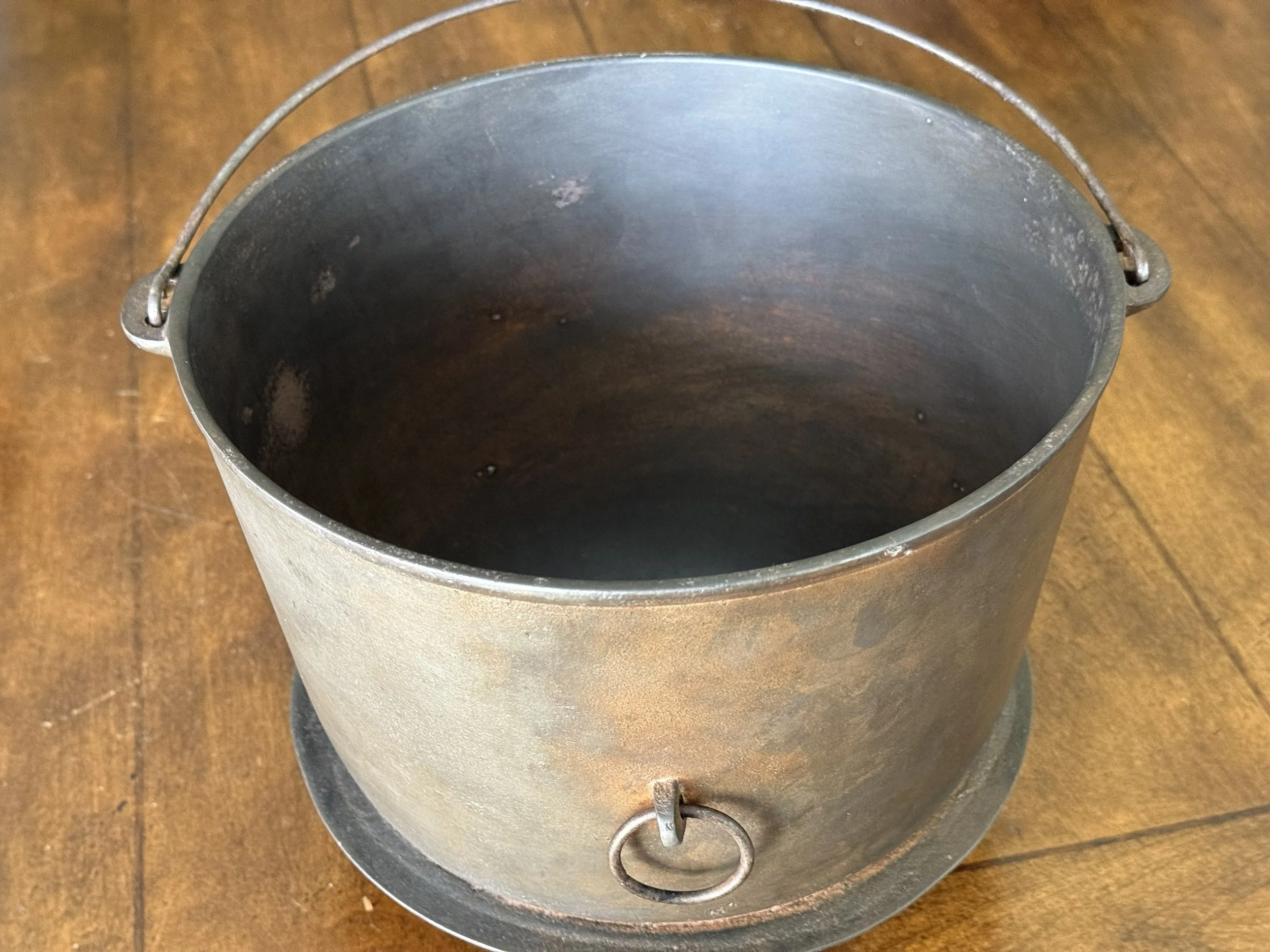
Side view showing the rounded body, side hanger loop, and pivoting wire bail handle.
This piece's plain “WAGNER” mark, with no city or state identifier, dates to a period when Wagner was still a young, regionally rooted foundry rather than the internationally distributed company it would become. The company added nickel-plated ware in 1892 and was among the earliest American makers of aluminum cookware in 1894 (Wikipedia). It acquired the competing Sidney Hollow Ware foundry in 1897, placing William H. Wagner in charge of it, before selling it back to its original owner in 1903 (The Cast Iron Collector). Global distribution of Wagner products would not be reached until 1913, meaning a plain, Sidney-free “WAGNER” marked piece like this one predates that period of wide distribution (Wikipedia). This bean pot sits within that early, foundry-scale chapter of Wagner's history rather than the mass-market “Sidney -O-” era most collectors associate with the brand.
Updated Piece Details
· Manufacturer: Wagner Manufacturing Company (Wagner), Sidney, Shelby County, Ohio
· Company founded: 1891, by Milton M. and Bernard P. Wagner
· Company closed: Sold to the Randall Company, 1952; Sidney plant operated under later owners until 1999
· Peak size / scale: Not documented for this specific early period; company reached worldwide distribution by 1913 (Wikipedia)
· Piece type: Three-footed cast iron bean pot (“gypsy kettle” style) with domed lid and wire bail handle
· Size/model: No. 8 (raised numeral cast on both the pot underside and lid)
· Casting/maker's marks: Plain arched “WAGNER” with no “WARE,” “SIDNEY,” or “-O-”; raised numeral “8” centered beneath
· Associated patent (if any): None identified on the piece or in this research pass
· Patent subject (verified): Not applicable
· Relationship to maker: Direct — the maker's mark is cast into both the pot and the lid
· Date of manufacture: Approximately 1891–1910, based on the plain arc/block “WAGNER” (no Sidney identifier) logo era (The Cast Iron Collector; Steve's Seasoned Classics skillet-dating reference)
· Place of manufacture: Sidney, Shelby County, Ohio
· SSC catalog no.: SSC-WAG-KTL-008-002
· Acquisition: Herndon's Antique Store, part of a multi-item deal; July 4, 2026
Open Questions for Further Research
In keeping with our own stated research standard — document what is verified, flag what is not — here is what this pass could confirm, and what still needs primary-source verification:
· Confirmed: Maker (Wagner Manufacturing Company, Sidney, Ohio) from the cast mark on the object itself; company founding in 1891 by Milton M. and Bernard P. Wagner, and the 1952 sale to the Randall Company (Wikipedia; Wagner Cast Iron company history).
· Confirmed: The plain arc/block “WAGNER” mark with no Sidney or Ohio identifier belongs to Wagner's earliest branding phase, predating the “Sidney -O-” era (The Cast Iron Collector's trademark-evolution study).
· Unverified — needs primary confirmation: The precise date window for the plain arc “WAGNER” logo. The Cast Iron Collector's table gives 1891–1910 for the arc form; a separate SSC reference post frames overlapping but not identical eras (1891–1897 block, 1897–1922 arc with Sidney beginning to appear); a Reddit thread on a similar piece cites 1897–1903 without a stated source. A period Wagner catalog or dated advertisement showing this specific mark and size would narrow this range.
· Unverified — needs primary confirmation: Whether “gypsy kettle” was ever used by Wagner itself as a product name for this line, versus being purely a generic period/collector term for the style, as described by the National Park Service's Fort Scott cooking-tools reference. No Wagner catalog page has been located in this pass confirming or denying company use of the term.
· Still open: A tighter manufacturing date within the 1891–1910 window. Matching this pot's exact lug and lid-fit style against a dated Wagner catalog illustration, or cross-referencing with other precisely dated examples of the plain arc “WAGNER” mark, would likely narrow this further.
Why This Still Matters
A pot that came out of heavy rust with only electrolysis — no lye soak needed — still carries a verifiable paper trail underneath the corrosion: a cast maker's mark ties it to a specific Ohio foundry, and a documented trademark timeline places it in an early, pre-“Sidney -O-” phase of that foundry's history. Sharing that sourced record — and being upfront that the exact decade within 1891–1910 remains an open question — gives another collector something concrete to compare their own early Wagner piece against.
Sources
· The Cast Iron Collector, “Evolution of the Wagner Trademark”
· Steve's Seasoned Classics, “How To Date A Wagner Ware Skillet”
· Fort Scott National Historic Site, National Park Service, “Cooking – Tools of the Trade”
· “Wagner Manufacturing Company,” Wikipedia (tertiary/background)
· Wagner Cast Iron, “The Story Behind Wagner”
· The Cast Iron Collector, “Wagner Manufacturing Co.” company overview
· SSC internal records: acquisition and catalog records, SSC-WAG-KTL-008-002
