Shinnick Hattan & Co. No. 9 Cast Iron Kettle
SSC MUSEUM COLLECTION
Catalog No. SSC-SHINNICK-KTL-9-1863-001
No. 9 Kettle with Original Lid | Gate Marked | Zanesville, Ohio
Patent June 23, 1863 • Shinnick Hattan & Co. • Pre-1905 Collection

Top view showing the complete lid marking: “SHINNICK HATTAN & CO. / ZANESVILLE O. / JUNE 23. 1863” arranged in a full circle around the lid’s central knob, with size numerals “8” and “9” cast inside the inner ring. The bail handle crosses the lid. Pour spout visible at upper left. This is the oldest datable piece in the SSC collection—cast during the American Civil War, ten days before the Battle of Gettysburg.
June 23, 1863. The Army of the Potomac is marching north through Maryland, trying to locate Robert E. Lee’s Confederate forces somewhere in Pennsylvania. In ten days, the two armies will collide at a small crossroads town called Gettysburg. In eastern Ohio, communities along the Muskingum River are bracing for Morgan’s Raid—the audacious Confederate cavalry incursion that would become the deepest penetration of Northern territory during the entire war. More than five thousand Union soldiers and hundreds of armed civilians are stationed in and around Zanesville to defend the city and its bridges. And in a foundry in Zanesville, Muskingum County, Ohio, a company called Shinnick Hattan & Co. is casting iron kettles and stamping them with the date.
This is one of those kettles. A No. 9 cast iron kettle with its original fitted lid, marked with the company name, the city and state, and the precise date—June 23, 1863—cast in raised letters around the lid’s circumference. The gate mark on the bottom confirms the pre-1875 casting method. The bail handle is original. The pour spout is intact. The kettle body retains its original surface patina—undisturbed, unstripped, unpolished—exactly as 162 years of handling and storage have left it. This is the oldest datable piece in the Steve’s Seasoned Classics collection, the only Civil War-era piece, and the only piece from Zanesville. It is the crown jewel.
The SSC collection exists to document Ohio’s cast iron heritage. Most of that heritage dates to the Golden Age of American cast iron—the 1880s through the 1930s, when foundries like Wagner, Griswold, Favorite, and Wapak were producing the cookware that defined American kitchens. But Ohio’s iron heritage did not begin with those companies. It began decades earlier, in the foundries of river towns like Zanesville, where iron was being cast before the Civil War, before the Transcontinental Railroad, before Ohio’s population had reached two million. This kettle takes the SSC timeline back to 1863—to the foundries that made Ohio’s later industrial dominance possible.
The Marking: Reading the Lid

Close-up of the lid marking showing “SHINNICK HATTAN & CO.” arched at the top, “ZANESVILLE O.” along the left curve, and “JUNE 23. 1863” along the bottom. Size numerals “8” and “9” are cast inside the inner ring flanking the central lid knob. The casting quality of the lettering—crisp, evenly spaced, fully legible after 162 years—is remarkable for a piece of this age.
The lid carries one of the most complete markings in the SSC collection: company name, city, state, and exact date, all cast in raised letters around the full circumference. The dual size numbers—“8” and “9”—inside the inner ring indicate the lid fit both No. 8 and No. 9 kettle bodies, a common practice in the era when foundries economized by casting lids that served multiple sizes. The central knob is the lift point, and its diamond or shield shape is a period design element consistent with mid-nineteenth-century casting conventions.
Piece Details

Side profile showing the bulbous kettle body, the pour spout at left, and the bail handle in carrying position. The form is characteristic of pre-industrial hollow ware: a deep, rounded body designed for hearth or stove-top use, with substantial wall thickness and a heavy base. The original surface patina is intact across the entire piece.
Manufacturer
Shinnick Hattan & Co.
Piece Type
No. 9 Kettle with Original Fitted Lid
Material
Cast Iron (gate marked)
Lid Marking
SHINNICK HATTAN & CO. / ZANESVILLE O. / JUNE 23. 1863 / 8 / 9
Bottom Configuration
Gate mark (vertical seam); confirms pre-1875 casting method
Pour Spout
Single pour spout on kettle body
Bail Handle
Wire bail handle; appears original to piece
Lid Configuration
Fitted lid with central knob; lid serves No. 8 and No. 9 sizes
Date of Manufacture
1863 (patent date cast into lid)
Place of Manufacture
Zanesville, Muskingum County, Ohio
Surface Condition
Original patina; undisturbed; not stripped, polished, or refinished
Structural Condition
Excellent for age — no cracks; gate mark intact; bail functional; lid fits properly; pour spout clean
Acquisition Date
February 27, 2026
Acquisition Source
eBay — Seller: de_kathrine
eBay Item Number
357493177322
Order Number
25-14275-42067
SSC Catalog Number
SSC-SHINNICK-KTL-9-1863-001
Collection Designation
Pre-1905 Collection — Anchor Piece

Open view showing the kettle interior and the lid marking from above. The interior surface shows the expected patina of a piece that has been in use and storage for over 160 years—darkened, seasoned, and undisturbed. The lid’s full circular marking is clearly legible from this angle. The bail handle pivots freely on its mounting ears.
June 23, 1863: Ohio on the Edge of Invasion
The date cast into this kettle’s lid is not an abstraction. June 23, 1863 was a specific day in a specific war, and Zanesville, Ohio was not a bystander. The Civil War had been raging for two years. Union and Confederate armies were maneuvering across Virginia, Maryland, and Pennsylvania in the campaign that would climax at Gettysburg on July 1–3. But the war was also coming to Ohio.
In early July 1863—just days after the date on this kettle—Confederate Brigadier General John Hunt Morgan led approximately 2,400 cavalrymen across the Ohio River from Kentucky into Indiana and then into Ohio. Morgan’s Raid was the deepest Confederate penetration into Northern territory during the entire war, cutting a path across southern and eastern Ohio that terrified communities and triggered a massive home defense mobilization. More than five thousand Union soldiers and armed civilians were stationed in the Zanesville area to protect the city, its bridges over the Muskingum River, and its industrial infrastructure—including its foundries.
Zanesville was not raided. Morgan’s forces passed to the south and east, eventually being captured near Salineville in Columbiana County on July 26. But the threat was real, the mobilization was real, and the foundries of Zanesville were operating under wartime conditions when this kettle was cast. The iron that went into this piece may have been the same iron that could have gone into munitions or military hardware. That it went instead into a household kettle—a vessel for boiling water, making soup, heating wash water—tells you something about the dual reality of the home front: the war was coming, and dinner still had to be made.
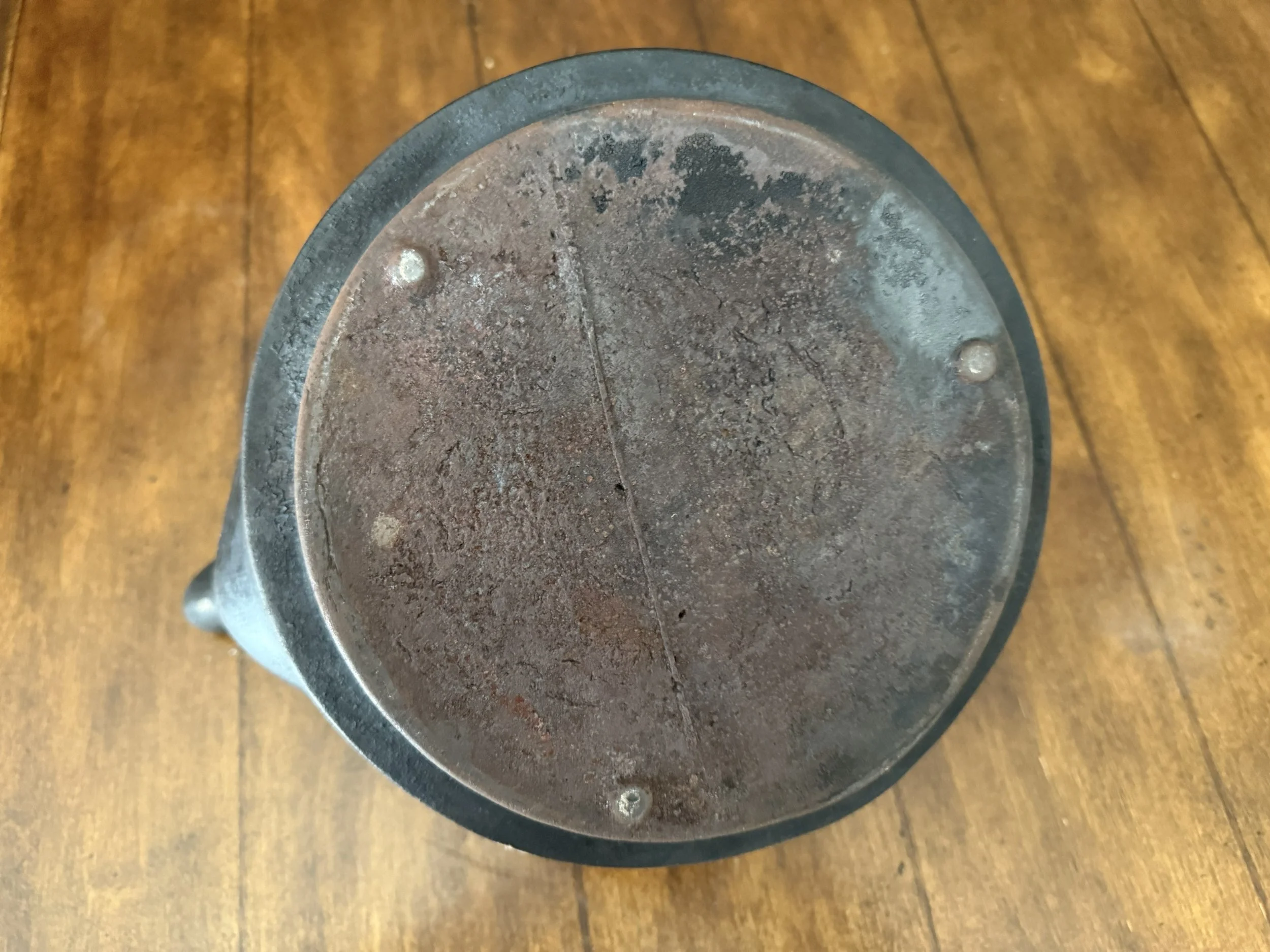
Bottom view showing the gate mark—the vertical casting seam running across the base—which confirms this piece was made using pre-1875 casting technology. Three small feet or contact points are visible on the base. The surface retains its original patina with the expected wear and oxidation of a piece that is over 160 years old.
The Shinnick Family and Zanesville’s Iron Heritage
The Shinnick name runs deep in Zanesville. The family’s involvement in the city’s industrial life spanned multiple generations and multiple industries. The foundry that produced this kettle—Shinnick Hattan & Co.—operated under several partnership configurations over the years: surviving pieces also carry the names “Shinnick & Co.” and “Shinnick Woodside & Gibbons,” each representing a different era of partnership.
William M. Shinnick, born in Zanesville on December 21, 1846—just seventeen years old when this kettle was patented—entered his father’s rope and cordage works as a young man and eventually became one of Zanesville’s most prominent citizens. He served as city clerk, assistant postmaster, member of the board of education, and later as vice president of the First Trust and Savings Bank. His most lasting impact came through the Mosaic Tile Company, where he served as secretary, treasurer, and eventually general manager. After his death in 1923, the Shinnick Educational Fund—the largest benefaction in Muskingum County history—continued his legacy of community investment.
The connection between the Shinnick iron foundry of the 1860s and the Shinnick family’s later prominence in Zanesville industry and philanthropy is a thread that runs through the entire history of the city’s manufacturing base. Zanesville had seven iron foundries operating as early as 1846. By 1863, when this kettle was cast, the city’s position at the confluence of the Licking and Muskingum Rivers—crossed by the National Road and connected to markets by canal and river transport—made it a natural center for iron production. The Shinnick foundry was part of that ecosystem, and this kettle is its surviving testimony.
Preserving a 162-Year-Old Surface
The original patina on this kettle is not merely important—it is sacred. This surface has been accumulating since Abraham Lincoln was president. Every layer of oxidation, every handling mark, every tonal variation in the iron’s color records a chapter in a story that spans the Civil War, Reconstruction, the Gilded Age, two World Wars, and the entire arc of modern American history. To strip this surface would be to erase that story permanently.
The SSC Archival Black™ protocol applies with maximum force to a piece of this age and significance. No grinding. No sanding. No wire brushing. No chemical stripping. No electrolysis. The only acceptable intervention is the gentlest possible stabilization of any active corrosion to prevent further deterioration. The goal is not restoration—it is preservation. This kettle does not need to look new. It needs to look exactly like what it is: a 162-year-old cast iron vessel from a Zanesville foundry that was operating while the Civil War raged around it.
Historical Timeline: Zanesville, Ohio — 1863
1797
Ebenezer Zane founds the settlement that becomes Zanesville at the confluence of the Licking and Muskingum Rivers in what will become Muskingum County, Ohio.
1810–12
Zanesville serves as the state capital of Ohio.
1826
The National (Cumberland) Road reaches Zanesville, connecting the city to eastern markets and accelerating industrial growth.
1846
Seven iron foundries are operating in Zanesville, along with cotton mills, flour mills, sawmills, and other manufacturing operations. The Shinnick family is active in local industry.
1863
June 23: Shinnick Hattan & Co. patents or produces this No. 9 kettle in Zanesville. The date is cast into the lid. Ten days later, the Battle of Gettysburg begins. In early July, Morgan’s Raid brings Confederate cavalry into Ohio; over 5,000 Union soldiers defend the Zanesville area.
1863–80s
The Shinnick foundry continues under various partnership names: Shinnick Hattan & Co., Shinnick & Co., and Shinnick Woodside & Gibbons. Pieces survive in multiple sizes.
1894
William M. Shinnick joins the Mosaic Tile Company as secretary and treasurer, beginning the family’s prominent role in Zanesville’s later ceramic industry.
1923
William M. Shinnick dies on May 30. The Shinnick Educational Fund—the largest benefaction in Muskingum County history—is established from his estate.
2026
Steve’s Seasoned Classics acquires this No. 9 kettle from eBay seller de_kathrine, documenting it as the oldest datable piece in the collection and the anchor of the Pre-1905 Collection.
Why This Piece Matters
The Shinnick Hattan & Co. No. 9 kettle is the most historically significant piece in the Steve’s Seasoned Classics collection. It is the oldest datable piece by decades. It is the only piece that carries a specific date from the Civil War era. It is the only piece from Zanesville, Ohio—a city that was once the state capital, a city with seven iron foundries operating before the war, a city that mobilized five thousand soldiers to defend its bridges and factories from Confederate raiders in the same month this kettle was cast. And it survives with its original lid, its original bail handle, its original surface patina, and every letter of its 162-year-old marking fully legible.
This kettle extends the SSC collection’s Ohio map into Muskingum County—eastern Ohio, on the Muskingum River, along the National Road. It extends the SSC timeline back to 1863—thirty years before Wagner, twenty years before Columbus Hollow Ware, a full generation before the Ohio Foundry Corridor as we know it existed. And it connects the SSC collection to the largest story in American history: the Civil War, fought on battlefields and in foundries, in armies and in kitchens, in the iron that made weapons and the iron that made dinner.
The iron endures. The markings tell the truth. The story deserves to be told.
Sources & Further Reading
U.S. Patent No. 38,978 — Improvement in Tea-Kettles, Patented June 23, 1863 — Google Patents
Southeastern Ohio History / VisitZanesville.com — Zanesville industrial history: seven iron foundries operating by 1846; National Road connection; strategic importance during Civil War.
Wikipedia — Zanesville, Ohio: Morgan’s Raid context; “In excess of 5,000 Union soldiers, along with hundreds of townsfolk, were stationed in the Zanesville area to protect the city in 1863.”
William M. Shinnick Educational Fund (shinnickeducationalfund.com) — Shinnick family biography: William M. Shinnick (1846–1923), rope and cordage works, Mosaic Tile Company, civic leadership.
WorthPoint.com — Auction records for Shinnick & Co. and Shinnick Hattan & Co. kettles in multiple sizes, confirming Zanesville production and June 23, 1863 date across multiple specimens.
Britannica / Ohio History Connection — Zanesville founding, National Road, Muskingum County industrial context.
About Steve’s Seasoned Classics
Steve’s Seasoned Classics is an online museum dedicated to preserving and documenting the heritage of American cast iron, with a singular focus on the obscure, defunct foundries of Ohio from the 19th and early 20th centuries. The SSC collection spans 130+ pieces from 50+ confirmed Ohio makers — the majority absent from standard collector references. Makers were identified through physical artifacts exhibiting gate marks, patent dates, foundry traits, and documented regional provenance, cross-checked against surviving trade directories, census records, and existing collector guides. Makers lacking representation in published guides but supported by physical evidence were flagged for first-time documentation — a core function of the SSC research mission.
www.stevesseasonedclassics.com
References & Provenance
Markings (transcribed verbatim):
SHINNICK HATTAN & CO. / ZANESVILLE, O. / JUNE 23, 1863 — raised cast lettering on bottom, three-line arc.
Patent & Design Lineage:
Original Patent: Barney Menke, Improvement in Tea-Kettles, U.S. Patent No. 38,978 — Filed May 1863, Patented June 23, 1863. [View on Google Patents]
Licensed variants: Scheidler Patent 1868, Greer & King of Dayton, Yourtee, Hollister & Co. of Cincinnati — See SSC Patent Network: The Kettle and the War (forthcoming Oct 2026)
Manufacturer:
Shinnick, Hattan & Co., Zanesville, Muskingum County, Ohio (1860-1865). Successor to Shinnick & Co., predecessor to Kearns, Hattan & Co.
Location: Historic foundry site, Zanesville riverfront — 1860s Muskingum County Atlas / Sanborn
Sanborn Fire Insurance Map from Zanesville, Muskingum County, Ohio, Sep 1889 — Library of Congress
Acquisition & Condition:
Acquired: 02/27/2026, eBay
Condition as found: Original patina preserved, casting date legible, pour cup slag intact. No grinding, sanding, or metal removal. Conserved with SSC Archival Black™ for display.
Photography & Documentation:
SSC Museum Standard: 12-angle photography, markings macro, provenance file on record. Catalog No. SSC-SHINNICK-KTL-9-1863-001.
Related SSC Pages:
Other Menke Patent Kettles:
