H. Wells & Bro. Extra Large Cast Iron Tea Kettle
SSC MUSEUM COLLECTION
Catalog No. SSC-WELLS-KTL-1867-001
Tea Kettle with Original Lid | Gate Marked | Martins Ferry, Ohio
1867 • H. Wells & Bro. • Pre-1905 Collection

Top view showing the complete lid marking: “H. WELLS & BRO.” arched at the top, “MARTINS FERRY O.” along the bottom curve, and “1867” at the base. Decorative star or cross elements flank the date. The bail handle crosses the lid. Pour spout visible at top. This is the second oldest datable piece in the SSC collection—cast two years after the Civil War ended, in Ohio’s oldest permanent settlement.
The Civil War ended on April 9, 1865. Two years later, in 1867, a foundry called H. Wells & Bro. in Martins Ferry, Ohio was casting tea kettles and stamping them with the date. The country was in the early years of Reconstruction—the tumultuous period of rebuilding, political upheaval, and industrial transformation that followed four years of war. The Thirteenth Amendment had abolished slavery. The Fourteenth Amendment, guaranteeing citizenship and equal protection, was working its way through the ratification process and would be adopted the following year. And on the banks of the Ohio River, in a town that had served as an Underground Railroad station before the war, the Wells brothers were making iron.
Martins Ferry is not just any Ohio town. It is the oldest permanent European settlement in the state of Ohio—settled in 1779, twenty years before Zanesville, a decade before Marietta, and nearly two decades before Ohio achieved statehood. Its location on the Ohio River, directly across from Wheeling, Virginia (now West Virginia), placed it at the literal border between North and South, between free soil and slave soil, between the industrial economy of the Northern states and the agrarian economy of the upper South. Before the war, Martins Ferry was a station on the Underground Railroad. After the war, it became an industrial center fueled by local coal deposits and connected to national markets by the Cleveland and Pittsburgh Railroad, which had reached the town in 1852.
H. Wells & Bro. operated in this environment—a small Belmont County foundry producing household cast iron in a river town that was simultaneously one of Ohio’s oldest communities and one of its newest industrial centers. The company is virtually undocumented in the cast iron collector literature. No corporate records, no factory photographs, no catalog pages, no annual reports have surfaced. What we know about H. Wells & Bro. we know from the iron: the company name, the city, and the year, cast into the lids of the kettles they produced. The SSC collection may be creating the only detailed public record of this foundry’s existence.
Reading the Lid: The Marking in Detail

Close-up of the lid marking showing “H. WELLS & BRO.” in raised block letters arched across the top, “1867” along the lower curve, and “MARTINS FERRY” visible at left. Decorative star or maltese cross elements are cast between the text blocks. The diamond-shaped lid knob is a period design element consistent with mid-nineteenth-century foundry conventions. The casting quality of the lettering is clear and well-formed.
The lid marking follows the same circular arrangement seen on the Shinnick Hattan kettle from Zanesville—a convention of the era in which the foundry’s identity was cast into the most visible and most frequently handled part of the vessel. The “& Bro.” designation tells us this was a family operation: H. Wells and at least one brother, working together in a partnership foundry. The year 1867 may be a patent date, a founding date, or simply the year of manufacture—the conventions of the era did not always distinguish between these. What it establishes beyond question is that the foundry was operating in 1867, two years into Reconstruction, producing household iron in Ohio’s oldest settlement.
Piece Details
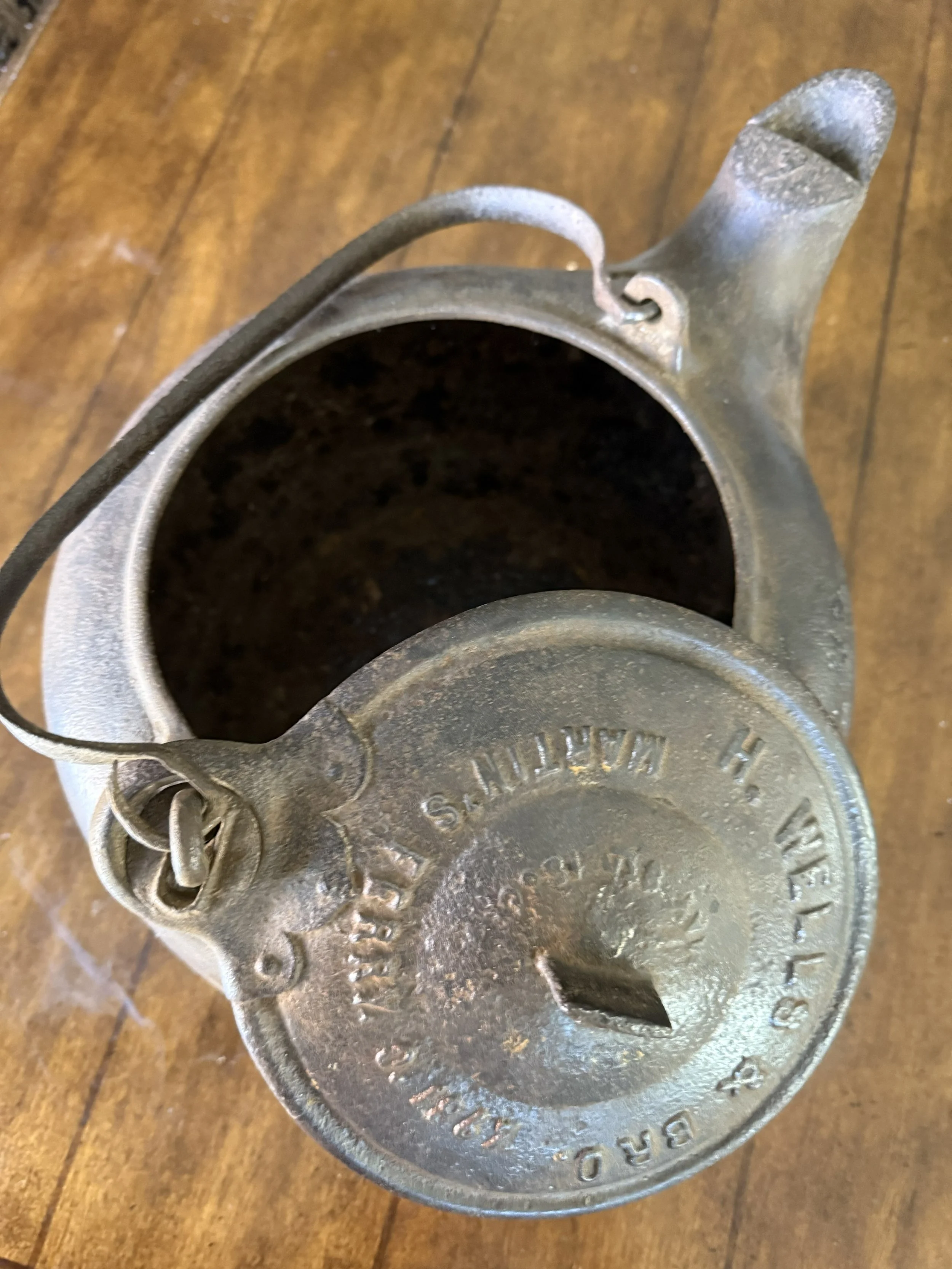
Open view showing the kettle interior with lid removed and resting at an angle. The deep kettle body, bail handle, and pour spout are visible. The interior shows the expected patina of a piece that has been in use and storage for over 158 years. The lid’s circular marking is legible from this angle, and the bail handle pivots on its mounting ears.
Manufacturer
H. Wells & Bro.
Piece Type
Extra Large Tea Kettle with Original Fitted Lid
Material
Cast Iron (gate marked)
Lid Marking
H. WELLS & BRO. / MARTINS FERRY O. / 1867 (with decorative star elements)
Bottom Configuration
Gate mark (vertical casting seam); confirms pre-1875 casting method
Pour Spout
Single pour spout on kettle body
Bail Handle
Wire bail handle; original to piece
Lid Configuration
Fitted lid with diamond-shaped central knob; full circular marking
Date
1867 (cast into lid)
Place of Manufacture
Martins Ferry, Belmont County, Ohio
Surface Condition
Original patina; undisturbed; consistent with SSC Archival Black™ protocol
Structural Condition
Very Good for age — gate mark intact; bail functional; lid fits; pour spout clean; no cracks
Acquisition Date
February 26, 2026
Acquisition Source
eBay — Seller: kathyskountry
eBay Item Number
298066244313
Order Number
27-14268-75441
SSC Catalog Number
SSC-WELLS-KTL-1867-001
Collection Designation
Pre-1905 Collection
The Gate Mark: What the Bottom Tells Us
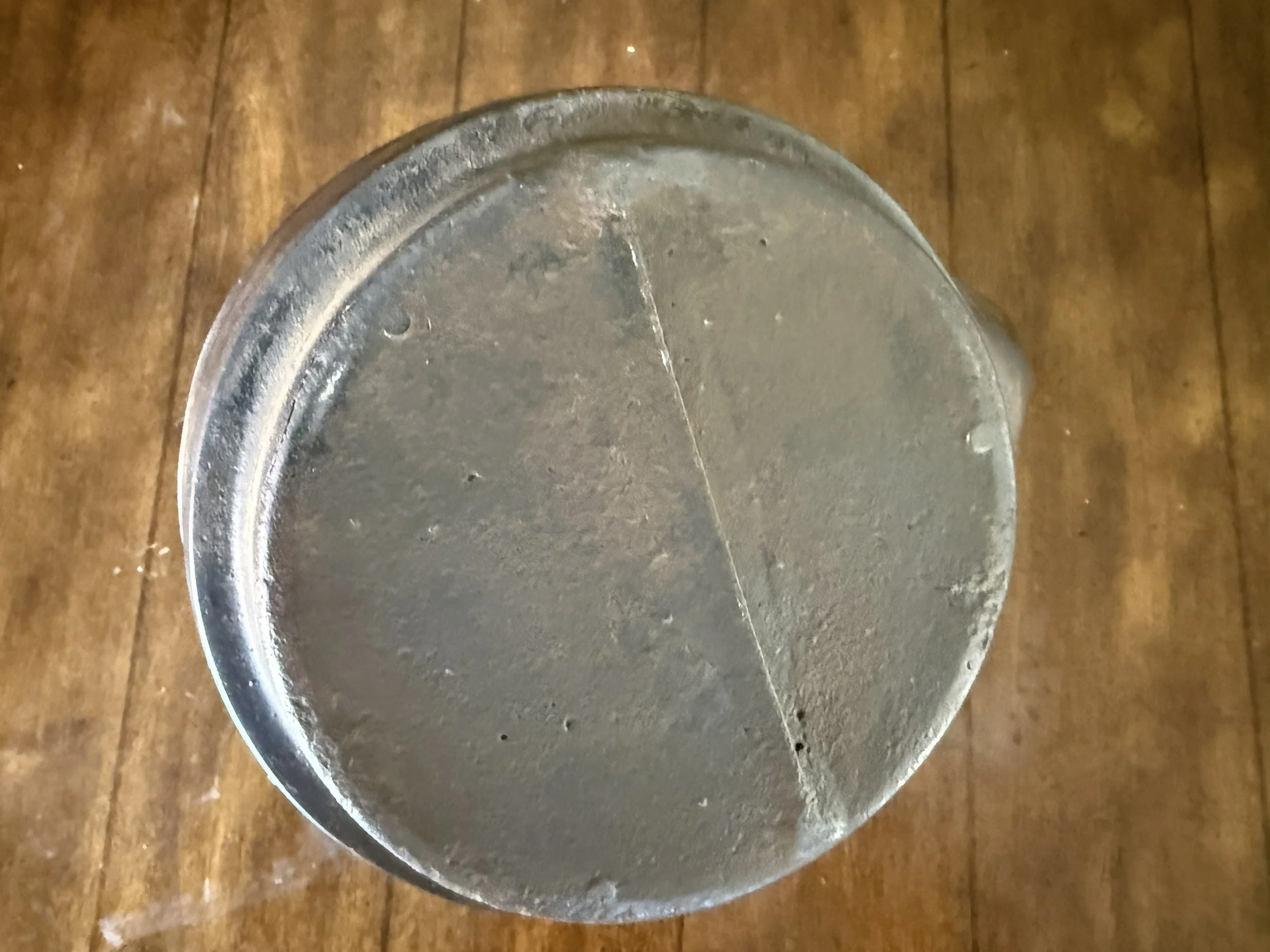
Bottom view showing the gate mark—the vertical casting seam running across the full diameter of the base. This is the definitive indicator of pre-1875 sand mold casting technology. The gate was the channel through which molten iron entered the mold; when the casting was removed and the gate broken off, it left this characteristic raised seam. After approximately 1875, foundries transitioned to bottom-gated molds that eliminated the visible gate mark.
A gate mark is the raised line or seam left on the bottom of a cast iron piece where the molten iron entered the sand mold through a channel called a “gate.” In the early and mid-nineteenth century, iron was poured into molds through a gate cut into the side of the mold at the parting line, and when the casting cooled and was removed, the remnant of that gate channel remained as a raised line across the bottom surface. This is the single most reliable indicator of age in American cast iron: if a piece has a gate mark, it was almost certainly cast before 1875.
The transition away from gate-marked casting happened in the 1870s as foundries adopted bottom-gated molds—molds where the iron entered from below, leaving no visible seam on the cooking or exterior surface. By the 1880s, the gate mark had essentially disappeared from American hollow ware production. Both of the SSC Pre-1905 Collection’s anchor pieces—this Wells kettle (1867) and the Shinnick Hattan kettle (1863)—carry prominent gate marks, confirming their place in the earliest era of Ohio cast iron production.
Ohio’s Oldest Settlement: Martins Ferry on the Ohio River
Martins Ferry holds a distinction that no other Ohio community can claim: it is the oldest permanent European settlement in the state, established in 1779—eighteen years before Zanesville, twenty years before Ohio became a territory, and twenty-four years before Ohio achieved statehood. The settlement grew up on the Ohio River directly across from Wheeling, at the point where the frontier road known as Zane’s Trace met the river crossing. The Martin family operated a ferry there, giving the town its eventual name.
The location was strategic in ways that shaped every chapter of the town’s history. On the Ohio River, Martins Ferry was a natural point of transit for goods, people, and ideas moving between the Eastern seaboard and the interior of the continent. Before the Civil War, this transit included enslaved people escaping to freedom: Martins Ferry was a documented station on the Underground Railroad, its position on the border between free Ohio and slave-holding Virginia making it a critical crossing point. The same river that carried commerce carried freedom.
After the war, the river and the railroad turned Martins Ferry into an industrial center. The Cleveland and Pittsburgh Railroad had reached the town in 1852, and the combination of river transport, rail connections, and abundant local coal created the conditions for a manufacturing boom. By 1886, Martins Ferry supported multiple foundries, a blast furnace producing 65–70 tons of Bessemer pig iron daily, stove factories, glass works, and a nail mill that was becoming the largest in the world. H. Wells & Bro. operated in the early years of this industrial expansion—a small foundry in a town that was rapidly becoming one of the Ohio Valley’s most productive manufacturing centers.
Why This Piece Will Never Be Restored
Some viewers will look at this kettle and see a rusty old teakettle. SSC sees something different. SSC sees a 158-year-old document written in iron—a document whose every surface tells a story that no restorer’s hand could improve and any restorer’s hand could destroy.
The dark, mottled surface of this kettle is not damage. It is not neglect. It is the original patina—the accumulated record of 158 years of existence. Every layer of oxidation records an environment. Every wear mark records a hand that gripped the bail handle. Every tonal variation across the casting surface records a chapter in the thermal history of a vessel that spent decades over fires, on stoves, in kitchens, in storage rooms, in attics, and in the hands of people whose names we will never know. That surface is the piece’s autobiography, and it is irreplaceable.
The temptation to “clean up” a piece like this is strong. A sandblaster could strip it to bare gray iron in minutes. An electrolysis tank could remove the oxidation overnight. A coat of new seasoning could make it look like it was cast last year. And every one of those interventions would erase the very thing that makes this piece historically significant. A restored 1867 kettle looks like every other restored kettle. An unrestored 1867 kettle looks like what it is: an object that has survived the entire arc of modern American history with its original surface intact.
SSC’s Archival Black™ preservation protocol is unambiguous on pieces of this age and significance: no restoration. No grinding. No sanding. No sandblasting. No chemical stripping. No electrolysis. No re-seasoning. The only acceptable intervention is the stabilization of active corrosion to prevent further deterioration—and even that is done with the lightest possible touch. This kettle will be presented to the public exactly as it arrived in the SSC collection: with its original surface, its original patina, and its 158 years of history visible in every square inch of its casting.
The rust is not the enemy. The rust is the record. A museum’s job is not to make old things look new. A museum’s job is to preserve old things as the documents they are—and to explain to the viewer why what they’re seeing matters. This is not a rusty old teakettle. This is a Reconstruction-era casting from Ohio’s oldest settlement, made by a foundry that left no other record of its existence, carrying a gate mark that dates it to the earliest era of American cast iron production. The surface you see is the surface the Wells brothers gave it in 1867, plus 158 years of American history written in iron oxide. SSC will not erase a single line of that story.
The Undocumented Foundry: When Iron Is the Only Record
H. Wells & Bro. does not appear in the Cast Iron Collector foundry database. It does not appear in the Wagner and Griswold Society records. It does not appear in any collector reference that SSC has been able to locate. The company’s surviving documentation consists entirely of the iron itself—the kettles that carry its name, its city, and its date. This is not unusual for small, mid-nineteenth-century foundries. Hundreds of regional foundries operated in Ohio in the decades before and after the Civil War, producing iron for local and regional markets, and most of them left no corporate records that have survived into the present day.
What makes the SSC documentation significant is that it creates a permanent, publicly accessible record where none existed. When a researcher or collector encounters an H. Wells & Bro. kettle in the future—at an auction, an estate sale, an antique shop—and searches for information about the manufacturer, the SSC catalog entry will be there. The company name, the city, the date, the gate mark, the photographs, the acquisition history, and the historical context of Martins Ferry in 1867 will all be documented in one place. That is what a museum does. It preserves not just the object but the knowledge that gives the object meaning.
Historical Timeline: Martins Ferry, Ohio — 1867
1779
Martins Ferry established as the oldest permanent European settlement in Ohio. The Martin family operates a ferry across the Ohio River at the site.
1835
Ebenezer Martin replats the settlement as Martinsville with a grid street system that survives today.
1840s–60s
Martins Ferry serves as a station on the Underground Railroad, its position on the Ohio River border between free Ohio and slave-holding Virginia making it a critical crossing point for people escaping slavery.
1852
The Cleveland and Pittsburgh Railroad reaches Martins Ferry, connecting the town to national markets and accelerating industrial growth.
1865
The Civil War ends (April 9). Martinsville is incorporated as a village and renamed Martin’s Ferry in honor of Absalom Martin’s ferry. Reconstruction begins.
1867
H. Wells & Bro. produces this tea kettle in Martins Ferry, Belmont County, Ohio. The date is cast into the lid. The gate mark on the bottom confirms pre-1875 casting technology. The Fourteenth Amendment is being ratified.
1880s
Martins Ferry’s industrial boom: multiple foundries, blast furnaces, stove factories, glass works, nail mills, and the Laughlin Mill. The town is “bound to advance rapidly in wealth and population.”
1885
Martins Ferry achieves city status.
2026
Steve’s Seasoned Classics acquires this kettle, documenting it as SSC-WELLS-KTL-1867-001 and adding it to the Pre-1905 Collection. SSC may be creating the only detailed public record of the H. Wells & Bro. foundry.
Why This Piece Matters
The H. Wells & Bro. tea kettle is one of the most historically significant pieces in the SSC collection. It is the second oldest datable piece, after the 1863 Shinnick Hattan kettle. It is the only piece from Martins Ferry—Ohio’s oldest settlement—and the only piece from Belmont County. It carries a gate mark that confirms pre-1875 casting technology. And it documents a foundry that appears to have no other public record of its existence.
Together, the Shinnick kettle (Zanesville, 1863) and the Wells kettle (Martins Ferry, 1867) form the foundation of the SSC Pre-1905 Collection—two Reconstruction-era Ohio kettles from river towns on opposite sides of the state, both gate-marked, both with original lids, both carrying their foundry’s name and date cast into the iron. They represent the deepest roots of Ohio’s cast iron heritage: the small, family-operated foundries of the 1860s that predated the great cookware manufacturers by a generation. Wagner would not be founded for another twenty-four years. Griswold was still called Selden & Griswold. Favorite Stove & Range did not yet exist. But H. Wells and his brother were making iron in Martins Ferry, in Ohio’s oldest town, on the Ohio River, two years after the war.
The iron endures. The markings tell the truth. The story deserves to be told.
Sources & Further Reading
Britannica — Martins Ferry, Ohio: settlement history, Underground Railroad station, Cleveland and Pittsburgh Railroad (1852), industrial growth.
Wikipedia / Grokipedia — Martins Ferry, Ohio: oldest permanent European settlement in Ohio (1779); incorporation as village 1865; Belmont County coal production and industrial development.
Ohio County Public Library (Wheeling, WV) — “Martins Ferry in 1886”: detailed industrial survey including multiple foundries, blast furnaces, stove works, and manufacturing operations.
Visit Belmont County — Martins Ferry: “enjoys the honor of being the oldest settlement in the state of Ohio, having been settled at least as early as 1779.”
SSC Internal Collection Records — H. Wells & Bro. is not documented in CastIronCollector.com foundry database, Wagner & Griswold Society records, or other collector references consulted. This SSC catalog entry may constitute the only detailed public record of the foundry.
About Steve’s Seasoned Classics
Steve’s Seasoned Classics is an online museum dedicated to preserving and documenting the heritage of American cast iron, with a singular focus on the obscure, defunct foundries of Ohio from the 19th and early 20th centuries. The SSC collection spans 130+ pieces from 50+ confirmed Ohio makers — the majority absent from standard collector references. Makers were identified through physical artifacts exhibiting gate marks, patent dates, foundry traits, and documented regional provenance, cross-checked against surviving trade directories, census records, and existing collector guides. Makers lacking representation in published guides but supported by physical evidence were flagged for first-time documentation — a core function of the SSC research mission.
