Wagner Ware Sidney -O- No. 4 Nickel-Plated Skillet
SSC MUSEUM COLLECTION
Catalog No. SSC-WAGNER-SKL-4-NP-001
Stylized Logo | Pattern 1054 | Nickel-Plated | Outer Heat Ring | Sidney, Ohio
Circa 1924–1935 • Wagner Manufacturing Co. • Wagner Specialty & Variant Collection
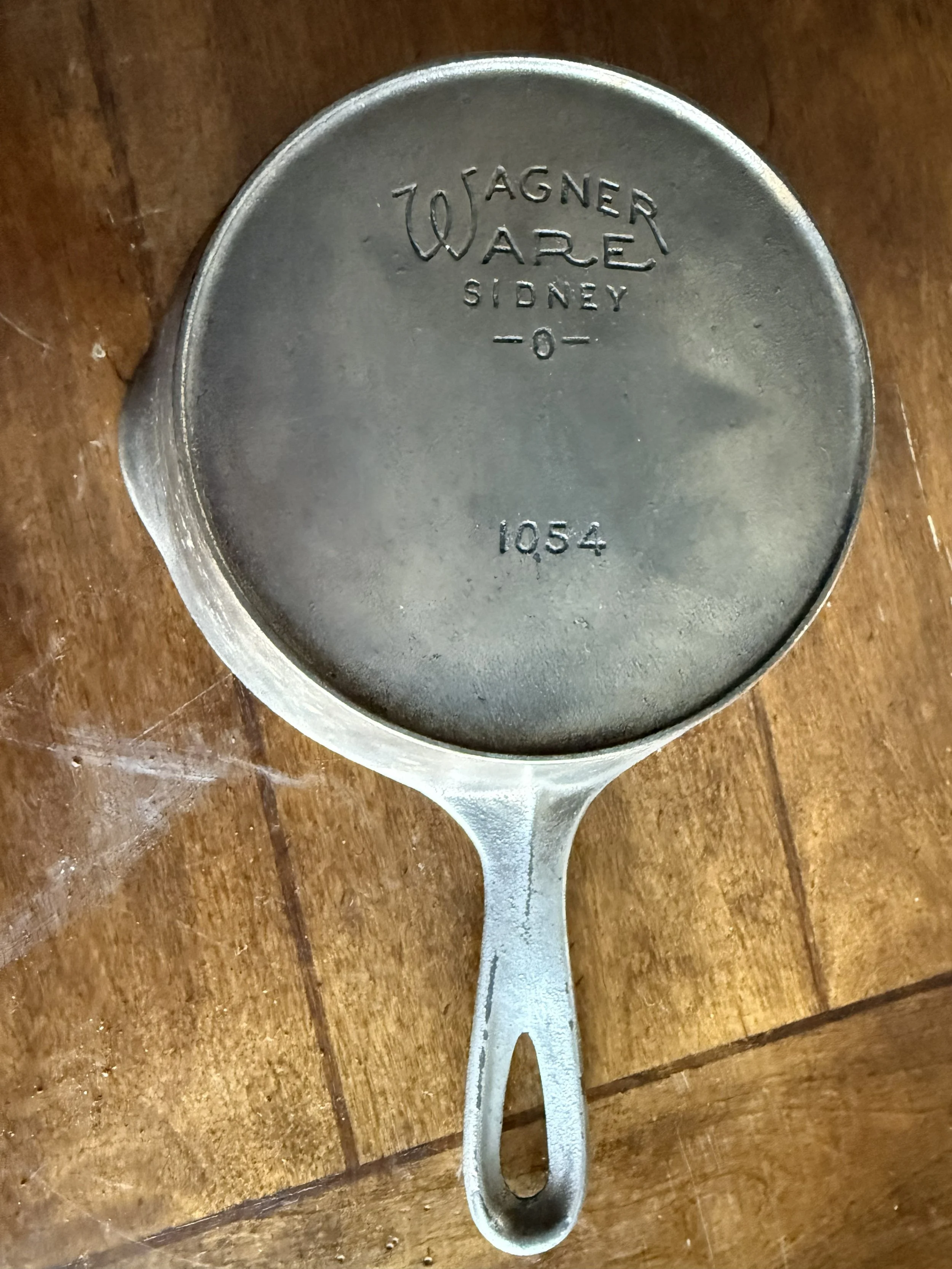
Bottom view showing the stylized “Wagner Ware Sidney -O-” trademark, pattern number “1054,” and the distinctive silvery finish of original factory nickel plating. The outer heat ring is visible at the base’s perimeter. The nickel plating on this piece is original to manufacture—applied at the Sidney foundry as a premium finish option—and must never be subjected to any restoration process that would damage or remove it.
Not every skillet that left the Wagner foundry in Sidney looked the same. While the standard production run received the familiar black seasoned finish that most collectors associate with vintage cast iron, Wagner also offered a premium option: nickel plating. For an additional cost, a customer could purchase a Wagner skillet with a bright, silvery nickel finish applied over the cast iron—a finish that resisted rust, was easier to clean, and signaled quality in a way that plain black iron could not. The nickel-plated Wagner was the prestige piece, the skillet that sat in the front of the hardware store display, the one the salesman reached for when a customer wanted the best.
This No. 4 skillet—pattern 1054—is one of those premium pieces. The silvery finish visible on the bottom, the handle, and the exterior walls is not bare iron and it is not modern refinishing. It is the original factory nickel plating, applied at the Wagner foundry in Sidney, Ohio during the stylized logo period (c. 1924–1935). The outer heat ring dates the piece to the earlier portion of this window, when Wagner was still producing heat-ringed skillets for use on wood and coal stoves. The “4” stamped on the handle top identifies the size, and the 1054 pattern number is the catalog designation for the No. 4 nickel-plated skillet.
Wagner introduced nickel-plated ware to its product line in 1892—just one year after the company’s founding—making it one of the earliest features of the Wagner catalog. The process involved electroplating a thin layer of nickel onto the finished cast iron surface, producing a bright, corrosion-resistant finish that was both functional and decorative. Nickel-plated pieces commanded a premium price and were marketed as the top tier of Wagner’s cookware offering. They are less common in the collector market today than standard-finish pieces, because the nickel plating—while durable—is vulnerable to the very restoration processes that collectors routinely apply to plain cast iron.
Why Nickel-Plated Pieces Must Never Be Restored
This is the most important thing a collector or viewer needs to understand about nickel-plated cast iron: standard cast iron restoration processes will destroy the nickel plating permanently, and once it is gone, it cannot be put back.
Lye baths—the standard first step in cast iron restoration—will not damage nickel plating. But electrolysis, which is the standard second step for removing rust, can damage or strip nickel if the piece is left in the tank too long or if the current is too high. Sandblasting will obliterate nickel plating instantly. Wire brushing will scratch through it. Oven cleaning cycles will discolor and weaken it. Chemical rust removers like naval jelly or phosphoric acid solutions can etch and dull the nickel surface. And re-seasoning—baking oil onto the surface at high temperature—will darken and obscure the nickel finish that is the piece’s most distinctive feature.
The result of any of these interventions is a nickel-plated skillet that no longer looks nickel-plated. The bright, silvery finish—the finish that Wagner applied at the factory as a premium upgrade, the finish that the original purchaser paid extra for, the finish that distinguishes this piece from every standard-finish Wagner in the collection—is gone. What remains is a piece that looks like any other stripped and re-seasoned skillet, with no visible evidence that it was ever anything special. The nickel plating is what makes this piece a specialty item. Remove it, and you have removed the specialty.
The SSC Archival Black™ protocol is explicit on this point: nickel-plated pieces receive no restoration beyond the gentlest possible cleaning of surface debris. No electrolysis. No sandblasting. No wire brushing (steel wire—brass brushing at the collector’s discretion for marking legibility only, as brass is softer than nickel). No chemical stripping. No re-seasoning of the plated exterior surfaces. The nickel finish is preserved as the factory-original surface it is—a document of Wagner’s manufacturing process and a record of how this piece was intended to look when it was new.
The cooking surface—the interior of the skillet—is a different matter. On most surviving nickel-plated pieces, the interior has been seasoned and used over the decades, developing the familiar black patina of a working skillet. This seasoned interior is compatible with the nickel exterior and does not need to be stripped. The piece functions exactly as Wagner intended: a bright, easy-to-clean exterior with a seasoned, non-stick cooking surface inside.
Piece Details

Top view showing the seasoned cooking interior, the size numeral “4” stamped on the handle top, dual pour spouts at opposing rim positions, and the teardrop hanging loop. The contrast between the dark seasoned interior and the bright nickel-plated exterior and handle is clearly visible—this is how Wagner intended the piece to look in use: silver outside, seasoned black inside.
Manufacturer
Wagner Manufacturing Co.
Brand
Wagner Ware
Piece Type
No. 4 Skillet (nickel-plated)
Size Number
No. 4
Pattern Number
1054 (nickel-plated No. 4 designation)
Base Marking
Stylized “Wagner Ware Sidney -O-” / 1054
Handle Marking
“4” stamped on handle top
Surface Finish
Original factory nickel plating (exterior); seasoned cooking surface (interior)
Bottom Configuration
Outer heat ring; smooth base
Pour Spouts
Two opposing spouts at rim
Handle
Flat handle with teardrop hanging loop
Logo Period
Stylized Wagner Ware with outer heat ring (c. 1924–1935)
Date of Manufacture
Circa 1924–1935
Place of Manufacture
Sidney, Shelby County, Ohio
Preservation Status
Original nickel plating preserved; no restoration applied; Archival Black™ protocol
Condition
Very Good — original nickel plating intact with expected age-appropriate wear; legible markings; sits flat; no cracks
Acquisition Date
August 25, 2025
Acquisition Source
eBay — Seller: illig1683
eBay Item Number
286695033081
Order Number
10-13495-29133
SSC Catalog Number
SSC-WAGNER-SKL-4-NP-001
Collection Designation
Wagner Specialty & Variant Collection
Wagner’s Nickel-Plated Line: The Premium Tier
Wagner Manufacturing Company added nickel-plated ware to its product line in 1892—just one year after the Wagner brothers established their Sidney foundry. The timing tells you something about the Wagner brothers’ ambitions: they were not content to produce standard cast iron. From virtually the beginning, they wanted to offer a premium product that would distinguish their brand in a crowded market. Nickel plating was that differentiator.
The electroplating process deposited a thin, bright layer of nickel over the finished cast iron surface. The result was a piece that looked dramatically different from plain iron: silvery, reflective, and resistant to the rust that was the constant enemy of unfinished cast iron in an era before modern seasoning techniques were widely understood. A nickel-plated skillet could be wiped clean after use, hung on a kitchen wall peg, and displayed proudly—it would not rust, it would not darken, and it would not stain the wall. In an era when the kitchen was increasingly a showpiece as well as a workspace, the nickel-plated Wagner was the piece that said quality.
The pattern numbering system reflects the premium positioning. Standard Wagner No. 4 skillets carried lower pattern numbers; the 1054 designation specifically identified the nickel-plated variant. This allowed dealers to order the correct finish and allowed Wagner’s own inventory system to track plated and unplated production separately. When a customer walked into a hardware store and asked for the nickel Wagner, the dealer knew to pull the 1054, not the standard pattern.
Nickel-plated Wagner pieces are less common in the collector market today than standard-finish pieces—partly because they were always the premium option and sold in smaller quantities, and partly because many surviving examples have been stripped by well-meaning collectors who did not understand that the nickel was the point. Every nickel-plated Wagner that survives with its plating intact is a piece that someone, somewhere in its century-long history, understood was special enough to leave alone. The SSC collection will continue that tradition.
The No. 4: Wagner’s Small Skillet
The No. 4 is one of the smaller sizes in Wagner’s skillet range—approximately 7 inches across the top rim, designed for single-serving cooking, egg frying, warming small portions, and individual-plate presentations. In the SSC collection’s documented Wagner Sidney-O complete skillet set (Nos. 0–14), the No. 4 represents the transition point between the miniature/novelty sizes (Nos. 0–3) and the working kitchen sizes (Nos. 5 and up). It is small enough to handle with one hand, large enough to cook a useful meal, and—in its nickel-plated variant—elegant enough to serve directly to the table.
The outer heat ring on this piece dates it to the period when Wagner was still producing skillets designed for wood and coal stove use. The heat ring—a raised ridge around the perimeter of the base—seated the skillet into the circular opening of a stove lid, providing stable contact and efficient heat transfer. As gas and electric stoves became standard in American kitchens through the 1930s and 1940s, the heat ring became unnecessary and Wagner transitioned to smooth-bottom production. The presence of the heat ring on this nickel-plated No. 4 places it in the earlier portion of the stylized logo period—likely 1924 to the early 1930s.
Timeline: Wagner’s Nickel-Plated Production
1891
Wagner Manufacturing Co. established in Sidney, Ohio by Milton M. and Bernard P. Wagner.
1892
Nickel-plated ware added to the product line—one of Wagner’s earliest premium offerings. Pattern numbers for nickel-plated pieces (e.g., 1054 for No. 4) are established.
c.1924
The stylized “Wagner Ware Sidney -O-” logo is introduced. Nickel-plated production continues with the new trademark. This No. 4 (pattern 1054) dates to this period.
1930s
Gas and electric stoves begin replacing wood/coal stoves in American kitchens. Wagner transitions from heat-ringed to smooth-bottom production. Nickel-plated pieces with outer heat rings—like this No. 4—represent the last generation of the combined features.
1952–53
Wagner sold to the Randall Company. Nickel-plated production status under later ownership is unclear; the premium finish may have been discontinued as production shifted.
Why This Piece Matters
The Wagner Ware No. 4 nickel-plated skillet matters because it represents the premium tier of Ohio’s greatest cast iron foundry—the upgrade, the showpiece, the piece that cost more because it was finished to a higher standard. In a collection that includes everything from a ten-dollar spanner wrench to a three-hundred-dollar Civil War kettle, this nickel-plated Wagner occupies a specific curatorial role: it shows what the best Ohio foundries could do when they were trying to impress.
The survival of the original nickel plating is the piece’s most important characteristic. Every collector who has owned this skillet over the past century made the same decision: leave the nickel alone. That chain of correct decisions—stretching back through multiple owners across nearly a hundred years—is what the SSC collection inherits and continues. The plating stays. The finish stays. The piece is presented as Wagner made it, as the original purchaser bought it, and as every subsequent owner had the wisdom to preserve it.
The iron endures. The markings tell the truth. The story deserves to be told.
Sources & Further Reading
CastIronCollector.com — Wagner Manufacturing Co.: “1892 — Nickel-plated ware added.” Sidney, Shelby County, Ohio; founded 1891; full corporate timeline through 1959.
CastIronCollector.com — Plated Finish Ware: documentation of nickel plating as a premium factory finish option offered by Wagner, Griswold, and other major manufacturers.
SSC Internal Collection Records — Wagner Sidney-O complete skillet set (Nos. 0–14); Archival Black™ preservation protocol for nickel-plated pieces.
About Steve’s Seasoned Classics
Steve’s Seasoned Classics is an online museum dedicated to preserving and documenting the heritage of American cast iron, with a focus on Ohio foundry pieces from the 19th and early 20th centuries. The SSC collection features over 130 pieces with detailed provenance, historical research, and photography for each item.
