“WAGNER” Sidney, O. No. 9 Nickel-Plated Skillet
SSC MUSEUM COLLECTION
Catalog No. SSC-WAGNER-SKL-9-NP-001
Arc Logo with Quotation Marks | No. 9 B | Nickel-Plated | Sidney, Ohio
Circa 1891–1924 • Wagner Manufacturing Co. • Wagner Specialty & Variant Collection
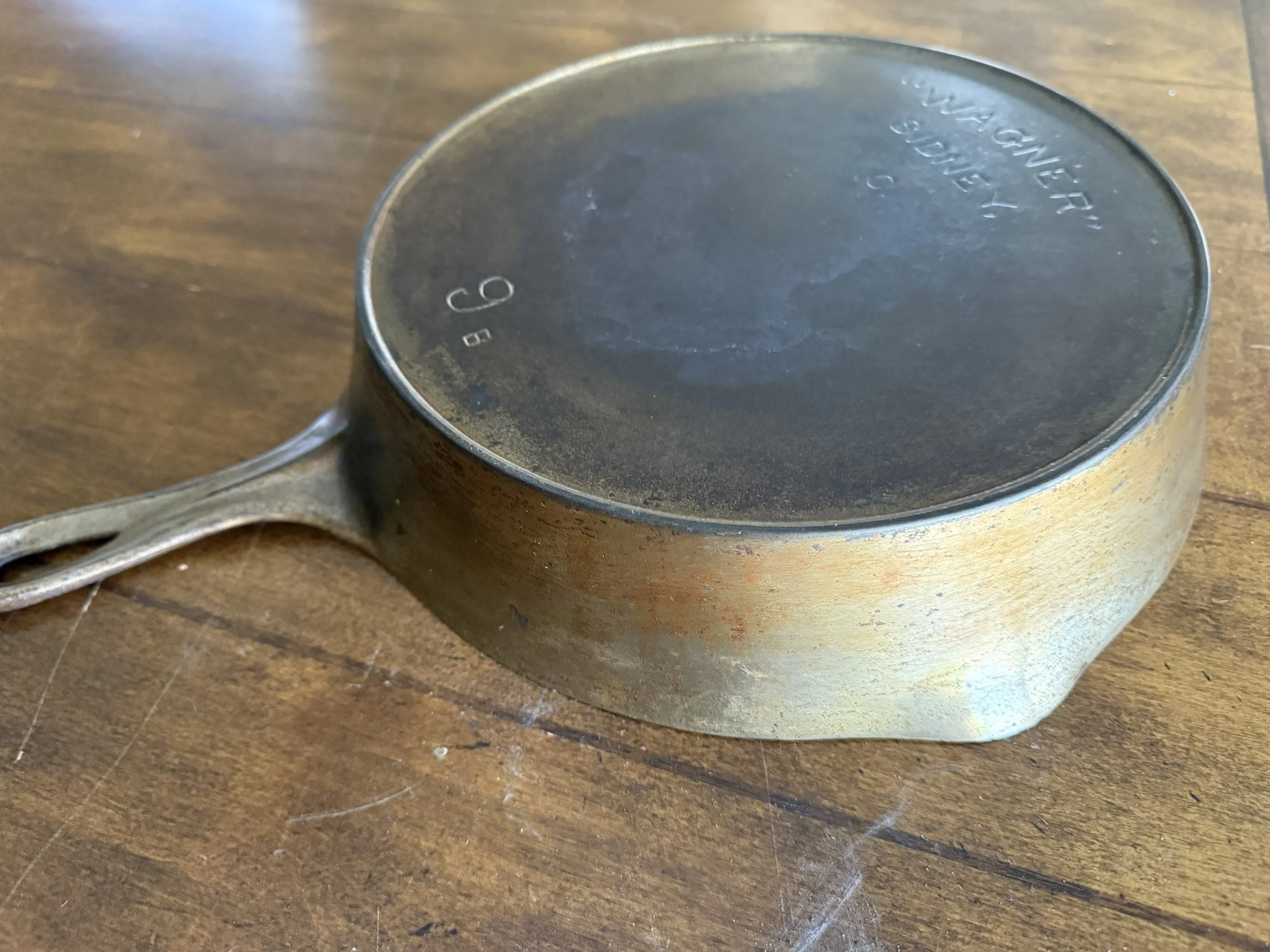
Profile view showing the distinctive golden-silver patina of aged original nickel plating on the sidewalls and base. This is what a century of undisturbed nickel plating looks like—not the bright silver of a new plating job, but a warm, tonal surface that records a hundred years of handling, storage, and atmospheric exposure without ever being stripped or refinished. The “WAGNER” SIDNEY, O. marking and “9 B” designation are visible on the base. The nickel on this piece must never be disturbed.
This is early Wagner. The marking on the base reads “WAGNER” in quotation marks, followed by SIDNEY, O.—with a comma after SIDNEY and a period after O. This is the arc/block letter trademark that Wagner used from the company’s earliest years through approximately 1924, before the stylized interlocking-W logo was introduced. The quotation marks around WAGNER are a distinctive feature of this early period and are not present on any later Wagner production. A collector who recognizes this mark immediately knows they are looking at first-generation or early-second-generation Wagner—iron from the era when the Wagner brothers themselves were running the foundry.
And this one is nickel-plated. The warm, golden-silver tone visible across the sidewalls, the base, and the handle is not bare iron showing through worn seasoning. It is the original factory nickel plating—applied at the Sidney foundry sometime between 1892 (when Wagner introduced nickel-plated ware) and approximately 1924 (when the trademark changed). A century of atmospheric exposure has mellowed the originally bright nickel into a rich, warm patina that collectors of plated ware prize above all else: the look of genuine age on an undisturbed original surface.
The SSC collection now holds two nickel-plated Wagner skillets from two different trademark periods: this No. 9 from the early arc logo era (c. 1891–1924) and the No. 4 (pattern 1054) from the stylized logo era (c. 1924–1935). Together, they document the full span of Wagner’s nickel-plated production across both major trademark periods—and both carry the same preservation mandate: the nickel stays.
Reading the Early Mark

Bottom view showing the early arc/block letter trademark: “WAGNER” in quotation marks, SIDNEY, (with comma), O. (with period), and the size/mold designation “9 B” below. The quotation marks around WAGNER are the signature feature of this early trademark period—they do not appear on any later Wagner production. The nickel plating is visible as the lighter-toned surface surrounding the marking area, with the base showing the expected wear pattern of a piece that sat on stove lids for decades.
The early Wagner trademark carries several features that distinguish it from later production. The quotation marks around “WAGNER” served as a trademark indicator in the pre-1924 era—a way of signaling that WAGNER was a registered brand name, not merely a description. The comma after SIDNEY and the period after O. are punctuation conventions that disappeared in the stylized logo era. And the “B” after the size numeral 9 is a mold letter—an internal foundry designation that identified which specific pattern mold was used to cast this particular piece, allowing Wagner’s quality control to trace any casting defect back to its source mold.
For the collector, this combination of features—quotation marks, punctuation, and mold letter—places the piece firmly in Wagner’s first three decades of production. Combined with the nickel plating (introduced 1892), the dating window narrows to approximately 1892–1924. This is Wagner iron from the era when Milton, Bernard, and William Wagner were personally overseeing the foundry that bore their name.
Piece Details
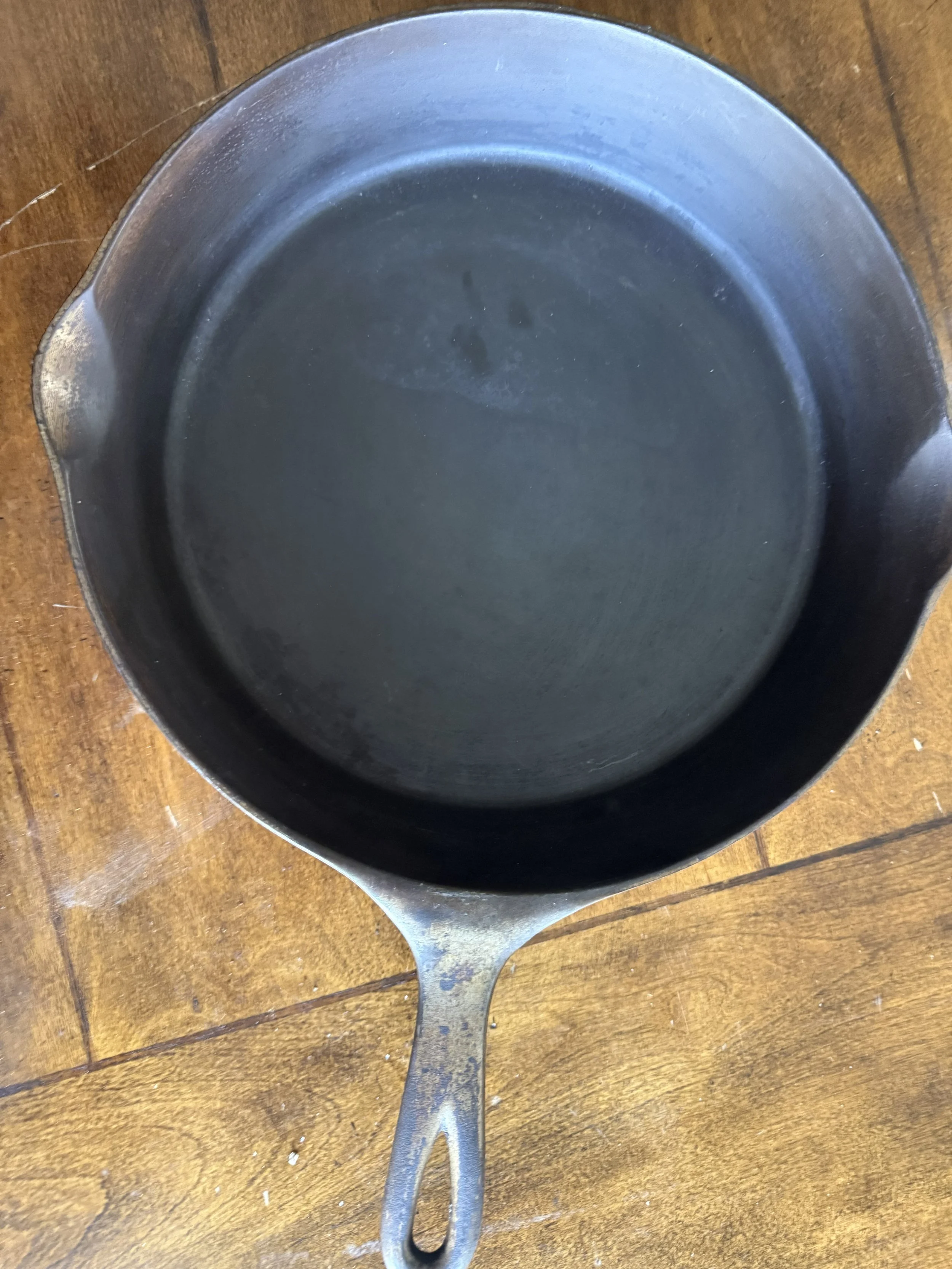
Top view showing the seasoned cooking interior, dual pour spouts at opposing rim positions, and the flat handle with teardrop hanging loop. The smooth, dark cooking surface contrasts with the nickel-plated exterior visible at the rim edge and handle—the intended configuration: seasoned inside for cooking, plated outside for appearance and corrosion resistance.
Manufacturer
Wagner Manufacturing Co.
Piece Type
No. 9 Skillet (nickel-plated)
Size / Mold
No. 9 B
Base Marking
“WAGNER” (in quotation marks) / SIDNEY, / O. / 9 B
Trademark Period
Arc/block letter with quotation marks (c. 1891–1924)
Surface Finish
Original factory nickel plating (exterior); seasoned cooking surface (interior)
Bottom Configuration
Smooth base, no heat ring
Pour Spouts
Two opposing spouts at rim
Handle
Flat handle with teardrop hanging loop
Date of Manufacture
Circa 1892–1924 (nickel plating introduced 1892; arc logo period ends c. 1924)
Place of Manufacture
Sidney, Shelby County, Ohio
Preservation Status
Original nickel plating preserved; no restoration applied; Archival Black™ protocol
Condition
Very Good — original nickel plating with warm aged patina; legible early mark with quotation marks; sits flat; no cracks; seasoned interior
Acquisition Date
August 19, 2025
Acquisition Source
eBay — Seller: gabbog2
eBay Item Number
116344171162
Order Number
03-13480-77655
SSC Catalog Number
SSC-WAGNER-SKL-9-NP-001
Collection Designation
Wagner Specialty & Variant Collection
The Nickel Patina: What a Century of Age Looks Like
The profile photograph of this skillet shows exactly what collectors and museum professionals mean when they talk about aged nickel patina. The sidewalls display a warm, golden-silver tone—not the bright, mirror-like silver of freshly applied nickel, but a mellowed, complex surface that has developed over approximately a century of atmospheric exposure. The tone varies across the surface: warmer where the iron beneath has influenced the color through microscopic porosity in the plating, cooler where the nickel layer is thickest and most intact, and subtly darker near the base where heat exposure during the skillet’s working life left its thermal signature.
This is what original patina looks like on nickel-plated cast iron. It is not damage. It is not deterioration. It is the natural aging of a metallic surface that was applied more than a hundred years ago and has been interacting with its environment ever since. Every tonal variation is a record of time, temperature, humidity, and handling. Remove this surface—strip it, polish it, re-plate it—and you replace a century of authentic history with a surface that is hours old and tells no story at all.
The SSC Archival Black™ protocol is unambiguous: this nickel patina will not be disturbed. No electrolysis. No sandblasting. No polishing compounds. No wire brushing. No chemical treatments. The piece will be presented to the public exactly as these photographs show it—with the warm, complex, age-appropriate surface that makes it unmistakably what it is: a piece of early Wagner nickel-plated ware that has survived a century with its factory finish intact. The patina is not a flaw to be corrected. The patina is the evidence.
Two Nickel Wagners: Spanning the Trademark Eras
The SSC Wagner Specialty & Variant Collection now holds two nickel-plated skillets that together span the full arc of Wagner’s plated production. The No. 9 (this piece) carries the early arc/block letter mark with quotation marks, dating it to approximately 1892–1924—the era of the Wagner brothers’ personal ownership. The No. 4 (pattern 1054, SSC-WAGNER-SKL-4-NP-001) carries the stylized interlocking-W logo with an outer heat ring, dating it to approximately 1924–1935—the era of Wagner’s peak production and brand recognition.
Together, they document a forty-year span of nickel-plated production from a single Sidney foundry. The early No. 9 shows the warm aged patina of plating that may be 130 years old. The later No. 4 shows the brighter, more uniform surface of plating from the 1920s–1930s. The two pieces side by side on a display shelf tell the story of how nickel ages—how time, temperature, and atmospheric chemistry transform a bright factory finish into the complex, tonal surface that makes original plated pieces so valued by serious collectors.
Both pieces carry the same preservation mandate. Neither will be restored. Neither will be stripped. Neither will be polished. The nickel on both pieces is the artifact, and the SSC collection will protect it as long as the website stands.
Wagner Trademark Evolution
1891
Wagner Manufacturing Co. established in Sidney, Ohio. The initial trademark uses block letters with “WAGNER” in quotation marks—the mark on this No. 9 skillet.
1892
Nickel-plated ware introduced. This No. 9 could date from as early as this year.
1891–1924
The arc/block letter period: “WAGNER” in quotation marks, SIDNEY with comma, O with period. Mold letters (like the “B” on this piece) are used for quality control tracking.
c.1924
The stylized interlocking-W “Wagner Ware Sidney -O-” logo is introduced, replacing the arc/block letter mark. The No. 4 nickel-plated skillet (SSC-WAGNER-SKL-4-NP-001) dates from this later period.
1952–53
Wagner sold to the Randall Company. The arc/block letter mark has been obsolete for nearly thirty years by this point.
Why This Piece Matters
The “WAGNER” Sidney, O. No. 9 nickel-plated skillet is among the earliest pieces in the SSC Wagner collection by trademark dating. The quotation marks around WAGNER, the punctuated city and state, and the mold letter all point to production during the first three decades of the company’s existence—the era when the founders were still running the foundry. That this piece also carries its original nickel plating, with a warm aged patina that records a century of undisturbed existence, makes it doubly significant: it is both an early Wagner and a preserved nickel Wagner, two characteristics that rarely survive together.
The No. 9 is also the most practical of the nickel-plated sizes in the collection. Where the No. 4 is a small, single-serving piece, the No. 9 is a full-sized family skillet—approximately 11 inches across the top, large enough to fry chicken, sear a roast, or cook breakfast for a household. That a piece this size, used this hard, in this many kitchens over this many decades, still retains its original nickel plating is a testament to the durability of Wagner’s electroplating process and to every owner who had the sense to leave it alone.
The iron endures. The markings tell the truth. The story deserves to be told.
Sources & Further Reading
CastIronCollector.com — Wagner Manufacturing Co.: trademark evolution from arc/block letters (1891–1924) to stylized logo (1924–1959); nickel-plated ware introduced 1892.
CastIronCollector.com — Evolution of the Wagner Trademark: detailed chronology of mark changes including quotation marks, punctuation conventions, and mold letter usage.
SSC Internal Collection Records — Wagner Specialty & Variant Collection: companion piece SSC-WAGNER-SKL-4-NP-001 (stylized logo period nickel-plated No. 4).
About Steve’s Seasoned Classics
Steve’s Seasoned Classics is an online museum dedicated to preserving and documenting the heritage of American cast iron, with a focus on Ohio foundry pieces from the 19th and early 20th centuries. The SSC collection features over 130 pieces with detailed provenance, historical research, and photography for each item.
