Wagner Ware Sidney -O- No. 7 Cast Iron Skillet
SSC MUSEUM COLLECTION
Catalog No. SSC-WAGNER-SKL-7G-001
Stylized Logo | No. 7 G | Smooth Bottom | Sidney, Ohio
Circa 1935–1959 • Wagner Manufacturing Co. • Wagner Specialty & Variant Collection
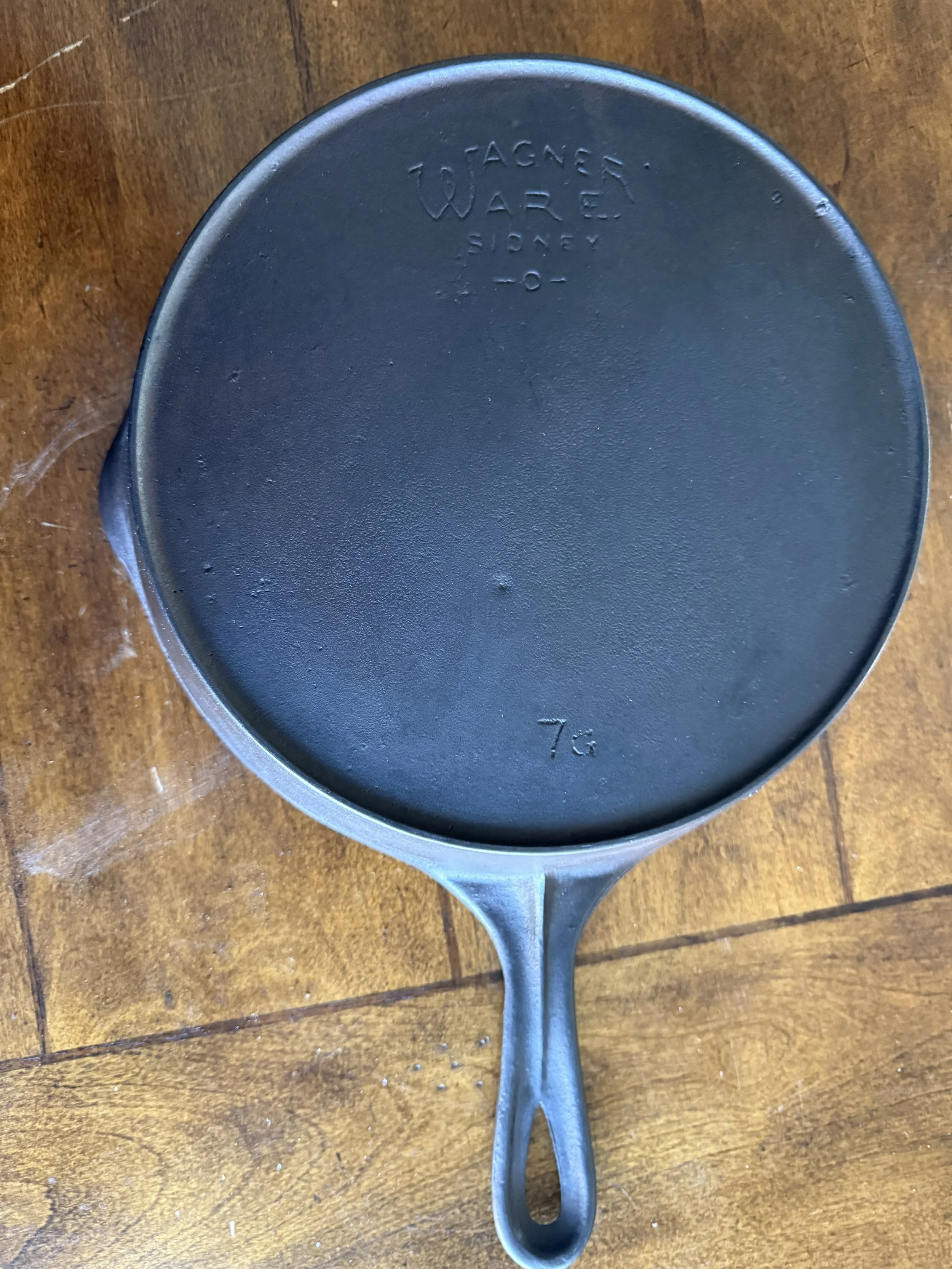
Bottom view showing the stylized “Wagner Ware Sidney -O-” trademark and the size/mold designation “7 G” near the handle. The smooth bottom with no heat ring dates this piece to the mid-to-late stylized logo period (c. 1935–1959), after Wagner transitioned away from heat-ringed production for gas and electric stove compatibility. The seasoning on this piece is deep and even—the mark of decades of careful use.
Every cast iron collector knows the Wagner No. 8. It is the most common size, the most frequently found at flea markets and estate sales, the skillet that turns up in every antique mall in Ohio. The No. 10 runs a close second. Between them, the 8 and the 10 account for the vast majority of Wagner skillets in circulation. Ask a collector about Wagner and these are the sizes they picture.
The No. 7 is different. It is the in-between size—approximately 9¼ inches across the top rim, slotted between the medium No. 6 and the full-sized No. 8. It was not the best seller. It was not the most versatile. It was the size that a household bought when they already had the 8 and the 10 and wanted something that filled the gap: large enough for a proper meal, small enough for efficient heating, and just right for sautéing vegetables, frying eggs for two, or making a pan sauce. The No. 7 was the specialist, and specialists were produced in smaller quantities than generalists.
That is why the Etsy seller’s description called this piece “harder to find.” The No. 7 in the stylized logo period is not rare in the formal sense—it is not a one-of-a-kind foundry piece or a Civil War kettle. But it is genuinely less common than its neighboring sizes, and a clean example with good seasoning and legible markings commands attention from collectors who understand the Wagner size spectrum. The “G” mold letter after the size numeral is a foundry quality-control designation that identified which specific pattern mold was used to cast this piece, allowing Wagner to trace any defect back to its source.
Piece Details

Top view showing the beautifully seasoned cooking interior, dual pour spouts at opposing rim positions, and the flat handle with teardrop hanging loop. The cooking surface is smooth and even—the machine-polished finish that Wagner was famous for, now enhanced by decades of seasoning. This is a skillet that was used, cared for, and passed on.
Manufacturer
Wagner Manufacturing Co.
Brand
Wagner Ware
Piece Type
No. 7 Skillet
Size / Mold
No. 7 G
Base Marking
Stylized “Wagner Ware Sidney -O-” / 7 G
Surface Finish
Seasoned cast iron (standard finish)
Bottom Configuration
Smooth base, no heat ring
Pour Spouts
Two opposing spouts at rim
Handle
Flat handle with teardrop hanging loop
Logo Period
Stylized Wagner Ware, smooth bottom (c. 1935–1959)
Date of Manufacture
Circa 1935–1959
Place of Manufacture
Sidney, Shelby County, Ohio
Condition
Excellent — deep even seasoning; legible markings; sits flat; no cracks; smooth cooking surface
Acquisition Date
January 6, 2026
Acquisition Source
Etsy — Seller: CastAndClaraBell
Etsy Order Number
3935669130
Transaction Number
4922090319
SSC Catalog Number
SSC-WAGNER-SKL-7G-001
Collection Designation
Wagner Specialty & Variant Collection
The No. 7: Wagner’s Overlooked Middle Size
Cast iron skillet sizes follow a numbering system inherited from the wood and coal stove era, when each size number corresponded to a specific stove lid opening. By the time Wagner was producing smooth-bottom skillets for gas and electric stoves in the 1930s through 1950s, the size numbers had become a traditional designation rather than a functional specification—but the production quantities still reflected consumer preferences that had been established decades earlier.
The No. 8 (approximately 10¼ inches) was the all-purpose family skillet—the default size, the wedding gift, the piece every kitchen needed. The No. 10 (approximately 11¾ inches) was the big skillet for Sunday dinner, for frying chicken, for feeding a crowd. Between them, these two sizes dominated sales and production. The No. 7 occupied a middle position that was useful but not essential: at approximately 9¼ inches, it was a two-person skillet, a sauté pan, a breakfast skillet for a couple rather than a family. Households that owned a No. 8 did not always need a No. 7, and households that were buying their first skillet reached for the 8.
The result is that the No. 7 was produced in smaller quantities than the 8 or 10, and fewer survive in the collector market. This does not make it rare—Wagner produced millions of skillets across all sizes—but it makes a clean, well-marked example like this one a more interesting find than yet another No. 8. For the SSC Wagner Specialty & Variant Collection, which is designed to document the full range of Wagner’s production beyond the most common pieces, the No. 7 fills an important gap.
The Smooth Bottom: Wagner’s Transition to Modern Stoves
This skillet has a smooth bottom with no heat ring—the feature that most clearly dates it within the stylized logo period. Wagner’s transition from heat-ringed to smooth-bottom production reflected the wholesale transformation of American kitchens from wood and coal stoves to gas and electric ranges during the 1930s and 1940s.
The heat ring—a raised ridge around the perimeter of the skillet’s base—had been standard on cast iron cookware since the nineteenth century. It seated the skillet into the circular opening of a stove lid, providing stable contact and efficient heat transfer from the fire below. But a gas burner or an electric coil does not have a circular opening. A heat ring on a flat-topped range is a liability: it creates a gap between the skillet’s cooking surface and the heat source, reducing efficiency and stability. The smooth bottom solves this problem by providing full, flat contact with the range surface.
Wagner began producing smooth-bottom skillets in the early-to-mid 1930s, and by the late 1930s the transition was essentially complete for new production. Skillets with the stylized Wagner Ware logo and a smooth bottom—like this No. 7G—date from approximately 1935 to 1959, the last two decades of Wagner family and early Randall-era production. They represent the mature phase of Wagner’s design evolution: the stylized logo at its most refined, the smooth bottom for modern stove compatibility, and the machine-polished cooking surface that made Wagner iron the standard against which all other cast iron was measured.
Wagner in the SSC Collection
The SSC Wagner Specialty & Variant Collection is not an attempt to collect every Wagner skillet ever made—that would be an exercise in accumulation, not curation. Instead, the collection documents the range of Wagner’s production through carefully selected pieces that each tell a different part of the story. The nickel-plated No. 9 (SSC-WAGNER-SKL-9-NP-001) tells the story of Wagner’s earliest trademark period and its premium plated finish. The nickel-plated No. 4 (SSC-WAGNER-SKL-4-NP-001) shows the same premium finish under the later stylized logo. The No. 7 saucepan (SSC-WAGNER-SAU-7-1935-001) documents Wagner’s range beyond skillets. And this No. 7G skillet fills a specific curatorial need: a less common size in the stylized logo period, with exceptional seasoning and a smooth bottom that documents the transition to modern stove technology.
Together, these Wagner pieces—alongside the documented complete Sidney-O skillet set (Nos. 0–14)—present Wagner Manufacturing Company not as a brand name to be collected for its own sake, but as a foundry whose products document the evolution of American domestic technology from wood stoves to gas ranges, from nickel plating to seasoned iron, from heat rings to smooth bottoms. Each piece is a document. Each document tells a story. And the No. 7G’s story is about the size that fell between the cracks of consumer preference—and survived anyway.
Why This Piece Matters
The Wagner Ware No. 7G matters because it represents the road less traveled in Wagner collecting. It is not the common size. It is not the showpiece size. It is the size that a knowledgeable cook chose deliberately, because they understood that a 9¼-inch skillet does things that a 10¼-inch skillet cannot: it heats faster, it concentrates fond more effectively, it makes a better pan sauce, and it handles with one hand more comfortably. The No. 7 was the cook’s choice, not the catalog’s choice—and that distinction is exactly what the Wagner Specialty & Variant Collection exists to preserve.
The iron endures. The markings tell the truth. The story deserves to be told.
Sources & Further Reading
CastIronCollector.com — Wagner Manufacturing Co.: trademark evolution, smooth bottom transition timeline, size numbering conventions.
CastIronCollector.com — Evolution of the Wagner Trademark: stylized logo period dating (c. 1924–1959); heat ring to smooth bottom transition (c. 1935).
SSC Internal Collection Records — Wagner Specialty & Variant Collection: companion pieces SSC-WAGNER-SKL-4-NP-001, SSC-WAGNER-SKL-9-NP-001, SSC-WAGNER-SAU-7-1935-001.
About Steve’s Seasoned Classics
Steve’s Seasoned Classics is an online museum dedicated to preserving and documenting the heritage of American cast iron, with a focus on Ohio foundry pieces from the 19th and early 20th centuries. The SSC collection features over 130 pieces with detailed provenance, historical research, and photography for each item.
