Wagner Ware Sidney -O- No. 7 Cast Iron Saucepan
SSC MUSEUM COLLECTION
Catalog No. SSC-WAGNER-SAU-7-1935-001
Stylized Logo | No. 7 Saucepan with Bail Handle | Sidney, Ohio
Circa 1924–1959 • Wagner Manufacturing Co. • Restored & Seasoned by SSC

Bottom view showing the stylized “Wagner Ware Sidney -O-” trademark—the signature logo of Wagner Manufacturing Company’s mature production period (c. 1924–1959). A pattern number is visible below the logo. The smooth base with no heat ring is consistent with post-1920s Wagner production. This piece was restored, seasoned, and preserved by SSC using the Archival Black™ protocol.
Wagner Ware needs no introduction in the cast iron collecting world. The Wagner Manufacturing Company of Sidney, Shelby County, Ohio is one of the most recognized and most collected names in American cast iron—a company whose stylized trademark, with its distinctive interlocking “W” letterforms, is instantly identifiable to anyone who has ever turned over a piece of vintage cookware. This No. 7 saucepan carries that trademark on its base, placing it squarely in Wagner’s mature production period between approximately 1924 and 1959.
But in the SSC collection, this Wagner saucepan does something that the Pre-1905 pieces cannot do: it demonstrates the other side of the Archival Black™ preservation protocol. Where the Shinnick kettle and the Wells kettle will never be restored—their 160-year-old surfaces are too historically significant to disturb—this Wagner saucepan arrived in the SSC collection in condition that warranted intervention. It was degreased, cleaned by electrolysis, and re-seasoned by SSC using only non-destructive methods. The result is the piece you see in these photographs: a clean, well-seasoned Wagner saucepan with its original casting intact, its marking fully legible, and a surface that is ready for display or cooking.
The distinction matters. The Archival Black™ protocol is not a blanket “never touch” policy. It is a decision framework that evaluates each piece individually. For a one-of-a-kind Civil War kettle from an undocumented foundry, the original surface is the artifact and must be preserved at all costs. For a Wagner Ware saucepan—a piece from a well-documented foundry, produced in substantial quantities, with no unique surface history that would be lost—responsible restoration using non-destructive methods is not only acceptable but appropriate. The goal in both cases is the same: to present the piece in the condition that best serves its role as a museum document. For the Shinnick kettle, that means original patina. For this Wagner saucepan, that means a clean, seasoned surface that shows the casting quality Sidney was famous for.
Piece Details

Top view showing the deep saucepan bowl with clean, seasoned interior—restored by SSC. The wire bail handle pivots on cast ears at the rim. The flat handle with teardrop hanging loop extends from one side. Dual pour spouts at opposing rim positions. The casting quality is characteristic of Wagner’s Sidney production: smooth walls, even thickness, and clean lines.
Manufacturer
Wagner Manufacturing Co.
Brand
Wagner Ware
Piece Type
No. 7 Saucepan with Bail Handle
Size Number
No. 7
Base Marking
Stylized “Wagner Ware Sidney -O-” with pattern number
Bottom Configuration
Smooth base, no heat ring
Pour Spouts
Two opposing spouts at rim
Handle
Flat handle with teardrop hanging loop; wire bail handle
Logo Period
Stylized Wagner Ware (c. 1924–1959)
Date of Manufacture
Circa 1924–1959 (stylized logo period)
Place of Manufacture
Sidney, Shelby County, Ohio
SSC Restoration
Degreased, electrolysis cleaned, and re-seasoned by SSC (non-destructive methods only)
Condition
Excellent — restored and seasoned by SSC; legible marking; bail intact; no cracks; display and use ready
Acquisition Date
November 11, 2025
Acquisition Source
ShopGoodwill — Goodwill Industries of the Inland Northwest
Order Number
58560778
SSC Catalog Number
SSC-WAGNER-SAU-7-1935-001
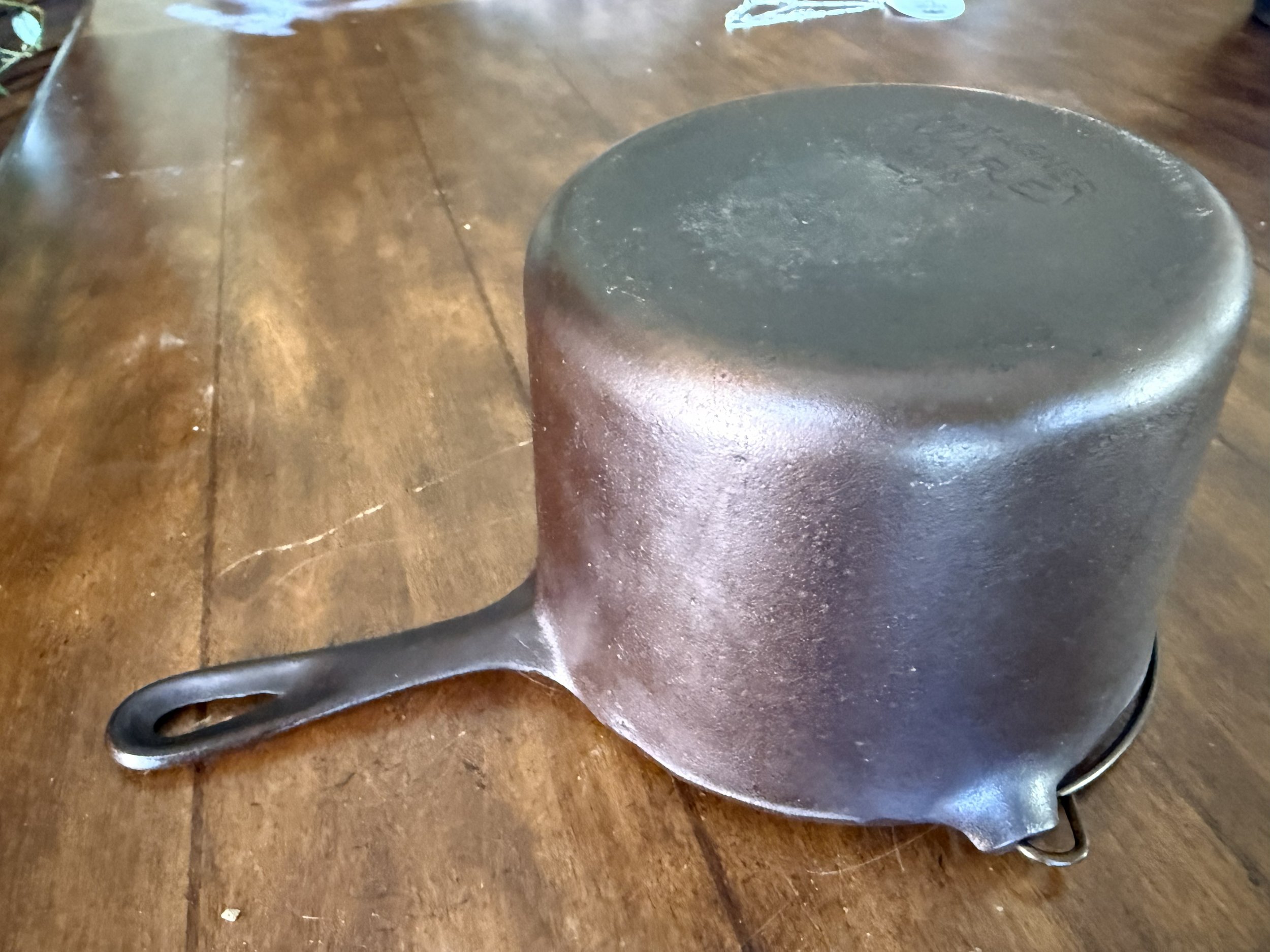
Profile view showing the deep saucepan form, the flat handle at left, and the bail handle at right. The saucepan’s depth—substantially greater than a skillet of the same diameter—made it the preferred vessel for heating liquids, making sauces, and warming soups on the stovetop. The Wagner Ware marking is visible on the base.
Archival Black™: When Restoration Is the Right Choice
The SSC collection includes pieces that span 162 years of Ohio cast iron production—from an 1863 Civil War kettle to mid-twentieth-century Wagner Ware. The Archival Black™ preservation protocol must be flexible enough to serve all of them, and that means making piece-by-piece decisions about when to preserve original patina and when to restore.
The decision framework is straightforward. If a piece’s original surface is historically irreplaceable—because the piece is extremely old, because the foundry is undocumented, because the surface itself tells a story that cannot be recovered once lost—then the surface is preserved as-is, with only the most minimal stabilization of active corrosion. The Shinnick Hattan kettle (1863), the H. Wells & Bro. kettle (1867), and the Marion Stove Co. lid lifter with original nickel plating all fall into this category. Their surfaces are documents, and SSC will not erase them.
But when a piece is from a well-documented foundry, was produced in substantial quantities, and carries no unique surface history that would be lost to cleaning—then responsible restoration using non-destructive methods is not only acceptable but preferred. This Wagner Ware No. 7 saucepan is exactly such a piece. Wagner Manufacturing Co. is one of the most thoroughly documented foundries in American cast iron history. The stylized “Wagner Ware Sidney -O-” logo is one of the most recognized marks in the hobby. Tens of thousands of Wagner saucepans survive in collector and kitchen use. The piece’s historical value lies in its casting quality, its marking, and its place in Wagner’s product line—not in any irreplaceable surface patina.
SSC’s restoration of this piece followed the Archival Black™ non-destructive protocol: lye degreasing to remove accumulated organic buildup, electrolysis to address rust and oxidation, and re-seasoning with food-grade oil baked at high temperature. No grinding. No sanding. No sandblasting. No chemical stripping beyond lye. The casting itself was not altered in any way—only the surface layers that obscured the original iron were removed, and a new seasoning layer was applied to protect the piece and present it in cooking-ready condition. The result is a saucepan that looks as close to its original factory condition as non-destructive methods can achieve.
Wagner Manufacturing Co.: Sidney’s Greatest Foundry
Wagner Manufacturing Company was established in Sidney, Shelby County, Ohio in 1891 by brothers Milton M. and Bernard P. Wagner. Their first superintendent was R.O. Bingham—previously of the Marion Stove Works, the same company whose lid lifter is documented elsewhere in the SSC collection. From the beginning, Wagner was a quality-first operation, and by 1913 its products were distributed worldwide.
The stylized “Wagner Ware” logo on this saucepan dates the piece to the company’s mature period, approximately 1924 to 1959. This was the era when Wagner was at the peak of its production and reputation—producing a full line of cast iron and cast aluminum cookware that competed directly with Griswold of Erie, Pennsylvania for the title of America’s finest hollow ware manufacturer. The saucepan was one of Wagner’s workhouse forms: a deep vessel for heating liquids, making sauces, boiling eggs, and warming soups, with a bail handle for hanging over a fire or carrying and a flat handle for stovetop maneuvering.
Wagner’s Sidney operation continued until 1952–1953, when the heirs of the original Wagner brothers sold the company to the Randall Company of Cincinnati. Production continued under various corporate owners until the brand eventually passed to General Housewares Corporation and then ceased domestic production. The Sidney foundry is gone, but Wagner Ware remains one of the most collected and most used names in American cast iron—a testament to the quality of what the Wagner brothers built in a small Shelby County town beginning in 1891.
Corporate Timeline: Wagner Manufacturing Co.
1891
Milton M. and Bernard P. Wagner establish Wagner Manufacturing Co. in Sidney, Shelby County, Ohio. R.O. Bingham of Marion Stove Works joins as superintendent.
1892
Nickel-plated ware added to the product line.
1894
Cast aluminum ware added—one of the earliest producers of aluminum cookware in the United States.
1913
Wagner products distribution extends worldwide.
c.1924
The stylized “Wagner Ware Sidney -O-” logo is introduced, beginning the mark period represented by this saucepan.
1934
Magnalite brand cast aluminum ware introduced.
1952–53
Wagner heirs sell the company to the Randall Company of Cincinnati, Ohio.
1959
Wagner Manufacturing Co. production in Sidney effectively ends under Randall ownership.
1969
General Housewares Corporation acquires both Wagner and Griswold brands from Randall.
Why This Piece Matters
The Wagner Ware No. 7 saucepan serves two roles in the SSC collection. First, it represents Wagner Manufacturing Company—Sidney’s greatest foundry, the crown jewel of the Ohio Foundry Corridor, and the benchmark against which all other Ohio cast iron is measured. No SSC collection would be complete without Wagner, and this saucepan—with its stylized logo, its bail handle, its deep saucepan form, and its excellent restored condition—is a fine representative of the brand at its peak.
Second, and perhaps more importantly for the SSC mission, this piece demonstrates the Archival Black™ protocol in action. By presenting this Wagner saucepan alongside the unrestored Pre-1905 pieces, the SSC collection shows visitors that preservation is not a one-size-fits-all approach. The right treatment depends on the piece: its age, its rarity, its surface history, and its role in the collection. This Wagner was restored because restoration served the piece. The Shinnick kettle was not restored because preservation served the piece. Both decisions were correct. Both are part of the same philosophy: present each piece in the condition that best honors its history and serves the visitor’s understanding.
The iron endures. The markings tell the truth. The story deserves to be told.
Sources & Further Reading
CastIronCollector.com — Wagner Manufacturing Co. reference page: Sidney, Shelby County, Ohio; founded 1891; R.O. Bingham superintendent; stylized logo c. 1924–1959; sale to Randall 1952–53.
SSC Internal Collection Records — Wagner Ware Sidney-O complete skillet set documentation (Nos. 0–14); Marion Stove Works / R.O. Bingham connection.
About Steve’s Seasoned Classics
Steve’s Seasoned Classics is an online museum dedicated to preserving and documenting the heritage of American cast iron, with a focus on Ohio foundry pieces from the 19th and early 20th centuries. The SSC collection features over 130 pieces with detailed provenance, historical research, and photography for each item.
