Wagner Manufacturing Company — Square Cast Iron Waffle Iron (Tall Enclosed Base)
SSC MUSEUM COLLECTION
Catalog No. SSC-WGNR-WFL-SQ-TB-001
Wagner | Square Waffle Iron | Sidney, Ohio
Wagner Manufacturing Company • Sidney, Shelby County • Founded 1891 • Patented July 26, 1892

Top view of the Wagner square waffle iron showing the full marking on the upper lid: “WAGNER / WAFFLE IRON / PAT’D JULY 26 / 1892.” The square form, wire bail handle on the tall enclosed base, and turned wood handle on the lower paddle are all visible. This is the most substantial of Wagner’s three founding-era waffle iron configurations.
This is the third and final piece in the SSC’s Wagner waffle iron design evolution grouping—and it is the most dramatically different of the three. Where the low-base (SSC-WGNR-WFL-8-LB-001) and high-base (SSC-WGNR-WFL-8-HB-001) variants are round-paddled No. 8 waffle irons on ring-style bases, this piece is a square waffle iron seated in a tall enclosed box-style base stand. Same patent date. Same foundry. Same July 26, 1892 marking. But a completely different form—one that transforms the waffle iron from an open stovetop tool into something closer to an oven.
The tall enclosed base is the defining feature of this variant. Instead of a ring or pedestal that holds the lower paddle in open air, this base is a deep, solid-walled box that fully surrounds the lower waffle plate. The result is a chamber that traps and circulates heat around the waffle, baking it more evenly and retaining temperature longer than the open-base designs. The turned wood handle on the lower paddle extends through the base wall, and a wire bail on the base frame provides a lift point for the entire assembly. The upper lid is hinged at the rear and marked with the Wagner name and patent date.
The square form itself is notable. Most American waffle irons of this era were round. The square plates produce a square waffle—four quadrants of grid pattern, just like the round models, but in a shape that tiles more efficiently on a plate, stacks more neatly, and sits more naturally beside bacon and eggs. The square form also allows the tall enclosed base to be a simple box rather than a cylinder, making it easier to cast and more stable on the stove top.
Piece Details

Profile view showing the tall enclosed box base that distinguishes this variant from the low-base and high-base round models. The marking “WAFFLE IRON / PAT’D JULY 26 / 1892” is visible on the upper lid. The turned wood handle extends through the base wall. The deep solid walls of the base create an enclosed chamber around the lower waffle plate for superior heat retention.
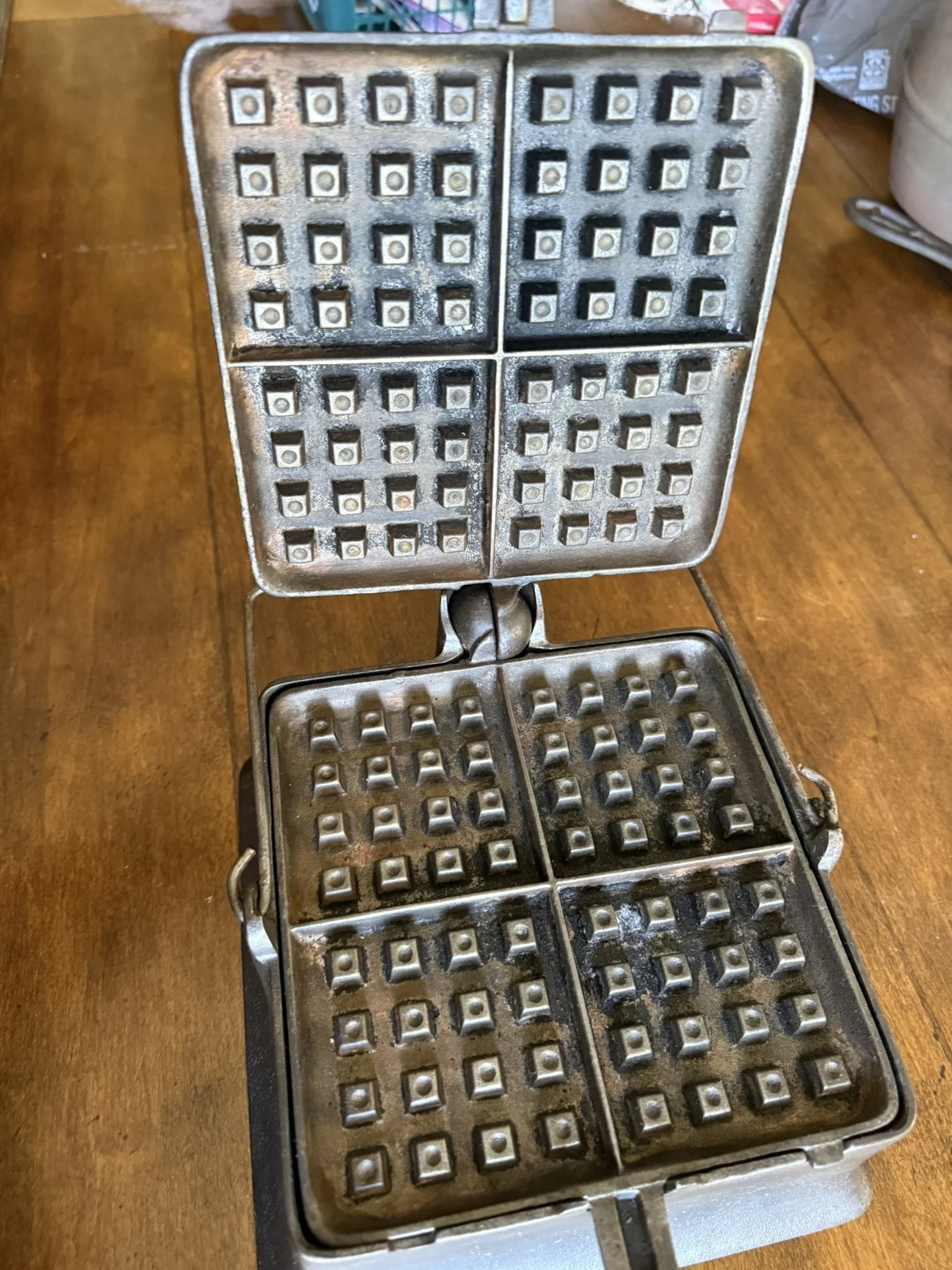
Open view showing both square waffle plates. The upper lid is hinged open to reveal matching four-quadrant square grid patterns on both cooking surfaces. The square wells with center buttons are identical in design to those on the round No. 8 models—the same waffle pattern cast into a different plate shape. The enclosed base walls are visible surrounding the lower plate.
Manufacturer
Wagner Manufacturing Company (Sidney, Ohio)
Piece Type
Cast iron square waffle iron with tall enclosed base stand
Shape
Square
Patent Date
July 26, 1892
Material
Cast iron paddles and tall enclosed box base; turned wood handle; wire bail on base
Construction
Two-piece hinged square waffle iron paddles seated in a tall enclosed box-style base stand; upper paddle hinged at rear; turned wood handle on lower paddle extending through the base; wire bail handle on base for lifting; the tall enclosed base fully surrounds the lower paddle, creating an oven-like chamber that retains heat for more even baking
Waffle Pattern
Square grid pattern divided into four quadrants by cross channels; raised square wells with center buttons on both upper and lower plates
Marking
“WAGNER / WAFFLE IRON / PAT’D JULY 26 / 1892” cast in raised letters on the upper lid exterior
Base Type
Tall enclosed base — a deep box-style stand with solid walls that fully enclose the lower paddle; the most substantial and thermally efficient of Wagner’s waffle iron base configurations
Date of Manufacture
c. 1892 or later (patent date July 26, 1892; first-generation Wagner production)
Place of Manufacture
Sidney, Shelby County, Ohio
Condition
Very Good — marking legible; both square waffle plates intact with full grid pattern; hinge mechanism functional; original turned wood handle present; wire bail intact; tall base structurally sound; no cracks or structural damage
Acquisition Date
November 5, 2025
Acquisition Source
eBay — Seller: vdub023
eBay Item Number
116706061698
Order Number
17-13782-98929
SSC Catalog Number
SSC-WGNR-WFL-SQ-TB-001
Historical Background
Three Forms, One Patent: The Complete Wagner Waffle Iron Line
The SSC now holds all three known base configurations of Wagner’s founding-era waffle iron, each carrying the July 26, 1892 patent date. Together, they document the full scope of Wagner’s product-line strategy in its first year of production. The low base (SSC-WGNR-WFL-8-LB-001) was the compact, entry-level option at $141.96 on the secondary market. The high base with dual wood handles (SSC-WGNR-WFL-8-HB-001) was the premium round model at $223.81. And this square tall-base (SSC-WGNR-WFL-SQ-TB-001) was the top-of-the-line offering at $292.88—the most iron, the most engineering, and the most thermally sophisticated design.
The price progression on the secondary market mirrors what was almost certainly the original retail hierarchy: the more base, the more handles, the more enclosed the design, the higher the price. Wagner was not selling one waffle iron in 1892. It was selling a waffle iron line—three tiers of the same patented product, each targeted at a different budget and a different kitchen. That is a remarkably mature business strategy for a company in its first year of operations.
The Enclosed Base: Engineering for Even Heat
The tall enclosed base on this waffle iron is not just a stand—it is a thermal management system. By surrounding the lower waffle plate with solid cast iron walls, the base creates a miniature oven chamber that traps heat radiating from the stove eye below. The walls reflect heat back toward the waffle plate, reducing temperature variation across the cooking surface and extending the time the iron stays at baking temperature between waffles. The result is a more evenly baked waffle with less risk of burning on the bottom while the top remains underdone.
This engineering advantage came at a cost—literally. The tall enclosed base requires significantly more iron than a ring or pedestal base, making the piece heavier and more expensive to produce. The solid walls also make the assembly harder to heat initially, as the base itself absorbs heat before the waffle plates reach baking temperature. But once at temperature, the enclosed base holds heat longer and recovers faster between waffles than any open-base design. For a household making waffles in quantity—for a large family, a church breakfast, or a boarding house—the enclosed base was the superior tool.
SSC Collection Context: The Completed Trio
With this square tall-base waffle iron, the SSC’s Wagner waffle iron design evolution grouping is complete. Three pieces. Three base configurations. Three price points. One patent date: July 26, 1892. One foundry: Sidney, Shelby County, Ohio. One story: how two brothers in a small Ohio city launched a manufacturing company and, within their first year, built a three-tier product line that served every kitchen from the budget-conscious to the best-equipped.
No other grouping in the SSC collection documents a single manufacturer’s product-line strategy with this level of depth. The three Wagner waffle irons are a design evolution study in cast iron—each piece carrying the same patent, the same foundry name, and the same waffle pattern, but differing in form, function, and market position. The iron tells the engineering story. The markings tell the manufacturing story. And the three pieces together tell the business story of a company that thought in product lines from the very start.
Round or square. Low or tall. Open or enclosed. The patent is 1892. The foundry is Wagner. And the waffles—from any of the three—came out of Sidney, Ohio.
Wagner Manufacturing Company — Company Timeline
1891
The Wagner Manufacturing Company is founded in Sidney, Shelby County, Ohio by brothers Milton M. and Bernard P. Wagner.
1892
Wagner receives U.S. patent dated July 26, 1892 for its waffle iron design. The company produces the waffle iron in multiple configurations: round paddles with low base, round paddles with high base and wood handles, and square paddles with tall enclosed base stand (this piece).
1890s–1910s
Wagner expands into a full-line cast iron manufacturer. The variety of waffle iron base types demonstrates a sophisticated product-line strategy from the company’s earliest years.
1920s–1940s
Wagner introduces the “Wagner Ware Sidney -O-” trademark. Electric waffle irons begin to supplement and eventually replace stovetop models.
1952
Wagner merges with the Randall Company under Textron’s corporate umbrella.
1959
Textron acquires Griswold Manufacturing Company of Erie, Pennsylvania.
1999
The Sidney foundry closes after more than a century of continuous operation.
2025
Steve’s Seasoned Classics acquires this Wagner square waffle iron with tall base from eBay seller vdub023. The piece is documented as SSC-WGNR-WFL-SQ-TB-001, completing the SSC’s three-piece Wagner waffle iron design evolution grouping.
Why This Piece Matters
This square Wagner waffle iron with its tall enclosed base is the flagship of a three-piece founding-era grouping that represents the most comprehensive documentation of a single Ohio manufacturer’s early product strategy in the SSC collection. It is the most iron. The most engineering. The most expensive on the secondary market. And the most thermally sophisticated of the three designs. It is the piece that a household bought when they wanted the best waffle iron Wagner made—and Wagner made it in its very first year.
For the SSC, this piece completes a story that began with the low-base variant: the story of how the Wagner Manufacturing Company of Sidney, Ohio thought about its market, designed its products, and built its business from the ground up. Three waffle irons. Three bases. One patent. One city. One foundry. And all of it cast in Ohio iron that has lasted more than 130 years.
Sources & Further Reading
Cast Iron Collector — The Wagner Trademark (castironcollector.com): evolution of Wagner logo designs and dating guidelines.
Cast Iron Collector — Waffle Irons (castironcollector.com): reference guide to American cast iron waffle iron forms, base types, and patent dates.
Wagner and Griswold Society (wag-society.org): collector community and foundry reference archive.
eBay listing and invoice documentation — Item 116706061698, Order 17-13782-98929.
About Steve’s Seasoned Classics
Steve’s Seasoned Classics is an online museum dedicated to preserving and documenting the heritage of American cast iron, with a singular focus on the obscure, defunct foundries of Ohio from the 19th and early 20th centuries. The SSC collection spans 130+ pieces from 50+ confirmed Ohio makers — the majority absent from standard collector references. Makers were identified through physical artifacts exhibiting gate marks, patent dates, foundry traits, and documented regional provenance, cross-checked against surviving trade directories, census records, and existing collector guides. Makers lacking representation in published guides but supported by physical evidence were flagged for first-time documentation — a core function of the SSC research mission.
