Wagner Manufacturing Company — No. 8 Cast Iron Waffle Iron (High Base, Wood Handles)
SSC MUSEUM COLLECTION
Catalog No. SSC-WGNR-WFL-8-HB-001
Wagner Mfg. Co. | No. 8 Waffle Iron | Sidney, Ohio
Wagner Manufacturing Company • Sidney, Shelby County • Founded 1891 • Patented July 26, 1892

Top view showing the Wagner No. 8 waffle iron on its high pedestal base. The full marking is visible on the upper paddle exterior: “WAGNER” arched at top, “M’F’G CO SIDNEY. O.” arched below, with “PAT. JULY 26 1892” and size “8” at center. The wire bail handle on the base and the turned wood handle on the lower paddle are visible. This is the high-base variant—the most substantial of Wagner’s waffle iron configurations.
This is the second of two Wagner No. 8 waffle irons in the SSC collection, and together they document the design evolution of Wagner’s founding-era waffle iron line. Where the SSC’s low-base variant (SSC-WGNR-WFL-8-LB-001) sits close to the stove surface with a single wood handle, this high-base variant stands tall on a pedestal ring, features original turned wood handles on both the upper and lower paddles, and includes a wire bail on the base for lifting. Both carry the same July 1892 patent date and the same “Wagner M’F’G Co Sidney. O.” first-generation marking. But the physical differences between the two pieces tell a story about how Wagner served different kitchens, different stoves, and different price points from the very start.
The high base is the most visually impressive of Wagner’s waffle iron configurations. The tall pedestal ring elevates the waffle paddles several inches above the stove surface, providing air circulation around the base and more even heat distribution to the lower paddle. The dual wood handles—one on each paddle—allow the cook to flip the entire assembly without touching hot iron, a significant ergonomic improvement over the single-handle low-base design. The wire bail on the base provides a third grip point for moving the heavy assembly on and off the stove. This is a piece designed for a household that could afford the premium model—more iron, more hardware, more convenience.
The marking on this piece provides the complete patent date that was partially obscured on the low-base variant: “PAT. JULY 26 1892.” July 26, 1892 is now confirmed as the specific date of Wagner’s waffle iron patent—less than a year after the company’s 1891 founding. This is a founding-era product from a company that would go on to operate for more than a century.
Piece Details

Profile view showing the high pedestal base that distinguishes this variant from the low-base model. The tall ring base elevates the waffle paddles well above the stove surface. The original turned wood handle is visible on the lower paddle at right. The concentric ring pattern on the base bottom and the substantial depth of the pedestal are clearly visible.
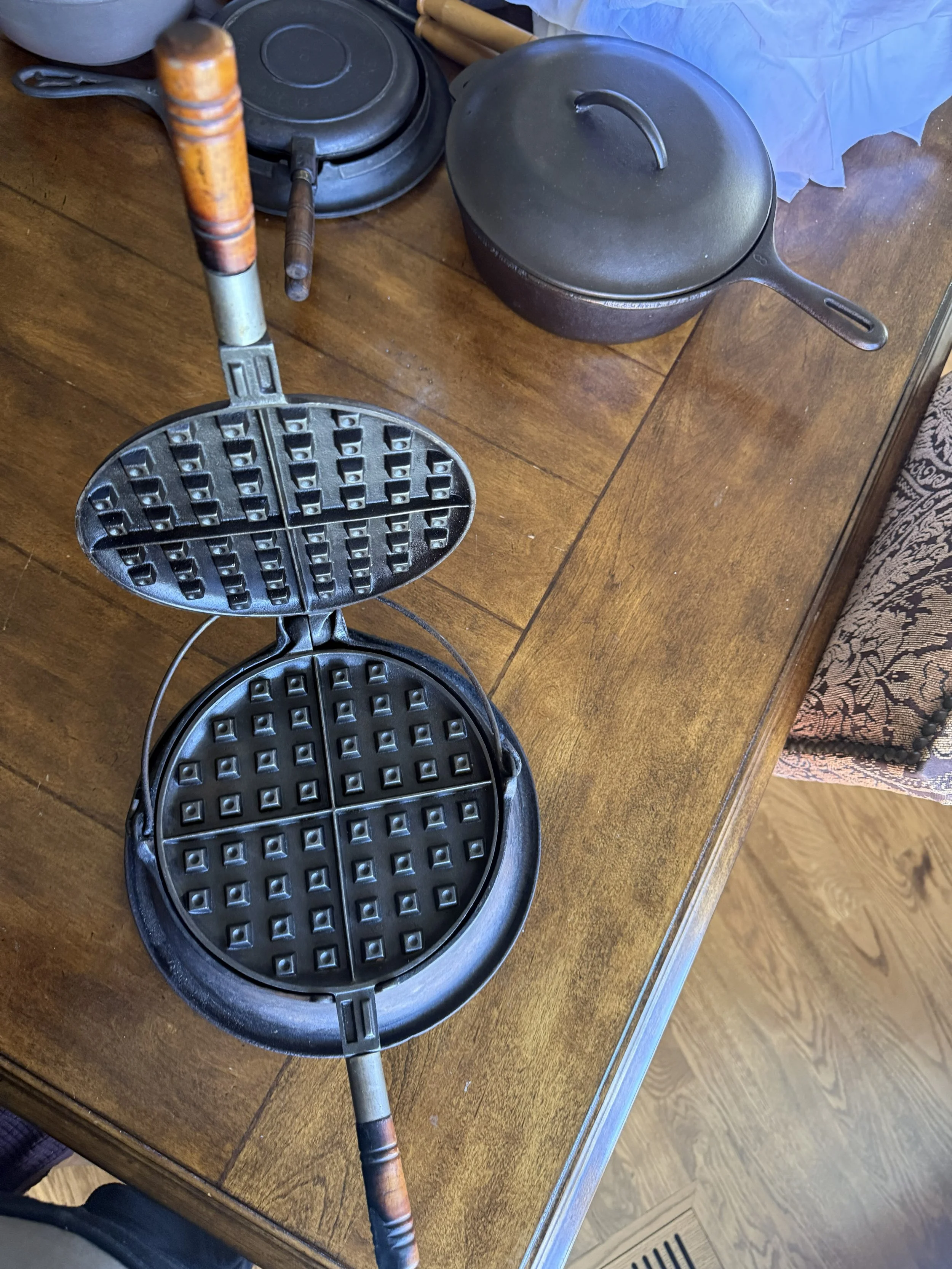
Open view showing both waffle plates with matching four-quadrant square grid patterns. The upper paddle is hinged open. Original turned wood handles are visible on both paddles—the upper handle at top center, the lower handle extending toward the bottom of the frame. The low-base Wagner waffle iron from the same collection is visible in the background at top left.
Manufacturer
Wagner Manufacturing Company (Sidney, Ohio)
Piece Type
Cast iron waffle iron with high base and wood handles
Size
No. 8
Patent Date
July 26, 1892
Material
Cast iron paddles and high pedestal base; original turned wood handles on both upper and lower paddles; wire bail handle on base
Construction
Two-piece hinged round waffle iron paddles mounted on a tall pedestal base; upper paddle hinged at rear with turned wood handle; lower paddle with turned wood handle extends opposite direction; wire bail on base for lifting; high base elevates paddles above stove eye for air circulation and even heat distribution
Waffle Pattern
Square grid pattern divided into four quadrants by cross channels; raised square wells with center buttons on both upper and lower plates
Marking
“WAGNER” arched at top; “M’F’G CO SIDNEY. O.” arched below; “PAT. JULY 26 1892” and size “8” at center of upper paddle exterior
Base Type
High base — a tall pedestal ring that elevates the waffle paddles significantly above the stove surface; the most substantial of Wagner’s base configurations, providing maximum air circulation and heat management
Handle Configuration
Dual original turned wood handles — one on upper paddle, one on lower paddle; both original with age-appropriate patina; wire bail on base frame
Date of Manufacture
c. 1892 or later (patent date July 26, 1892; first-generation Wagner production)
Place of Manufacture
Sidney, Shelby County, Ohio
Condition
Very Good — full marking legible including complete patent date; both waffle plates intact with full grid pattern; hinge mechanism functional; both original wood handles present; high base intact with wire bail; no cracks or structural damage
Acquisition Date
October 21, 2025
Acquisition Source
eBay — Seller: heatherirene001
eBay Item Number
205768129419
Order Number
25-13710-76327
SSC Catalog Number
SSC-WGNR-WFL-8-HB-001
Historical Background
Two Bases, One Patent: Wagner’s Product Strategy from Day One
The existence of multiple base configurations for the same No. 8 waffle iron—all carrying the same July 26, 1892 patent date—reveals that Wagner was thinking about market segmentation from its earliest days. The low-base model was the entry-level option: compact, simple, and affordable. The high-base model with dual wood handles was the premium offering: taller, more comfortable to use, and more impressive on the stove or at the table. Both made the same waffle. But one cost more, looked more substantial, and gave the cook a better experience.
This kind of product-line thinking is characteristic of the great Ohio foundries. Favorite Stove & Range in Piqua did the same thing with its Favorite Piqua Ware, Miami, and Puritan brands—three tiers of cookware from one foundry. Griswold in Erie offered regular and nickel-plated finishes at different price points. Wagner’s waffle iron base variants are the same strategy applied to a single product: same patent, same waffle plates, different base, different handles, different price. It is manufacturing efficiency married to marketing sophistication—and Wagner was doing it in its first year of business.
The Wood Handles: Original and Irreplaceable
The turned wood handles on both paddles of this waffle iron are original. This matters because wood handles are the most fragile component of any cast iron tool—they crack, burn, warp, and break over time. Many surviving Wagner waffle irons have replacement handles or no handles at all. An 1892-patent Wagner waffle iron with both original wood handles intact is a notably complete example. The handles show age-appropriate patina and wear—darkened wood, minor surface checking—but they are structurally sound and firmly attached. They have survived 130-plus years of use, storage, and the hands of every owner who came before.
SSC Collection Context: The Wagner Waffle Iron Pair
With the addition of this high-base variant, the SSC now holds a matched pair of Wagner No. 8 waffle irons from the company’s founding era. Together, the two pieces document Wagner’s complete base-variant design strategy for its first patented waffle iron product. The low base (SSC-WGNR-WFL-8-LB-001) represents the entry-level configuration. The high base with wood handles (SSC-WGNR-WFL-8-HB-001) represents the premium configuration. Both carry the July 1892 patent. Both bear the earliest form of the Wagner trademark. And both were made in Sidney, Shelby County, Ohio, by a company that was less than two years old.
This pairing is exactly the kind of depth the SSC does well—not just one example of a product, but the full range of variants that tell the complete story. The waffle is the same. The patent is the same. The foundry is the same. But the iron tells two different stories about who bought it, what stove it sat on, and what kind of kitchen it served. The low base went to the practical household. The high base went to the household that wanted the best. Wagner made both, from day one.
The patent date is July 26, 1892. The foundry is Sidney. And two waffle irons—one tall, one short, both Wagner—now stand together in the SSC collection, documenting the start of a century-long story.
Wagner Manufacturing Company — Company Timeline
1891
The Wagner Manufacturing Company is founded in Sidney, Shelby County, Ohio by brothers Milton M. and Bernard P. Wagner.
1892
Wagner receives U.S. patent dated July 26, 1892 for a waffle iron design. The company produces the No. 8 waffle iron in multiple base configurations: low base, high base (this piece), and variations with different handle arrangements.
1890s–1910s
Wagner expands into a full-line cast iron manufacturer. Waffle irons remain a signature product alongside skillets, dutch ovens, tea kettles, and griddles.
1920s–1940s
Wagner introduces the “Wagner Ware Sidney -O-” trademark. The company becomes one of the largest cast iron manufacturers in the United States.
1952
Wagner merges with the Randall Company under Textron’s corporate umbrella.
1959
Textron acquires Griswold Manufacturing Company of Erie, Pennsylvania.
1999
The Sidney foundry closes after more than a century of continuous operation.
2025
Steve’s Seasoned Classics acquires this Wagner No. 8 high-base waffle iron from eBay seller heatherirene001. The piece is documented as SSC-WGNR-WFL-8-HB-001, joining the SSC’s Wagner No. 8 low-base waffle iron (SSC-WGNR-WFL-8-LB-001) to document Wagner’s base-variant design evolution.
Why This Piece Matters
A Wagner No. 8 waffle iron with a high pedestal base, both original wood handles, and a July 26, 1892 patent date is the premium variant of the company’s first patented product. It is more complete, more visually impressive, and more collectible than its low-base counterpart—and it tells a more detailed story about how Wagner thought about its market from the very beginning. The company did not simply make a waffle iron and sell it. It made a waffle iron in multiple configurations and sold each one to a different customer at a different price point. That is not a startup’s strategy. That is a mature manufacturer’s strategy—executed by a company that was barely a year old.
For the SSC, this piece completes the Wagner waffle iron pair and establishes the founding-era Wagner collection as one of the strongest groupings in the museum. The 1892 patent. The earliest trademark. The original wood handles. The high base. The story of two brothers in Sidney, Ohio, who built a foundry and—within a year—were already thinking about how to serve every kitchen in America.
Sources & Further Reading
Cast Iron Collector — The Wagner Trademark (castironcollector.com): evolution of Wagner logo designs and dating guidelines.
Cast Iron Collector — Waffle Irons (castironcollector.com): reference guide to American cast iron waffle iron forms, base types, and patent dates.
Wagner and Griswold Society (wag-society.org): collector community and foundry reference archive.
eBay listing and invoice documentation — Item 205768129419, Order 25-13710-76327.
About Steve’s Seasoned Classics
Steve’s Seasoned Classics is an online museum dedicated to preserving and documenting the heritage of American cast iron, with a singular focus on the obscure, defunct foundries of Ohio from the 19th and early 20th centuries. The SSC collection spans 130+ pieces from 50+ confirmed Ohio makers — the majority absent from standard collector references. Makers were identified through physical artifacts exhibiting gate marks, patent dates, foundry traits, and documented regional provenance, cross-checked against surviving trade directories, census records, and existing collector guides. Makers lacking representation in published guides but supported by physical evidence were flagged for first-time documentation — a core function of the SSC research mission.
