The H.S. Pease Coal-Heated Charcoal Sad Iron
SSC MUSEUM COLLECTION
Catalog No. SSC-PEASE-IRN-1885-001
Charcoal Box Iron | Wood Handle | Draft Controls | Cincinnati, Ohio
Circa 1885–1900 • Horace S. Pease • Ohio Foundry Corridor

Close-up of the maker’s mark cast into the rim of the hinged lid: “CINC’TI OHIO” is legible in raised letters on the left side, confirming Cincinnati as the place of manufacture. On the opposite side of the same rim, the name “PEASE” appears in the same raised-letter casting technique. The full mark reads “H.S. PEASE” and “CINC’TI, O.”—the standard marking convention used by Horace S. Pease on his charcoal irons manufactured in Cincinnati, Hamilton County, Ohio, from the mid-1880s through at least 1907.
Before the electric iron arrived in American homes at the turn of the twentieth century, pressing clothes was a job that required fire. The charcoal box iron—sometimes called a coal iron or self-heating sad iron—was the workhorse of the late nineteenth-century laundry: a hollow cast iron body designed to hold burning coals, with a hinged lid for loading fuel, ventilation ports to maintain draft, a chimney for exhaust, and a wooden handle mounted high above the heat to protect the user’s hand. It was heavy, it was hot, and it worked. And for a Cincinnati inventor named Horace S. Pease, it was not just a household tool—it was a platform for innovation.
H.S. Pease of Cincinnati, Ohio was a prolific inventor and manufacturer of charcoal-heated sad irons during the last quarter of the nineteenth century and into the early 1900s. He held multiple United States patents covering improvements to the charcoal iron form, including innovations in air draft controls, combination iron-and-fluter designs, and dedicated sad iron stands. His most distinctive contribution was the combination charcoal iron and fluting device—a single tool that could press flat fabrics when used conventionally, and also create the decorative pleated fluting that Victorian-era fashion demanded for collars, cuffs, and ruffles. Pease irons were manufactured and sold from Cincinnati, with patent dates appearing on various models from the mid-1880s through 1907.
This piece—a coal-heated charcoal box iron marked “H.S. PEASE” and “CINC’TI, O.” on the lid rim—is one of Pease’s production models. It exhibits the hallmarks of his design: a hollow cast iron body with a boat-shaped profile, a hinged lid with a decorative serrated edge, ventilation ports at the rear for draft control, a chimney opening at the front for smoke exhaust, and a turned wooden handle mounted on a raised cast iron bracket. It is a working artifact of Cincinnati’s contribution to the mundane but essential technology of keeping clothes pressed in an age before electricity.
Horace S. Pease: Cincinnati’s Charcoal Iron Innovator
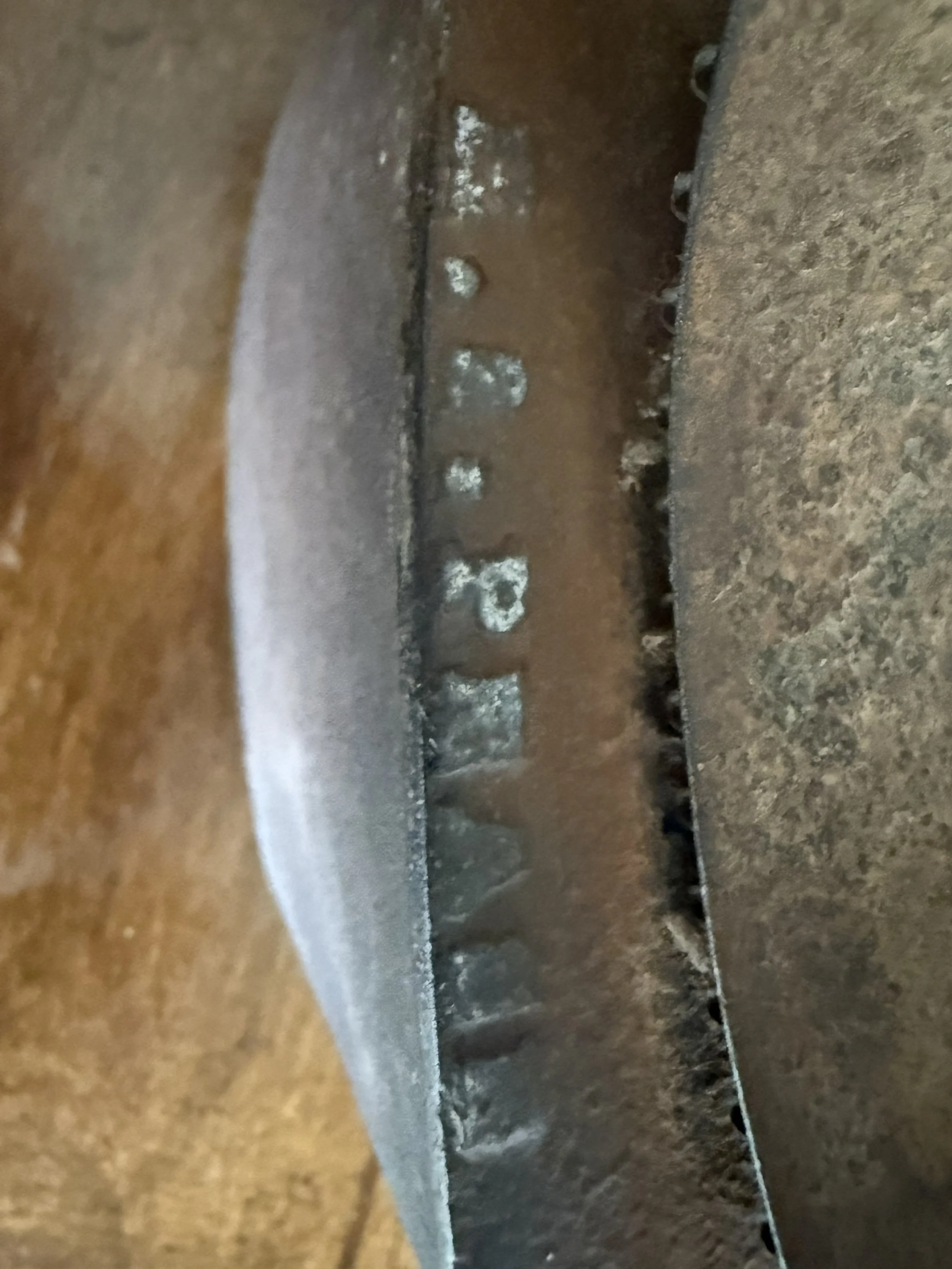
Second close-up of the maker’s mark on the opposite side of the lid rim, showing the “PEASE” name in raised cast letters. The lettering is cast directly into the iron—part of the original pattern, not stamped or applied after casting. The raised-letter technique was standard for Cincinnati makers of the period and ensured the mark would survive decades of use without wearing away.
Horace S. Pease operated out of Cincinnati, Hamilton County, Ohio, and his career as an inventor of laundry equipment spans at least three decades of patent activity. His name appears on United States patents assigned between the 1880s and 1907, all related to charcoal-heated sad irons and their accessories. The earliest patent dates found on Pease irons are from the mid-1880s, with some examples carrying dates of 1885, August 1886, and August 14, 1888. One model is also marked “Pat. 74,” which may reference an 1874 patent or a patent number—placing the beginning of Pease’s involvement with charcoal iron design potentially as early as the 1870s.
Pease’s later patents are well documented. U.S. Patent 768,072, assigned August 23, 1904, covered a fluting device and stand designed to work with his charcoal iron. The iron served double duty: when placed flat on the stand, it functioned as a conventional pressing iron; when the stand was positioned at the edge of an ironing board with the iron’s tip pointed down, a side-mounted fluter could be engaged to create decorative pleats. The rocker portion of the fluter was attached to the removable wooden handle, which could be lifted off when a pin was released. This meant the handle itself had two purposes: grip for pressing, and fluting roller for pleating.
U.S. Patent 873,779, assigned December 17, 1907, covered a dedicated sad iron stand designed to support charcoal-heated irons. Pease’s stand incorporated automatic damper controls—when the hot iron was placed on the stand, the weight of the iron engaged arms that pressed against the draft dampers on the sides of the iron, automatically closing them and reducing airflow to the coals. When the iron was lifted from the stand, the dampers reopened. This was a clever solution to a practical problem: controlling the burn rate of charcoal inside the iron without requiring the user to manually adjust air vents every time the iron was set down or picked up.
The range of Pease’s patent portfolio—from the iron itself to the fluting attachment to the stand—tells us that he was not simply a foundry owner casting someone else’s design. He was an engineer of the complete laundry pressing system, thinking through every step of the process: how the iron heats, how the user controls the temperature, how the iron transitions between pressing and fluting, and how it rests between uses. This was a Cincinnati inventor working at the intersection of cast iron manufacturing and household technology, producing patented innovations that addressed the daily reality of Victorian-era laundry work.
The Charcoal Box Iron: Form and Function

Top and side view of the Pease charcoal iron, showing the full form: the hollow cast iron body, hinged lid with decorative serrated edge, curved wooden handle with turned knob, and the overall boat-shaped profile characteristic of late nineteenth-century American charcoal irons. The lid lifts from the rear to allow hot coals to be placed inside the body cavity. The serrated or ratcheted edge of the lid helped provide a tighter seal when closed, containing sparks and ash while maintaining airflow.
The charcoal box iron is a distinct form within the broader family of nineteenth-century pressing irons. Unlike the solid “sad iron”—a heavy slab of cast iron heated on a stove top and used until it cooled—the box iron has a hollow interior combustion chamber designed to hold burning coals. This self-heating design gave it a significant practical advantage: it maintained its own temperature rather than requiring constant reheating, allowing the user to press clothes continuously, even outdoors, away from the heat of the kitchen stove. As one contemporary patent description put it, the ironing could be done “in some cool retreat—even under the shade of a tree where the person performing the labor can be fanned by every breeze that blows instead of being oppressed to the verge of prostration between the four walls of a heated room.”

Rear view showing the two large ventilation ports at the base and the draft opening above them. These openings allowed air to circulate through the coal chamber, keeping the fuel burning evenly. The wooden handle is mounted on a cast iron bracket that elevates it above the body of the iron, providing both grip and insulation from the heat below.
The Pease iron exhibits all the standard features of the form, plus several refinements that distinguish it from simpler charcoal irons of the period. The body is boat-shaped cast iron with a pointed front for reaching into pleats and corners, and a flat sole plate for pressing. The hinged lid lifts from the rear to accept fuel. Ventilation ports at the back allow air to enter the combustion chamber, while a chimney opening at the front allows smoke and combustion gases to exhaust forward—away from the user. The turned wooden handle is mounted on a raised bracket that holds the user’s grip well above the hot body. The lid features a serrated edge that was both decorative and functional, improving the seal between lid and body.

Top-down view of the interior coal chamber with the lid removed, showing the cavity where hot coals or charcoal were placed. The raised platform in the chamber allowed ash to settle below while keeping the coals elevated for better airflow and more even heat distribution across the sole plate. The interior casting quality is visible: smooth walls with clean edges, consistent with a production foundry rather than a crude jobber operation.
Pease irons were known for incorporating air controls—sliding damper plates on the sides of the iron body that allowed the user to regulate the flow of air to the coals. Opening the dampers increased airflow and raised the temperature; closing them starved the coals of oxygen and allowed the iron to cool down. This was not a universal feature on charcoal irons of the period—many simpler designs relied on fixed ventilation holes with no adjustment. The presence of adjustable draft controls on Pease’s irons reflects the patent-driven approach of a manufacturer who was actively improving the form, not merely reproducing it.
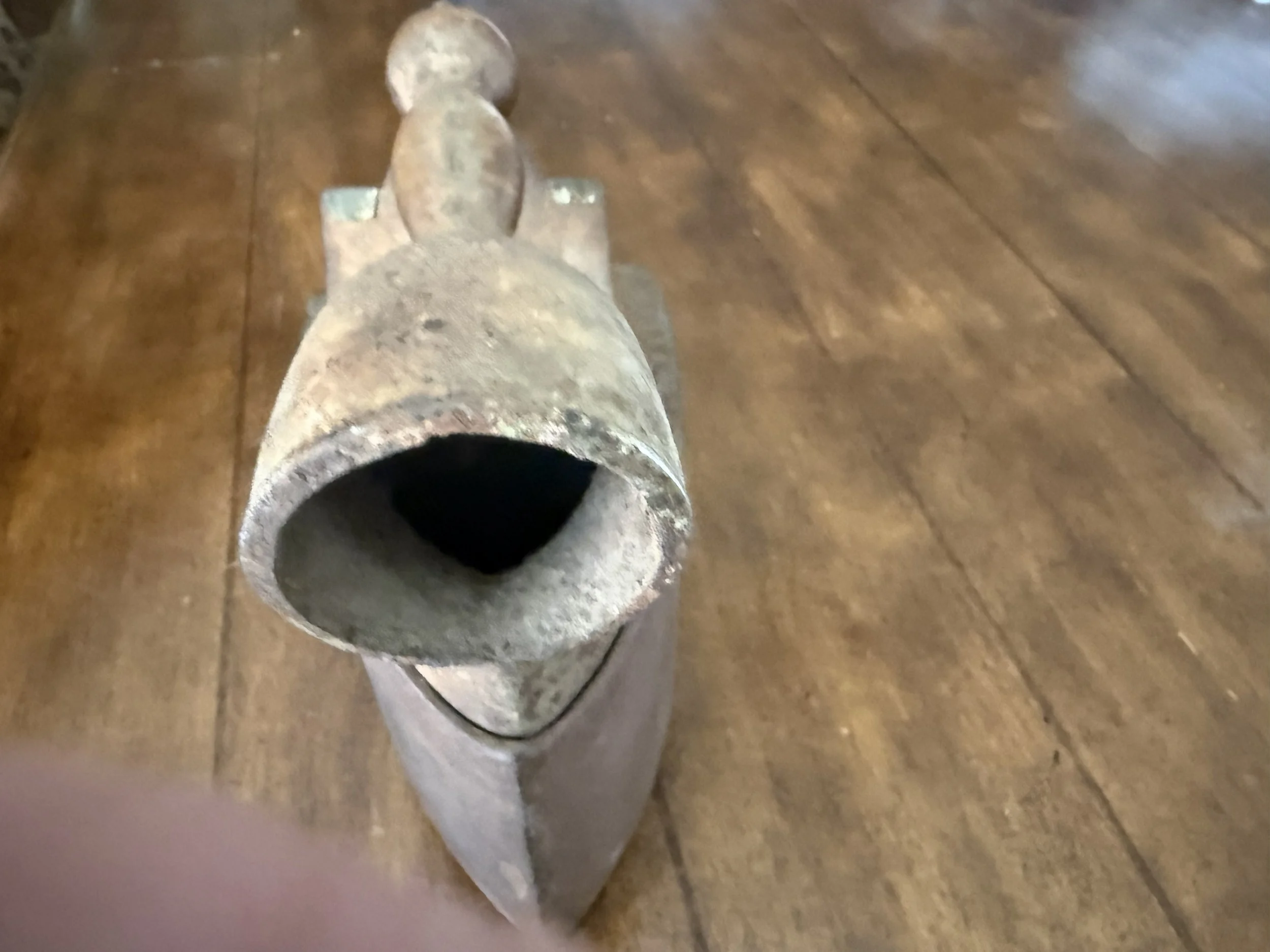
Front view showing the chimney opening at the nose of the iron. This opening allowed smoke and combustion gases from the burning coals to vent forward and away from the user during pressing. The smooth, tapered sole plate narrows to a point—essential for reaching into pleats, ruffles, and gathered fabric. The overall casting quality and proportions are consistent with a manufactured product rather than a one-off foundry piece.
Piece Details
Manufacturer
H.S. Pease (Horace S. Pease), Cincinnati, Ohio
Piece Type
Coal-Heated Charcoal Sad Iron (Charcoal Box Iron)
Form
Hollow box iron with hinged lid, serrated lid edge, turned wood handle on raised bracket, draft vents, chimney opening
Material
Cast Iron with turned wooden handle
Marking
“H.S. PEASE” and “CINC’TI, O.” cast in raised letters on lid rim
Purpose
Household clothes pressing iron, charcoal/coal-heated, self-heating type
Date of Manufacture
Circa 1885–1900
Place of Manufacture
Cincinnati, Hamilton County, Ohio
Condition
Good — legible maker’s mark and city mark on lid rim; complete with original wooden handle; lid hinge functional; sole plate shows normal use wear; surface oxidation consistent with age; no cracks, breaks, or repairs
Acquisition Date
March 4, 2026
Acquisition Source
eBay — Seller: tsp8ntball5hnf
eBay Item Number
227238243616
Order Number
05-14325-47882
SSC Catalog Number
SSC-PEASE-IRN-1885-001
Collection Designation
Ohio Foundry Corridor
Corporate Timeline: H.S. Pease, Cincinnati
c. 1874–?
Earliest possible date of Pease’s involvement in charcoal iron manufacture, based on “Pat. 74” marking found on some Pease irons. May reference a patent from 1874 or an internal patent/model number.
c. 1885
Patent date appearing on production Pease charcoal irons. Marks the beginning of confirmed patent activity. Pease operates from Cincinnati, Hamilton County, Ohio.
Aug 1886
Additional patent date found on some Pease irons, indicating ongoing design refinement during this period.
Aug 14, 1888
Patent date appearing on Pease combination charcoal iron and fluter models. The combination iron/fluter becomes Pease’s signature product: a single tool for both pressing and pleating.
Aug 23, 1904
U.S. Patent 768,072 assigned to Horace S. Pease of Cincinnati, Ohio. Covers a fluting device and stand designed to work with his charcoal iron. The stand supports the iron for pressing or positions the fluter for pleating.
Dec 17, 1907
U.S. Patent 873,779 assigned to Horace S. Pease of Cincinnati, Ohio. Covers a sad iron stand with automatic damper controls that close the iron’s draft openings when it is placed on the stand.
Status
Defunct. No evidence of production beyond the early twentieth century. The rise of electric irons after 1900 rendered charcoal iron technology obsolete. Pease’s final known patent (1907) coincides with the period when electric irons were rapidly replacing all other heating methods.
Cincinnati and the Charcoal Iron Trade
Cincinnati was one of the great manufacturing cities of nineteenth-century America. By mid-century it was the largest city in the American interior, a river port and rail hub whose factories produced everything from steamboat engines to soap. The city’s stove and foundry industries were particularly robust. Firms like W.C. Davis & Company (later Favorite Stove Works, which relocated to Piqua in 1887), the Enterprise Company, Woodrow Mears & Co., and W. Resor & Co. all operated foundries in Cincinnati, casting stoves, hollow ware, hardware, and household implements for a market that stretched from the Ohio Valley to the Mississippi Delta.
Horace S. Pease operated within this ecosystem, but his niche was specific: he was not casting stoves or skillets. He was manufacturing and patenting a single specialized product line—charcoal-heated pressing irons and their accessories. This kind of specialization was common in late nineteenth-century Cincinnati manufacturing. The city’s industrial economy was highly fragmented, with hundreds of small firms each serving a narrow market. A maker who focused exclusively on charcoal irons, and who held his own patents on the design, was a typical product of Cincinnati’s competitive manufacturing culture—a city where innovation happened not in giant corporations but in small shops where the owner was also the inventor, the pattern maker, and the salesman.
The Pease charcoal iron adds another Cincinnati maker to the SSC collection’s growing roster of the city’s foundry products. W. Resor & Co. made waffle irons. Adams & Britt cast stove kettles and griddles. John D. Browne patented a cast iron broom head. Century Machine Co. produced industrial castings. And now H.S. Pease contributes the first laundry implement—a tool from the domain of domestic work, the weekly ironing, the task that every household in nineteenth-century America performed and that no household enjoyed. Pease made the job a little easier, and he did it from Cincinnati.
The Pease Innovation: Combination Iron and Fluter
The feature that distinguished Pease’s product line from the many other charcoal iron manufacturers of the period was his combination iron and fluting device. Victorian-era fashion demanded fluted—that is, pleated—trim on collars, cuffs, shirt fronts, and decorative ruffles. Creating and maintaining these pleats required a specialized tool called a fluting iron or fluter, which pressed fabric between corrugated surfaces to produce evenly spaced ridges. Most households that cared about their appearance needed both a pressing iron and a fluting iron—two separate tools for two separate tasks.
Pease’s solution was to combine them. His charcoal iron featured a removable handle that doubled as a fluting roller. When the handle was attached normally, the iron functioned as a conventional pressing tool. When the handle was detached and positioned in a side-mounted fluting bracket, the hot iron body served as the heat source for the fluting operation. A companion stand, also patented by Pease, supported the iron in the correct position for either mode of operation. The result was a single multi-function tool—a charcoal iron, a fluting iron, and a stand, all designed as an integrated system. This was not a crude adaptation. It was an engineered solution backed by multiple patents, and it was the product that Pease built his business around.
The piece in the SSC collection appears to be a standard pressing model from the Pease line—a charcoal box iron without the fluting attachment, but bearing the same maker’s mark and construction quality as the combination models. Whether this iron originally had a companion fluter and stand that were separated over time, or whether Pease also sold a basic pressing-only model, is unknown. What is clear is that it was manufactured by the same firm, in the same city, using the same casting techniques, and carrying the same proud mark: H.S. Pease, Cincinnati, Ohio.
Why This Piece Matters
The H.S. Pease charcoal sad iron matters because it documents a Cincinnati inventor-manufacturer who was actively patenting and producing cast iron household technology during the last decades of the nineteenth century. Horace S. Pease was not a major foundry. His name does not appear in the standard cast iron collecting references or the Cast Iron Collector Foundry Database. He was a niche manufacturer—a specialist in a single product category that happened to be one of the most essential household items of his era. His patents show a mind actively working to improve the charcoal iron: better air controls, a combination pressing-and-fluting design, an automatic-damper stand. These were not trivial innovations. They addressed real problems that every person who ironed clothes in the 1880s and 1890s understood intimately.
The piece also matters because of what it represents in the arc of American domestic technology. The charcoal iron was the last generation of fire-heated pressing tools before electricity changed everything. By the time Pease received his final patent in 1907, the electric iron was already on the market and spreading rapidly. Within a decade, charcoal irons would be obsolete. Pease’s career, from the mid-1880s through 1907, maps almost exactly onto the twilight of the coal-heated iron—the final era when inventors were still finding ways to improve a technology that was about to be rendered irrelevant by a fundamentally different one.
And it matters because it adds another name—another Ohio name, another Cincinnati name—to the record. The SSC collection exists to capture exactly these makers: the ones who cast their name into the iron and sent their products out into the world, and who left behind no company history, no factory photographs, no corporate archive—nothing but the marks on the pieces themselves. H.S. Pease, Cincinnati, Ohio. That’s what the iron says. And now there is a permanent record of what it means.
The iron endures. The markings tell the truth. The story deserves to be told.
Sources & Further Reading
Physical examination of piece: “H.S. PEASE” and “CINC’TI, O.” cast in raised letters on lid rim. No patent date visible on this example. Charcoal box iron form consistent with late nineteenth-century American manufacture.
U.S. Patent 768,072 (Aug. 23, 1904) — Fluting Device & Stand, assigned to Horace S. Pease of Cincinnati, Ohio. Combination charcoal iron/fluter design with companion stand.
U.S. Patent 873,779 (Dec. 17, 1907) — Sad-Iron Stand, assigned to Horace S. Pease of Cincinnati, Ohio. Stand with automatic damper controls for charcoal-heated sad irons.
Trivetology (trivetology.com) — Lynn Rosack, “Trivets and Stands with Patents,” May 1, 2019. Documents Pease Patents 768,072 and 873,779 with photographs of Pease stands and companion charcoal irons.
WorthPoint (worthpoint.com) — Auction records for H.S. Pease charcoal irons with patent dates of 1885 and 1888. Descriptions note air controls, combination fluter handles, and “H.S. PEASE CINCINNATI, O.” markings.
AuctionZip (auctionzip.com) — Auction listing for H.S. Pease nickel-plated charcoal iron with fluting handle. Marked “H.S. PEASE CINCINNATI, O.” with “Pat. 74” on rotating draft and dates of Aug. 1886 and Aug. 14, 1888 on handle.
AntiqBuyer (antiqbuyer.com) — Past sale: Pease Combination Charcoal Iron / Fluter Iron, sold for $95.
SSC Internal Collection Records — Cincinnati foundry pieces: W. Resor & Co. (SSC-RESOR-WFL-1870-001), Adams & Britt (SSC-ADAMSBRITT-GRD-1870-001), John D. Browne / Browne’s Patent (SSC-BROWNE-BRM-1880-001), Century Machine Co. (Ohio Foundry Checklist).
About Steve’s Seasoned Classics
Steve’s Seasoned Classics is an online museum dedicated to preserving and documenting the heritage of American cast iron, with a singular focus on the obscure, defunct foundries of Ohio from the 19th and early 20th centuries. The SSC collection spans 130+ pieces from 50+ confirmed Ohio makers — the majority absent from standard collector references. Makers were identified through physical artifacts exhibiting gate marks, patent dates, foundry traits, and documented regional provenance, cross-checked against surviving trade directories, census records, and existing collector guides. Makers lacking representation in published guides but supported by physical evidence were flagged for first-time documentation — a core function of the SSC research mission.
