The Kingery Mfg. Co. No. 20 Conical Ice Cream Scoop
SSC MUSEUM COLLECTION
Catalog No. SSC-KINGERY-SCP-1894-001
Conical Ice Cream Disher | No. 20 | Wood Handle | Cincinnati, Ohio
Circa 1894–1910 • Kingery Manufacturing Company • Ohio Foundry Corridor

The Kingery No. 20 conical ice cream scoop in the open position, showing the bowl with its internal scraper blade visible. The conical bowl is designed to form ice cream into a cone shape for direct placement into a wafer cone or dish. The scraper blade moves when the handle mechanism is activated, releasing the ice cream cleanly from the bowl. The turned wooden handle connects to a metal shaft that operates the internal blade mechanism. This is the form that was marketed as “Kingery’s Rapid Ice Cream Disher”—advertised as the first ice cream scoop designed for one-handed use.
Before the modern spring-loaded ice cream scoop became a kitchen standard, there was the Kingery. Manufactured by the Kingery Manufacturing Company of Cincinnati, Ohio, the conical ice cream disher was one of the earliest commercial scoops designed for one-handed operation—a design innovation that revolutionized the speed and efficiency of serving ice cream in the parlors, soda fountains, and street vendor carts of late nineteenth-century America. When the handle was squeezed, the conical bowl rotated and internal scraper blades released the ice cream in a single smooth motion. No second hand was needed. No knife or spoon to pry the ice cream loose. One squeeze, one cone-shaped serving, one satisfied customer. It was, as Kingery’s own advertising proclaimed, a “Rapid Ice Cream Disher.”
This is a Kingery No. 20 conical ice cream scoop with a turned wooden handle, marked “PATENT APLD” (patent applied for). The No. 20 designation indicates the size: twenty scoops to the quart, making this one of the smaller serving sizes in Kingery’s line. The scoop was patented on September 4, 1894, and was manufactured by the Kingery Manufacturing Company from their operations in Cincinnati and nearby Hamilton, Ohio. Kingery was not a foundry in the traditional sense—they were a manufacturer of confectionery and food-service equipment whose product line eventually encompassed everything from ice cream freezers and dishers to peanut roasters, popcorn machines, and steam-powered vending wagons. The ice cream scoop was one piece in a much larger story of Cincinnati food-equipment innovation.
The Kingery Manufacturing Company: From Hokey-Pokey to Popcorn Machines
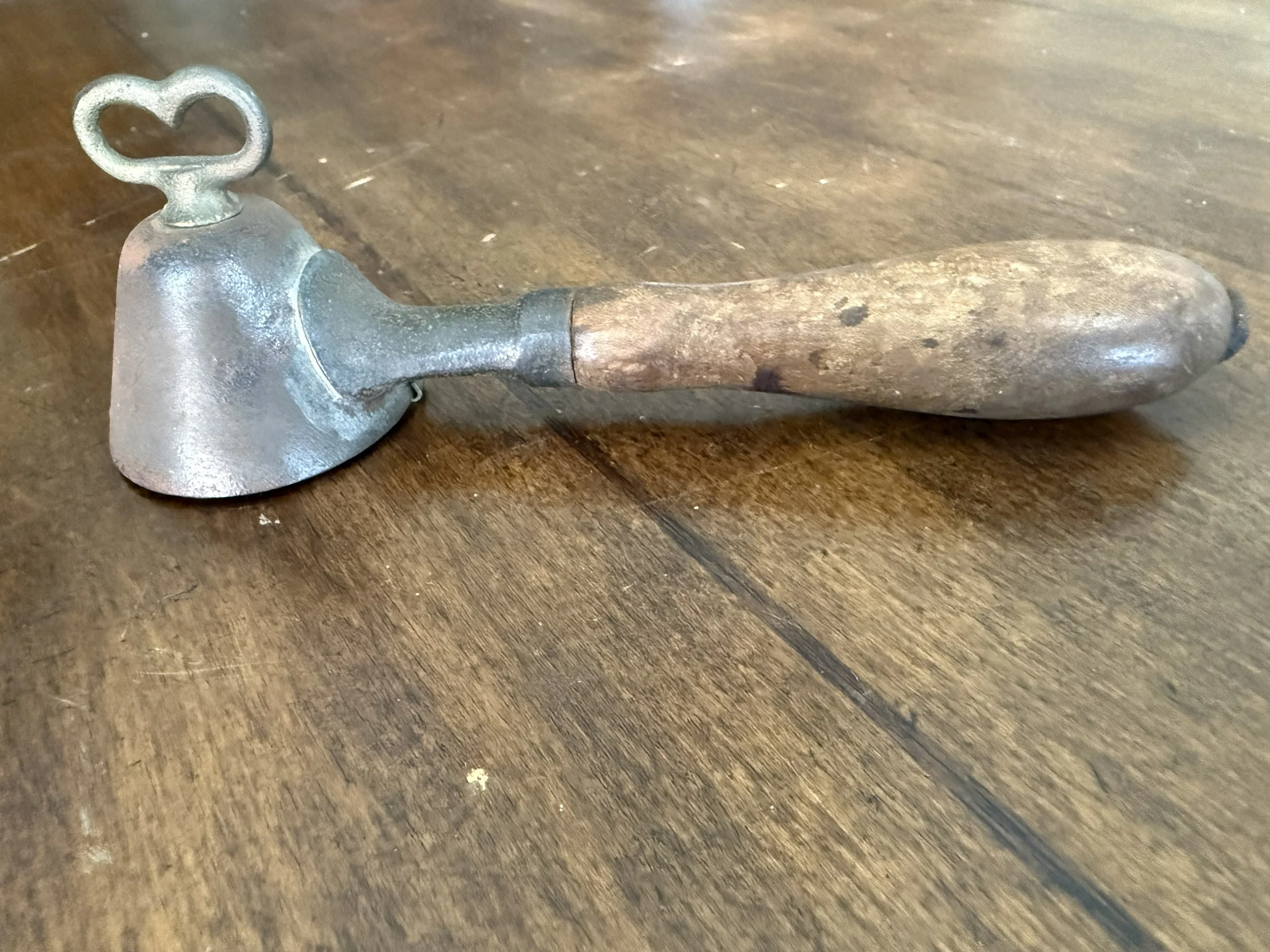
Profile view of the Kingery No. 20 scoop showing the conical bowl in its closed position with the key-shaped thumb lever at the top. Squeezing the handle activates internal scraper blades that rotate within the cone, releasing the ice cream. The turned wooden handle is original, showing the wear and patina of more than a century. The overall length is approximately eight inches—a commercial tool designed for continuous use in a soda fountain or ice cream parlor.
The Kingery Manufacturing Company was founded in 1876 by brothers Samuel Sylvester Kingery (born 1850) and Hiel H. Kingery (born 1858) in Camden, a small town in northwestern Indiana. In 1879, they moved the business to 50 Sycamore Street in Cincinnati. By 1882, Samuel Kingery was listed in the Cincinnati city directory as a maker of ice cream. The brothers sold ice cream scooped into waxed paper—a street treat called “hokey-pokey”—from vendor carts. The hokey-pokey men of the 1880s and 1890s were a familiar sight on American streets, and the hokey-pokey dances and songs of the 1940s nostalgically recalled those earlier ice cream vendors.
A third brother, George W. Kingery, joined the firm as a traveling agent in 1883. By 1884, Kingery was advertising Crystal Flake (an ice cream ingredient), flavoring extracts, coffee roasters, and peanut roasters. In 1885, the company relocated to a four-story building at 9 West Pearl Street, employing up to twenty workers and selling gelatin, ice cream freezers, and roasters. By 1889, a factory had been opened in nearby Hamilton, Ohio, where the brothers and partners F.H. Berk and H.P. Deuscher had converted the old Rupp pork house into a gelatin plant.
The product line expanded rapidly through the 1890s and into the new century. By 1899, Kingery catalogs listed French pot freezers, ice cream cabinets, ice cream dishers, ice shavers, milk shakers, lemon squeezers, rotary corn poppers, and combined peanut roasters and popcorn poppers. The peanut roaster and popcorn machine business became Kingery’s most visible product line: steam-powered machines with nickel plating, German silver, and polished brass that attracted customers with the motion of their miniature steam engines. Kingery catalogs boasted that the engines “fascinated patrons and helped guarantee sales.” By 1905, Kingery operated from 106–108 East Pearl Street. The 1913 directory featured horse-drawn and hand-pulled vending wagons. By the 1920s, Kingery was advertising a full line of barbecue machines. The company continued until after 1945, when it no longer appeared in Cincinnati city directories.
Kingery’s Rapid Ice Cream Disher: The First One-Handed Scoop
The Kingery conical ice cream scoop, patented September 4, 1894, holds a significant place in the history of food-service equipment. According to the reference book Ice Cream Dippers, it was the first ice cream disher designed for one-handed use. Before the Kingery design, scooping and serving ice cream required two hands: one to hold the scoop and one to use a knife or spoon to release the ice cream from the bowl. Kingery’s mechanism—in which squeezing the handle caused the conical bowl to rotate and internal scraper blades to release the contents—allowed the server to operate the scoop, form the ice cream, and release it into a cone or dish with a single hand motion.
This was not merely a convenience. In a busy soda fountain or ice cream parlor, one-handed operation meant faster service, which meant more customers served per hour, which meant more revenue. The Kingery scoop was a commercial tool designed to increase the throughput of an ice cream counter. The conical shape of the bowl was equally purposeful: it formed the ice cream into a cone shape that fit perfectly into the wafer ice cream cones that were becoming popular in the 1890s and would explode in popularity after the 1904 St. Louis World’s Fair.
Kingery produced the conical scoop in multiple sizes, designated by how many scoops were needed to empty a quart of ice cream. A No. 5 was the largest (five scoops per quart), and a No. 30 was among the smallest. The No. 20 in the SSC collection is a smaller serving size—twenty scoops to the quart—appropriate for a child’s portion or a single cone. Later models, designated “Victor” and carrying an October 6, 1908 patent date, featured an improved mechanism but retained the same basic conical form and one-handed operation. The Kingery scoop was also produced in nickel-plated versions for commercial use, with the maker’s mark—“KINGERY MF’G. CO. CIN’TI, O.”—engraved on the scraper blades inside the conical bowl.
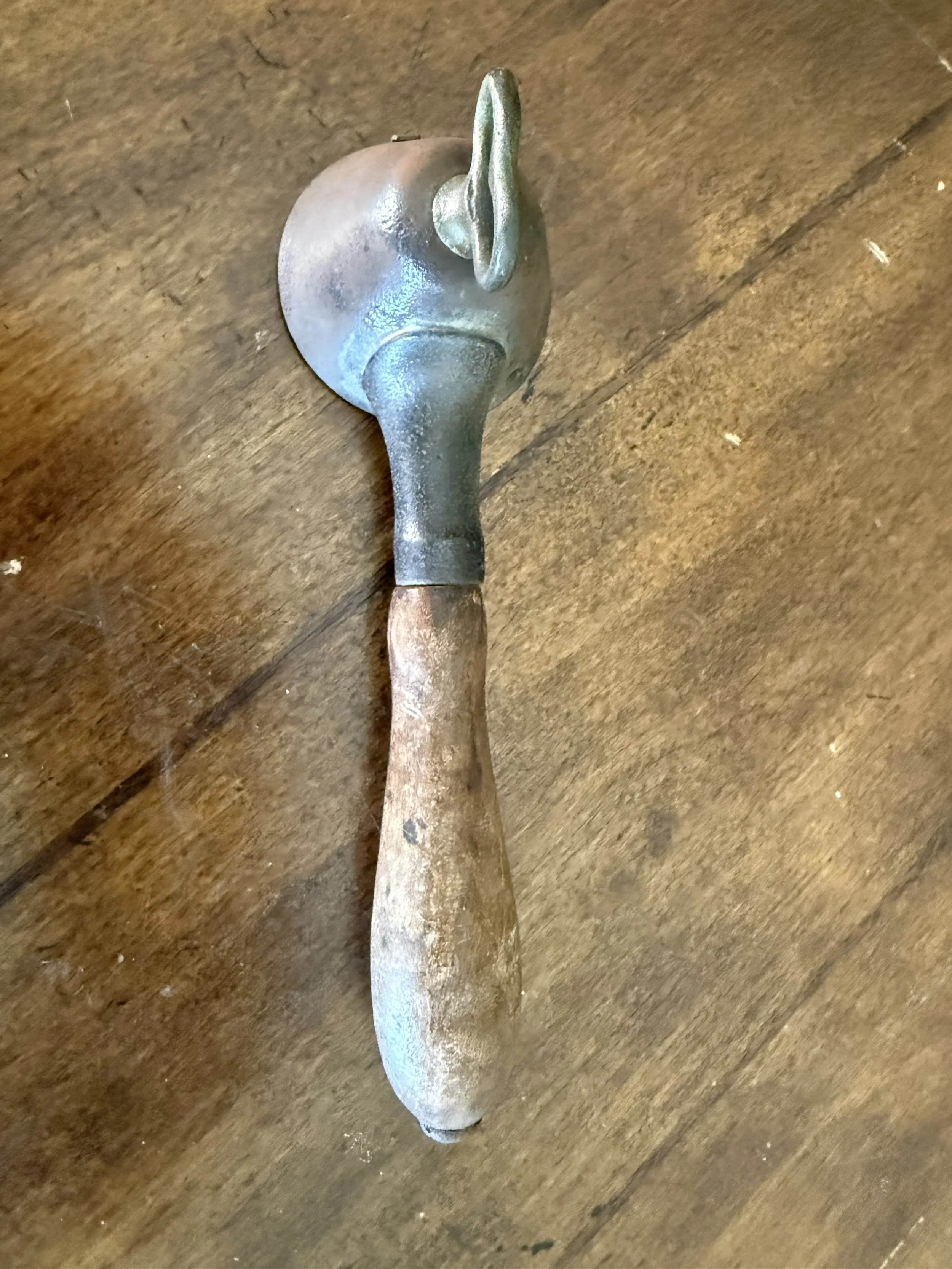
Top-down view of the Kingery No. 20 showing the conical bowl, the key-shaped thumb lever that activates the scraper mechanism, and the turned wooden handle. The “PATENT APLD” marking indicates this piece was manufactured while the patent application was pending—likely in the period immediately surrounding the September 4, 1894 patent grant. The bowl’s conical form was designed to shape ice cream for direct placement into wafer cones.
Piece Details
Manufacturer
Kingery Manufacturing Company, Cincinnati (and Hamilton), Ohio
Piece Type
Conical Ice Cream Scoop / Disher, No. 20 (20 scoops per quart)
Form
Conical bowl with internal scraper blades, key-shaped thumb lever, turned wooden handle; one-handed squeeze operation
Material
Metal (likely nickel-plated steel) with turned wooden handle
Marking
“PATENT APLD” visible; full production models marked “KINGERY MF’G. CO. CIN’TI, O.” on internal scraper blades
Purpose
Commercial ice cream serving tool for soda fountains, ice cream parlors, and vendors
Patent Date
September 4, 1894 (this example marked “PATENT APLD”)
Date of Manufacture
Circa 1894–1910
Place of Manufacture
Cincinnati, Hamilton County, Ohio (factory also in Hamilton, Butler County, Ohio)
Condition
Good — mechanism functional; conical bowl intact; internal scraper blades present; original turned wooden handle; metal shows age-appropriate patina and wear consistent with commercial use
Acquisition Date
March 12, 2026
Acquisition Source
eBay — Seller: mod50s
eBay Item Number
157008578756
Order Number
21-14340-42298
SSC Catalog Number
SSC-KINGERY-SCP-1894-001
Collection Designation
Ohio Foundry Corridor
Corporate Timeline: The Kingery Manufacturing Company
1876
Samuel Sylvester Kingery (b. 1850) and Hiel H. Kingery (b. 1858) found a confectionery business in Camden, Indiana.
1879
Company moves to 50 Sycamore Street, Cincinnati, Ohio. Samuel Kingery listed as an ice cream maker by 1882.
1883
George W. Kingery joins as traveling agent. Company begins advertising Crystal Flake, flavoring extracts, coffee roasters, and peanut roasters.
1885
Moves to four-story building at 9 West Pearl Street, Cincinnati. Up to twenty employees. Products include gelatin and ice cream freezers.
1889
Factory opened in Hamilton, Butler County, Ohio (converted Rupp pork house). Gelatin plant established with partners F.H. Berk and H.P. Deuscher.
Sept 4, 1894
Patent granted for the conical ice cream disher—marketed as “Kingery’s Rapid Ice Cream Disher.” First commercial scoop designed for one-handed operation.
1897–1899
Product line expands to include steam-powered and hand-cranked peanut roasters, French pot freezers, ice cream cabinets, dishers, ice shavers, milk shakers, lemon squeezers, and combined peanut roasters and popcorn poppers.
1905
Company at 106–108 East Pearl Street, Cincinnati. Chewing gum added to product line in 1907.
Oct 6, 1908
Patent granted for the improved “Victor” model ice cream scoop, replacing the original 1894 conical design with an updated mechanism.
1913–1920s
Horse-drawn and hand-pulled vending wagons featured in catalogs. Steam-, electric-, spring-, and hand-powered equipment offered. Barbecue machines added.
1929
Samuel S. Kingery Jr. (b. 1898) becomes secretary-treasurer. Geary F. Stewart rises to president.
1933
End of Prohibition. Kingery adds beer equipment and cheese-coating machinery.
1938
Samuel S. Kingery Jr. becomes president.
c. 1945
Kingery Manufacturing Company no longer appears in Cincinnati city directories. Company presumed defunct.
Cincinnati’s Food Equipment Industry
The Kingery Manufacturing Company joins the Century Machine Company as the second Cincinnati food-equipment manufacturer in the SSC collection. Both firms operated from the same city during the same era, both served the commercial food industry, and both are now defunct. But where Century Machine built bakery ovens for wholesale bread production, Kingery served the retail end of the food business—the soda fountains, ice cream parlors, street vendors, candy shops, and movie theaters where Americans went for treats. Kingery’s products were the machines that roasted the peanuts, popped the corn, froze the ice cream, and scooped it into cones.
Cincinnati’s position as a food-equipment manufacturing center in the late nineteenth and early twentieth centuries was no accident. The city was already a major food processing hub—“Porkopolis,” as it was known—with deep expertise in meat packing, grain milling, and food distribution. The infrastructure of food processing—foundries, machine shops, metalworkers, transportation networks—was already in place. Companies like Kingery could draw on Cincinnati’s manufacturing base to produce the specialized equipment that the emerging American food-service industry demanded. The ice cream scoop, the peanut roaster, the popcorn machine—these were the tools of a new kind of American business, the retail food vendor, and Cincinnati was where many of those tools were made.
Why This Piece Matters
The Kingery No. 20 conical ice cream scoop matters because it represents a genuine innovation in American food-service technology. The one-handed ice cream disher was not a minor improvement—it fundamentally changed how ice cream was served in commercial settings. Before Kingery’s 1894 patent, every scoop required two hands. After it, one hand was enough. That freed the other hand to hold the cone, make change, or reach for the next order. In the fast-paced environment of a soda fountain or a street vendor’s cart, that was a transformative difference.
It also matters because the Kingery Manufacturing Company is a Cincinnati story that deserves to be better known. The brothers who started selling hokey-pokey ice cream from vendor carts in 1879 built a manufacturing company that lasted nearly seventy years, produced equipment used in movie theaters and amusement parks across the country, and created some of the most beautiful steam-powered vending machines ever built. Three Kingery machines are on display at the Wyandot Popcorn Museum in Marion, Ohio. The company’s elegant trademark and ornate machine designs are recognized by collectors of antique food-service equipment worldwide. But in Cincinnati itself, the Kingery name is largely forgotten.
This scoop—sixty-eight dollars on eBay, a small metal cone with a wooden handle—is a piece of that story. It was designed to put ice cream into cones at a time when the ice cream cone itself was a new invention. It was made in Cincinnati by a company that started with hokey-pokey and ended up building steam-powered vending wagons. And it carries the mark of an Ohio manufacturer that the SSC collection exists to preserve.
The iron endures. The markings tell the truth. The story deserves to be told.
Sources & Further Reading
Physical examination of piece: Kingery Mfg. Co. No. 20 conical ice cream scoop with turned wooden handle. Marked “PATENT APLD.” Conical bowl with internal scraper blades and key-shaped thumb lever.
Robert T. Rhode, “The Kingery Manufacturing Company of Cincinnati, Ohio,” Engineers & Engines, April–May 2010, pp. 7–11. Comprehensive company history from 1876 founding through post-1945 disappearance. Documents founding by Kingery brothers in Camden, Indiana; 1879 move to Cincinnati; factory in Hamilton; product line expansion into peanut roasters, popcorn machines, and vending wagons.
Ice Cream Dippers (collector’s reference book) — Cited in WorthPoint listing. Identifies Kingery’s conical disher as the first ice cream scoop designed for one-handed use.
WorthPoint (worthpoint.com) — Multiple auction records for Kingery conical scoops in sizes 5, 10, 12, 16, 20, and 30. Patent date September 4, 1894. Victor model patent October 6, 1908. Markings: “KINGERY MF’G. CO. CIN’TI, O.” on internal scraper blades.
Wyandot Popcorn Museum, Marion County Historical Society, Marion, Ohio — Houses three Kingery peanut roaster/popcorn popper machines, including a restored No. 180 dated 1896.
SSC Internal Collection Records — Kingery Mfg. Co. listed on Ohio Foundry Checklist. This is the first Kingery piece in the SSC collection.
About Steve’s Seasoned Classics
Steve’s Seasoned Classics is an online museum dedicated to preserving and documenting the heritage of American cast iron, with a singular focus on the obscure, defunct foundries of Ohio from the 19th and early 20th centuries. The SSC collection spans 130+ pieces from 50+ confirmed Ohio makers — the majority absent from standard collector references. Makers were identified through physical artifacts exhibiting gate marks, patent dates, foundry traits, and documented regional provenance, cross-checked against surviving trade directories, census records, and existing collector guides. Makers lacking representation in published guides but supported by physical evidence were flagged for first-time documentation — a core function of the SSC research mission.
