Mrs. Shaeffer's Cake Griddle
Mrs. Shaeffer's Cake Griddle
Patented 1889 | Shaeffer Griddle Co. | Canton, Ohio
SSC Museum Collection | Catalog No. SSC-SHF-GDL-CAKE-001 | Research cutoff September 17, 2026
This unusual hinged cast-iron utensil is a documented production example of Milton Shaeffer's 1889 cake-griddle patent. The patent identifies Shaeffer of Canton, Ohio, as inventor and Barbara Shaeffer of the same place as assignee. The iron itself adds a trade name absent from the patent: Shaeffer Griddle Co. The evidence supports a small specialty venture built around this patented griddle, but it does not yet prove that the business was incorporated, operated its own foundry, made no other products, or produced only a particular number of examples.
Object Identification
Catalog number
SSC-SHF-GDL-CAKE-001
Object
Hinged three-cake cast-iron griddle
Cast product name
MRS. SHAEFFER'S CAKE GRIDDLE
Cast maker or trade name
SHAEFFER GRIDDLE CO.
Cast place
CANTON, O.
Cast patent date
SEPT. 24, 89
Patent
U.S. Patent No. 411,619, issued September 24, 1889
Inventor
Milton Shaeffer, Canton, Stark County, Ohio
Patent assignee
Barbara Shaeffer, Canton, Ohio
Materials
Cast iron body; wire handle; black grip or covering of unverified material
Dimensions
Not yet measured by SSC; no exact dimensions are asserted here
Acquisition
eBay, seller pnw2017, September 11, 2026; item 137648608664
Object Photographs
The following photographs document the SSC example as acquired. They show the smooth receiving plate, the three circular cake cups, the hinge, the detachable spring-wire handle arrangement, and the raised cast inscriptions.

Closed profile showing the three marked cups and handle.
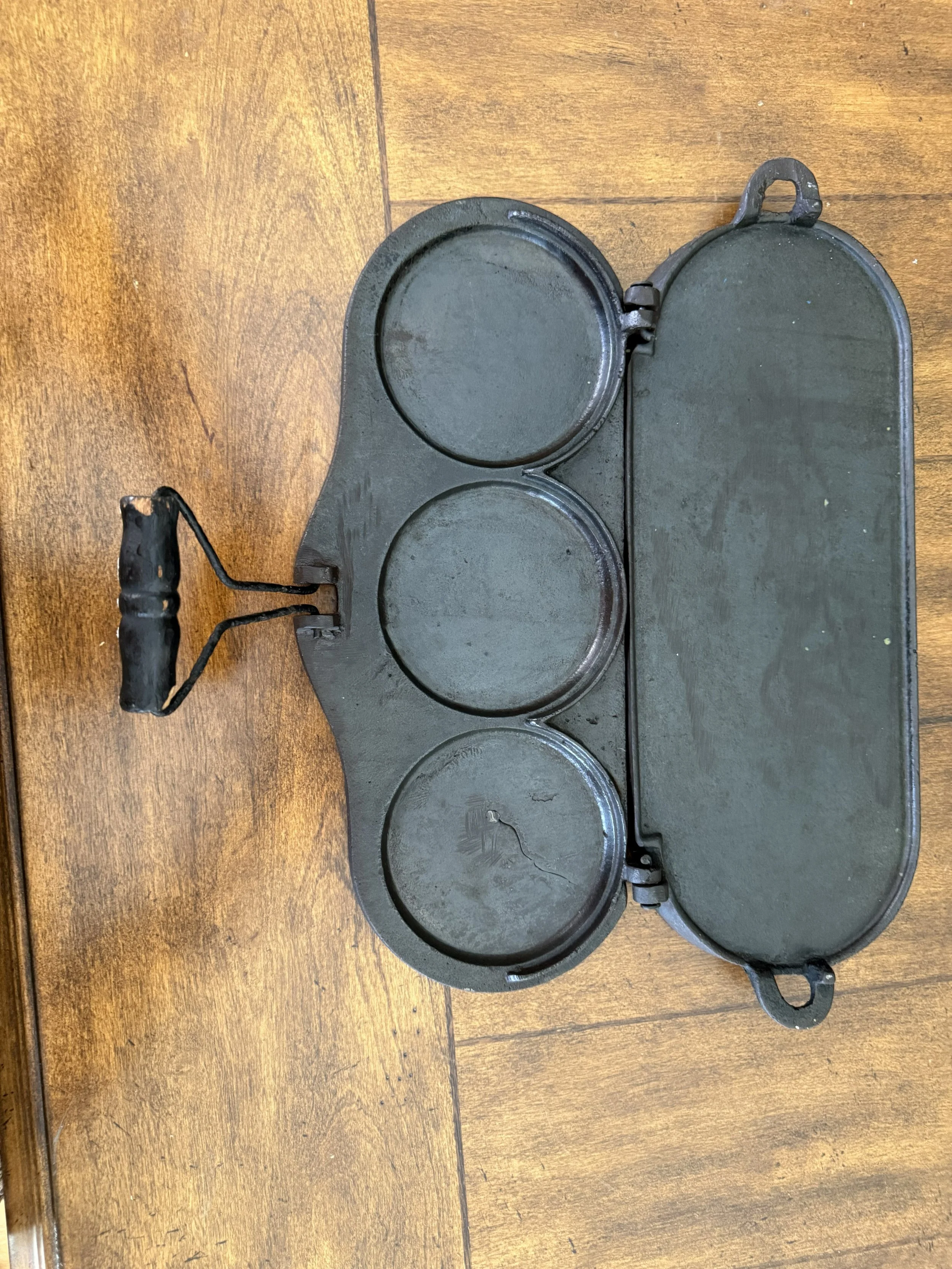
Open operating position: three cups opposite the flat receiving plate.

Exterior of the flat section.

Detail of the cast product, patent, maker, and place markings.
What the Patent Establishes
U.S. Patent No. 411,619 was filed on June 5, 1889, and issued on September 24, 1889. The specification names Milton Shaeffer, a United States citizen residing in Canton, Stark County, Ohio, as inventor. It identifies Barbara Shaeffer, also of Canton, as assignee. The patent does not identify the Shaeffer Griddle Co., a factory, a foundry, or a business address.
The patented combination consists of two hinged sections. One section is flat and smooth. The other contains cake cups - three are shown in the patent drawing, although the specification allows more or fewer. Studs support the cup section at the intended height when it is folded over the flat section. Guide flanges help keep the cakes from overlapping during transfer and help control grease. A spring-arm handle operates the cup section. Those features are visible, in substantially the patented arrangement, on the SSC example.
Primary source: U.S. Patent No. 411,619 on Google Patents
Research note: Google Patents labels the page 'Peters,' apparently because of faulty indexing or OCR. The scanned patent text and drawing themselves identify M. Shaeffer and Milton Shaeffer. The original document, not the erroneous page title, controls the identification.
Milton and Barbara Shaeffer
The patent directly establishes only three points about the people behind the design: Milton Shaeffer lived in Canton, invented the griddle, and assigned the patent to Barbara Shaeffer of the same city. Canton city directories from the period place Milton Shaeffer in Canton and later list Milton with Barbara at North Cleveland Avenue addresses. Those directory entries support a continuing household association, but the patent itself does not state their relationship. A later Canton newspaper item refers to Mrs. Shaeffer and her husband Milton, supporting the identification of Barbara as Milton's wife; the griddle patent nevertheless remains the controlling source for ownership of the invention.
The city directories do not present Milton as a foundry owner. In several later issues he is listed as a traveling salesman or salesman. This does not rule out a griddle venture in 1889, but it argues against describing him, without further evidence, as the proprietor of an established foundry.
Was Shaeffer Griddle Co. Created for One Product
Probable, not confirmed. The surviving evidence fits a small, product-specific venture: the business name is built directly from the patented utensil; the known marked iron carries that name; the patent concerns this product; and no second Shaeffer Griddle Co. product has been located in the sources searched. No separate company entry, incorporation record, factory address, trade catalog, advertisement, production ledger, or additional patent assigned to the company was found in the Canton directories, searchable Stark County newspaper archive, web-indexed books, patent databases, or accessible auction references reviewed for this article.
That pattern makes it reasonable to infer that “Shaeffer Griddle Co.” may have been a trade style used to market Milton Shaeffer's patented utensil, perhaps with casting contracted to an unidentified Canton-area foundry. It is also possible that the company was a short-lived unincorporated partnership or a formal concern whose records have not survived or are not digitized. The evidence does not identify the actual foundry, legal organization, owners, employees, capital, operating dates, or distribution network.
Accordingly, the strongest publishable wording is: Shaeffer Griddle Co. appears to have been a small, short-lived specialty venture centered on Mrs. Shaeffer's Cake Griddle. It cannot yet be stated as fact that the business was created solely for this one product or that it manufactured the castings in its own plant.
Contemporary Record Trail
Two contemporary record groups anchor the story. First, the 1889 patent provides the invention, date, place, inventor, assignee, and mechanical description. Second, the Stark County Democrat of September 26, 1889, carried a brief patent roundup that includes a Canton cake-griddle patent immediately after the September 24 grant. The newspaper notice corroborates that the invention was locally newsworthy, but it does not describe a company or production operation.
Searches of Canton directories around the patent year found Milton Shaeffer as a resident but did not locate a separately indexed Shaeffer Griddle Co. entry. Searches of the Stark Library newspaper archive for “Shaeffer Griddle,” spelling variants, and “cake griddle” did not surface a company advertisement or factory report. Because optical character recognition is imperfect and archive coverage is incomplete, this is a “not found” result, not proof that no advertisement or listing ever existed.
How the Griddle Worked
The cook would place batter in the three circular cups and heat the cup section until the first side set. The hinged assembly allowed the cakes to be transferred together onto the flat section for completion. Shaeffer's guide flanges were intended to prevent the cakes from sliding over one another during that movement, while the studs controlled the spacing of the folded sections. This description follows the patent; it should not be expanded into unverified claims about a particular stove type, exact heat source, batch timing, or use as a warmer.
The cast phrase “Mrs. Shaeffer's” is the commercial product name on the utensil. It may reflect Barbara Shaeffer's ownership of the patent rights, domestic marketing, or both, but no period advertisement or company record located for this research explains why that wording was chosen.
Condition of the SSC Example
The photographed griddle is substantially complete: both cast sections, the hinge elements, and the wire handle assembly are present. The cast inscriptions remain legible. A crack is visible in the cup carrying the company-and-place marking, running from the central area toward the rim, with a shorter branch visible in the photographs. The black grip or covering on the wire handle shows losses and light-colored exposed areas. No claim is made here about whether the grip is original, what material it is, or whether an earlier repair is present; those questions require hands-on examination.
Because cracked cast iron can fail when heated, this example should be treated as a research and display object unless a qualified examination establishes otherwise. No restoration treatment is documented in the acquisition record supplied to SSC.
Rarity and the Surviving Population
The griddle is demonstrably scarce in the accessible public record, but its production and survival numbers are unknown. This research located the SSC acquisition, a November 8, 2024 Chupp Auctions offering indexed by Invaluable, a separate eBay asking-price listing, and a web page documenting another marketed example. These references do not constitute a census: duplicate listings, private collections, unindexed auctions, and undiscovered examples may exist.
The Chupp catalog described its example as 16 inches long and reported a maker or agent marking different from the SSC example. Without side-by-side photographs and direct inspection, that wording should be treated as an auction-house description, not proof of a distinct factory variant. The separate eBay listing carried a $350 asking price; an asking price is not a realized sale and should not be used alone as a market valuation.
The responsible conclusion is therefore qualitative: Mrs. Shaeffer's Cake Griddle is very scarce in currently accessible auction and sales records. It would be unsupported to claim that only a fixed number were made or survive.
Not the Later Canton Cake Griddle
This 1889 utensil should not be merged with the later “Canton Cake Griddle” associated with the Canton Cake Griddle Co. The firms have different names, different cast markings, and different patent histories. Both operated in Canton and both made hinged multi-cake griddles, so a business or design connection is conceivable, but no source located for this article proves succession, common ownership, or a transfer of Shaeffer's rights. They remain separate documented objects unless new evidence establishes a link.
Acquisition and Provenance
SSC acquired the griddle through eBay from seller pnw2017 on September 11, 2026. The invoice identifies item 137648608664 and order 20-15134-99205. The private shipping address shown on the invoice is intentionally omitted from this public-facing article. No earlier ownership history was supplied, so provenance before the 2026 sale is unknown.
Historical Significance
Mrs. Shaeffer's Cake Griddle preserves more than an ingenious kitchen mechanism. It joins a dated federal patent to a fully marked production casting and reveals a tiny Canton enterprise otherwise difficult to see in the surviving record. The object demonstrates how a patented household idea could be commercialized under a specialized trade name even when the legal form, manufacturing arrangements, and lifespan of the venture remain obscure.
Its importance lies precisely in what can be documented: Milton Shaeffer's 1889 design, Barbara Shaeffer's patent ownership, the cast name Shaeffer Griddle Co., and a surviving working-form example. The broader company story is promising but unfinished. Preserving that uncertainty is more historically useful than filling the gaps with a confident narrative.
Evidence Status
Confirmed: The SSC object carries the product name, company name, Canton location, and September 24, 1889 patent date. U.S. Patent No. 411,619 names Milton Shaeffer of Canton as inventor and Barbara Shaeffer of Canton as assignee. The patent drawing and specification describe the essential hinged, three-cup configuration visible on the object. The eBay invoice documents SSC's September 11, 2026 acquisition.
Probable: Shaeffer Griddle Co. was a small and short-lived specialty venture organized around this patented product. This conclusion is an inference from the company name, the known marked product, the patent, and the absence of evidence for a broader product line in the sources searched.
Possible: The company contracted an existing foundry to cast the griddles rather than owning a foundry. A relationship to the later Canton Cake Griddle Co. is also possible. Neither possibility is presently supported strongly enough to state as fact.
Unknown: Legal form, founders or partners beyond the patent parties, factory or office address, actual foundry, start and end dates, advertising channels, sales territory, production quantity, number surviving, original retail price, explanation of the “Mrs. Shaeffer's” branding, exact dimensions of the SSC example, and pre-2026 provenance.
Sources and Documentation
Source titles are clickable. Primary and contemporaneous records are listed first; market and collector references are included only to document known public appearances, not as proof of company history.
• U.S. Patent No. 411,619, Cake-Griddle, issued September 24, 1889. Primary patent scan and OCR; names inventor Milton Shaeffer and assignee Barbara Shaeffer and describes the mechanism.
• Stark County Democrat, September 26, 1889, page 5. Contemporary local patent notice; OCR and image quality require cautious transcription.
• Canton City Directory, 1889, Shaeffer search view. Contemporary directory evidence for Milton Shaeffer in Canton; OCR spelling varies.
• Stark County Democrat, June 11, 1896, page 4. Later newspaper item referring to Mrs. Shaeffer and her husband Milton; useful for relationship context, not company history.
• Chupp Auctions listing indexed by Invaluable, November 8, 2024. Documents a public auction appearance and the cataloguer's description; realized price is not publicly visible.
• eBay listing for another Mrs. Shaeffer's cake griddle. Documents an asking-price example; not evidence of a completed sale or production total.
• Collector-sales page documenting a 1889 Mrs. Shaeffer griddle. Secondary web documentation; useful as an occurrence lead, not independent company proof.
• SSC article on the later Canton Cake Griddle. Comparison object only; it should not be conflated with the 1889 Shaeffer griddle.
Research Scope and Limits
Research completed through September 17, 2026 included the federal patent, the physical markings and photographs of the SSC object, the acquisition invoice, searchable Canton city directories, the Stark Library historic newspaper archive, general web and book-index searches, and accessible auction and sales records. OCR errors, incomplete digitization, paywalls, unindexed local records, and the absence of a known corporate archive limit the conclusions. “Not found” means not located in those sources; it does not mean the record never existed.
The most productive next research targets are original Stark County or Ohio business filings, 1889-1892 Canton tax and assessment records, non-digitized trade catalogs, local hardware-store advertisements, and surviving correspondence or probate material for Milton or Barbara Shaeffer. A systematic photographic registry of marked examples could also establish whether multiple mold or marking variants exist.
