Sullivan & Herdman of Zanesville and Menke’s 1863 Patent
The Kettle Behind a Foundry Transition: Sullivan & Herdman of Zanesville and Menke’s 1863 Patent
Catalog No. SSC-SH-KTL-8-001 | No. 8 Cast Iron Tea Kettle | Zanesville, Muskingum County, Ohio
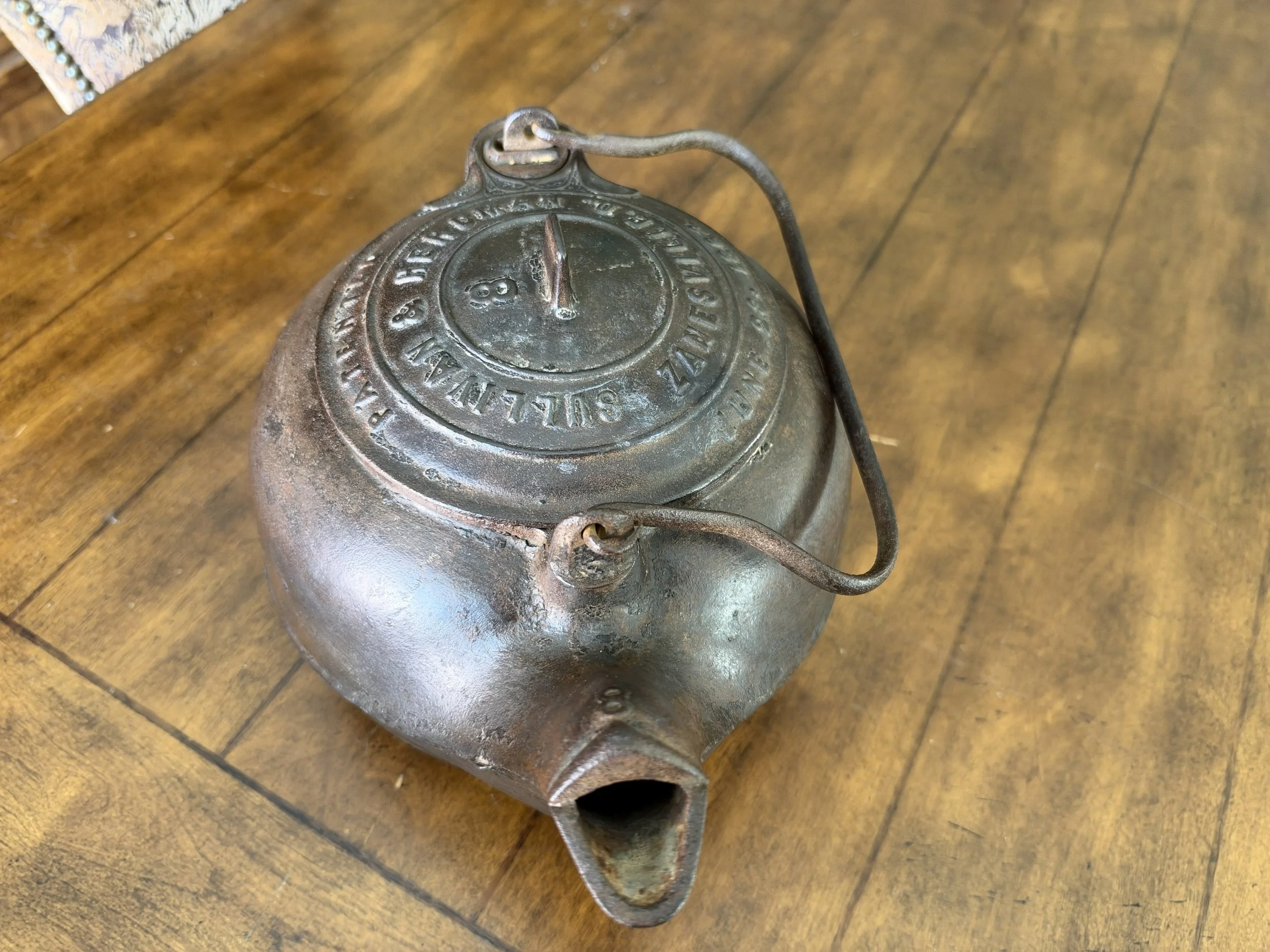
Sullivan & Herdman No. 8 tea kettle viewed from the spout, with the wire bail seated through the opposing cast ears and the pivoting lid retained at the rear ear.
Every catalog entry starts with what the object tells you directly. This cast iron tea kettle has a rounded body, integral spout, wrought- or malleable-iron wire bail, and a circular lid that pivots at the rear bail ear. Its raised inscription reads PATENTED / SULLIVAN & HERDMAN / ZANESVILLE, O. / JUNE 23. 1863., with the size 8 in the lid’s center field. The body, lid, bail, spout, and pivot assembly are present; the surface shows oxidation, finish variation, and ordinary working wear. A diagonal linear casting feature crosses the underside, but photographs alone do not establish whether it is a gate-related feature, mold artifact, or later repair.
The inscription, the surviving mechanism, U.S. Patent No. 38,972, and two period histories make a closely bounded account possible. They document Sullivan & Herdman as proprietors of an older Zanesville foundry beginning in 1863, identify the kettle’s lid-retaining mechanism, and place the partnership within a successor chain that led to Jones & Abbott. They do not yet identify Sullivan and Herdman by full name, prove a formal patent license, or date this individual casting more precisely than the documented partnership window.
Finding the Patent
The search began with the exact date cast on the kettle rather than with a presumed maker history. Searching United States patent records for tea-kettle patents issued on June 23, 1863 produced U.S. Patent No. 38,972, granted to Barney H. Menke of Cincinnati, Ohio for an “Improvement in Tea-Kettles” (Google Patents).
Menke described a cast iron vessel whose lid swings horizontally around one bail ear. The patented element was a slotted thimble fitted over that ear: it served as the pivot, retained the lid, and was secured when the bail was inserted. The specification further explained that the body, lid, and thimble could be cast complete from the sand without filing, screw-cutting, or other finishing work (U.S. Patent No. 38,972).

Close view of the concentric lid inscription: “PATENTED / SULLIVAN & HERDMAN / ZANESVILLE, O. / JUNE 23. 1863.” The central “8” identifies the kettle size.
The object preserves the arrangement described in the patent: the lid extends into a circular opening at the rear ear, and the bail passes through the assembled area. That physical correspondence supports identification of the cast date as a patent reference, not as a serial number or decorative date. It does not prove that the kettle was cast on June 23, 1863; patent dates commonly mark the protected design, while manufacture may follow later.
Who Were Sullivan & Herdman?
A period county history published in 1882 gives the clearest contemporary account of the partnership’s place in the Third Street foundry lineage. Its “Founders and Machinists” section states:
“In 1819, Thos. L. Pierce started a foundry on the site now owned by Jacob Smith & Co. In 1827, Richmond and Robert Bostwick purchased the business. In 1832, John A. Adams and Benjamin Wheeler became their successors. In 1839, they built on the site now occupied by Jones & Abbott, and continued the business until 1848, when the firm changed to Gilbert & Wheeler, who continued the business until 1863, when Sullivan & Herdman became proprietors. In 1866, Charles H. Jones was admitted to the firm, and in 1871 Charles H. Abbott became a partner, and the firm name was changed to Jones & Abbott.”
Source: J. F. Everhart & Co., History of Muskingum County, Ohio, 1882, p. 82 (Muskingum County government scan).
That account separates the age of the physical foundry from the age of the Sullivan & Herdman partnership. It supports the following narrow chronology:
· Foundry ancestry: The facility traced its ownership through Thomas L. Pierce; Richmond and Robert Bostwick; Adams & Wheeler; and Gilbert & Wheeler before Sullivan & Herdman became proprietors in 1863.
· Sullivan & Herdman period: The partnership name is documented from 1863. Charles H. Jones entered the firm in 1866, but the period source does not state whether the public business name changed at that moment.
· Successor: Charles H. Abbott entered in 1871, when the business became Jones & Abbott. The 1882 history lists Jones & Abbott at 41 South Third Street under both stove manufacturers and plow manufacturers.
A second period source, published in 1905, repeats the same succession and adds that Sullivan died in 1871 and his interest was sold to Charles H. Abbott. It describes Charles H. Jones as joining the foundry in 1866 and identifies the later Jones operation as a stove-and-range manufacturer (Past and Present of the City of Zanesville and Muskingum County, 1905). The book does not provide Sullivan’s first name in this passage, and it does not identify which member of Zanesville’s Herdman families was the foundry partner. Those identities remain open rather than inferred.

Overhead view showing the complete Menke-pattern assembly: drawn spout at left, wire bail, circular lid, and the retained pivot at the rear bail ear.
Zanesville in 1863: Historical Context
The Sullivan & Herdman name belongs to a foundry site with a longer documented life than the partnership itself. The 1882 county history places the operation at the later Jones & Abbott site and traces ownership changes back through the first half of the nineteenth century. The 1905 history locates the later Jones Stove Foundry on Third Street between Main and South streets, giving a more precise location for the successor operation (1882 county history; 1905 county history).
Zanesville supported more than one foundry lineage during the same decade. The 1905 account records that Shinnick, Hatton & Company took possession of a separate Fountain Alley works on January 1, 1866, enlarged it, and changed the name in 1870. This establishes a documented local setting in which multiple firms were making cast products, but it does not by itself prove commercial or licensing ties between those firms and Sullivan & Herdman (1905 county history).
The kettle’s patent date also fixes the design in 1863. Menke’s specification emphasized manufacturability: the kettle could consist of four principal pieces, and the cast components were intended to emerge complete from the sand. That concern with reducing finishing operations helps explain the practical form visible here, but no surviving Sullivan & Herdman catalog or production record was located to show how the Zanesville shop marketed the kettle (U.S. Patent No. 38,972).

Underside of the kettle with three low support feet and a pronounced diagonal linear casting feature. Its exact origin remains unresolved pending direct examination and comparison.
Updated Kettle Details
· Manufacturer: Sullivan & Herdman, Zanesville, Muskingum County, Ohio.
· Company founded: The Sullivan & Herdman proprietorship is documented as beginning in 1863; the underlying foundry business had earlier owners.
· Company closed: The partnership name ended by 1871, when Charles H. Abbott entered and the successor firm became Jones & Abbott. Sullivan’s death is reported by the 1905 county history as the reason his interest was sold.
· Peak size / scale: Not documented for Sullivan & Herdman. Later scale figures for Jones’s operation cannot be assigned backward to this partnership.
· Piece type: Bailed cast iron tea kettle with horizontally pivoting lid.
· Size/model: No. 8, represented by the raised “8” in the lid’s center field.
· Casting/maker’s marks: PATENTED / SULLIVAN & HERDMAN / ZANESVILLE, O. / JUNE 23. 1863. / 8.
· Associated patent (if any): U.S. Patent No. 38,972, Barney H. Menke, “Improvement in Tea-Kettles,” issued June 23, 1863.
· Patent subject (verified): A slotted thimble fitted over a bail ear to retain the lid while allowing horizontal movement, with the assembly secured by insertion of the bail.
· Relationship to maker: The kettle bears Sullivan & Herdman’s name and Menke’s patent date, and its surviving pivot assembly corresponds to the patent. A formal assignment or license to Sullivan & Herdman has not been located.
· Date of manufacture: Most defensible range: 1863–1871, based on the patent date and the documented Sullivan & Herdman business-name window. A narrower date is not verified.
· Place of manufacture: Zanesville, Muskingum County, Ohio, as cast into the lid.
· SSC catalog no.: SSC-SH-KTL-8-001.
· Acquisition: eBay, seller vons_collections, September 24, 2026.
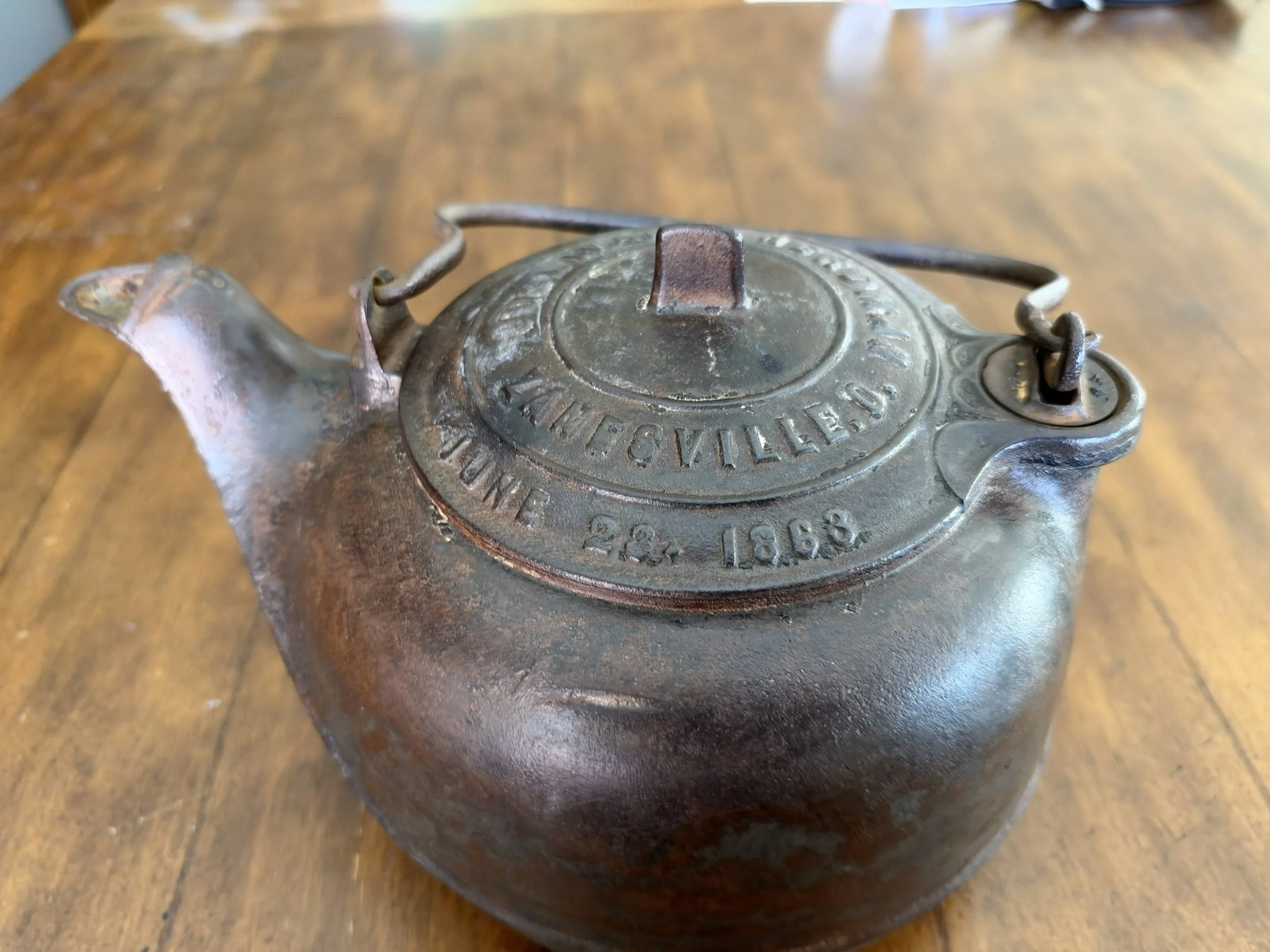
Low profile view emphasizing the rounded body, tapered spout, raised patent date, lid tab, and rear pivot assembly retained by the wire bail.
Open Questions for Further Research
In keeping with SSC’s research standard—document what is verified, flag what is not—this pass separates the evidence as follows:
· Confirmed: The object itself identifies Sullivan & Herdman of Zanesville, Ohio; size 8; and the patent date June 23, 1863. U.S. Patent No. 38,972 confirms Barney H. Menke of Cincinnati as the inventor and describes the lid-retaining thimble mechanism.
· Confirmed: The 1882 county history states that Sullivan & Herdman became proprietors of the older foundry in 1863, that Charles H. Jones entered in 1866, and that Charles H. Abbott’s 1871 entry accompanied the change to Jones & Abbott.
· Unverified — needs primary confirmation: Collector and auction references report other Sullivan & Herdman kettles, including size No. 7 examples, but these reports do not establish a complete size range or production series. A period trade catalog, price list, or examined group of marked originals would be needed.
· Unverified — needs primary confirmation: Specialty foundry lists record “Sullivan & Herdman — Zanesville,” but they add no sourced corporate history. They corroborate collector recognition of the name only; they do not establish dates, output, or rarity.
· Still open: The full names and individual roles of the Sullivan and Herdman partners. City directories, partnership notices, deeds, probate files, or contemporary newspaper advertisements from 1863–1871 are the most likely records to resolve them.
· Still open: Whether Sullivan & Herdman held a written license or other contractual right to use Menke’s patent. The patent names Menke as inventor, while the marked object proves use of the date and mechanism, not the legal arrangement.
· Still open: The precise casting year of this kettle within 1863–1871, and the function of the diagonal underside feature. Direct examination, nondestructive inspection, and comparison with documented examples may narrow both questions.
· Still open: The later transition date from Jones & Abbott to Jones alone. Separate passages in the 1905 history give 1902 and 1903, so the discrepancy should be resolved through city directories or legal notices rather than harmonized by assumption.
Why This Still Matters
This kettle supplies a physical record for a short corporate name inside a much longer Zanesville foundry succession. Its cast lettering ties Sullivan & Herdman to a specific place, size, and patent date; the 1863 patent explains the surviving mechanism; and period county histories bound the partnership to a documented 1863–1871 window. What remains unknown is equally useful: the partners’ full identities, the legal patent relationship, the precise casting year, and the shop’s full hollow-ware line now form a defined research agenda rather than collector lore.
Sources
· Physical object: Sullivan & Herdman No. 8 cast iron tea kettle, SSC-SH-KTL-8-001; physical markings and construction documented from SSC collection photography, September 2026.
· U.S. Patent No. 38,972: Barney H. Menke, “Improvement in Tea-Kettles,” issued June 23, 1863 — Google Patents.
· Period county history: J. F. Everhart & Co., History of Muskingum County, Ohio (1882), p. 82 — Muskingum County government PDF.
· Period city and county history: J. Hope Sutor, Past and Present of the City of Zanesville and Muskingum County, Ohio (S. J. Clarke Publishing Co., 1905), pp. 165–166 and 358–359 — Internet Archive scan.
· Cast Iron Collector (secondary collector compilation): Foundry Database entry for Sullivan & Herdman, Zanesville, Ohio — Cast Iron Collector; used only to document collector-list recognition of the name.
· Wagner and Griswold Society (secondary society compilation): Foundries of the Past and Present listing — WAGS PDF; used only as a corroborating collector list.
· SSC internal records: Acquisition record and seller invoice for SSC-SH-KTL-8-001, September 24, 2026. No purchase-price information is reproduced in this post.
