The Peck-Williamson Co. — Cast Iron Furnace Damper Plate
SSC MUSEUM COLLECTION
Catalog No. SSC-PW-FRN-DMP-001
The Peck-Williamson Co. | Furnaces | Cincinnati, Ohio
Pioneers of Central Heating • Founded 1882 • Cincinnati, Hamilton County

Front view showing the complete maker’s identification in raised block letters: “PECK-WILLIAMSON / CO.” arched at top, “FURNACES” across the middle, and “CINCINNATI.” at the bottom. The arched sliding damper mechanism is visible at the top. A decorative screw/bolt motif sits at center. The original iron chain hangs from the bottom edge.
Before central air conditioning, before forced-air gas furnaces, before programmable thermostats—there was the coal furnace. And in Cincinnati, Ohio, The Peck-Williamson Company was one of the first manufacturers in America to build central furnace heating systems that could warm an entire house from a single unit in the basement. This cast iron damper plate is a component of that technology: a functional piece of furnace hardware that controlled airflow through the heating system, marked with the company’s full name, product line, and city of manufacture in bold raised letters.
The plate features an arched “tombstone” shape with the company identification cast prominently on the front face: “THE PECK-WILLIAMSON CO.” arched at top, “FURNACES” across the middle, and “CINCINNATI.” at the bottom. An arched sliding damper mechanism at the top allowed the homeowner or furnace operator to regulate airflow, and the original iron chain attached at the bottom provided a pull mechanism for operation—sometimes from a distance, as these plates were often mounted on hot furnace surfaces. Every component of the original design is present on this example.
The Peck-Williamson Company traces its corporate lineage back to 1882, when the Bennett Furnace Company was founded in Cincinnati. The company reorganized several times through the 1890s before settling on The Peck-Williamson Heating & Ventilating Company. By the early 1900s, Peck-Williamson was advertising its “Underfeed Furnace” in national publications like The Saturday Evening Post and Popular Mechanics. In 1911, the company purchased several competitors and reorganized as the Williamson Heater Company—a name that would become synonymous with residential heating in the Cincinnati area for decades. The Peck-Williamson name on this damper plate places it in the pre-1911 era, making it a document of the company’s earliest identity.
Piece Details
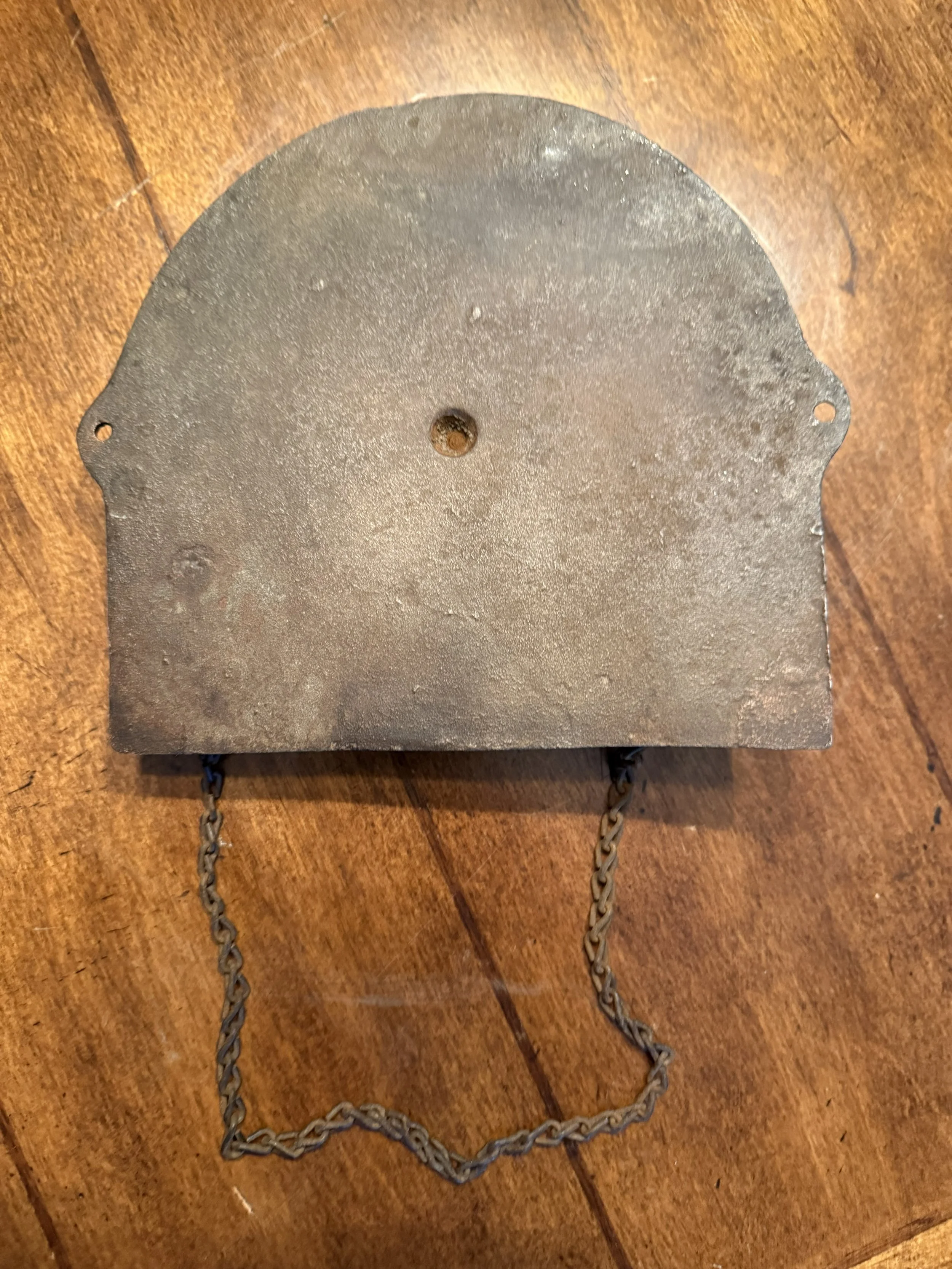
Reverse view showing the plain flat back with center mounting hole and two small mounting holes at upper corners. The original iron chain is attached at the bottom. The arched shape and mounting configuration indicate this plate was designed to fit a specific furnace opening or cleanout port.
Manufacturer
The Peck-Williamson Co. (Cincinnati, Ohio)
Piece Type
Cast iron furnace damper control plate / cleanout door
Product Line
Furnaces
Material
Cast iron
Shape
Arched / tombstone shape with flat bottom edge
Dimensions
Approximately 6 inches wide x 7 inches tall
Front Marking
“PECK-WILLIAMSON / CO.” arched at top; decorative screw/bolt motif center; “THE” at left, company name continues; “FURNACES” across middle; “CINCINNATI.” across bottom; all in raised block letters
Back
Plain flat reverse with center mounting hole and two small mounting holes at upper corners
Chain
Original iron chain attached at bottom, used for damper operation
Sliding Mechanism
Arched sliding damper visible at top of front face
Date of Manufacture
Estimated circa 1895–1911
Place of Manufacture
Cincinnati, Hamilton County, Ohio
Condition
Very Good — all lettering crisp and fully legible; original chain intact; sliding damper mechanism present; mounting holes intact; surface patina consistent with age; no cracks or structural damage
Acquisition Date
November 28, 2025
Acquisition Source
eBay — Seller: premantiquesandcollectibles
eBay Item Number
267485435688
Order Number
01-13908-48998
SSC Catalog Number
SSC-PW-FRN-DMP-001
Historical Background
From Bennett Furnace to Peck-Williamson
The corporate history of this piece begins in 1882 with the founding of the Bennett Furnace Company in Cincinnati, Ohio. Around 1890, the company reorganized as Bennett & Peck, and then as The Peck-Williamson Heating & Ventilating Company. The name changes reflected evolving partnerships and a growing ambition: Peck-Williamson was positioning itself not just as a furnace maker but as a complete heating and ventilating systems company. By the mid-1890s, the company was advertising in trade publications and establishing a reputation for reliable central heating equipment.
The company’s most notable innovation was the “Underfeed” furnace system, which fed coal from below the fire rather than on top—a design that produced more complete combustion and cleaner burning. Peck-Williamson advertised the Underfeed aggressively in national magazines between 1905 and 1911, building a market that extended well beyond Cincinnati. In 1900, the company commissioned its own sheet metal shop to produce galvanized ductwork under the Seal-Tite brand—making Peck-Williamson one of the first furnace manufacturers to control the complete distribution system from furnace to vent.
Cincinnati’s Heating Industry
Cincinnati’s position as a major manufacturing center made it a natural home for heating equipment companies. The city’s foundry infrastructure, transportation networks, and proximity to coal-producing regions in southeastern Ohio, West Virginia, and Kentucky gave Cincinnati-based furnace makers a competitive advantage in both raw materials and distribution. Peck-Williamson was one of several Cincinnati firms that helped establish the city as a center of the American heating industry—a legacy that continued through the Williamson Heater Company’s operations into the late 20th century.
The Damper Plate: Functional Hardware as Corporate Identity
A furnace damper plate like this one served a dual purpose: it was a functional component of the heating system (controlling airflow through the furnace or ductwork) and it was a permanent advertisement for the manufacturer. Every homeowner who walked into their basement to tend the furnace saw the Peck-Williamson name cast in iron on the face of their heating system. Unlike a printed advertisement that could be discarded or a painted sign that could weather away, a cast iron furnace plate lasted as long as the furnace itself—and often longer, as this example demonstrates more than a century after its manufacture.
The original chain is a particularly notable survival. Chain-operated dampers allowed homeowners to control airflow without reaching directly onto hot metal surfaces. The chain hung down from the plate, and a pull would slide the arched damper open or closed. Finding the plate with its original chain intact is uncommon; most surviving examples have lost this consumable component over decades of use and replacement.
SSC Collection Context
This Peck-Williamson furnace plate is the second Cincinnati piece to enter the SSC collection, joining the Newman Brothers Last Supper plaque in extending the museum’s geographic coverage into Hamilton County. Together, these pieces document two very different Cincinnati industries—decorative metalwork and heating equipment—that shared a common foundation in the city’s deep foundry and metalworking tradition.
The piece also expands the SSC’s documentation of Ohio cast iron into the industrial heating category. A furnace damper plate is not cookware, and it is not decorative art. It is functional industrial hardware—a component of the infrastructure that heated American homes in the coal-burning era. But it is cast iron, it was made in Cincinnati, Ohio, and it carries a complete maker’s identification that connects it to a documented company with a traceable corporate history dating to 1882. The SSC’s mandate does not distinguish between the kitchen and the basement. Ohio iron is Ohio iron.
The iron endures. The markings tell the truth. The story deserves to be told.
The Peck-Williamson Co. — Corporate Timeline
1882
Bennett Furnace Company founded in Cincinnati, Ohio—the earliest corporate ancestor of Peck-Williamson.
c. 1890
The company reorganizes as Bennett & Peck Company, then as The Peck-Williamson Heating & Ventilating Company.
1894
Peck-Williamson Heating & Ventilation advertising documented in Cincinnati.
1895
The Metal Worker publishes material on Peck-Williamson products.
1900
Peck-Williamson commissions its sheet metal shop in downtown Cincinnati. The Seal-Tite brand of galvanized ductwork is born—one of the first manufacturers to produce its own branded ductwork for central furnace systems.
1905–1908
Peck-Williamson advertises its “Underfeed Furnace” in The Saturday Evening Post and Popular Mechanics, establishing a national market presence.
1911
Peck-Williamson purchases several other heating equipment businesses and reorganizes as the Williamson Heater Company. The Peck-Williamson name is phased out.
Mid-1900s
The Williamson Heater Company becomes a major force in the HVAC industry, producing furnaces, boilers, and air conditioning equipment from its Cincinnati plant at Ridge and Madison Road.
1960s–1970s
Williamson produces the “Five In One” combination heating/cooling units, marketed heavily in the Cincinnati area.
1992
Metzger Machine Corporation acquires The Williamson Company and moves production to Milwaukee, Wisconsin.
1999
The Marley-Wylain Company acquires the Williamson and Thermoflo brand names, forming Williamson-Thermoflo.
2025
Steve’s Seasoned Classics acquires this Peck-Williamson furnace plate from eBay seller premantiquesandcollectibles. The piece is documented as SSC-PW-FRN-DMP-001.
Why This Piece Matters
The Peck-Williamson damper plate documents a Cincinnati company that helped pioneer central home heating in America. Before Peck-Williamson and its competitors, most American homes were heated room by room—a fireplace here, a stove there, cold hallways in between. The central furnace changed that, and companies like Peck-Williamson built the equipment that made it possible. This cast iron plate is a surviving piece of that revolution, marked with the name of the company that made it and the city where it was produced.
The Peck-Williamson name on this plate dates it to before 1911, when the company reorganized as the Williamson Heater Company. That places it in the company’s formative period—the years when it was building its reputation through the Underfeed furnace and national advertising campaigns. This is not just a piece of cast iron hardware. It is a piece of Cincinnati’s industrial history, a document of the transition from room-by-room heating to central systems, and evidence of the Ohio foundry tradition operating in a sector far removed from cookware.
Sources & Further Reading
Williamson-Thermoflo corporate history — Hanover Supply: traces the company lineage from Bennett Furnace Company (1882) through Peck-Williamson to Williamson Heater Company and modern Williamson-Thermoflo.
Highland County Press — Seal-Tite 125th Anniversary (2025): documents the 1900 founding of Peck-Williamson’s sheet metal shop and Seal-Tite ductwork brand.
WorthPoint — Antique Peck-Williamson Furnace Heat Control listing: comparable damper plate dated circa 1915 with original chain.
Getty Images — Peck-Williamson Underfeed Furnace advertisement, 1906: documents national advertising campaigns.
MyCompanies Wiki — Peck-Williamson Company: advertising references from The Metal Worker (1895), Saturday Evening Post (1905), Popular Mechanics (1908), and Century Magazine (1911).
eBay listing and invoice documentation — Item 267485435688, Order 01-13908-48998.
About Steve’s Seasoned Classics
Steve’s Seasoned Classics is an online museum dedicated to preserving and documenting the heritage of American cast iron, with a focus on Ohio foundry pieces from the 19th and early 20th centuries. The SSC collection features over 130 pieces with detailed provenance, historical research, and photography for each item.
