Ober Manufacturing Company — Cast Iron Trivet / Sadiron Stand
SSC MUSEUM COLLECTION
Catalog No. SSC-OBER-TRV-SQ-001
Ober | Cast Iron Trivet | Chagrin Falls, Ohio
Ober Manufacturing Company • Chagrin Falls, Cuyahoga County • Founded 1873
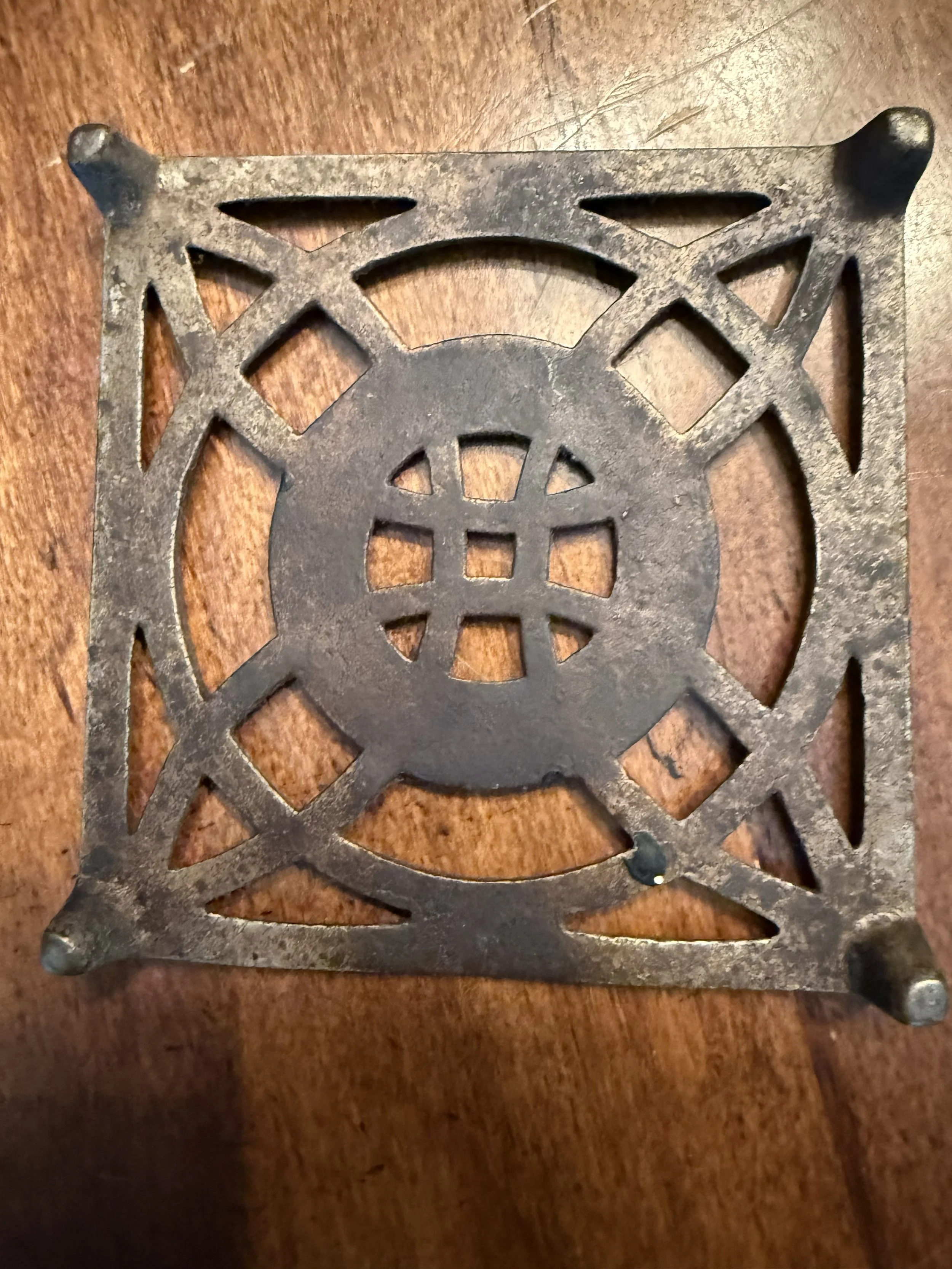
Bottom view showing the maker’s mark cast in raised letters within the central circle band: “OBER” arched above, “CHAGRIN FALLS • OHIO” arched below. The geometric openwork pattern of interlocking curved bands is visible through the casting. Four peg feet at corners.
In the village of Chagrin Falls, Ohio—about 25 miles east of Cleveland in Cuyahoga County—the Ober Manufacturing Company operated for over 80 years as one of the community’s major industries. Founded by brothers John and George Ober in the 1870s, the company began as a lumber mill and evolved into a diversified manufacturer of woodworking machinery, sadirons (flat irons for pressing clothes), trivets, tool handles, and a variety of cast iron household products. This square trivet—marked “OBER / CHAGRIN FALLS • OHIO” on its underside—is a product of that foundry tradition.
Ober trivets are among the most collectible products the company made. Originally designed as sadiron stands—platforms to hold a hot flat iron between uses—they served double duty as coffee stands, teapot stands, and table protectors. The company produced them in a variety of patterns: square geometric designs like this one, circular forms, and decorative leaf patterns. They were available in either a japanned (black enamel) finish or electroplated nickel. Trivet collectors value Ober pieces for their clean geometric casting, consistent quality, and the attractive “OBER / CHAGRIN FALLS” marking that identifies both the maker and the small Ohio village where they were produced.
This particular trivet features a square frame with an interlocking geometric openwork pattern centered on a circle-and-grid motif. Four small peg feet at the corners elevate the trivet above the surface to prevent heat transfer to the table below. The marking on the underside is crisp and fully legible. For the SSC collection, this piece documents an Ohio manufacturer that most people outside the trivet and sadiron collecting communities have never heard of—but whose products were exported worldwide from a small village on the Chagrin River.
Piece Details

Top view showing the geometric openwork pattern: a central circle with a grid/cross motif surrounded by interlocking curved bands within a square frame. The four corner peg feet are visible. The pattern is characteristic of Ober’s square sadiron stand designs documented in their 1914 catalog.
Manufacturer
Ober Manufacturing Company (Chagrin Falls, Ohio)
Piece Type
Cast iron trivet / sadiron stand
Shape
Square with geometric openwork pattern
Material
Cast iron
Dimensions
Approximately 4¼ inches square
Front (Top)
Openwork geometric pattern: central circle with grid/cross motif surrounded by interlocking curved bands within a square frame; four small peg feet at corners
Back (Bottom) Marking
“OBER” arched above center; “CHAGRIN FALLS • OHIO” arched below center; marking cast in raised letters within the central circle band
Feet
Four small cast peg feet at corners to elevate trivet above surface
Date of Manufacture
Estimated late 19th to early 20th century
Place of Manufacture
Chagrin Falls, Cuyahoga County, Ohio
Condition
Very Good — all markings legible; geometric pattern intact; four feet present; some surface wear and patina consistent with age; no cracks or structural damage
Acquisition Date
November 28, 2025
Acquisition Source
eBay — Seller: whiplash6699
eBay Item Number
236450783757
Order Number
23-13877-52023
SSC Catalog Number
SSC-OBER-TRV-SQ-001
Historical Background
The Ober Brothers: From Newbury to Chagrin Falls
The Ober family moved to Newbury, Ohio from Washington, New Hampshire in 1834. George H. Ober was born in South Newbury in 1838. He and his older brother John began manufacturing together in the 1860s, initially producing wooden handles and lumber products. In 1873, the brothers decided to relocate to Chagrin Falls, purchasing a 2¼-acre parcel at the corner of Bell Street and Cleveland Street from William ‘Boss’ Hutchings for $700.
The brothers built rapidly. First came a planing mill constructed over a small stream that ran through the property. Next, a sawmill with a five-foot circular saw blade. Then a boiler house with a 30-horsepower engine and a 40-foot iron smokestack. Within two years, a barn, blacksmith shop, and steam dry kiln had been added. The plant opened in 1874 with five employees. By the mid-1880s, demand had grown to the point where the company was running 10-hour shifts, and by 1925, over 70 people were employed at the Chagrin Falls works.
George H. Ober: Inventor and Industrialist
In 1881, John and George dissolved their partnership and George founded the Ober Manufacturing Company. George was the creative force behind the operation—an inventor and designer who held multiple patents, including an improved detachable handle design for sadirons (patented May 28, 1895). He was widely known as an incredibly creative designer and a caring employer who took a personal interest in the welfare of his workers. George Ober died on December 10, 1903, from chronic heart disease. His last patent application was submitted just prior to his death and was approved posthumously.
The company continued to prosper under George’s son Archie and later his grandson Gale. When Archie died in 1950, family members helped clear out his home—and reportedly discarded dozens of boxes of Ober Manufacturing records and documents. What a loss for the historical record. Today, the Chagrin Falls Historical Society is housed in George H. Ober’s own home at 87 East Washington Street, preserving a collection of Ober trivets, sadirons, and company artifacts.
Ober Trivets: Functional Art from Chagrin Falls
Ober sadiron stands were designed with both function and aesthetics in mind. Their smaller size made them versatile—serving as hot iron rests during laundry work, but equally useful as coffee or teapot stands at the table. The company produced stands in square, circular, and leaf patterns, all executed with the clean lines and precise casting that made Ober products stand out. A 1914 Ober catalog documents the full range of available designs. The square geometric patterns, like this SSC example, are among the most commonly encountered Ober trivets, though all patterns are collectible.
The Trivetology research site notes that only the leaf-pattern designs were signed on the reverse—making this square geometric trivet with its full “OBER / CHAGRIN FALLS • OHIO” marking a notable example of the company’s branding practice. The marking identifies not just the maker but the specific Ohio village where the iron was cast—a small-town provenance that gives these pieces a particular charm in the collecting community.
SSC Collection Context
This Ober trivet extends the SSC’s geographic coverage into Chagrin Falls—a small village in Cuyahoga County that most people associate with its picturesque waterfall, not with cast iron manufacturing. Yet for over 80 years, the Ober Manufacturing Company operated a foundry there that produced cast iron products exported around the world. The company’s story is exactly the kind the SSC exists to tell: a family-owned Ohio foundry, rooted in a specific community, producing marked cast iron products of exceptional quality.
The piece also expands the SSC’s documentation of Ohio cast iron beyond cookware into the domestic hardware category. A trivet is not a skillet—but it lived in the same kitchen, served the same household, and came from the same tradition of Ohio foundry craftsmanship. The marking connects it to a maker, a village, and a state. That is all the SSC’s mandate requires.
The iron endures. The markings tell the truth. The story deserves to be told.
Ober Manufacturing Company — Company Timeline
1838
George H. Ober born in South Newbury, Ohio. The Ober family had moved from Washington, New Hampshire to Newbury in 1834.
1862
John and George Ober found their first manufacturing venture in Newbury, Ohio, producing wooden handles and lumber products.
1873
The Ober brothers move their business to Chagrin Falls, Ohio, purchasing 2¼ acres at the corner of Bell Street and Cleveland Street for $700. They build a planing mill, sawmill, boiler house, and supporting structures.
1874
The Chagrin Falls plant opens with five employees. George Ober builds a home on East Washington Street.
1881
John and George dissolve their partnership. George starts Ober Manufacturing Company, focusing on lathes, woodworking machinery, and cast iron household products.
Mid-1880s
Demand grows to the point where the company runs 10-hour shifts. The operation expands into four departments: wood making, machine shop, general sadirons, and foundry.
1895
George H. Ober patents an improved detachable handle design for sadirons (Pat’d May 28, 1895).
1903
George H. Ober dies on December 10 from chronic heart disease. His son Archie takes over management of the company.
c. 1914
Ober Manufacturing Company catalog documents the full line of sadiron stands and trivets in square, grid, and leaf patterns, available in japanned or nickel-plated finish.
1925
The company employs over 70 people and exports products worldwide.
1950
Archie Ober (George’s son) dies. Family members help clear out company records—dozens of boxes of documents reportedly discarded.
2015
The Chagrin Falls Historical Society moves to the George H. Ober House at 87 East Washington Street, Chagrin Falls—the founder’s own home.
2025
Steve’s Seasoned Classics acquires this Ober trivet from eBay seller whiplash6699. The piece is documented as SSC-OBER-TRV-SQ-001.
Why This Piece Matters
The Ober trivet is a small piece of iron with a big story. It connects to a family of New Hampshire transplants who built a manufacturing business in a small Ohio village. It connects to an inventor who held multiple patents and cared about his workers. It connects to a foundry that ran for over 80 years and exported products worldwide from a plant on Bell Street in Chagrin Falls. And it connects to a historical society that now operates out of the founder’s own home, preserving the artifacts of a company whose paper records were largely lost when the founder’s grandson died in 1950.
For the SSC, this trivet represents the village-scale Ohio foundry—smaller than Cleveland’s Taylor & Boggis, smaller than Sidney’s Wagner, but no less significant in the story of Ohio’s cast iron heritage. Chagrin Falls put its name on this iron, and the iron kept the name. More than a century later, the marking is still legible, the pattern is still beautiful, and the story is still worth telling.
Sources & Further Reading
Trivetology — The Ober Manufacturing Company (trivetology.com): comprehensive history of Ober trivets and sadirons with 1914 catalog documentation and pattern gallery.
Chagrin Falls Historical Society — Ober Mfg. Co. (chagrinhistorical.org): company history including founding, plant construction, and employment figures.
Chagrin Falls Historical Society — George H. Ober biographical document: birth, family history, patents, death, and company legacy.
Still Bank Collectors Club of America — Ober Mfg Company profile: founding date, product range, and Chagrin Falls location.
AntiqBuyer.com — Ober Irons Past Sales: collector sales records documenting Ober sadirons and trivets.
eBay listing and invoice documentation — Item 236450783757, Order 23-13877-52023.
About Steve’s Seasoned Classics
Steve’s Seasoned Classics is an online museum dedicated to preserving and documenting the heritage of American cast iron, with a focus on Ohio foundry pieces from the 19th and early 20th centuries. The SSC collection features over 130 pieces with detailed provenance, historical research, and photography for each item.
