Adamson Manufacturing Company — Cast Iron Tire Tube Vulcanizer
SSC MUSEUM COLLECTION
Catalog No. SSC-ADAM-VUL-001
Adamson Mfg. Co. | Tire Tube Vulcanizer | East Palestine, Ohio
Adamson Manufacturing Company • East Palestine, Columbiana County • Patented April 1913
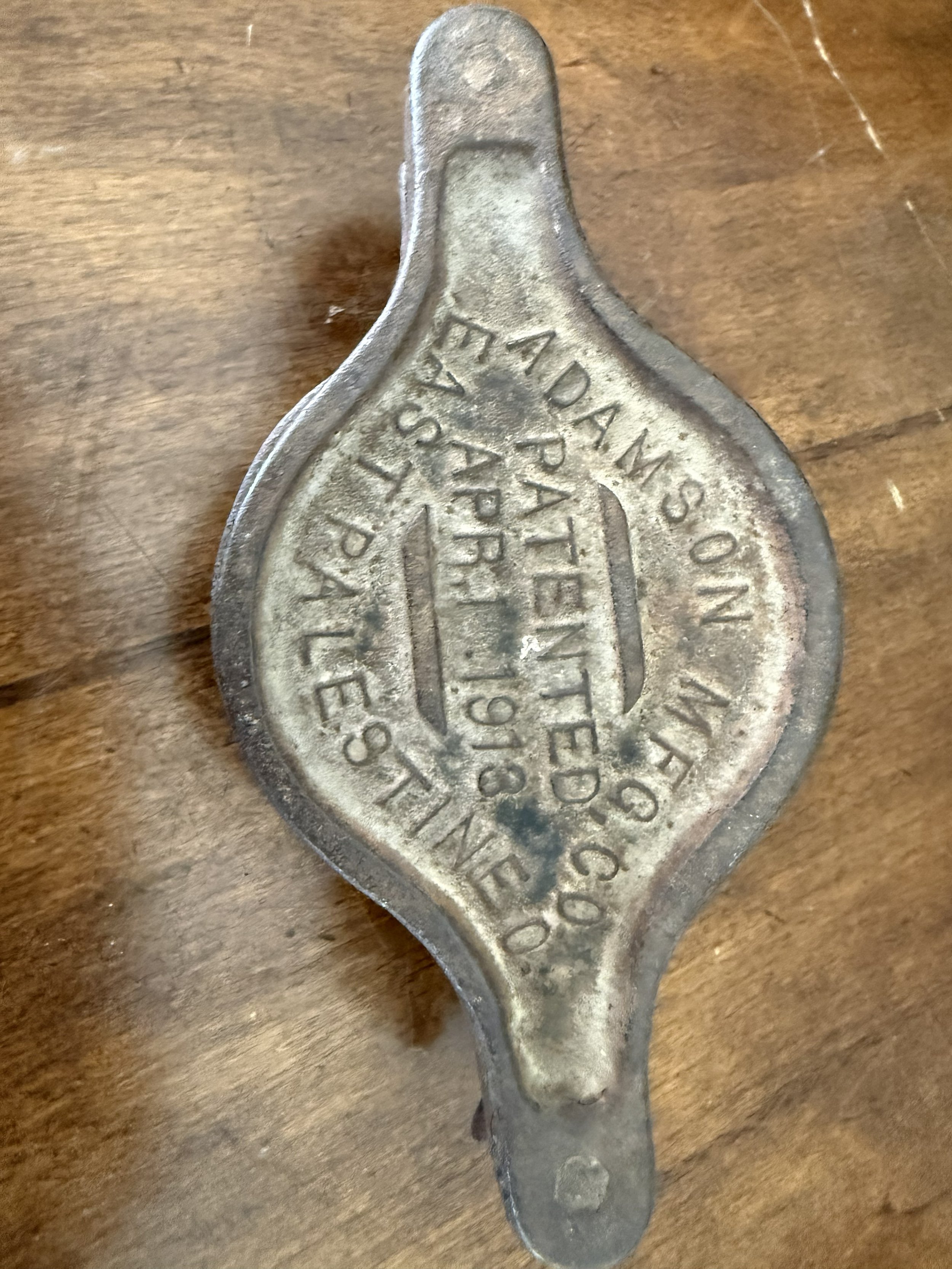
Top view of the Adamson vulcanizer showing the full maker’s mark cast in raised letters: “ADAMSON MFG. CO. / PATENTED / APR 1913 / E. PALESTINE, O.” The diamond-shaped lid profile with pointed upper and lower tabs is characteristic of Adamson’s vulcanizer design. Original patina intact.
In the first decades of the automobile age, a flat tire was not an inconvenience—it was a certainty. Pneumatic tires mounted on wooden or wire-spoke wheels rode on thin rubber inner tubes that punctured constantly on the unpaved, nail-strewn, and gravel-covered roads of early 20th-century America. Spare tubes were expensive. Roadside tire shops were scarce outside cities. The solution was the vulcanizer—a simple cast iron tool that allowed a motorist, mechanic, or garage owner to permanently repair a punctured inner tube using heat and raw rubber.
The Adamson Manufacturing Company of East Palestine, Ohio, was one of the companies that built these tools for the early automotive market. Their patented vulcanizer—marked “ADAMSON MFG. CO. / PATENTED / APR 1913 / E. PALESTINE, O.” on the upper lid—is a compact, two-piece hinged clamp designed for heat-activated rubber patching. The process was straightforward: the user placed a raw rubber patch over the puncture on the inner tube, positioned the tube between the vulcanizer’s two halves with the patch against the studded base plate, clamped the halves together with the wing bolt, and then applied heat to the bottom—either by filling the lower cup with fuel and lighting it, or by placing the whole assembly on a stove. The heat triggered vulcanization, the same chemical process Charles Goodyear had patented in 1844: sulfur-bearing raw rubber, when heated under pressure, undergoes molecular crosslinking that permanently bonds the patch to the tube. Not a glue joint—a molecular weld.
The raised studs visible on the interior of the base plate served two purposes: they distributed heat evenly across the patch surface, and they gripped the rubber to prevent the patch from shifting during the curing process. The diamond-shaped profile of the upper lid—with its pointed tabs at top and bottom—allowed the tool to accommodate tubes of different diameters by centering the patch area regardless of tube curvature.
For the SSC, this piece documents an East Palestine manufacturer operating at the intersection of two Ohio industrial traditions: cast iron foundry work and the early automobile economy. East Palestine—a small village in Columbiana County, about 20 miles south of Youngstown and 40 miles northwest of Pittsburgh—was a manufacturing center whose products reached far beyond its borders.
Piece Details
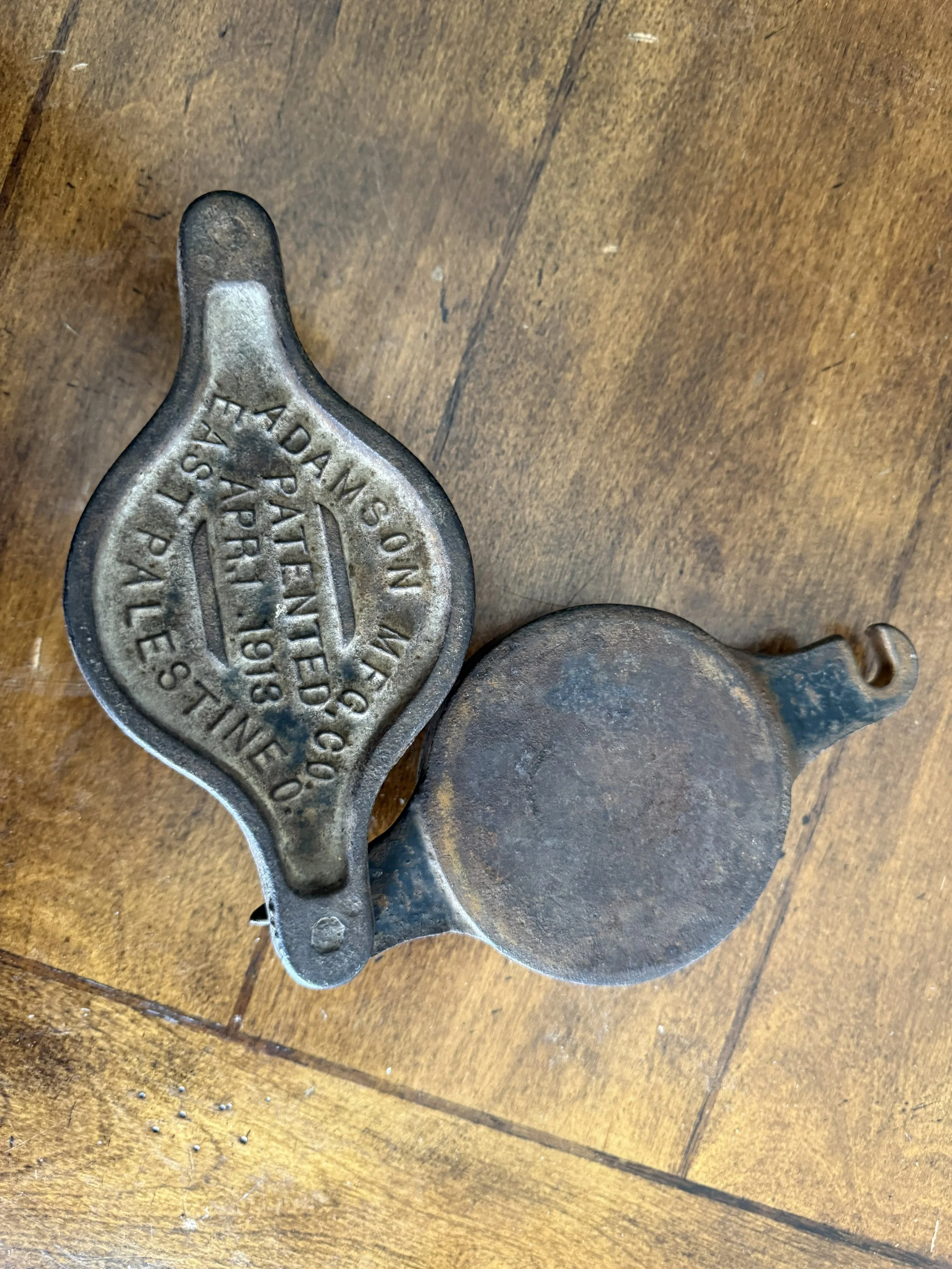
Open view showing the hinged two-piece construction. The upper lid displays the maker’s mark; the lower circular base with its smooth pressing surface faces outward. The hinge mechanism and wing bolt clamp are visible at top. This view shows the compact design that allowed motorists to carry the vulcanizer in a toolbox or automobile kit.
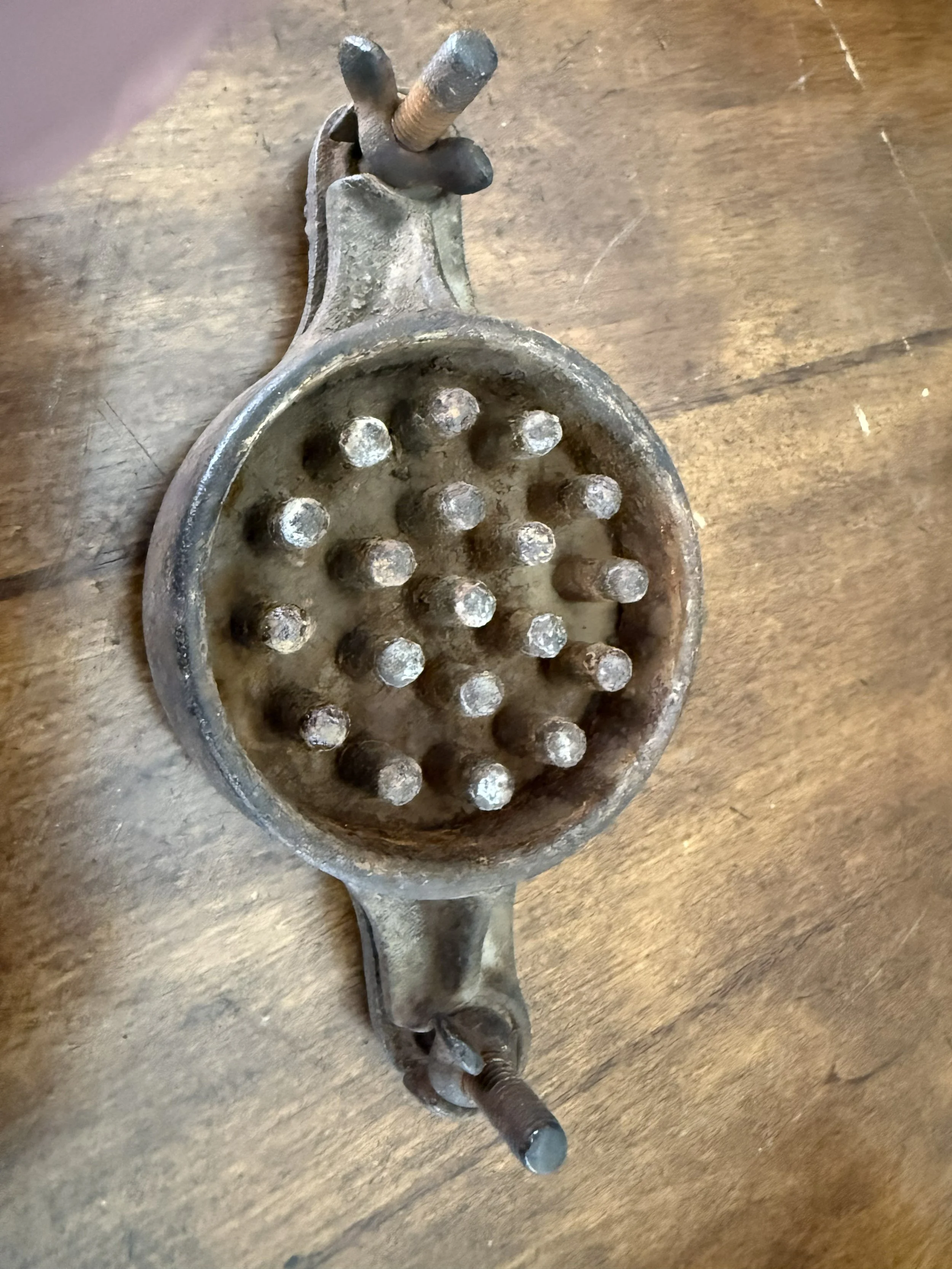
Interior view of the lower base plate showing the array of raised cast iron studs. These studs served as heat distribution points and grip surfaces during vulcanization, holding the raw rubber patch in place against the inner tube while heat bonded the two permanently at the molecular level.
Manufacturer
Adamson Manufacturing Company (East Palestine, Ohio)
Piece Type
Cast iron tire tube vulcanizer
Function
Heat-activated rubber patch tool for repairing punctured pneumatic inner tubes; bonds raw rubber patch to tube through vulcanization (heat-induced chemical crosslinking of rubber molecules)
Material
Cast iron
Construction
Two-piece hinged clamp design: upper lid with maker’s mark and diamond-shaped profile; lower circular base with array of raised studs for heat distribution and grip; wing bolt clamp mechanism to apply pressure during vulcanization; lower handle/stem serves as fuel cup holder or stove rest
Markings
“ADAMSON MFG. CO. / PATENTED / APR 1913 / E. PALESTINE, O.” cast in raised letters on upper lid face
Patent Date
April 1913
Date of Manufacture
c. 1913 or later
Place of Manufacture
East Palestine, Columbiana County, Ohio
Condition
As-found original patina — retained without preservation treatment; all markings crisp and fully legible; wing bolt and hinge mechanism intact and functional; raised studs on base plate intact; surface oxidation and wear consistent with early 20th-century use and storage
Preservation Note
Original patina retained; no Archival Black™ protocol applied — piece preserved in as-found condition
Acquisition Date
March 5, 2026
Acquisition Source
eBay — Seller: funmoneyfromselling
eBay Item Number
286244114423
Order Number
16-14316-36776
SSC Catalog Number
SSC-ADAM-VUL-001
Historical Background
What Is Vulcanization?
Vulcanization is the chemical process of treating raw rubber with heat (and typically sulfur) to create permanent molecular bonds—called crosslinks—between the rubber’s polymer chains. The process was discovered by Charles Goodyear in 1839 and patented in 1844. Before vulcanization, raw rubber was sticky when warm, brittle when cold, and largely useless for industrial applications. Vulcanized rubber is elastic, durable, and resistant to temperature changes—the material that made pneumatic tires, gaskets, hoses, and a thousand other modern products possible.
A tire tube vulcanizer applies this same chemistry on a small scale. By heating a raw rubber patch against a damaged tube under clamping pressure, the tool causes the patch and the tube to crosslink into a single piece of vulcanized rubber. The result is not a patch sitting on top of a tube—it is a molecular bond that makes the patch and the tube one continuous material. A properly vulcanized repair is often stronger than the original tube.
East Palestine: A Manufacturing Village on the Pennsylvania Line
East Palestine sits in Columbiana County in Ohio’s northeastern corner, directly on the Pennsylvania border. Platted in 1828 and incorporated in 1875, the village grew into a significant manufacturing center thanks to its location on the Pennsylvania Railroad’s four-track main line and its access to local clay deposits. By the 1920s, East Palestine’s leading industries included the W.S. George Pottery Company (one of Ohio’s major ceramics producers), the Edwin C. McGraw Tire Company (automobile tires), and a range of foundries and fabrication shops producing steel tanks, electrical refractories, and industrial castings.
The Adamson Manufacturing Company operated within this industrial ecosystem, producing automotive repair tools for a market that was growing as fast as Americans could buy Model Ts. The company’s 1913 patent date places it squarely in the early automobile boom, when tire technology was still primitive and puncture repair was a daily necessity. Adamson produced multiple vulcanizer models, from compact portable units like this SSC example to larger bench-mounted models for professional garages. A 1918 advertisement in The Horseless Age—one of the era’s leading automotive trade publications—documents the company’s Model E vulcanizer, confirming Adamson’s presence in the national automotive supply market.
East Palestine gained unwanted national attention in February 2023 when a Norfolk Southern freight train carrying hazardous chemicals derailed on the village’s eastern edge, triggering evacuations, environmental contamination, and a protracted cleanup effort. The derailment occurred on the same rail corridor—the Fort Wayne Line—that once connected East Palestine’s manufacturers to markets across the eastern United States.
SSC Collection Context
The Adamson vulcanizer extends the SSC’s documentation of Ohio cast iron into the automotive industrial category—a first for the collection. This is not cookware, not a household tool, and not a stove accessory. It is a piece of automotive repair equipment that documents Ohio’s role in the early automobile economy. East Palestine’s manufacturing identity—built on ceramics, tires, and industrial castings—is captured in this single cast iron tool.
The piece also adds Columbiana County to the SSC’s geographic coverage. East Palestine is in Ohio’s far northeastern corner, close enough to Pittsburgh to share its industrial DNA but firmly on the Ohio side of the border. The Adamson mark—with its proud “E. PALESTINE, O.” cast into the lid—places the village name in iron, just as Wagner placed Sidney and Favorite placed Piqua.
The iron endures. The village name endures. And a small cast iron tool that once saved a motorist from walking home on a flat tire is now part of the permanent record.
East Palestine Manufacturing Heritage — Historical Context Timeline
1828
East Palestine is platted by Thomas McCalla and William Grate, originally named Mechanicsburg. Renamed in 1833 after the Middle Eastern region of Palestine.
1875
East Palestine is incorporated. The village develops an industrial base built on local clay deposits, with brick, tile, and ceramics manufacturing.
c. 1900s
The Adamson Manufacturing Company is established in East Palestine, Ohio, producing automotive repair tools and equipment for the rapidly growing automobile market.
1913
Adamson receives a U.S. patent in April 1913 for its tire tube vulcanizer design. The company produces multiple models ranging from small home-use units to larger garage models.
1910s–1920s
East Palestine’s manufacturing economy peaks. Major industries include the W.S. George Pottery Company (ceramics), the Edwin C. McGraw Tire Company (automobile tires), and multiple foundries and fabrication shops. The Pennsylvania Railroad’s four-track system connects the city to Pittsburgh and points east.
1920
East Palestine reaches a population of 5,000 and operates as a statutory city. The public library opens.
2023
East Palestine makes national news when a Norfolk Southern freight train carrying hazardous chemicals derails on February 3, triggering evacuations and environmental contamination. The event draws worldwide attention to the small Columbiana County village.
2026
Steve’s Seasoned Classics acquires this Adamson vulcanizer from eBay seller funmoneyfromselling. The piece is documented as SSC-ADAM-VUL-001.
Why This Piece Matters
An Adamson vulcanizer is a tool that most people today would not recognize—and that is part of its value. It documents a moment in American technological history when cars were common enough to create a mass market for repair tools, but tire technology was still primitive enough that every motorist needed one. It is a product of a specific Ohio village—East Palestine, Columbiana County—and a specific moment in that village’s industrial life, when small manufacturers could produce patented cast iron tools and ship them nationwide via the Pennsylvania Railroad.
For the SSC, this vulcanizer represents the broadest possible interpretation of the collection’s mandate: any marked cast iron from an Ohio manufacturer. Not cookware. Not kitchen hardware. An automotive repair tool—cast in iron, marked with a maker’s name and an Ohio village, and preserved in its original working-life patina for more than a century. The SSC documents the iron. The iron documents the maker. And the maker documents a village that put its name on a product and sent it out into the world.
Sources & Further Reading
Antique Automobile Club of America Forums — Adamson Tire Tube Vulcanizer discussion (forums.aaca.org): collector identification of Adamson models including the Model E, with reference to a 1918 Horseless Age advertisement.
Wikipedia — East Palestine, Ohio (en.wikipedia.org): village history, industrial base, Pennsylvania Railroad connection, and 2023 train derailment.
Smokstak Antique Engine Community — Adamson Manufacturing discussion (smokstak.com): collector identification of Adamson products and Canadian branch operation.
Wikipedia — Clothes Iron / Vulcanization (en.wikipedia.org): technical background on vulcanization chemistry and Charles Goodyear’s 1844 patent.
eBay listing and invoice documentation — Item 286244114423, Order 16-14316-36776.
About Steve’s Seasoned Classics
Steve’s Seasoned Classics is an online museum dedicated to preserving and documenting the heritage of American cast iron, with a focus on Ohio foundry pieces from the 19th and early 20th centuries. The SSC collection features over 130 pieces with detailed provenance, historical research, and photography for each item.
