Standard Churn Company of Wapakoneta, Ohio
The Drive Unit Behind the Comb: Standard Churn Company of Wapakoneta, Ohio, and the Cast Iron Honey Extractor Mechanism
Catalog No. SSC-SCC-HEX-2-001 | Cast Iron Honey Extractor Drive Unit | Wapakoneta, Auglaize County, Ohio

Hero — Full overview of the Standard Churn Co. honey extractor drive unit laid flat, showing both iron frame-holder arms, the rack-and-pinion gear assembly at center, the curved iron crank arm, and the surviving original wooden handle. Catalog no. SSC-SCC-HEX-2-001.
──────────────────────────────────────────────────────────────────────
This is a cast iron honey extractor drive unit — the mechanical gear assembly that powered a centrifugal honey extractor in the late nineteenth or early twentieth century. It is not, on its own, a butter churn. The object is cast iron throughout, with a surviving original wooden crank handle. The main casting carries a rack-and-pinion gear mechanism: a pinion gear (the small toothed crown gear) engages a toothed rack bar and translates the rotary motion of the hand crank into the spinning force needed to extract honey from uncapped honeycomb frames. Two long iron frame-holder arms extend from the central casting; these are the pieces that would have held the honeycomb frames during extraction. The device clamps or suspends into a tank or barrel, which is the vessel not present here — what survives is the drive and frame-holder assembly only.
The main casting is marked in raised lettering along the vertical bar: THE STANDARD CHURN CO. / WAPAKONETA, OHIO. / PATENTED. Immediately above the PATENTED mark, the numbers 12 and 14 are cast into the iron — appearing as two separate digits rather than a single four-digit number. The gears turn freely and have not seized. This post reports a first-time research pass on this piece.
What this pass could confirm is the identity, founding period, and operational history of the Standard Churn Company, and the function of the object itself. What remains unconfirmed is the specific patent number or numbers referenced by the PATENTED casting, and the precise manufacturing date. Both are documented as open leads below.
──────────────────────────────────────────────────────────────────────
Finding the Maker

Close-up of the maker's mark on the vertical bar of the main casting, reading THE STANDARD CHURN CO. along the upper portion. The iron frame-hook arm is visible at left.
Research began with the inscription on the casting itself, which is unusually legible and complete: THE STANDARD CHURN CO. / WAPAKONETA, OHIO. / PATENTED. The company name, city, and state are transcribed exactly as they appear on the object.

Close-up continuing the maker's mark: WAPAKONETA, OHIO. The pinion gear and toothed rack are visible at center right, showing the intact gear engagement. The crank shaft stub extends to the left.
A search of the Smithsonian Institution's National Museum of American History archives confirms that Standard Churn Company, Wapakoneta, Ohio, has a dedicated folder in the Warshaw Collection of Business Americana: Dairy (Series 1, Subseries 1: Manufacturers and Dealers of Dairy Machinery and Products, Box 2, Folder 28). The Warshaw Collection — assembled by New York bookseller Isadore Warshaw over nearly fifty years and donated to the Smithsonian between 1967 and 1971 — represents one of the largest primary source collections on American business ephemera, and the Standard Churn Company folder indicates the company was a recognized commercial manufacturer in the dairy and farm supply trade. The materials in that folder have not been reviewed in person for this research pass; the finding aid alone confirms the company's presence in primary-source institutional records. (Warshaw Collection finding aid: https://sirismm.si.edu/EADpdfs/NMAH.AC.0060.S01.01.Dairy.pdf)
Secondary sources consulted across multiple independent platforms consistently report the same founding details: the Standard Churn Company of Wapakoneta, Ohio, was established in 1889 by F.H. Haman, R.C. Haman, and S.A. Hoskins. This claim appears in the Delta County Historical Museum's catalog record for a Standard Churn Company No. 2 crank butter churn (catalog number A-2020.19.094) (https://deltahistorical.pastperfectonline.com/Webobject/DA7C8BA4-085D-49B9-B1F3-256562609114), in RubyLane item descriptions, in the antiques blog The Butter Churn ... Continuing Adventures of the Antiques Detective (November 2010), and in a WorthPoint item description — four independent secondary sources all agreeing on the 1889 founding and the same three principals. None of these sources have been checked against a primary county record such as an Auglaize County incorporation filing, a local newspaper announcement, or the 1923 History of Auglaize County, Ohio edited by William J. McMurray — that verification step is identified below as the primary confirmation still needed.
The company later appears to have operated under the expanded name Standard Churn & Mfg. Co., as referenced in a Michigan State University agricultural study and in Bee Culture magazine advertisements. By the time of a September 1935 Bee Culture advertisement that has been partially identified in research, the company was advertising itself as 'For 60 years making honest...' equipment — which, if the 1935 date is accurate and the '60 years' claim is literal, would place the founding around 1875, considerably earlier than the 1889 date given in the secondary collector sources. This discrepancy is flagged as unverified and is addressed in Open Questions below.
──────────────────────────────────────────────────────────────────────
What Is This Object? A Plain Explanation for Non-Beekeepers
Most people encountering this piece will not immediately recognize it. Before the history, here is what it actually is and how it was used.
The Honey Extractor: Why It Exists
Bees store honey inside wax cells built into wooden frames inside a beehive. Before the honey extractor was invented, the only way to get that honey was to crush the entire comb — destroying the wax structure the bees had labored to build. Austrian beekeeper Franz Hruschka developed the centrifugal honey extractor in 1865, and the design concept reached American manufacturers by the 1870s and 1880s. The machine's purpose was elegantly simple: spin the uncapped frames fast enough that centrifugal force flings the honey out of the wax cells and against the walls of an outer drum or barrel, from which it drains to the bottom and out through a gate, all without destroying the comb. The empty comb could then be returned to the hive for the bees to refill, saving enormous labor on both sides.
This Piece: The Drive Unit

View from below showing the underside of the two iron frame-holder arms, the gear crown visible at center, and the sliding adjustment mechanism with its two bolts. The rack gear is visible at left and right of center.
The object in the collection is specifically the drive mechanism and frame-holder assembly of a tangential honey extractor. A complete extractor would consist of this drive unit mounted inside a cylindrical drum or barrel (usually tin or wood in the period). The honeycomb frames would have been slid into the two long iron arms — the frame holders — and secured. The beekeeper would then turn the wooden-handled crank. The crank drove the pinion gear, which engaged the toothed rack, which transferred that rotary motion to spin the frame-holder assembly. Honey was flung from the cells by centrifugal force, hit the walls of the outer drum, and drained to the bottom.
The rack-and-pinion mechanism visible on this piece performed a specific and important function beyond simple rotation: it controlled the speed and mechanical advantage of the spin. The beekeeper needed to start slowly — spinning too fast too soon would collapse the fragile wax comb under centrifugal force before it had time to give up the honey. The gear ratio between the crank and the rack allowed a moderate hand-crank speed to produce the higher rotation speed needed at the frame, while still giving the operator tactile control over acceleration. The ratchet or rack teeth visible on the casting are the physical evidence of that engineered relationship.
The term 'Butter Churn / Honey Extractor' that appears in auction and collector listings for this type of piece reflects the dual-purpose manufacturing history of Standard Churn Company: the same Wapakoneta factory that made wooden butter churns also designed and patented cast iron honey extractor drive units. The two functions — churning cream and spinning honey frames — both required a mechanical drive assembly to translate hand power into rotary motion, and Standard Churn's engineers built both.
The Numbers 12 and 14
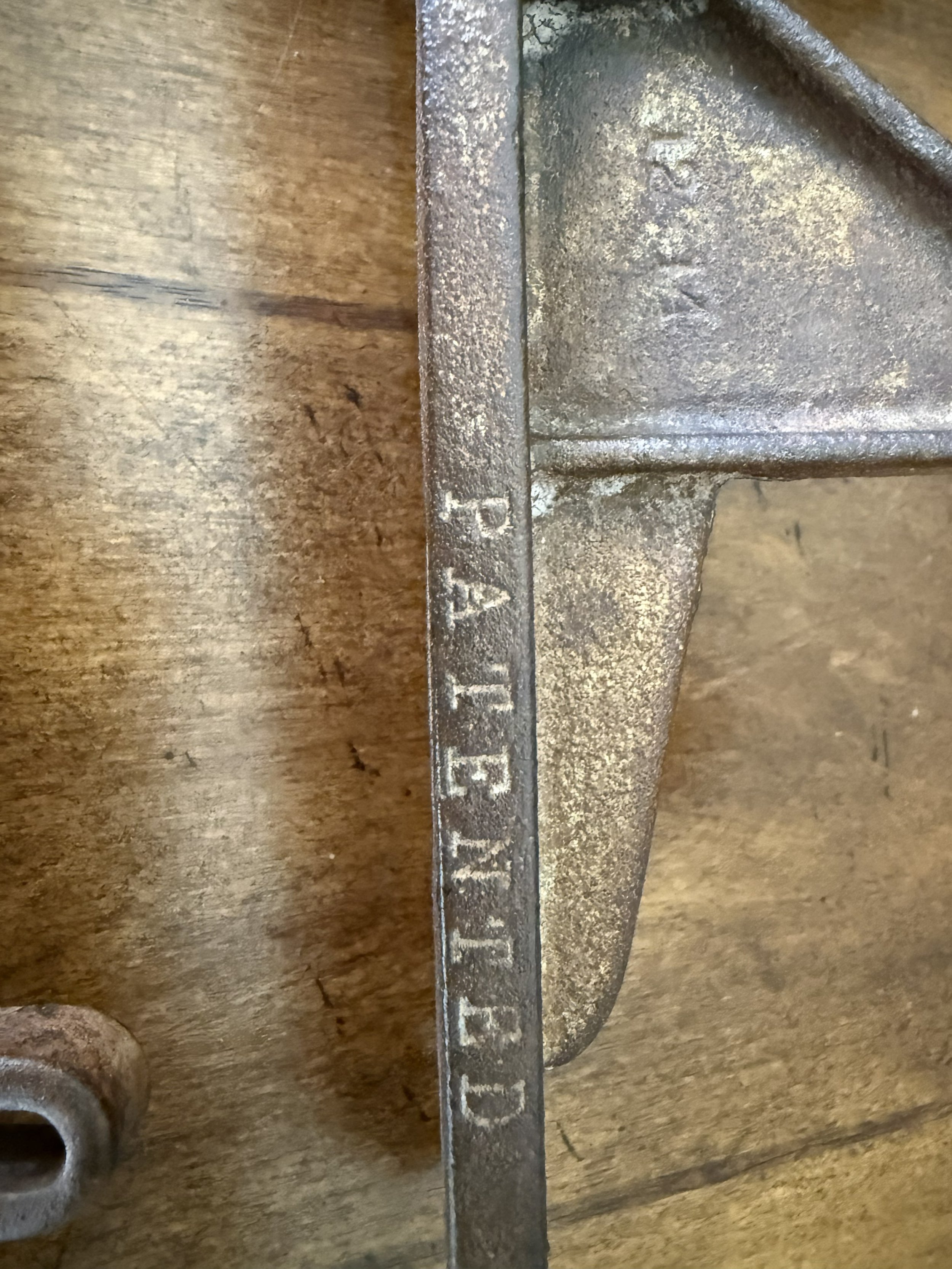
Close-up of the PATENTED mark on the vertical bar of the main casting, with the numbers 12 and 14 visible above it on the main casting body. The triangular braced casting structure is visible at right.
Visible above the PATENTED mark on the casting are the numbers 12 and 14. These most likely represent a size or model designation — possibly indicating frame size compatibility (such as frames up to 12 inches by 14 inches, which corresponds to common late nineteenth-century frame dimensions) — but they could also represent a casting date code (month 12 / day 14, or year fragments), a mold number, or some other internal production designation. No primary source has been located that specifies what these numbers mean on Standard Churn Company extractor castings. This is identified as a still-open question.
──────────────────────────────────────────────────────────────────────
Who Were the Standard Churn Company?
Multiple independent secondary sources agree that the Standard Churn Company was founded in Wapakoneta, Auglaize County, Ohio, in 1889 by F.H. Haman, R.C. Haman, and S.A. Hoskins. By the early 1900s, the company was reportedly producing 40,000 churns per year — a production figure cited in the Delta County Historical Museum's catalog record and in collector descriptions across several platforms.
The company's product line spanned both the dairy and beekeeping supply trades. In the dairy line, Standard Churn manufactured the bentwood box churn, the glass-and-metal tabletop churn, and at least five documented wooden churn designs. In the beekeeping line — the category this piece belongs to — they produced at least a two-frame reversible honey extractor and the drive unit style represented by this piece. A Grand Rapids Bee Club listing documents a surviving four-frame Standard Churn Co. extractor that 'spins 4 frames at once,' demonstrating the company made multiple configurations. A March 2016 Bee Culture magazine reference notes a beekeeper in Alabama who used an antique Standard Churn Company extractor, demonstrating national distribution reach.
The company also appears in a Michigan State University agricultural study as Standard Churn & Mfg. Co., Wapakoneta under the heading 'Bee Keepers Equipment,' confirming that the beekeeping product line was a distinct and advertised part of their commercial offering, not an incidental sideline.
The Smithsonian Institution's Warshaw Collection includes a dedicated folder for Standard Churn Company (Box 2, Folder 28, NMAH.AC.0060.S01.01.Dairy). The company was recognized as a significant enough manufacturer to have accumulated advertising cards, catalogs, price lists, or correspondence surviving in the historical record. The contents of that specific folder have not been examined for this research pass and represent a primary source that could substantially expand the company's documented history.
What became of the company — whether it closed, merged, or was absorbed — has not been confirmed by a primary source for this research pass. The '60 years' claim in the partial 1935 Bee Culture advertisement suggests operations were ongoing at least into the mid-1930s, but the date of final closure is still open.
──────────────────────────────────────────────────────────────────────
Wapakoneta in 1889: Industrial Context
Wapakoneta is the county seat of Auglaize County in west-central Ohio, situated along the Auglaize River approximately 56 miles south of Toledo. By the time Standard Churn Company was founded — 1889 by the secondary source date — the town was riding the tail end of one of the most consequential industrial events in the region's history: the Ohio natural gas and oil boom.
In 1885, Benjamin C. Faurot drilled for natural gas in northwestern Ohio and found oil (American Oil & Gas Historical Society: https://aoghs.org/petroleum-pioneers/great-oil-boom-of-lima-ohio/), triggering a wave of industrial investment across the region. Auglaize County itself had documented gas and oil wells, as recorded in the 1923 History of Auglaize County, Ohio (McMurray, ed., Chapter I). The cheap, abundant natural gas transformed the cost structure of manufacturing in small Ohio towns overnight: factories that had previously relied on coal or wood could now power operations for almost nothing. That economic reality is why the 1880s and 1890s saw a concentrated burst of new manufacturing ventures in towns like Wapakoneta. The neighboring Wapak Foundry — which manufactured the Wapak cast iron skillet line — was founded in the same county-seat context and operated from 1903 until 1926, a parallel that gives a sense of the cast iron manufacturing environment Standard Churn was operating in.
The 1923 Auglaize County history records Wapakoneta's 'Commercial and Industrial Development' (Chapter XI, p. 367), though the full text has not been reviewed for this research pass. That chapter would be the most likely primary source for confirming the Standard Churn Company's specific founding date and any detail on the Haman and Hoskins principals. Table of contents indexed at: https://www.ohiogenealogyexpress.com/auglaize/auglaizeco_history1923_contents.htm
Wapakoneta by the early 1900s was also the home of M. Brown & Company, another manufacturer of bentwood butter churns with a Smithsonian Warshaw Collection folder of its own (Box 1, Folder 18). The presence of two separate churn manufacturers in a town the size of Wapakoneta reflects the regional agricultural economy: the farms of western Ohio required the full range of dairy and farm processing equipment, and the cheap gas and rail connections made small-city Ohio an efficient place to manufacture and distribute it.
──────────────────────────────────────────────────────────────────────
Why This Piece Does Not Appear in Standard Cast Iron References
The Cast Iron Collector's foundry database (https://www.castironcollector.com/foundries.php) has been checked as part of this research pass. Standard Churn Company does not appear in that database as a cast iron hollow ware producer — which is expected, as the Cast Iron Collector's database is organized around cookware and hollow ware producers, not around farm equipment and implement manufacturers. The absence from that specific database does not imply anything about the company's documented history, which is independently established through the Smithsonian Warshaw Collection and multiple secondary sources.
──────────────────────────────────────────────────────────────────────
Updated Piece Details
Manufacturer: The Standard Churn Co., Wapakoneta, Auglaize County, Ohio
Company founded: 1889 (per multiple secondary sources: F.H. Haman, R.C. Haman, and S.A. Hoskins) — unverified against primary Auglaize County records; see Open Questions
Company closed: Not confirmed by primary source. Operations documented at least through mid-1930s per partial Bee Culture advertisement reference. Date of final closure is still open.
Peak size / scale: Reportedly 40,000 churns per year in the early 1900s (per Delta County Historical Museum catalog record A-2020.19.094 and multiple secondary sources) — unverified against primary production records
Piece type: Cast iron honey extractor drive unit and frame-holder assembly (tangential type); the outer drum/barrel is not present
Size/model: Numbers 12 and 14 cast above PATENTED mark; interpretation of these numbers is still open (see Open Questions)
Casting/maker's marks: Transcribed exactly as they appear on the object: THE STANDARD CHURN CO. / WAPAKONETA, OHIO. / PATENTED (running along the vertical bar of the main casting). Numbers 12 and 14 appear above PATENTED.
Associated patent (if any): Unknown — the casting states PATENTED but does not include a patent number. No matching patent has been confirmed through USPTO records for this research pass.
Patent subject (verified): Not yet confirmed; the patent likely covers the rack-and-pinion drive mechanism and/or the frame-holder assembly design, based on what is mechanically distinctive about the piece. This is an interpretation only.
Relationship to maker: Direct — the maker's name is cast into the iron.
Date of manufacture: Post-1889 (company founding date per secondary sources) and consistent with pre-electric farm equipment manufacturing, placing it broadly in the 1890s–1910s era. No primary source narrows the date further.
Place of manufacture: Wapakoneta, Auglaize County, Ohio
SSC catalog no.: SSC-SCC-HEX-2-001
Acquisition: eBay, seller dealzandvintage, June 25, 2026
──────────────────────────────────────────────────────────────────────
Open Questions for Further Research
In keeping with the stated research standard — document what is verified, flag what is not — here is what this pass could confirm, and what still needs primary-source verification:
Confirmed: The Standard Churn Company existed in Wapakoneta, Auglaize County, Ohio — confirmed by the object itself (Tier 1: the casting marks) and by the company's presence in the Smithsonian Institution's Warshaw Collection of Business Americana, Archives Center, National Museum of American History (NMAH.AC.0060.S01.01.Dairy, Box 2, Folder 28). Finding aid: https://sirismm.si.edu/EADpdfs/NMAH.AC.0060.S01.01.Dairy.pdf
Confirmed: The object is a honey extractor drive unit (rack-and-pinion gear assembly with frame-holder arms), not a butter churn dasher or operating mechanism — confirmed by the object's physical construction and by collector documentation of equivalent Standard Churn Co. extractor assemblies.
Confirmed: The object's gears turn freely and have not seized, as noted directly from examination.
Unverified — needs primary confirmation: The founding year of 1889 and the founders F.H. Haman, R.C. Haman, and S.A. Hoskins appear consistently across four independent secondary sources but have not been checked against a primary Auglaize County record. What would confirm it: a named chapter or page in the 1923 History of Auglaize County, Ohio by McMurray, or an Ohio Secretary of State incorporation record.
Unverified — needs primary confirmation: The claim that Standard Churn was producing 40,000 churns per year in the early 1900s. What would confirm it: a Standard Churn Company trade catalog, a period Ohio manufacturing census entry, or a contemporary trade press article.
Unverified — needs primary confirmation: A September 1935 Bee Culture advertisement has been partially identified showing the company advertising 'For 60 years making honest...' equipment. If accurate, '60 years' from 1935 implies a founding around 1875 — significantly earlier than the 1889 date in secondary collector sources. What would confirm it: the complete advertisement text (beeculture.com digital archive), reconciled against county records.
Unverified — needs primary confirmation: The specific patent number or numbers referenced by the PATENTED mark on the casting have not been located. What would confirm it: a USPTO/Google Patents search for patents assigned to 'Standard Churn' or filed by F.H. Haman, R.C. Haman, or S.A. Hoskins, 1885–1920, for honey extractor or farm machinery subject matter. The Smithsonian Warshaw folder may contain a Standard Churn catalog listing the patent number directly.
Still open: The meaning of the numbers 12 and 14 cast above the PATENTED mark. Possible interpretations: frame size compatibility (12" × 14" frame dimension), size/model number, casting date code, or mold identifier. No primary catalog has been located that clarifies this.
Still open: When Standard Churn Company ceased operations. Operations documented at least to the mid-1930s. Whether the company closed, merged, or continued under a different name is unknown. Ohio Secretary of State historical records, Auglaize County newspaper archives, or a beekeeping trade press index would be the most likely sources to resolve this.
──────────────────────────────────────────────────────────────────────
Why This Still Matters
What this research pass adds to the collection record is a sourced identity and institutional paper trail for a piece that could easily be cataloged as 'Ohio farm implement, maker unknown.' The Standard Churn Company name cast into this iron is legible and complete — another owner of an identical or similar piece who searches that exact name will now find this post and the sourced research behind it. The Smithsonian's Warshaw Collection folder is a confirmed primary-source repository for this company's business records; a researcher with in-person access to the Archives Center in Washington, D.C., could potentially resolve several of the open questions above from materials already held there. The unresolved patent question in particular represents a real opportunity — a confirmed patent number would anchor the manufacturing date to within a bounded range and shed light on exactly what mechanical innovation Standard Churn was protecting.
──────────────────────────────────────────────────────────────────────
Sources
· The object itself (Tier 1 primary source): Casting marks transcribed directly — THE STANDARD CHURN CO. / WAPAKONETA, OHIO. / PATENTED; numbers 12 and 14.
· Warshaw Collection of Business Americana Subject Categories: Dairy, NMAH.AC.0060.S01.01.Dairy — Smithsonian Institution, Archives Center, National Museum of American History. Finding aid: https://sirismm.si.edu/EADpdfs/NMAH.AC.0060.S01.01.Dairy.pdf — Box 2, Folder 28: Standard Churn Company, Wapakoneta, Ohio.
· Warshaw Collection item record (Smithsonian online catalog): https://americanhistory.si.edu/es/collections/archival-item/sova-nmah-ac-0060-s01-01-dairy-ref734
· Delta County Historical Museum, catalog record A-2020.19.094, 'Wooden Standard No. 2 Crank Butter Churn': https://deltahistorical.pastperfectonline.com/Webobject/DA7C8BA4-085D-49B9-B1F3-256562609114 (secondary source — founding details unverified against primary Auglaize County records)
· RubyLane item description, 'Antique Standard Churn Co. Glass and Metal Butter Churn': https://www.rubylane.com/item/881025-SHLA-KITC-btrchrn/Antique-Standard-Churn-Co-Glass-Metal (secondary source — unverified against primary records)
· The Butter Churn ... Continuing Adventures of the Antiques Detective, November 8, 2010: https://wallawallalocal.wordpress.com/2010/11/08/the-butter-churn-adventures-of-the-antiques-detective-part-two/ (secondary source — unverified against primary records)
· webexhibits.org, 'Ways of churning butter': https://www.webexhibits.org/butter/kitchen.html (secondary source)
· Bee Culture magazine, September 1935 issue — partial reference; full text at https://beeculture.com/wp-content/uploads/2025/08/Sept-1935-FINAL-V2.pdf (secondary source — '60 years' advertising claim unverified against primary founding records)
· Michigan State University agricultural study — d.lib.msu.edu/etd/40424 — references 'Standard Churn & Mfg. Co., Wapakoneta' under Bee Keepers Equipment (secondary source)
· Bee Culture magazine, March 2016: https://cdn.beeculture.com/wp-content/uploads/2023/05/March2016_V1.pdf (secondary source — confirms product field use)
· Grand Rapids Bee Club Facebook group post: https://www.facebook.com/groups/grbeeclub/posts/5224480527591648/ (Tier 3 — crowd-sourced, cited only as evidence of a surviving working extractor, not for historical claims)
· History of Auglaize County, Ohio, ed. William J. McMurray, 2 vols., Historical Publishing Company, Indianapolis, 1923. Table of contents: https://www.ohiogenealogyexpress.com/auglaize/auglaizeco_history1923_contents.htm — consulted as a primary source index only; full text not reviewed for this pass.
· Internet Archive, History of Auglaize County, Ohio, 1880 edition: https://archive.org/details/historyofauglaiz00sutt — 1880 edition only; 1923 edition not confirmed available in full text online.
· Wikipedia, 'Honey extractor': https://en.wikipedia.org/wiki/Honey_extractor (background context only — Franz Hruschka 1865 invention; not used for claims about Standard Churn Company)
· HonestBee Ltd., 'How Does A Manual Honey Extractor Work?': https://honestbeeltd.com/faqs/how-does-a-manual-honey-extractor-work (background context for mechanical explanation only)
· American Oil & Gas Historical Society, 'Great Oil Boom of Lima, Ohio': https://aoghs.org/petroleum-pioneers/great-oil-boom-of-lima-ohio/ (background context — Ohio oil and gas boom)
· SSC internal records: eBay purchase invoice, order no. 03-14827-05849, seller dealzandvintage, June 25, 2026. Catalog no. SSC-SCC-HEX-2-001.
