Cincinnati Galvanizing Co. King Seamless-Cup Press
STEVE’S SEASONED CLASSICS
SSC Museum Collection
Potato Ricer — Cincinnati Galvanizing Co., Cincinnati, Ohio — c. 1920s–1940s
Marked: KING SEAMLESS-CUP PRESS • CIN’TI GALV CO.
SSC Catalog No. SSC-CINGALV-RCR-1920-001

SSC-CINGALV-RCR-1920-001 — Top view, assembled. The King Seamless-Cup Press with cast iron handle and galvanized steel perforated cup. Handle marking KING SEAMLESS-CUP PRESS visible on underside. Maker abbreviation CIN’TI GALV CO. marked on the press plate. Cincinnati Galvanizing Co., Cincinnati, Ohio, c. 1920s–1940s.
Catalog Record
SSC Catalog No.: SSC-CINGALV-RCR-1920-001
Maker: Cincinnati Galvanizing Co. (Cin’ti Galv Co.), Cincinnati, Ohio
Brand Name: King Seamless-Cup Press
Object: Potato ricer / cup press — cast iron handle with galvanized steel seamless perforated cup
Markings: KING SEAMLESS-CUP PRESS — raised casting on handle underside; CIN’TI GALV CO. — raised casting on press plate
Period: c. 1920s–1940s (Spring Grove Avenue plant era, post-1920 large plant construction)
Material: Cast iron handle; galvanized steel seamless cup
Condition: Original surfaces throughout. Cast iron handle retains original finish. Galvanized cup complete with all perforations intact. Full mechanical function — press plate seats and operates as designed.
Acquisition: ShopGoodwill.com, seller MERS/Missouri Goodwill Industries — Order #62891553, Item #264993657, May 29, 2026
Museum Collection: Ohio Foundry Corridor
Significance: The King Seamless-Cup Press is a confirmed specialty product of the firm, documented in aerial photography of the Spring Grove Avenue plant c. 1940 and referenced in the company's archival history. The cast-iron handle qualifies this piece for inclusion in an Ohio cast-iron collection.
Physical Description
The King Seamless-Cup Press is a two-component kitchen tool consisting of a cast-iron lever-handle assembly and a galvanized-steel seamless perforated cup. The two components work together like a potato ricer: the cup holds the food to be pressed, and the cast-iron handle drives a perforated press plate down through the cup, forcing the food through the holes in the cup wall.
The cast iron handle assembly is substantial in weight and construction, cast as a single piece with two arms extending from a central pivot joint. The upper arm terminates in an elongated loop handle with an oval aperture — a design feature that provides a secure grip and reduces overall weight without sacrificing handle strength. The lower arm carries the press plate, a flat perforated disc that fits precisely inside the cup. The pivot joint uses a simple pin-and-clevis mechanism that allows the two arms to open and close smoothly through the full range of pressing motion.
The marking KING SEAMLESS-CUP PRESS is raised in clear lettering along the underside of the lower arm. On the press plate itself, the abbreviated maker mark CIN’TI GALV CO. is cast in raised lettering — the standard abbreviation the Cincinnati Galvanizing Company used across its product line. Both markings are sharp and fully legible.

SSC-CINGALV-RCR-1920-001 — Handle detail, top view showing KING SEAMLESS-CUP PRESS marking on lower arm and CIN’TI GALV CO. on press plate. Both markings are raised casting, sharp and fully legible. The oval loop handle terminus and pivot pin joint are visible.
The galvanized steel cup is the defining feature of the design and the source of the “Seamless” brand name. The cup is formed from a single piece of drawn steel — no welded seam, no separate bottom pressed into place. Before this design, many cup-style ricers had cups with separately attached bottoms, creating a potential failure point at the joint. The seamless single-draw construction eliminated that weakness entirely. The cup walls are perforated with a regular grid of circular holes through which the pressed food passes. The perforations are consistent and clean, undamaged by use. The galvanized finish — hot-dip zinc coating — provides corrosion resistance appropriate for a kitchen tool in regular contact with wet food.
The cup sits in a cast iron outer ring that is attached to the lower arm of the handle. This ring cradles the cup, holds it in alignment during pressing, and allows the cup to be lifted out for cleaning. The rim of the cup seats cleanly in the ring, and the press plate descends precisely inside the cup walls when the handles are closed.

SSC-CINGALV-RCR-1920-001 — Side view, assembled for use. The cast iron handle assembly open position showing the pivot joint, press plate above cup, and the galvanized seamless cup in its cast iron outer ring. The complete operating mechanism is visible.
The Maker: Cincinnati Galvanizing Co., Cincinnati, Ohio
Origins: From Cooperage to Galvanizing, 1870s–1905
The Cincinnati Galvanizing Company was founded in 1905 by the sons of John Michael Schott, a German immigrant who had established J.M. Schott & Sons Cooperage in Cincinnati in the late 1870s. After John Schott died in 1903, his sons — Christian, William C., George, and Louis, known collectively as the Schott Brothers — decided to diversify beyond the family’s barrel-making business. Their reasoning was sound: wooden barrels were a commodity business tied closely to the brewing industry, and the early temperance movement was already suggesting that Prohibition might eventually arrive. A galvanizing company, producing metal containers rather than wooden ones, offered a hedge.
The company was initially established next to the cooperage on the east side of what is now McMicken Avenue, between Tafel Street and Straight Street in Cincinnati. The initial investment was $20,000. The early years were not without difficulty: when metal hoops were first dipped into the galvanizing pit of molten zinc, they reportedly burst into flames. The brothers persevered through these initial fires and production challenges, establishing a working operation that grew steadily through the first decade of the twentieth century.
Expansion: The Spring Grove Avenue Plant, 1920
In the early 1920s — the decision to build was made in 1920, with the groundbreaking documented in 1923 — the Schott Brothers invested in a major expansion of their galvanizing operation.They built a new and substantially larger galvanizing plant in the Cincinnati Mill Creek Industrial District, located at 4879 Spring Grove Avenue. This plant became the company’s primary manufacturing base for the next four decades and is the facility from which the King Seamless-Cup Press and the company’s other specialty products were produced.
Aerial photography of the Spring Grove Avenue plant taken around 1940 documents an active industrial operation. The plant “primarily made 30-gallon waste cans, buckets and paper baskets, in addition to some novelty items, like the King Seamless Press Potato Ricer,” according to historical documentation of the facility. The King Seamless product was therefore a specialty item within a broader galvanized metal container product line — not the firm’s core industrial output, but a recognized and documented product of the Spring Grove Avenue plant.
Products and Customers
The Cincinnati Galvanizing Company’s standard product line centered on galvanized metal containers: 30-gallon trash cans, buckets, waste baskets, and wash bins. These were practical, durable, commodities sold to households, businesses, and institutions. The firm’s customer base included local and regional Cincinnati-area firms as well as national chains — Sears was among their accounts. Government and military contracts were also part of the business, including 50-gallon water barrels manufactured for fallout shelters during the early Cold War period. By the mid-twentieth century, the product line had expanded to include decorative waste paper baskets, including versions featuring Disney character imagery.
Specialty products beyond the standard container line included canisters for hand-operated fire extinguishers and the King Seamless-Cup Press. The “King” brand name appeared across multiple Cincinnati Galvanizing products — including their “World’s Largest Ash Can” exhibit piece, marketed under the King brand at trade fairs in the 1930s. The company abbreviated its name consistently on marked products as Cin’ti Galv Co., the marking found on the SSC potato ricer.
Ownership, Brewery Acquisition, and Sale
The Schott Brothers operated the Cincinnati Galvanizing Company under family ownership until 1962 — nearly sixty years from founding. During this period the family also acquired, in 1937, the Schott Brothers also acquired the Bavarian Brewing Company of Covington, Kentucky, purchasing it out of bankruptcy court. The brewery and the galvanizing company operated as parallel family enterprises through the postwar decades, with Louis Schott serving as executive of Cincinnati Galvanizing in the 1960s until the company was sold.
The Cincinnati Galvanizing Company was sold in the mid-1960s to Bell Intercontinental, a diversified industrial company that produced Bell Helicopters, industrial staplers, and automotive parts. Through a series of subsequent corporate acquisitions — Wheelabrator Frye (1972), Signal Corporation (1982), Allied Signal (1985), Honeywell (1999) — the galvanizing operation and its Spring Grove Avenue property eventually passed entirely out of the Schott family’s control. The plant closed approximately 1970. Today the former Cincinnati Galvanizing facility at Spring Grove Avenue operates as a Clean Harbors environmental services facility. The original galvanizing, cooperage, and saloon structures no longer exist.
The Seamless Innovation: Why the Name Mattered
The “Seamless” in King Seamless-Cup Press was not marketing language. It was a structural distinction that addressed a genuine engineering problem in potato ricer design.
Early potato ricers — those produced before the turn of the twentieth century and into the early 1900s — commonly used cups constructed from a cylindrical side wall with a separately attached bottom disc. The bottom was either welded or mechanically pressed into the cylinder, creating a seam at the junction. That seam was a structural vulnerability: repeated pressure from pressing cycles, exposure to hot moist food, and the thermal cycling of kitchen use could work the joint loose over time, allowing the bottom to separate or the seam to split. A cup that failed at the seam was done.
The seamless construction used by Cincinnati Galvanizing solved this by drawing the entire cup — side walls and bottom — from a single piece of sheet steel using a deep-draw stamping process. No seam, no joint, no failure point. The result was a cup that was structurally stronger than any welded or press-fit alternative and capable of withstanding the mechanical loads of heavy kitchen use indefinitely. Pair that construction with the corrosion-resistant galvanized zinc coating, and the cup became what the product name implied: built to last.
This was the Cincinnati Galvanizing Company’s core industrial competency applied to a kitchen product. Their primary business was forming and galvanizing sheet metal into durable containers. The King Seamless-Cup Press was exactly that — a formed, galvanized, seamless container — adapted to a domestic food-preparation application. The cast iron handle was sourced or contracted separately and assembled with the galvanized cup to complete the product.
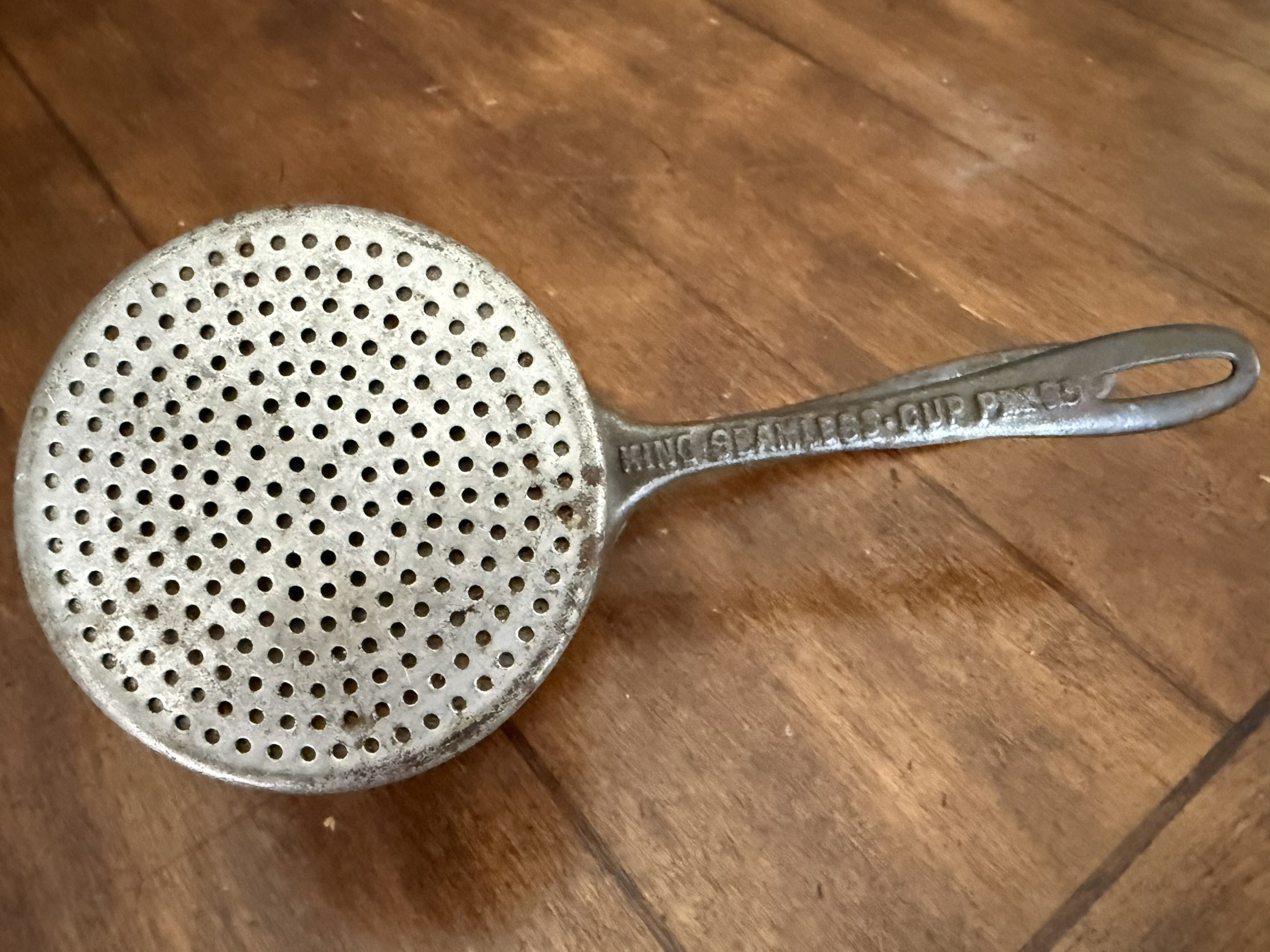
SSC-CINGALV-RCR-1920-001 — Bottom view, cup removed showing cast iron outer ring and press plate. The perforated press plate with CIN’TI GALV CO. marking is visible inside the ring. The seamless galvanized steel cup sits separately.

SSC-CINGALV-RCR-1920-001 — Interior detail. The CIN’TI GALV CO. marking on the press plate and the seamless drawn steel cup wall perforations. No seam or weld joint is visible anywhere on the cup construction — confirming the single-draw seamless manufacturing method.
Why This Piece Is in the SSC Collection
The Cincinnati Galvanizing Company is not an Ohio foundry in the traditional cast iron sense. It was a galvanizing and sheet metal fabrication company, not a furnace-and-flask iron-casting operation. But the King Seamless-Cup Press has a cast iron component — the handle — and the company was a Cincinnati, Ohio manufacturer that documented its products with clear maker’s marks. Cincinnati was one of the most important commercial and industrial cities in nineteenth and early twentieth century Ohio, and its domestic hardware trade was deeply connected to the city’s foundry and metalworking community.
The piece also represents a category of Ohio domestic material culture that SSC is beginning to document: marked Cincinnati-area kitchen and household hardware from the late 19th and early twentieth centuries. The King Seamless-Cup Press is a well-made, clearly marked, historically traceable product of a Cincinnati firm with a documented 65-year operating history. The Schott Brothers’ company is archived, photographed, and historically documented. The product is confirmed in that historical record. That is exactly the kind of documentation SSC looks for.
And it is a potato ricer with a cast iron handle, marked by its Cincinnati maker, that still works exactly as designed. The press plate descends cleanly through the seamless cup, the pivot joint operates smoothly, and the whole assembly functions as it did when it left the Spring Grove Avenue plant. The iron endures. The markings tell the truth. The story deserves to be told.
Acquisition Record
• SSC Catalog No.: SSC-CINGALV-RCR-1920-001
• Platform: ShopGoodwill.com
• Seller: MERS/Missouri Goodwill Industries
• Order No.: #62891553
• Item No.: #264993657
• Date Purchased: May 29, 2026
• Museum Collection: Ohio Foundry Corridor
Visit us at www.stevesseasonedclassics.com
Cincinnati Galvanizing Co. · Cincinnati Ohio · King Seamless Cup Press · Potato Ricer · Ohio Cast Iron · Ohio Foundry Corridor · SSC Museum Collection
Steve’s Seasoned Classics — Ohio Cast Iron Museum & Research © 2026 Steve Thaman. All rights reserved.
