May & Fiebeger Heater Furnace Damper Dial Gauge
STEVE’S SEASONED CLASSICS
SSC Museum Collection
The Akron Air Blast Furnace — May & Fiebeger, Akron, Ohio — c. 1890s–1910
Marked: MAY & FIEBEGER • CHECK • AKRON OHIO
SSC Catalog No. SSC-MAYFB-DMR-1890-001

SSC-MAYFB-DMR-1890-001 — Dial face (top). Marked MAY & FIEBEGER / CHECK / AKRON OHIO in raised casting. The rotating pointer and knurled dial edge are original and fully functional. Maker mark confirmed: May & Fiebeger, Akron, Ohio, c. 1890s–1910.
Catalog Record
SSC Catalog No.: SSC-MAYFB-DMR-1890-001
Maker: May & Fiebeger, Akron, Ohio
Object: Heater furnace damper dial gauge — cast iron draft / air-flow control
Marking: MAY & FIEBEGER • CHECK • AKRON OHIO — raised casting on dial face
Period: c. 1890s–1910 (active manufacturing period of May & Fiebeger)
Material: Cast iron
Function: Wall-mounted furnace damper control; rotating dial opens and closes internal air vents to regulate combustion draft in residential or commercial heating furnace
Condition: Original surface. Rotating mechanism fully operational — vent opens and closes exactly as designed. All original components intact.
Acquisition: Etsy, seller GMDAntiqueRescue — Order #4068012111, Transaction #5071467090, May 19, 2026
Museum Collection: Ohio Foundry Corridor
Significance: First known May & Fiebeger piece in the SSC collection. Marked artifact directly tied to the firm’s Akron Air Blast Furnace product line and Frank Fiebeger’s documented patent program for furnace air-control systems.
Physical Description
The May & Fiebeger damper dial gauge is a circular cast iron wall-mounted furnace control, consisting of two primary components: an outer mounting ring and an inner rotating dial mechanism. The outer ring features a flat circular flange with two mounting ears — one at top center and one at bottom center — each drilled for wall fastening. The inner face of the ring is recessed to accept and guide the rotating dial assembly.
The rotating dial sits within the outer ring and carries the maker’s markings on its face: MAY & FIEBEGER arcs across the right half of the dial; CHECK arcs across the left; and AKRON OHIO runs along the lower arc. A sunburst pattern of radiating lines fans out from the center pivot point, with the rotating pointer mounted at center on a pivot pin. The outer edge of the dial is knurled — milled with fine teeth — to provide grip for manual adjustment. The knurling is crisp and complete, consistent with a piece that has been preserved rather than used heavily.
The interior back of the housing reveals the mechanical heart of the piece: a central hub with multiple air-port openings arranged radially around the pivot axis. These ports align with corresponding openings in the rotating dial plate; as the dial turns, the ports open or close, directly controlling the volume of air admitted through the damper and into the furnace flue system. The mechanism operates on the same rotary-port principle that Frank Fiebeger documented in his U.S. patent filings for stove and furnace air-control systems.
The piece retains full mechanical function. The vent opens and closes exactly as it did when new — the rotating dial moves freely and smoothly through its full range of travel, the air ports open and close cleanly, and the pointer tracks the dial position accurately. After more than a century, the mechanism is intact and operational. This is not a display piece that has been frozen by rust or repair. It works.

SSC-MAYFB-DMR-1890-001 — Interior view, vent open. Rotating dial positioned to align air ports, allowing maximum draft flow through the damper. The radial port pattern and central pivot mechanism are clearly visible. The piece retains full mechanical function in this original open position.
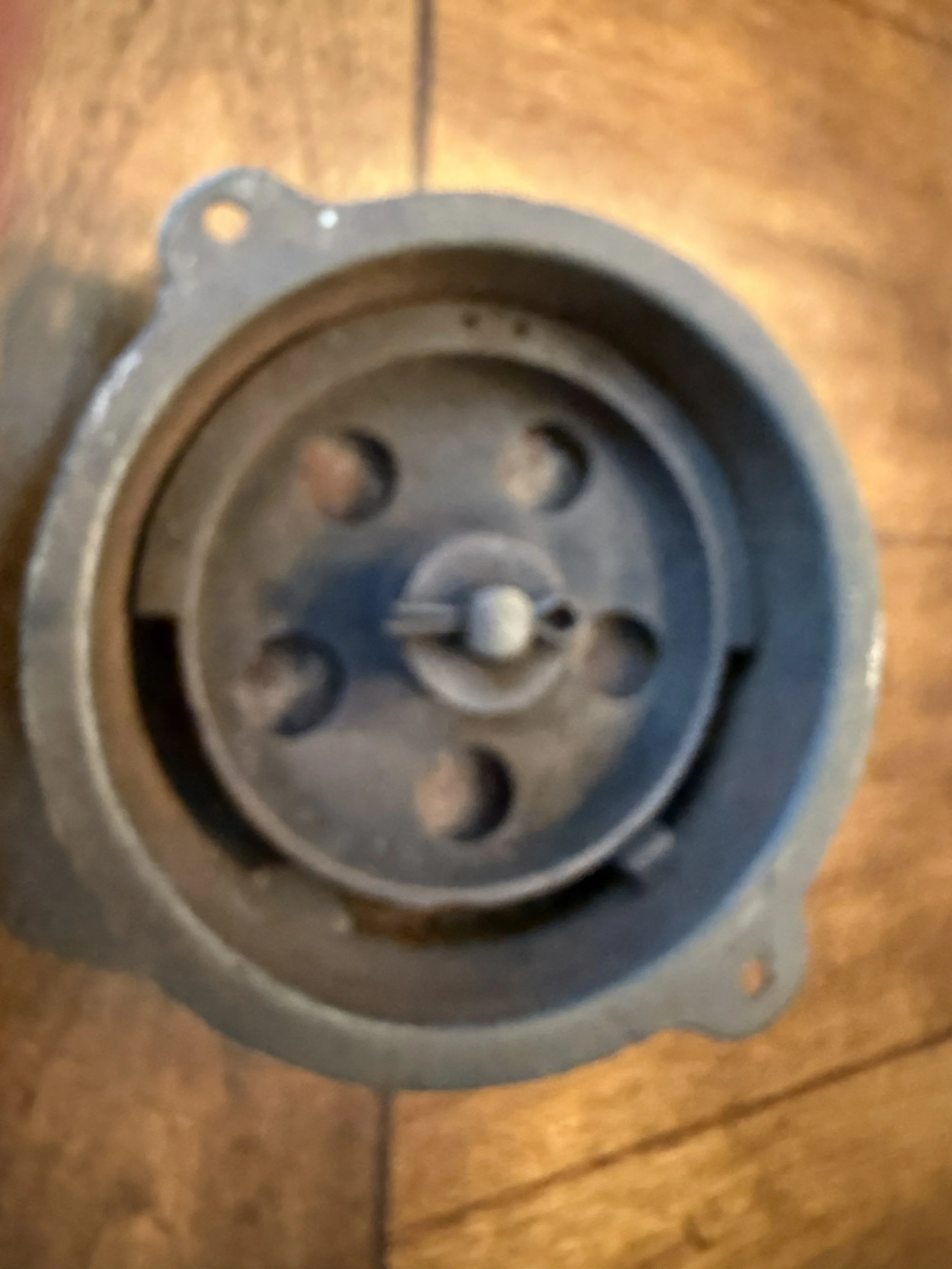
SSC-MAYFB-DMR-1890-001 — Interior view, vent closed. Rotating dial positioned to block air ports, cutting draft flow to the furnace. The same mechanism documented in Frank Fiebeger’s air-control patent filings (1906–1907) is visible here in physical form. Fully operational.
The Maker: May & Fiebeger, Akron, Ohio
Origins and Family History
The story of May & Fiebeger begins not in a foundry but on a sailing vessel crossing the Atlantic. Rudolph Anthony May was born April 3, 1846, in Bohemia, Austria. His father emigrated to the United States in 1848, and in 1850 the rest of the family followed — a voyage that took nearly three months, covering approximately 3,500 miles. The vessel spent sixty-three days crossing the Atlantic alone, and passengers reportedly saw Iceland, Greenland, and Nova Scotia before making port. From New York, the May family traveled up the Hudson to Albany, west to Buffalo, across Lake Erie to Cleveland, and finally south to Akron via the Ohio canal — arriving in a city of barely 1,500 to 2,000 people.
Rudolph’s father died in 1855, when Rudolph was nine. His mother subsequently remarried a man named Joseph Fiebeger, also an Austrian immigrant — a union that would prove pivotal for Akron’s manufacturing history. Frank Fiebeger, Rudolph’s half-brother through this remarriage, would become his business partner and the inventive engine behind the firm’s most significant engineering achievements.
Building the Business: 1867–1880
As a young man, Rudolph May worked in Columbus at silver plating, then trained in the tinner’s trade. He was working in Columbus with his uncle when Abraham Lincoln was assassinated, and he witnessed the president’s body lying in state in the capital. After returning to Akron, May became an employee of J. K. Cramer’s hardware business, and in 1867 he purchased a half-interest in the enterprise. Thirteen years later, he became its sole proprietor — operating what had grown into one of Akron’s leading hardware and tinning establishments.
Around 1880, Rudolph admitted his half-brother Frank Fiebeger as a partner, forming the firm of May & Fiebeger. A trade card from 1884 survives in the Arnold and Deanne Kaplan Collection of Early American Judaica at the University of Pennsylvania, documenting the firm’s active commercial presence during that period. The Akron Air Blast Furnace Company was founded on North Howard Street in 1880, and alongside furnaces the firm sold stoves, plows, and tinware.
The Akron Air Blast Furnace
The company’s defining product was the “Akron Air Blast” furnace, credited to Rudolph May’s “inventive genius.” After perfecting the design, the firm purchased the plant of the Akron Foundry Company and began manufacturing at scale. A surviving 1906 letterhead reads: “MAY & FIEBEGER — The Akron Air Blast Furnace — Akron, Ohio” — confirming the product remained central to the company’s identity at least through that year. The company operated at 14–18 N. Howard Street, Akron, a major commercial and industrial corridor.
The Smithsonian Institution’s National Museum of American History holds archival materials from the Warshaw Collection of Business Americana that include May & Fiebeger documentation, placing the firm in the permanent record of American industrial history. A 1902 copyright filed by Frank Fiebeger in his own name — “48 pp. illus. 12°. Copyright by Frank Fiebeger, Akron, Ohio. Class A, XXe, no. 31552, Apr. 23, 1902” — is believed to be a product catalog or technical manual for the Akron Air Blast Furnace, held in the Library of Congress catalog records.
Frank Fiebeger’s Patent Program: 1901–1910
Frank Fiebeger was the technical and inventive partner of the firm. Between 1901 and 1910, he secured seven U.S. patents for innovations in furnace grate design, cleaning doors, fuel-switching, combustion airflow, and heat-recovery radiators — a systematic engineering program that documented the evolution of the Akron Air Blast Furnace over a decade of development. An eighth patent (US814703A) was filed by inventor Hiram J. Hough but assigned to May-Fiebeger, demonstrating that the company operated as a genuine engineering organization with multiple contributors.
The patents most directly relevant to the SSC damper gauge are the airflow control inventions of 1906–1907. U.S. Patent No. 834282 (granted October 30, 1906) redesigned the fundamental fire-pot airflow system, suspending the fire-pot via an annular flange and using hollow integral ribs to direct combustion air. U.S. Patent No. 844342 (granted February 19, 1907) advanced this further with a divided air-inlet system — splitting incoming combustion air into two independently controlled streams with separate doors for each, allowing the operator to tune the combustion ratio between primary and secondary air. The rotary port mechanism visible in the SSC damper gauge is the physical implementation of these airflow control principles: a simple, durable, field-operable device that gave the homeowner or building engineer direct control over furnace draft without tools or disassembly.
Fiebeger’s final and most sophisticated patent — U.S. Patent No. 970483, granted September 20, 1910, for a stove or furnace radiator — introduced a reverberatory drum design that maximized heat extraction from combustion gases before venting, directly increasing furnace efficiency. Filed just before Rudolph May’s retirement in 1910, it represents the culmination of the firm’s engineering program.
The Patent Record in Full
• US710570A — Grate for Furnaces — Filed Dec. 11, 1901 • Granted Oct. 7, 1902
• US714792A — Cleaning-Door for Furnaces — Filed Jun. 28, 1902 • Granted Dec. 2, 1902
• US721506A — Convertible Furnace (coal or gas) — Filed Nov. 3, 1902 • Granted Feb. 24, 1903
• US814703A — Stove or Furnace (Hough, assigned to May-Fiebeger) — Filed Jul. 27, 1905 • Granted Mar. 13, 1906
• US834282A — Stove and Furnace (air-ring fire-pot) — Filed Mar. 26, 1906 • Granted Oct. 30, 1906
• US844342A — Stove and Furnace (divided air-inlet) — Filed Nov. 14, 1906 • Granted Feb. 19, 1907
• US970483A — Stove or Furnace Radiator — Filed Dec. 6, 1909 • Granted Sep. 20, 1910
Later History: Reorganization and Newark
In 1910, Rudolph May retired from the business. Frank Fiebeger reorganized the operation as The May-Fiebeger Company, continuing operations at 14–18 N. Howard Street, Akron. The company eventually relocated to Newark, Ohio, where it continued to be listed in industry directories into the 1940s. A 1941 advertisement in American Artisan shows The May-Fiebeger Co. of Newark, Ohio advertising the Diamond Smoke Pipe Damper. In 1944, the company was listed as an acceptor of U.S. Commercial Standard CS109-44 for solid-fuel furnaces — federal certification of manufacturing standards, confirming the firm was still an active and recognized manufacturer more than sixty years after its founding.
Rudolph A. May spent virtually his entire life in Akron. He was a charter member of St. Bernard’s Catholic Church, an active member of the Knights of Columbus, and in community affairs “his influence was always on the side of progress, reform and improvement.” He died December 28, 1926, at the age of eighty. His half-brother Frank Fiebeger’s dates of birth and death have not been confirmed in available primary sources and remain an open research question.
How the Damper Gauge Works
A furnace damper is a mechanical valve that controls the flow of air through a heating system. In coal or wood-fired furnaces of the late 19th and early 20th centuries, controlling draft — the flow of combustion air through the fire box and up the flue — was the primary means of regulating heat output. Too much draft and the fuel burned fast and hot, consuming coal quickly and overheating the structure. Too little draft and the fire smoldered, produced smoke, and failed to heat effectively.
The May & Fiebeger damper dial gauge solved this problem with a simple rotary mechanism. Mounted in the furnace flue or air-supply pathway, the device used a rotating cast iron dial to open or close a series of air ports in the housing. Turning the dial clockwise or counterclockwise aligned or misaligned the ports, increasing or decreasing airflow in precise, repeatable increments. The word CHECK cast into the dial face indicated the position at which draft was restricted — a “check” on the fire. The sunburst of lines on the dial face functioned as a visual reference scale, allowing the user to set and recall a specific draft position.
This device was mounted on a wall near the furnace or at a chimney clean-out, connected to the flue damper by a rod or chain mechanism. The homeowner or building engineer could adjust the draft without opening the furnace or accessing the fire box directly — a meaningful safety and convenience improvement in an era when most residential heating required direct physical interaction with an open fire.
The SSC example retains complete mechanical function. The rotating dial moves through its full range of travel, the ports open and close cleanly, the pointer tracks accurately, and no component has been repaired, replaced, or altered. What you see is what left the May & Fiebeger factory on North Howard Street in Akron, Ohio, more than a century ago. It still works.
Why This Piece Is in the SSC Collection
Steve’s Seasoned Classics documents Ohio cast iron makers, and May & Fiebeger is an Akron, Ohio maker — active from approximately 1880 through at least 1944, with its primary manufacturing period centered in the 1890s through 1910. The firm operated in Summit County, in the industrial belt of northeastern Ohio, producing cast iron heating equipment that served homes and commercial buildings across the region. It qualifies on maker, material, and geography.
But this piece is more than a checkbox. The damper gauge is a marked artifact — MAY & FIEBEGER • CHECK • AKRON OHIO cast directly into the face — connecting a physical object to a documented firm whose history includes immigration from Bohemia, a three-month Atlantic crossing, forty years of hardware and foundry work, seven U.S. patents, Smithsonian-held archival documentation, and a product line that remained in federal commercial standards certification into the 1940s. That is an extraordinary amount of documented history attached to a single piece of cast iron.
The fact that the mechanism still functions — that you can turn the dial and watch the ports open and close exactly as Frank Fiebeger designed them, exactly as the workers on North Howard Street assembled them — is what elevates this from a marked artifact to a working piece of industrial history. The iron endures. The markings tell the truth. The story deserves to be told.
Acquisition Record
• SSC Catalog No.: SSC-MAYFB-DMR-1890-001
• Platform: Etsy
• Seller: GMDAntiqueRescue
• Order No.: #4068012111
• Transaction No.: #5071467090
• Date Purchased: May 19, 2026
• Shipped: USPS Priority Mail
• Museum Collection: Ohio Foundry Corridor
Visit us at www.stevesseasonedclassics.com
May & Fiebeger · Akron Ohio · Ohio Foundry Corridor · Cast Iron Furnace · Furnace Damper · Ohio Cast Iron · SSC Museum Collection
Steve’s Seasoned Classics — Ohio Cast Iron Museum & Research © 2026 Steve Thaman. All rights reserved.
