Wagner Ware Sidney -O- Round Griddle No. 1109 D
SSC MUSEUM COLLECTION
Catalog No. SSC-WAGNER-GRD-1109D-001
Stylized Logo | Pattern 1109 D | 10-Inch Round Griddle | Sidney, Ohio
Circa 1924–1959 • Wagner Manufacturing Co. • Wagner Specialty & Variant Collection
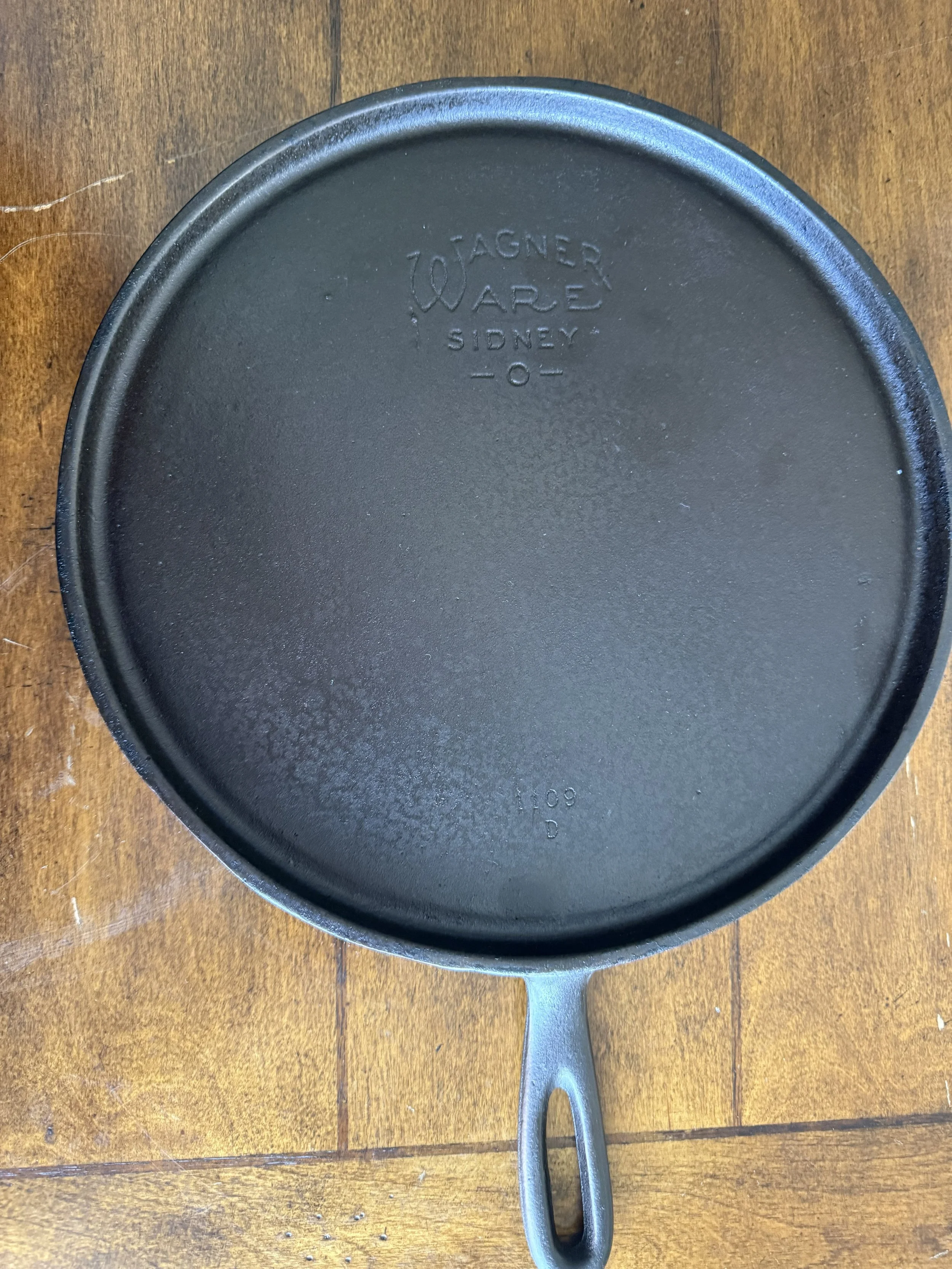
Bottom view showing the stylized “Wagner Ware Sidney -O-” trademark and the pattern/mold designation “1109 D” near the handle. The deep, even seasoning on the base is excellent—clean, dark, and uniform. The 1109 pattern number identifies this as a round griddle in Wagner’s catalog numbering system, and the “D” is a mold letter for quality control tracking.
If the early “WAGNER” No. 8 griddle (SSC-WAGNER-GRD-8-1900-001) represents the founding-era version of Wagner’s round griddle, this 1109 D represents the mature-era version—the same fundamental form, refined over three decades of production and carrying the stylized trademark that Wagner used from approximately 1924 to 1959. Together, the two griddles bracket the full span of Wagner’s round griddle production under two different trademarks, and side by side they demonstrate one of the most important points the SSC collection makes about industrial cast iron: the best forms don’t change.
The round griddle was already a perfected design when Wagner began producing it in the 1890s. By the time this 1109 D was cast—sometime between 1924 and 1959—the form had not changed in any meaningful way. It was still round. It still had a shallow raised rim. It still had a flat handle with a teardrop hanging loop. The cooking surface was still machine-polished to Wagner’s exacting standard. What changed was the trademark on the base and the catalog numbering system that organized the product line. The iron was the same. The function was the same. The quality was the same.
The pattern number 1109 tells us something specific about Wagner’s catalog organization during the stylized logo period. Where earlier Wagner products were identified simply by their type and size number (“No. 8 griddle”), the stylized-era catalog assigned four-digit pattern numbers that encoded product type, size, and sometimes finish into a single identifier. The 1109 was Wagner’s designation for this particular round griddle—approximately 10 inches in diameter, the size that saw the most kitchen use because it matched the standard large burner on a gas or electric range.
The Cooking Surface

Top view showing the cooking surface with seasoning that reflects decades of active kitchen use. The machine-polished finish beneath the seasoning is visible in areas where the original surface texture shows through—the concentric milling marks that are the signature of Wagner’s lathe-polished production process. The shallow raised rim and flat handle with teardrop hanging loop are identical in form to the early No. 8 griddle, confirming the design continuity across trademark periods.
The cooking surface of this 1109 D shows the kind of seasoning that develops only from years of regular use—not the uniform black of a freshly re-seasoned piece, but the complex, varied surface of a griddle that has cooked thousands of meals. The machine-polishing marks from Wagner’s production process are still visible beneath the seasoning in several areas, showing the concentric lathe marks that distinguished Wagner’s cooking surfaces from the rougher, unpolished surfaces of lesser foundries.
This visible machine polishing is one of the features that made Wagner the standard-bearer for American cast iron quality. After casting, Wagner’s cooking surfaces were turned on a lathe to create a smooth, even plane—a manufacturing step that added cost but dramatically improved cooking performance. A polished surface heats more evenly, releases food more readily, and builds seasoning more uniformly than an as-cast surface. It is the reason that a vintage Wagner griddle outperforms a modern cast iron griddle costing twice as much: the modern piece skips the polishing step to save manufacturing cost, and the cook pays the price every time they flip a pancake.
Piece Details
Manufacturer
Wagner Manufacturing Co.
Brand
Wagner Ware
Piece Type
Round Griddle
Pattern / Mold
1109 D
Size
Approximately 10 inches diameter
Base Marking
Stylized “Wagner Ware Sidney -O-” / 1109 D
Trademark Period
Stylized Wagner Ware (c. 1924–1959)
Surface Finish
Seasoned cast iron; machine-polished cooking surface visible beneath seasoning
Form
Round griddle with shallow raised rim; flat handle with teardrop hanging loop
Bottom Configuration
Smooth base
Date of Manufacture
Circa 1924–1959
Place of Manufacture
Sidney, Shelby County, Ohio
Condition
Very Good — legible stylized mark and pattern number; deep use-seasoning; sits flat; no cracks
Acquisition Date
November 11, 2025
Acquisition Source
eBay — Seller: kbcsolutions
eBay Item Number
167539335365
Order Number
22-13803-30580
SSC Catalog Number
SSC-WAGNER-GRD-1109D-001
Collection Designation
Wagner Specialty & Variant Collection
Decoding Pattern 1109
Wagner’s four-digit pattern numbering system during the stylized logo period organized the company’s entire product catalog into a systematic reference framework. The SSC collection now documents several entries in this system: 1053 (nickel-plated No. 3 skillet), 1054 (nickel-plated No. 4 skillet), 1101A (Bacon and Egg Breakfast Skillet), and now 1109 (round griddle). Each number identifies a specific product in the Wagner catalog—not just a type and size, but a specific combination of form, finish, and function.
The 1109 designation for the round griddle places it in a numbering range (1100s) that appears to encompass griddles and specialty flat cooking surfaces, alongside the 1101 Bacon and Egg Breakfast Skillet. The “D” mold letter serves the same quality control function as mold letters on Wagner’s skillets: it identified the specific pattern mold used to cast this piece, allowing Wagner’s inspection team to trace any quality issue back to its source. The presence of mold letters across Wagner’s entire product range—from No. 3 skillets to 10-inch griddles—speaks to the systematic quality management that operated at every level of the Sidney foundry.
The SSC Griddle Pair: Early Mark and Stylized Logo
The SSC Wagner Specialty & Variant Collection now holds two round griddles that document the same product across both of Wagner’s major trademark periods:
The “WAGNER” No. 8 (SSC-WAGNER-GRD-8-1900-001) carries the early arc/block letter mark with quotation marks, dating it to approximately 1891–1924. It is a 9-inch griddle from the era of wood and coal stoves, when the Wagner brothers were personally overseeing their foundry. Its mark reads “WAGNER” / SIDNEY, / O.—with punctuation that disappeared in the next generation.
This 1109 D carries the stylized “Wagner Ware Sidney -O-” logo, dating it to approximately 1924–1959. It is a 10-inch griddle from the era of gas and electric ranges, when Wagner was at the peak of its production volume and brand recognition. Its mark uses the interlocking-W letterforms and the four-digit pattern number that characterized Wagner’s mature catalog system.
The griddle itself—round, flat, shallow-rimmed, handled—is virtually unchanged between the two. The form needed no improvement. Only the trademark evolved, recording the passage of time on the iron the way tree rings record the passage of years in wood. A visitor looking at both griddles side by side sees the same tool made by the same foundry in the same Ohio town—separated by decades, connected by design.
Why This Piece Matters
The Wagner Ware 1109 D round griddle matters as the companion piece to the early “WAGNER” No. 8—the second half of a two-era griddle pair that documents one of the most fundamental forms in cast iron cookware across the full span of Wagner’s production history. At $27.49, it was one of the least expensive acquisitions in the SSC collection. At 10 inches of machine-polished Sidney iron, it remains one of the most functional. And as a document of Wagner’s mature-era catalog system—with its four-digit pattern number, its mold letter, and its stylized trademark—it tells the story of a foundry that grew from a small Shelby County startup into one of America’s most recognized housewares brands without ever compromising on the quality of its simplest, most essential product.
The iron endures. The markings tell the truth. The story deserves to be told.
Sources & Further Reading
CastIronCollector.com — Wagner Manufacturing Co.: stylized logo period (c. 1924–1959); pattern numbering conventions; machine-polished cooking surfaces.
SSC Internal Collection Records — Wagner Specialty & Variant Collection: companion griddle SSC-WAGNER-GRD-8-1900-001 (early arc logo period); pattern number cross-references 1053, 1054, 1101A.
About Steve’s Seasoned Classics
Steve’s Seasoned Classics is an online museum dedicated to preserving and documenting the heritage of American cast iron, with a focus on Ohio foundry pieces from the 19th and early 20th centuries. The SSC collection features over 130 pieces with detailed provenance, historical research, and photography for each item.
