Wagner Ware Sidney –O– No. 14 Cast Iron Skillet #1064
SSC MUSEUM COLLECTION
Catalog No. SSC-WAG-SKL-14-Sidney-O-1064-001
“Wagner Ware” | No. 14 Skillet | Sidney, Ohio
Catalog No. 1064 • Wagner Manufacturing Company • Circa 1924–1959
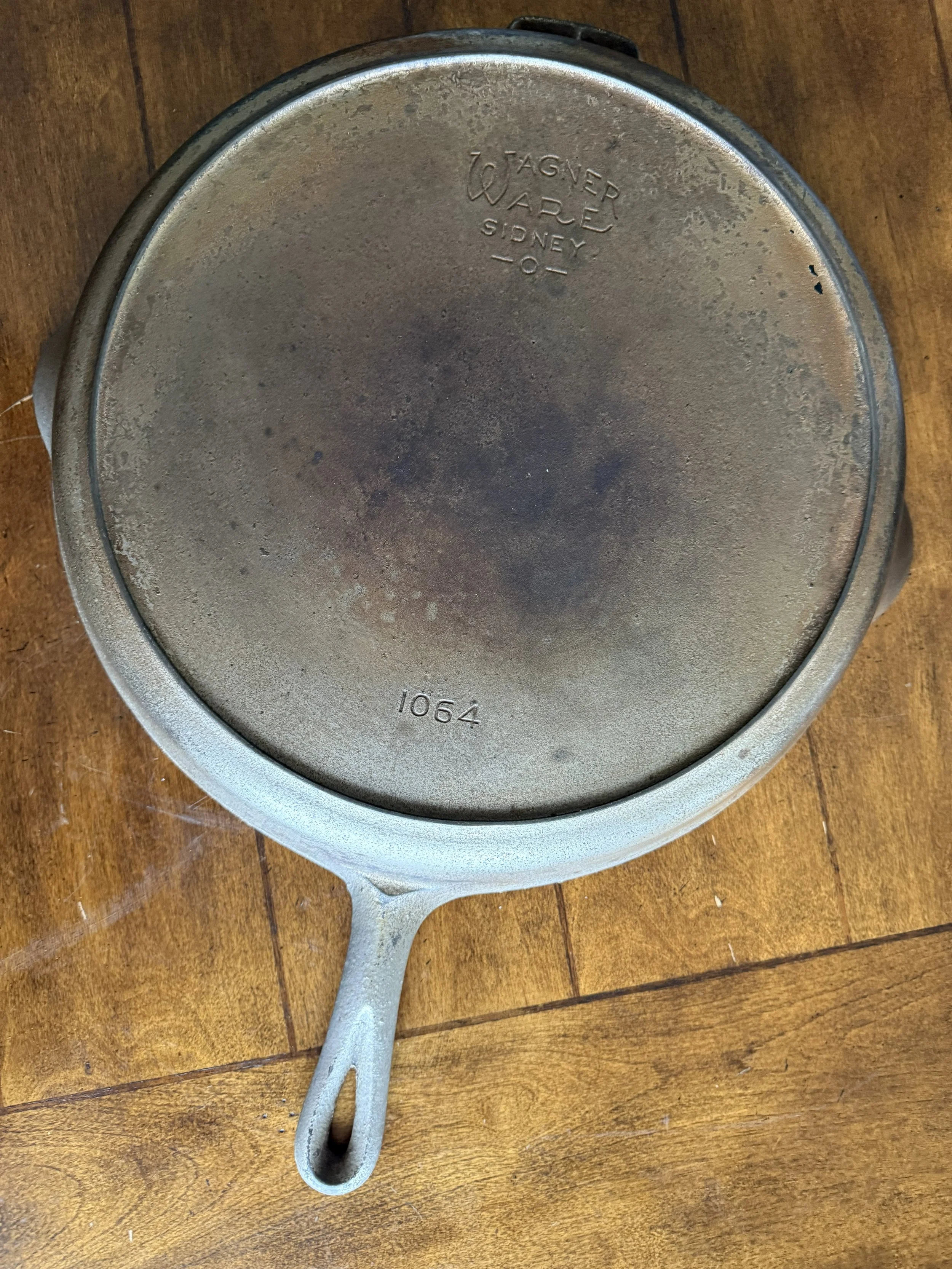
Bottom view showing stylized “Wagner Ware” logo at 12 o’clock, “SIDNEY –O–” below, and “1064” catalog number near handle. Heat ring intact on base. Bare iron surface preserved unseasoned under the Archival Black™ protocol for permanent museum display.
The Wagner Ware Sidney –O– No. 14 skillet is the largest single-handled skillet that Wagner Manufacturing Company ever produced at its Sidney, Ohio foundry. Marked with catalog number 1064 and bearing the iconic stylized “Wagner Ware” logo above “SIDNEY –O–,” this massive piece of American cast iron represents the upper limit of what a single-handled skillet could practically be. Only the two-handled No. 20 was larger in Wagner’s lineup. This example now serves as the crown piece of the SSC’s Wagner Sidney-O Complete Skillet Set, spanning every size from No. 0 through No. 14.
This particular No. 14 was acquired in January 2026 to upgrade the complete set with a museum-quality example. After careful lye degreasing under the SSC’s Archival Black™ preservation protocol, the skillet was intentionally left unseasoned—preserving its bare iron surface for permanent display. The result is a strikingly clean piece with every casting detail sharp and fully legible, from the stylized logo to the bold “1064” catalog number near the handle.
The No. 14 was never a high-production piece. Its size meant fewer could be cast per mold cycle, and consumer demand for a skillet this large was limited compared to the workhorse No. 8 and No. 10 sizes. At approximately 16–3/8 inches across the pour spouts and 21–1/2 inches from helper handle to handle tip, the No. 14 is an imposing piece of ironwork that required a two-hole finger-loop helper handle simply because of its weight. These skillets were designed for institutional kitchens, large family cooking, and outdoor use where volume mattered more than portability. Surviving examples in this condition are relatively scarce and command a premium among Wagner collectors.
Piece Details

Profile view showing the substantial sidewall depth and heat ring on the base. The stylized “Wagner Ware / SIDNEY –O–” logo and “1064” catalog number are visible on the bottom. The bare iron surface reveals the quality of Wagner’s casting and machining work.
Manufacturer
Wagner Manufacturing Company (Sidney, Ohio)
Brand
Wagner Ware
Piece Type
Cast Iron Skillet
Size Number
No. 14
Catalog Number
1064
Bottom Marking
Stylized “Wagner Ware” logo at 12 o’clock position; “SIDNEY” below in block letters; “–O–” below Sidney; “1064” catalog number near handle
Handle Marking
“14” size number cast on top of handle
Helper Handle
Two-hole finger loop at 12 o’clock position
Bottom Configuration
Heat ring (retained on No. 13 and No. 14 sizes throughout production)
Cooking Surface
Smooth machined interior with concentric milling marks
Pour Spouts
Dual opposing pour spouts
Overall Diameter
Approximately 16–3/8 inches across pour spouts
Overall Length
Approximately 21–1/2 inches from helper handle to handle end
Date of Manufacture
Circa 1924–1959
Place of Manufacture
Sidney, Shelby County, Ohio
Condition
Excellent — fully stripped via lye degreasing; bare iron preserved without seasoning for permanent museum display; all markings crisp and fully legible; no cracks, warping, or repairs; heat ring intact
Preservation Status
Archival Black™ protocol — lye degreased only; intentionally left unseasoned to preserve bare iron surface for museum display
Collection Placement
Wagner Sidney-O Complete Skillet Set (No. 0–14)
Acquisition Date
January 19, 2026
Acquisition Source
eBay — Seller: chrisddavis
eBay Item Number
206006726124
Order Number
25-14102-72894
SSC Catalog Number
SSC-WAGNER-SKL-14-SIDO-002
Historical Background
The Wagner Brothers and Sidney, Ohio
The story of Wagner Manufacturing Company begins with Matthias Wagner, a German immigrant who arrived in the United States in 1838 and worked on the Shelby County Canal before building a fortune in real estate and cattle in Sidney, Ohio. His sons Milton M. and Bernard P. Wagner chose a different path. In 1881, the brothers began manufacturing light hardware castings, and by 1890 they had commissioned architect Joseph Altenbach to build a dedicated foundry on Fair Road in Sidney. The Wagner Manufacturing Company was incorporated in June 1891, opening its doors with just 20 employees. Within three months the workforce had more than doubled to 41, melting 9,200 pounds of iron daily.
Wagner grew aggressively in its first decade. Nickel-plated ware was added in 1892. In 1894, Wagner became one of the first American companies to manufacture cast aluminum cookware. In 1897, the brothers acquired their competitor Sidney Hollow Ware from Phillip Smith, placing brother William H. Wagner in charge of the operation. By 1913, Wagner products were distributed worldwide, the plant had expanded to 160,000 square feet, and the Sidney Daily News boasted that the city was home to “the largest Holloware Plant in the World.”
The Stylized Logo and Catalog Number Era
Around 1922, Wagner introduced its most iconic trademark: the stylized “Wagner Ware” logo with the distinctive looped “W” serving double duty for both words, accompanied by “SIDNEY” and “–O–” (for Ohio) underneath. This marking would remain in use for nearly four decades and is today the most recognized Wagner trademark among collectors.
Wagner adopted a catalog numbering system around 1924. Regular skillets received catalog numbers starting at 1050 for the No. 0, incrementing by one for each size up to 1064 for the No. 14. During the early catalog-number period, all skillets still featured heat rings on their bases. Around 1930, Wagner began transitioning smaller sizes to smooth bottoms, but the No. 13 (catalog 1063) and No. 14 (catalog 1064) retained their heat rings throughout the entire production run. The structural demands of casting and supporting a skillet this large required the additional rigidity that a heat ring provides—making the No. 14 one of the last Wagner skillets to carry this older design feature into the later production years.
The No. 14: Largest Single-Handled Wagner Skillet
The No. 14 occupies a unique position in the Wagner lineup. It is the largest skillet that could be practically handled with a single main handle, supplemented by the two-hole finger loop at the opposite rim. Only the No. 20—a massive two-handled piece—was larger. The No. 14’s size made it impractical for most domestic stovetops, and it was primarily marketed for institutional use, outdoor cooking, and large-scale family meal preparation. A fully loaded No. 14 with food is far too heavy for one-handed operation, which is why the helper handle was a structural necessity rather than an optional convenience.
The combination of limited consumer demand, the difficulty of casting a piece this large, and the relatively short window of production under the Sidney -O- logo means that surviving No. 14 skillets with crisp, fully legible stylized markings are genuinely scarce. Most examples that surface show significant wear, pitting, or damage from decades of hard use. Finding one in condition suitable for museum display—with every letter of the logo readable and no structural issues—is a notable acquisition event.
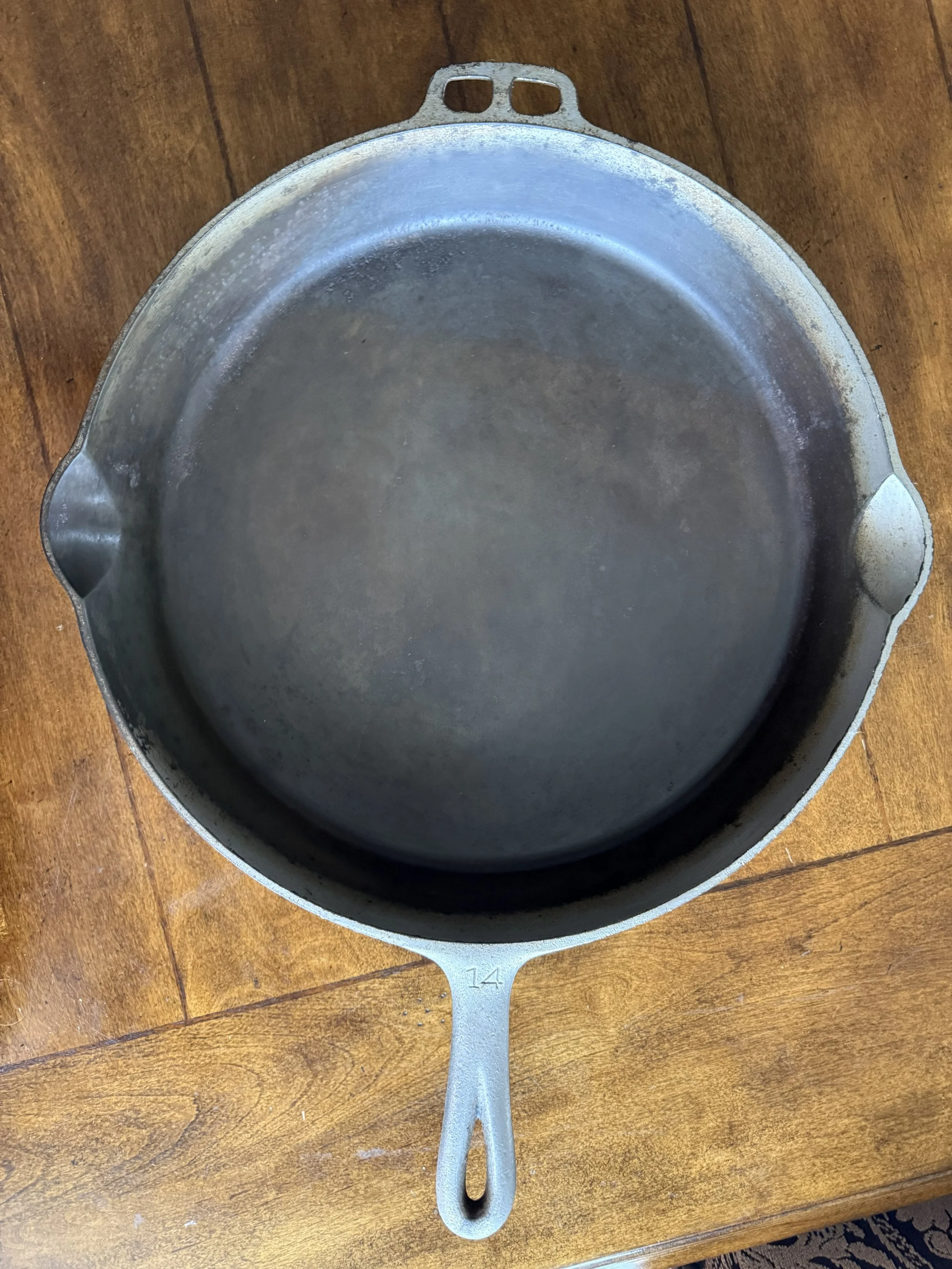
Interior cooking surface view showing smooth machined finish with concentric milling marks characteristic of Wagner’s production process. The “14” size number is visible on the handle. The two-hole finger-loop helper handle is visible at the top of the frame.
The End of an Era
The Wagner family began divesting their holdings in 1946, and by 1952 the Randall Company of Cincinnati had acquired full control. In 1957, Randall’s Wagner division purchased Griswold Manufacturing, bringing two of America’s most storied cast iron brands under one roof in Sidney. After 1959, the “SIDNEY –O–” marking was removed from the logo, and most collectors draw the line of desirable Wagner production at that date. The plant changed hands through Textron and General Housewares Corporation before finally closing for good in July 1999. The original foundry stood abandoned for over two decades before being demolished in June 2023.
SSC Collection Context
This No. 14 skillet completes an upgrade cycle for the SSC’s Wagner Sidney-O Complete Skillet Set, which spans every size from No. 0 through No. 14—a fifteen-piece run representing the full range of Wagner’s single-handled skillet production during the golden Sidney era. This example was selected specifically for its museum-quality markings and structural integrity, then preserved in bare iron under the Archival Black™ protocol to serve as the permanent display piece for the set.
The previous No. 14 in the collection has been reassigned to the Wagner Specialty & Variant Collection, where it continues to represent the size in a different context. This kind of strategic upgrading reflects the SSC’s commitment to presenting the finest possible examples in its primary thematic groupings while ensuring that no documented piece leaves the collection without purpose.
The Wagner Sidney-O Complete Skillet Set is one of the SSC’s signature displays, demonstrating the full scope of what one Ohio foundry achieved across decades of continuous production. From the diminutive No. 0—barely larger than a toy—to this commanding No. 14, the set tells the story of Wagner’s ambition and craftsmanship in cast iron.
Wagner Manufacturing Company — Corporate Timeline
1881
Milton and Bernard Wagner begin manufacturing light hardware castings in Sidney, Ohio.
1890
Construction begins on the Wagner foundry at 440 Fair Road, Sidney, under architect Joseph Altenbach.
1891
Wagner Manufacturing Company incorporated in June with 20 employees. Cast iron hollowware production begins. R.O. Bingham joins as superintendent.
1892
Nickel-plated ware added to the product line.
1894
Wagner becomes one of the first American manufacturers to produce cast aluminum cookware.
1897
Wagner acquires competitor Sidney Hollow Ware from Phillip Smith. William H. Wagner joins to oversee the operation.
1903
Sidney Hollow Ware sold back to Phillip Smith, who does not resume production.
1913
Wagner products distributed worldwide. Plant expanded to 160,000 square feet with approximately 300 employees.
c. 1922
Iconic stylized “Wagner Ware” logo introduced with the distinctive looped “W” and “SIDNEY –O–” marking.
c. 1924
Catalog numbering system adopted. Skillet catalog numbers follow the pattern 1050 (No. 0) through 1064 (No. 14). Heat rings still standard on all sizes.
c. 1930
Transition to smooth-bottom skillets begins for smaller sizes. No. 13 and No. 14 retain heat rings throughout production due to their massive size.
1934
Magnalite brand cast aluminum ware introduced.
1946–1953
Heirs of the founding Wagner brothers gradually divest their holdings in the company.
1952
Randall Company of Cincinnati, Ohio acquires Wagner Manufacturing Company.
1957
Randall’s Wagner division acquires Griswold Manufacturing from McGraw-Edison. Griswold production moves to the Sidney plant.
1959
Last year of production considered collectible by most enthusiasts. “SIDNEY –O–” marking removed from the logo after this date.
1969
General Housewares Corporation (GHC) acquires the Wagner and Griswold lines from Textron.
1999
Sidney plant closes permanently after a scheduled break in July. No Wagner cookware produced at the original location afterward.
2023
The original Wagner foundry building in Sidney demolished in June after years of abandonment and decay.
2026
Steve’s Seasoned Classics acquires this No. 14 skillet from eBay seller chrisddavis. The piece is documented as SSC-WAGNER-SKL-14-SIDO-002 and installed as the crown of the complete Wagner Sidney-O skillet set.
Why This Piece Matters
The Wagner No. 14 is a piece that most cast iron collectors know by reputation but few ever hold in their hands. It is the extreme end of single-handled skillet production—the point at which the foundry pushed the limits of what one person could reasonably lift, carry, and cook with. The fact that Wagner produced it at all speaks to the company’s ambition and its confidence in the quality of its iron. The fact that this example survives with every marking legible and no structural compromise speaks to the durability of that iron across a century of existence.
For the SSC, this piece does more than complete a set. It anchors the Wagner Sidney-O Complete Skillet Set with a statement piece—the largest, the heaviest, the most imposing skillet in the collection. It represents the full scope of what one Ohio foundry could achieve, from the smallest novelty size to this institutional-scale workhorse, all produced under the same roof in Sidney, Ohio, all bearing the same stylized logo and “SIDNEY –O–” marking that tells the world exactly where this iron was made.
The iron endures. The markings tell the truth. The story deserves to be told.
Sources & Further Reading
Cast Iron Collector — Wagner Manufacturing Co. (castironcollector.com/wagner.php): comprehensive corporate history and production timeline.
Cast Iron Collector — Evolution of the Wagner Trademark (castironcollector.com/wagnertm.php): detailed visual guide to logo changes and dating.
Cast Iron Collector Forums — Wagner Ware Collecting Discussion Thread (2017): collector discussion of catalog numbers, heat rings, and smooth-bottom transitions.
Wikipedia — Wagner Manufacturing Company: corporate history including founding, acquisitions, and closure.
Wagner Cast Iron — The Story Behind Wagner (wagnercastiron.com/pages/story): official brand history from the reissue company.
Boonie Hicks — Wagner Cast Iron: History, Dates and Logos: visual identification guide for Wagner trademarks and dating.
eBay listing and invoice documentation — Item 206006726124, Order 25-14102-72894.
About Steve’s Seasoned Classics
Steve’s Seasoned Classics is an online museum dedicated to preserving and documenting the heritage of American cast iron, with a focus on Ohio foundry pieces from the 19th and early 20th centuries. The SSC collection features over 130 pieces with detailed provenance, historical research, and photography for each item.
