Columbus Hollow Ware No. 9 Skillet
SSC MUSEUM COLLECTION
Catalog No. SSC-CHW-SKL-09-TF-001
“The Favorite” Logo | No. 9 Size | Columbus, Ohio
Circa 1882–1902 • Columbus Hollow Ware Co.
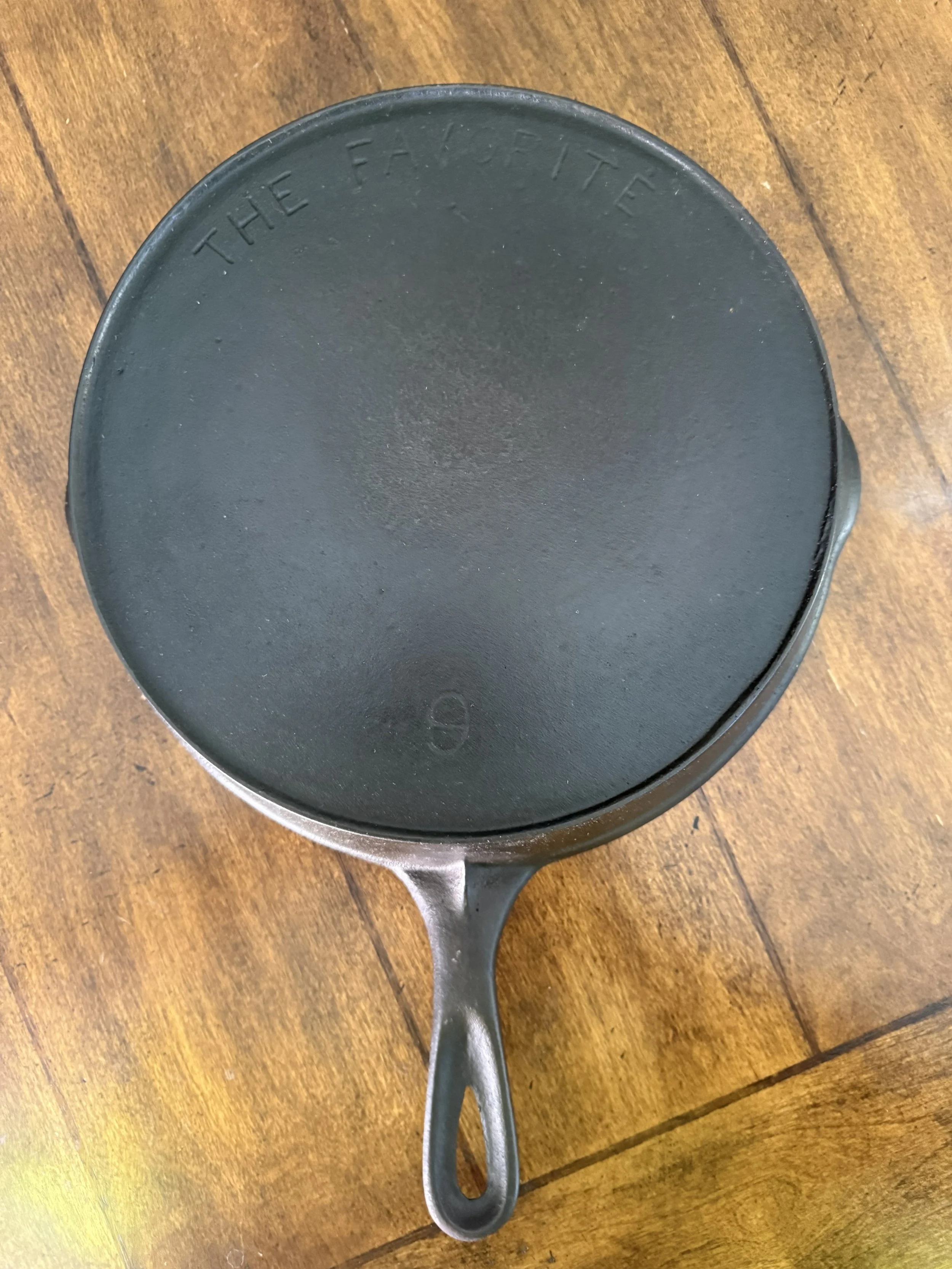
Bottom view showing “THE FAVORITE” logo arched at 12 o’clock and size numeral “9” cast near the handle junction. Unlike the No. 8 in this set, this specimen carries no subsidiary “S” mark below the logo arc.
The No. 9 is the quiet achiever of the Columbus Hollow Ware lineup. Not the bestselling workhorse—that distinction belongs to the No. 8—and not the large-format statement piece of the No. 11 or No. 12. The No. 9 occupies a practical middle ground: larger than the No. 8 by enough to matter when feeding a bigger table, smaller than the No. 10 by enough to remain manageable on a single-burner wood stove. At roughly 11 inches across the cooking surface, it is the skillet that a frontier household would have chosen when the No. 8 was already occupied and the family needed a second pan on the fire.
This Columbus Hollow Ware No. 9 carries the same spare, authoritative mark as every other piece in the line: “THE FAVORITE” arched in all capitals at 12 o’clock on the base exterior, with the size numeral “9” cast near the handle junction. What this specimen does not carry—a detail of genuine documentary significance when compared against the No. 8 from the same matched set—is the subsidiary “S” marking that appears below the logo arc on the companion piece. The two skillets were acquired together, very likely spent the better part of a century in the same household, and yet one carries the additional marking and one does not. That difference is exactly the kind of detail that SSC collection documentation is designed to capture and preserve for future research.
The rarity of this piece is identical to that of every surviving Columbus Hollow Ware specimen: genuine and irreducible. Two decades of production, a prison foundry under the constraints of state labor law, regional distribution only, and 120 years of attrition have left a surviving population that surfaces only occasionally on the secondary market. The No. 9 is somewhat less commonly encountered than the No. 8—production volumes for the mid-range sizes were lower, and fewer have survived into collector circulation. A clean, flat, sound No. 9 with a legible “THE FAVORITE” mark is a meaningful addition to any serious Ohio foundry collection.
Piece Details

Close-up of the base markings: “THE FAVORITE” arched at 12 o’clock and size numeral “9” near the handle junction. No subsidiary “S” mark is present on this specimen, in contrast to the No. 8 from the same acquired set — a documentation detail noted for future research.
Manufacturer
Columbus Hollow Ware Co.
Brand
The Favorite
Piece Type
Skillet
Size Number
No. 9
Base Marking
“THE FAVORITE” arched at 12 o’clock; “9” near handle junction; no subsidiary “S” mark
Bottom Configuration
Smooth base, no heat ring; raised outer rim foot
Pour Spouts
Two opposing spouts at 3 o’clock and 9 o’clock positions
Handle Style
Long flat handle with teardrop/keyhole hanging loop
Handle Junction
Raised bilateral sprue flanges at body-handle join
Date of Manufacture
Circa 1882–1902
Place of Manufacture
Columbus, Franklin County, Ohio (Ohio State Penitentiary)
Condition
Good to Very Good — legible markings; sits flat; no cracks or chips; established seasoning; some surface wear consistent with age
Acquisition Date
February 11, 2026
Acquisition Source
eBay — Seller: 4260doug
eBay Item Number
267517037106
Order Number
06-14230-47800
SSC Catalog Number
SSC-CHW-SKL-09-TF-001
The No. 9 in American Cast Iron: The In-Between Size
Every major American foundry of the late 19th and early 20th centuries produced a No. 9, but none of them led with it. The No. 8 was the flagship—the size that sold in the highest volume, earned the brand its reputation in everyday kitchens, and anchored every product catalog. The No. 10 and above addressed households with larger families or commercial cooking needs. The No. 9 existed for the space between: the family that had outgrown a No. 8 for regular use but didn’t need the full surface area of a No. 10, or the cook who wanted a second large pan on the fire without doubling up on the same size.
This functional positioning shaped the No. 9’s production history at every foundry. Because it sold in smaller volumes than the No. 8, fewer patterns were typically cut for it—which is why collectors rarely encounter No. 9 pattern letters beyond A or B, while the No. 8 lineup at the same foundries could extend much further through the alphabet. Fewer patterns meant fewer molds running simultaneously, which meant lower daily output, which ultimately means fewer surviving specimens in circulation today. The No. 9 is not dramatically rarer than the No. 8, but it is measurably less common across virtually every major foundry’s surviving population.
For Columbus Hollow Ware, the No. 9 represents a particularly significant documentation target. The total known surviving population of CHW pieces in any size is small, and the mid-range sizes—Nos. 9 and 10—appear in collector records less frequently than the No. 8. Finding a No. 9 in sound condition with a legible mark is a meaningful event in CHW collecting. Finding one as part of a five-piece matched set that includes specimens from No. 8 through No. 12 is extraordinary. This piece does not stand alone—it stands as part of a sequential run that SSC believes represents one of the most comprehensive private CHW collections currently documented anywhere.
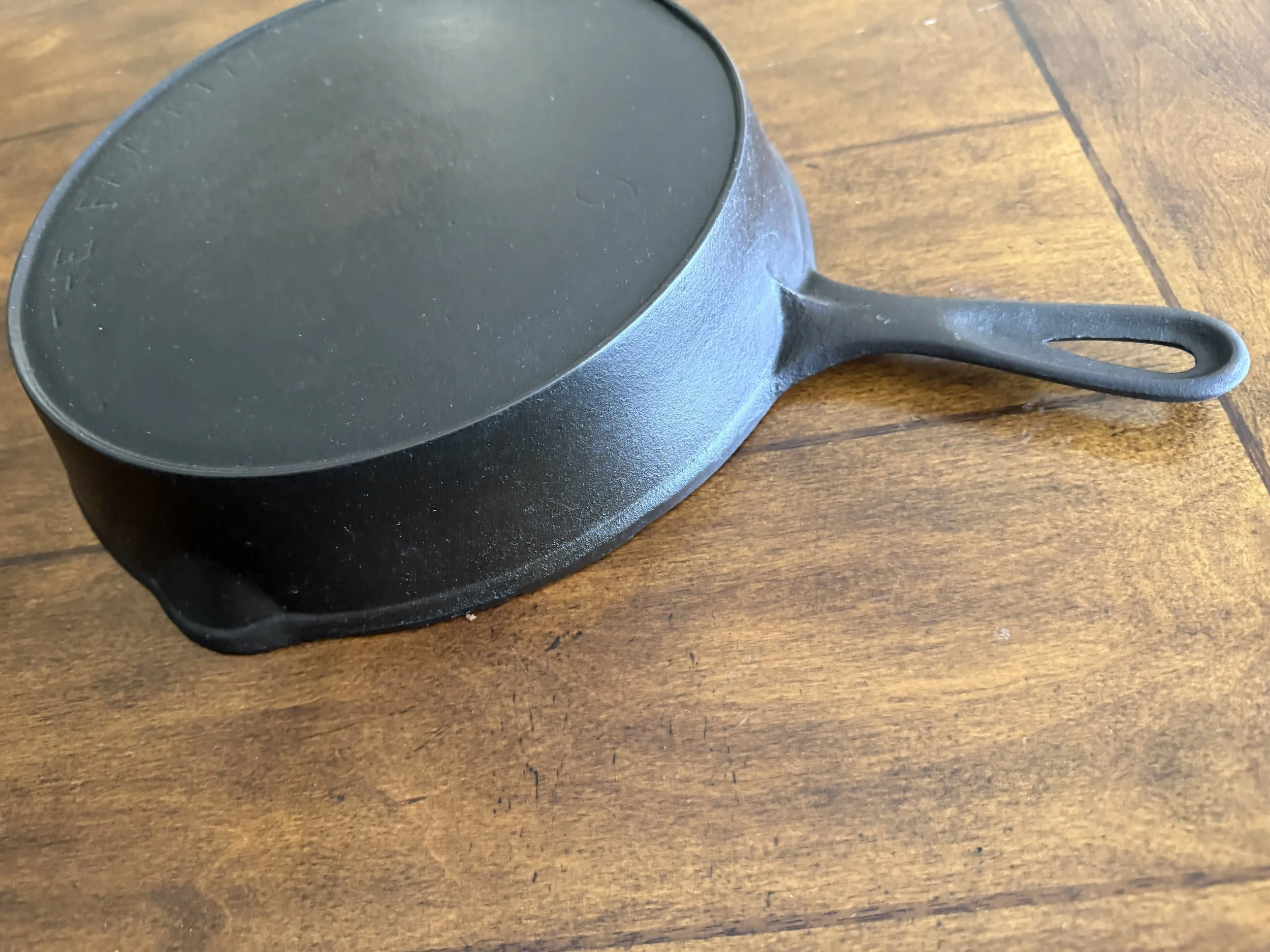
Profile view showing the smooth base (no heat ring), straight sidewall with noticeably greater depth than the No. 8, raised outer rim foot, bilateral sprue flanges at the handle junction, and the teardrop hanging loop at the handle terminus.
A Note on Marking Variation: The No. 8 “S” vs. the No. 9
One of the more intriguing documentation details to emerge from the SSC acquisition of this five-piece set is the presence of a subsidiary “S” mark below the “THE FAVORITE” logo arc on the No. 8 skillet—and its complete absence on this No. 9. Both pieces came from the same seller, were described as a matched set, and almost certainly spent the majority of their lives together. They carry the same brand mark, the same construction characteristics, and the same general period of manufacture. Yet the No. 8 has the “S” and the No. 9 does not.
This kind of intra-set marking variation is not unprecedented in American cast iron documentation. Pattern marks, batch codes, mold series identifiers, and individual foundry worker marks have been documented across multiple manufacturers, and they do not always appear consistently across an entire production run or across all sizes. The absence of the “S” on the No. 9 does not make this piece less authentic or less significant—it makes it more interesting as a documentary specimen. Together, the No. 8 and No. 9 from this set begin to establish the boundaries of where the “S” mark appears and where it does not, which is precisely the kind of comparative data that responsible collection documentation can generate over time.
SSC will continue to photograph, catalog, and note the presence or absence of the “S” marking across all five pieces in this set as each is documented. If the “S” appears only on certain sizes, or only on certain specimens within a size, that pattern itself becomes research data. The collector community is encouraged to examine their own CHW holdings and report whether the “S” appears on their pieces. This is exactly the kind of granular, comparative documentation that turns a private collection into a public research resource.
The Company: Columbus Hollow Ware Co.
The Columbus Hollow Ware Company was founded in Columbus, Franklin County, Ohio in 1882 by Jesse F. Hatcher and E.B. Hatcher, who acquired an existing foundry operation from iron manufacturer John Harker. The brand name “The Favorite” predated the Hatcher era—surviving pieces including a Harker-marked waffle iron and a tea kettle with an 1883 patent date both carry the “THE FAVORITE” stamp—establishing that the commercial identity the Hatchers inherited already had roots in Harker’s production.
The company produced a full line of domestic cast iron cookware under the “The Favorite” brand throughout its twenty-year operating history, with its most historically distinctive characteristic being its documented relationship with the Ohio State Penitentiary in Columbus. Under 19th-century prison labor contracting arrangements, the penitentiary provided inmate workforce to private businesses at contracted rates, with inmates receiving a portion of their wages for commissary use. The exact scope and timeline of CHW’s prison foundry involvement—including which specific marked pieces came from the prison operation versus in-house production—remains a subject of ongoing collector research and debate. What is not disputed is that the relationship existed, that it shaped the company’s production capacity and cost structure, and that the political turbulence around prison labor contracting in Ohio during the 1880s directly affected how such arrangements could be structured.
Columbus Hollow Ware ceased operations in 1902, leaving no surviving corporate records, product catalogs, or business documentation accessible to modern researchers. Every piece of “THE FAVORITE” marked cast iron in existence is a primary source artifact of Ohio industrial and social history—evidence of a foundry, a prison, a labor system, and a commercial enterprise that together constitute a chapter of American manufacturing history that deserves careful preservation and documentation.
Physical Characteristics & Condition Assessment
The No. 9 is a larger pan than the No. 8 in every dimension that matters to the cook: wider cooking surface, taller sidewall, greater overall depth. The additional depth is one of the most immediately apparent characteristics when the two sizes are placed side by side. Where the No. 8 is a relatively shallow pan well-suited for searing and frying at moderate depths of fat or liquid, the No. 9’s additional sidewall height gives it more capacity for braises, stews, and larger quantities of rendered fat. This functional distinction was not incidental—foundries designed their No. 9 as a specific tool for specific cooking tasks, and the proportions reflect that intent.
The base of this specimen is smooth—no heat ring—consistent with the No. 8 from the same set and with the smooth-bottom production approach documented across the CHW line. The outer rim foot provides a stable resting surface on a flat stovetop or table. Two opposing pour spouts interrupt the rim at the 3 o’clock and 9 o’clock positions. The handle is long and flat, terminating in a teardrop hanging loop, with bilateral sprue flanges at the body junction characteristic of sand-mold casting from this era.
Condition is assessed as Good to Very Good. The “THE FAVORITE” logo is legible, though it reads with slightly less crispness than the No. 8 from the same set—a common result of individual pattern wear at the time of casting, minor surface aging, or both. The piece sits flat with no warping or wobble. No cracks, cold shuts, or structural repairs are present. The cooking surface carries an established seasoning showing the characteristic variation in color and texture of a pan that has seen genuine use over its working life. Some surface wear and minor patina variation are consistent with the age of the piece and do not affect structural integrity or display quality. The piece is display-ready.
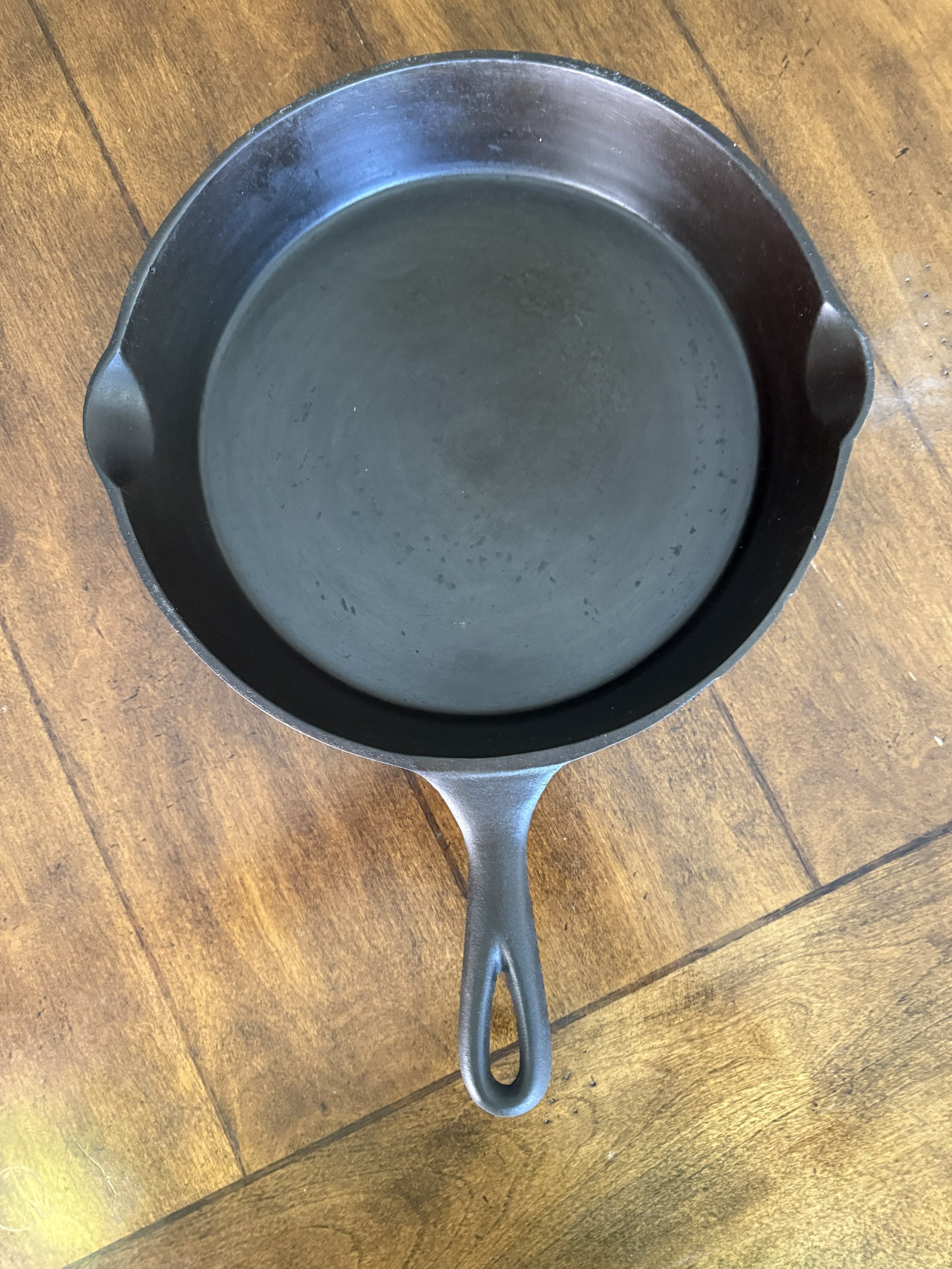
Top view showing the cooking surface with established seasoning, dual pour spouts at opposing rim positions, and the deep sidewall that distinguishes the No. 9 from the shallower No. 8 profile.
Collector’s Context
Within the Columbus Hollow Ware collecting universe—which is to say, a small but passionate subset of American cast iron collectors focused on pre-1905 Ohio foundry pieces—the No. 9 occupies an interesting position. It is more commonly encountered than the No. 11 or No. 12, which were produced in lower volume and which were more likely to be damaged or discarded given their size and weight. It is less commonly encountered than the No. 8, which simply existed in greater numbers. The No. 9 sits in a middle tier of CHW rarity: not the crown jewel of the size run, but not the easy find either.
For SSC, the significance of this No. 9 is inseparable from the set in which it arrived. A single CHW No. 9 in isolation is a noteworthy acquisition. A CHW No. 9 that spent more than a century alongside a No. 8, No. 10, No. 11, and No. 12 from the same foundry and the same era is something qualitatively different—it is a preserved unit of collection history, a matched set that arrived intact and will be documented intact. The SSC approach to this acquisition is to treat the five-piece set as both a group of individual catalog entries and as a coherent provenance unit, with each piece cross-referenced to the others throughout its documentation.
The pricing of this piece reflects set economics rather than individual market valuation. At $318.40 allocated from the five-piece set total, each skillet in the acquisition was priced at a figure that reflects the premium of purchasing a complete matched run from a single provenance. Individual CHW pieces of equivalent size and condition have sold for comparable or higher amounts on the secondary market when available—the set acquisition did not represent an overpayment but rather an appropriate valuation of assembled, documented, matched pieces from one of Ohio’s most historically distinctive foundries.
Provenance & Acquisition
This No. 9 skillet was acquired on February 11, 2026, via eBay from seller 4260doug, under eBay item number 267517037106 (order 06-14230-47800). The listing offered a five-piece matched set described as “The Favorite Columbus Hollow Ware Cast Iron Skillet Set 8 9 10 11 12 Holloware.” The set was purchased at $1,400.00 plus $67.61 UPS Ground shipping and $124.38 in sales tax, for a total acquisition cost of $1,591.99. Cost is allocated at $318.40 per piece for individual catalog records.
Physical examination on receipt confirmed the condition as described: no cracks, no chips, no active rust, flat base with no warping or wobble, legible markings, and established seasoning. The absence of the subsidiary “S” mark that appears on the companion No. 8 was noted on receipt and is documented here as a detail of collector and research significance. All five pieces in the set have been logged into the SSC collection as individual catalog entries under the SSC-CHW-SKL designation, with shared acquisition documentation cross-referenced across all five records.
Corporate Timeline: Columbus Hollow Ware Co.
1870s
John Harker operates a Columbus, Ohio foundry producing cast iron under an early “The Favorite” mark. Surviving artifacts document the brand predating the Hatcher era.
1882
Jesse F. Hatcher and E.B. Hatcher purchase the Harker foundry and formally establish the Columbus Hollow Ware Company in Columbus, Franklin County, Ohio.
1882–86
Early period of production under the “THE FAVORITE” brand. Full domestic hollow ware line including skillets across multiple sizes.
1882
Separately and without connection, the Favorite Stove Works Company is organized in Ohio by William King Boal—a different company, different brand family, different Ohio city.
1886–87
Ohio labor reform legislation introduces new regulations governing prison labor contracting, reshaping the terms under which businesses could engage state penitentiary inmates.
c.1890s
Columbus Hollow Ware engages production arrangements involving the Ohio State Penitentiary. Inmates employed in foundry work, wages applied toward commissary.
1902
Columbus Hollow Ware Company ceases operations. Production of “THE FAVORITE” brand cast iron ends permanently. No successor company continues the brand.
2026
Steve’s Seasoned Classics acquires the five-piece matched set (Nos. 8, 9, 10, 11, 12) from eBay seller 4260doug, establishing comprehensive CHW documentation in the SSC online museum.
Why This Piece Matters
The Columbus Hollow Ware No. 9 matters for the same reasons that every CHW specimen matters—it is a surviving artifact of a twenty-year foundry operation that left nothing behind but the iron—and it matters for one additional reason specific to this piece: the marking variation it documents in comparison to the No. 8 from the same set. The absence of the “S” mark on this specimen, set against its presence on the companion No. 8, is a data point that the collector community cannot generate without pieces like this one, documented carefully and made publicly accessible through resources like SSC.
Cast iron scholarship advances through accumulation of exactly this kind of granular comparative detail. A single piece in a private collection, undocumented and unseen, contributes nothing to the understanding of how Columbus Hollow Ware marked its production, how its patterns varied across sizes, or what the subsidiary marks may mean. The same piece, documented with full photography and cross-referenced against its set companions, begins to generate the kind of evidence from which real historical conclusions can eventually be drawn. That is the work SSC is doing, one catalog entry at a time.
The iron endures. The markings tell the truth. The story deserves to be told.
Sources & Further Reading
CastIronCollector.com — Columbus Hollow Ware Co. reference page: operational dates, location, and brand name documentation.
BoonieHicks.com — “The Favorite, Vintage Cast Iron By The Columbus Hollow Ware Co.”: collector analysis of the two-period theory and prison labor connections.
CastIronCookwareCollectorsGuide.com — “The Columbus Hollow Ware Co., The Favorite”: photographic documentation and collector discussion.
WorthPoint.com — Historical auction records for Columbus Hollow Ware specimens including No. 9 size documentation.
BoonieHicks.com — “Guide to Favorite Piqua Ware”: reference for distinguishing CHW “The Favorite” from Favorite Stove & Range “Favorite Piqua Ware.”
About Steve’s Seasoned Classics
Steve’s Seasoned Classics is an online museum dedicated to preserving and documenting the heritage of American cast iron cookware, with a focus on Ohio foundry pieces from the 19th and early 20th centuries. The SSC collection features over 60 pieces with detailed provenance, historical research, and photography for each item.
www.stevesseasonedclassics.com
