Columbus Hollow Ware No. 11 Skillet
SSC MUSEUM COLLECTION
Catalog No. SSC-CHW-SKL-11-TF-001
“The Favorite” Logo | No. 11 Size | Columbus, Ohio
Circa 1882–1902 • Columbus Hollow Ware Co.
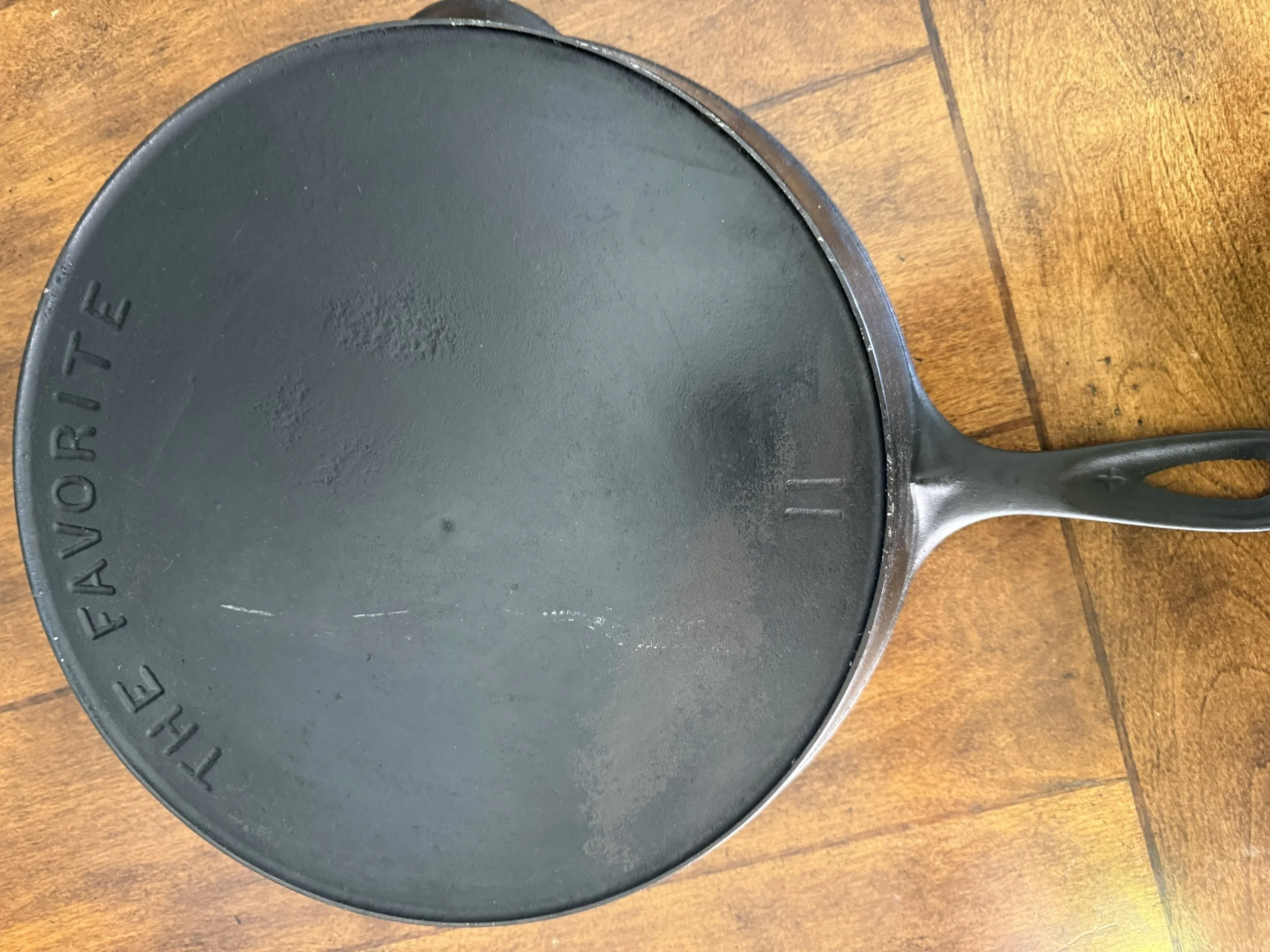
Bottom view showing “THE FAVORITE” logo arched at 12 o’clock and size numeral “11” cast near the handle junction. The scale of the No. 11 base is immediately apparent — this is among the largest skillets Columbus Hollow Ware produced.
There is a moment, when you pick up a No. 11 cast iron skillet, when you understand something about the people who cooked with it. This is not a one-hand pan. It is not a quick weeknight skillet. It is a pan built for serious quantity—for the kind of cooking that fed a large household, a farmhand crew, or a Sunday gathering where the table was set for ten and the cook needed room to work. At roughly 13 inches across the cooking surface, the No. 11 commands a stovetop. It is the pan that says: we are feeding people today.
This Columbus Hollow Ware No. 11 is the second-largest skillet in the five-piece matched set acquired by SSC in February 2026, and it carries the same authoritative mark as its companions: “THE FAVORITE” arched in all capitals at 12 o’clock, with the size numeral “11” cast near the handle junction. What this piece adds to the set narrative is sheer scale. Placed beside the No. 8 or No. 9, the No. 11 makes the progression of the Columbus Hollow Ware size run physically tangible. This is not an incremental step—this is a different category of cooking vessel, designed for different tasks, requiring a different kind of stovetop, and surviving in meaningfully smaller numbers than the smaller sizes precisely because its weight and bulk made it more vulnerable to damage and more likely to be set aside when the household no longer needed a pan of this capacity.
The No. 11 is one of the rarest sizes in the Columbus Hollow Ware line. Large-format cast iron skillets—Nos. 10, 11, and 12—were produced in lower volumes than the workhorse mid-range sizes, and they faced greater physical attrition over their working lives. A pan this size, dropped on a stone floor or subjected to a thermal shock, was more likely to crack than a smaller, thinner piece. Estate heirs confronted with a collection of old black iron were more likely to keep the No. 8 and discard the No. 11 simply because the No. 8 was more immediately useful in a modern kitchen. Every surviving No. 11 in collector circulation today is a piece that ran a long gauntlet of use, storage, neglect, and dispersal and came through intact. This one did.
Piece Details

Close-up of the base markings: “THE FAVORITE” arched at 12 o’clock and size numeral “11” near the handle junction. The lettering on this specimen is among the crispest in the five-piece set, cast with exceptional clarity relative to the scale of the pan.
Manufacturer
Columbus Hollow Ware Co.
Brand
The Favorite
Piece Type
Skillet
Size Number
No. 11
Base Marking
“THE FAVORITE” arched at 12 o’clock; “11” near handle junction; no subsidiary marks
Bottom Configuration
Smooth base, no heat ring; raised outer rim foot
Pour Spouts
Two opposing spouts at 3 o’clock and 9 o’clock positions
Handle Style
Long flat handle with teardrop/keyhole hanging loop
Handle Junction
Raised bilateral sprue flanges at body-handle join
Date of Manufacture
Circa 1882–1902
Place of Manufacture
Columbus, Franklin County, Ohio (Ohio State Penitentiary)
Condition
Very Good — crisp markings; sits flat; no cracks, chips, or active rust; well-seasoned; display ready
Acquisition Date
February 11, 2026
Acquisition Source
eBay — Seller: 4260doug
eBay Item Number
267517037106
Order Number
06-14230-47800
SSC Catalog Number
SSC-CHW-SKL-11-TF-001
The Large-Format Skillet: What a No. 11 Was For
In the late 19th-century American kitchen, skillet size was not an aesthetic choice—it was a practical decision driven by the size of the household, the nature of the cooking task, and the capacity of the stove. The No. 8 was the everyday workhorse, sized for a nuclear family’s daily cooking needs. The No. 9 and No. 10 served larger families and more ambitious meals. The No. 11 entered territory that the modern domestic cook rarely inhabits: large-scale family cooking, farmstead cooking for a working crew, or the kind of Sunday dinner where the extended family gathered and a smaller pan simply wasn’t adequate.
A No. 11 could fry a full chicken—not a cut-up fryer, but a whole bird, quartered, all four pieces at once. It could render the lard from a substantial quantity of fatback in a single batch. It could hold a corn pone large enough to serve a table of ten. On a wood-burning kitchen range, which typically had two large cooking eyes and two smaller ones, the No. 11 would occupy a large eye and demand the full heat output of that position. On a summer kitchen hearth, it would sit directly on the coals or over a dedicated fire, the scale of the vessel matched to the scale of the cooking operation.
This functional context explains both why large-format skillets were produced and why they survive in smaller numbers. The households that needed a No. 11 were operating at a scale—large farms, large families, households with hired help or boarders—that was common in the 1880s and 1890s and became progressively less common through the 20th century. As household sizes shrank, as commercial food production displaced home large-scale cooking, and as gas and electric ranges replaced wood stoves with their smaller burner diameters, the No. 11 became functionally obsolete in most kitchens. The pan that had been essential became surplus, and surplus cast iron was melted, broken, or simply lost.
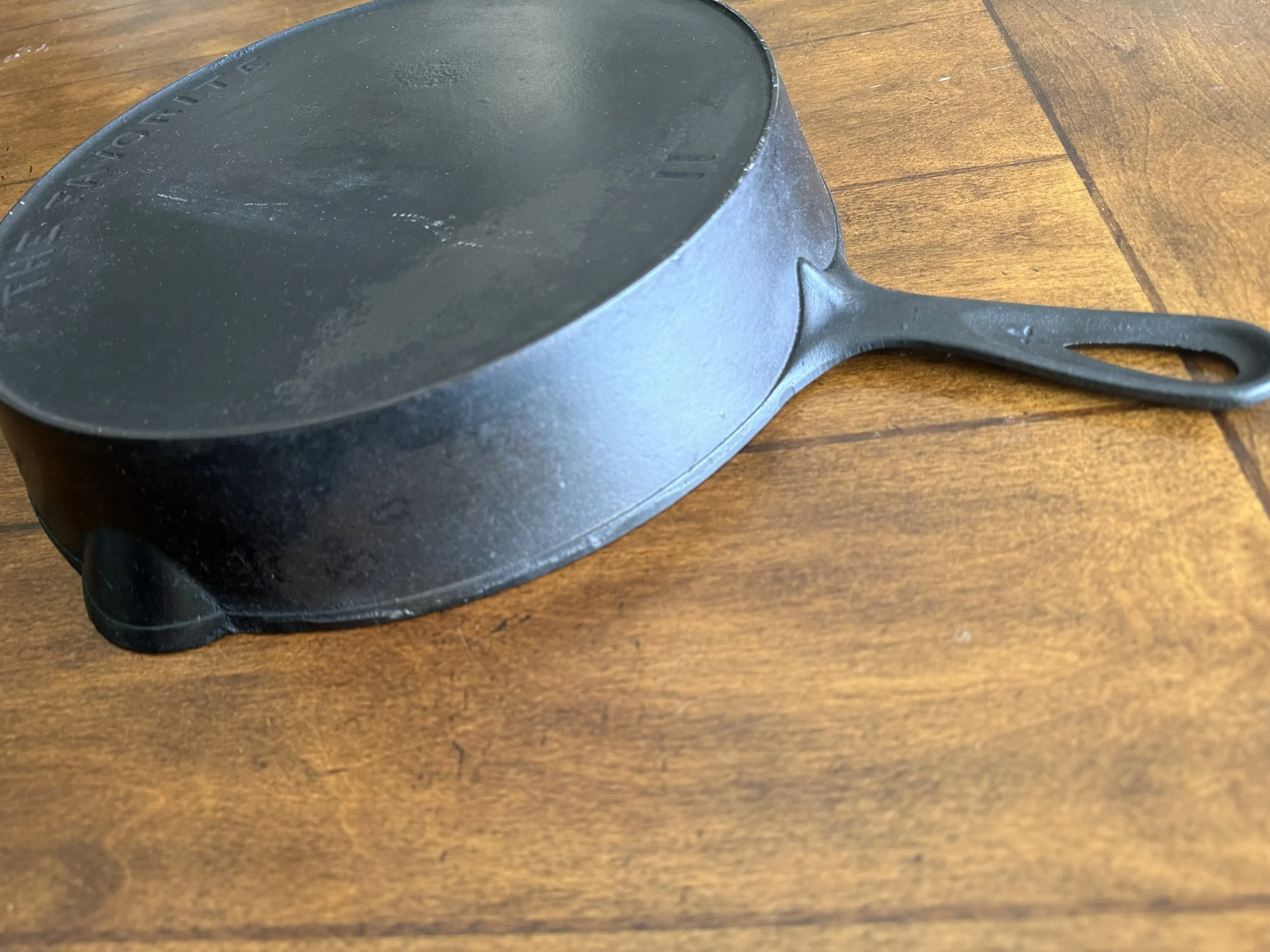
Profile view showing the substantial sidewall depth of the No. 11, the smooth base, the bilateral sprue flanges at the handle junction, and the significant overall mass of the piece relative to the smaller sizes in this set.
Rarity in the Columbus Hollow Ware Line: Why the Large Sizes Matter Most
Within the already-scarce universe of Columbus Hollow Ware collecting, the large-format sizes—No. 10, No. 11, and No. 12—occupy a tier of rarity above the mid-range pieces. The foundry operated for only twenty years, produced under the constraints of a prison labor contract, and distributed regionally in central Ohio. At every size, the total surviving population is small. But the large sizes face additional attrition factors that compound their scarcity.
Production volumes for No. 11 and No. 12 skillets were lower than for the No. 8 and No. 9 simply because demand was lower. Fewer households needed a pan this large, so fewer were cast. Fewer patterns were run simultaneously, meaning the total output per year was a fraction of the smaller sizes. Over a twenty-year operating period, the cumulative production of No. 11 Columbus Hollow Ware skillets was almost certainly measured in hundreds rather than thousands. The number that survived into the 21st century in collector-grade condition—clean, flat, sound, with legible markings—is impossible to know but is plainly a small fraction of original production.
The physical vulnerability of large cast iron also plays a role. A No. 11 contains significantly more iron than a No. 8—more mass concentrated in a larger cooking vessel means more thermal stress during heating and cooling, more potential energy in a drop, and more weight for a user to manage. The same stovetop accident that leaves a No. 8 with a superficial scratch can crack a No. 11 at the rim or through the cooking surface. Large pieces that cracked were typically discarded or melted rather than repaired, and the repair methods available to 19th-century households—brazing, pinning, or simply continuing to use a cracked pan—were not always successful over the long term. The No. 11 in the SSC collection shows none of these failure modes. It is structurally sound, flat, and intact—evidence of careful ownership across its entire working life.
The Company: Columbus Hollow Ware Co.
The Columbus Hollow Ware Company was founded in 1882 in Columbus, Franklin County, Ohio by Jesse F. Hatcher and E.B. Hatcher, who acquired an existing iron manufacturing operation from Columbus merchant John Harker. The “THE FAVORITE” brand predated the Hatcher era—surviving pieces including a Harker-marked waffle iron and an 1883-patent-dated tea kettle both carry the mark—establishing a commercial identity that the Hatchers inherited and continued through the company’s twenty-year run.
The company’s documented relationship with the Ohio State Penitentiary—which gave Columbus Hollow Ware its most distinctive historical character—involved inmates employed in foundry work under 19th-century prison labor contracting arrangements. The precise scope and timeline of prison foundry involvement in “THE FAVORITE” marked ware production remains partially unsettled in the collector literature, with debate centering on whether marked pieces came from in-house production, prison production, or both at different points in the company’s history. What is established is that the relationship existed, that it shaped the company’s production economics, and that the labor reform environment of the late 1880s materially affected how such arrangements could be structured. Columbus Hollow Ware ceased operations in 1902, leaving no surviving corporate records and no successor company. The iron is all that remains.
Physical Characteristics & Condition Assessment
The No. 11 is immediately distinguished from the smaller pieces in this set by its scale. The cooking bowl is wide and deep, with a generous interior capacity well-suited to the large-batch cooking tasks described above. The interior sidewall curves up to a broad, flat rim, and two opposing pour spouts interrupt the rim at the 3 o’clock and 9 o’clock positions. The spout geometry on the No. 11 is proportionally similar to that of the smaller sizes but physically larger, reflecting the greater volume of liquid that might need to be drained from a pan of this capacity.
The base is smooth—no heat ring—consistent with the other pieces in this set. The raised outer rim foot provides stable contact with a flat surface. The handle is long and flat, terminating in a teardrop hanging loop, with bilateral sprue flanges at the body junction. The overall proportions of handle to body are calibrated for two-handed use—a pan this size and weight would typically be moved with one hand on the handle and the other steadying the assist tab at the opposite rim, though this specimen appears to lack a dedicated assist handle, relying instead on the rim geometry for secondary grip.
Condition is assessed as Very Good. The “THE FAVORITE” logo on this specimen is among the crispest of the five pieces in the set—the lettering is fully legible with excellent definition, and the size numeral “11” reads clearly near the handle junction. The base sits flat with no warping or wobble. No cracks, cold shuts, structural repairs, or active rust are present. The cooking surface carries a well-established seasoning with the characteristic tonal variation of a genuinely used vintage pan. The overall presentation is excellent for a piece of this age and scale. Display ready.
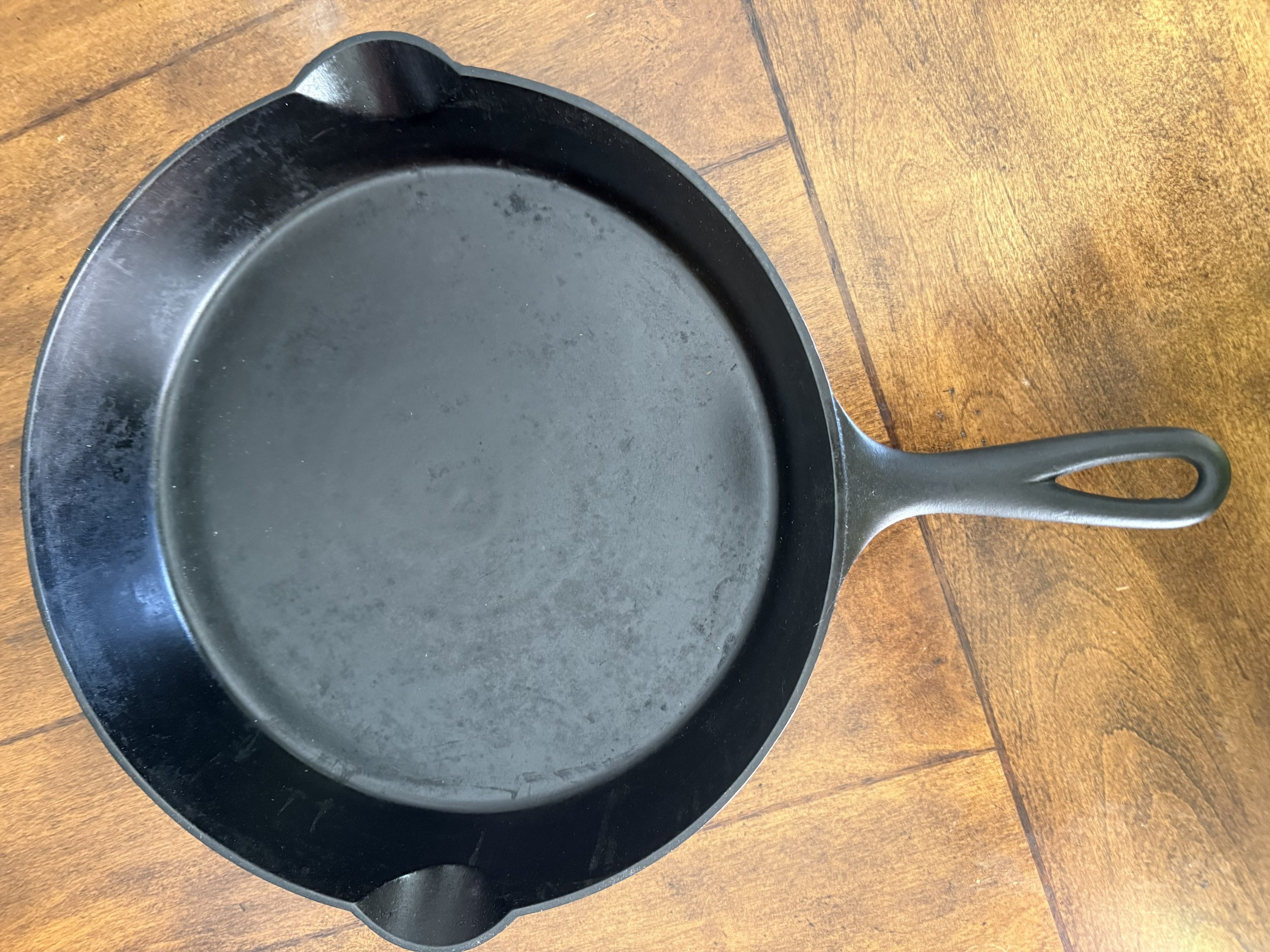
Top view showing the wide cooking surface of the No. 11, dual pour spouts at opposing rim positions, and the scale that made this size essential for large-household and farmstead cooking in the late 19th century.
Collector’s Context
For collectors focused on Columbus Hollow Ware, the No. 11 is a crown jewel—present in documented collections only occasionally, and almost never available as part of a matched set that includes the full size run. The combination of limited original production, significant physical attrition over 120+ years, and the general scarcity of CHW pieces in any size means that a sound No. 11 with crisp markings represents a serious acquisition by any measure.
The pricing of this piece at $318.40 allocated from the five-piece set reflects set acquisition economics rather than the standalone secondary market value of a No. 11 in this condition. Individual Columbus Hollow Ware pieces of comparable size and condition have historically sold at comparable or higher prices when they surface in isolation. The set acquisition gave SSC access to a No. 11 at an efficient per-piece cost while also preserving the provenance integrity of the matched set—a double benefit that standalone acquisition could not have provided.
In the context of the SSC Columbus Hollow Ware sub-collection, the No. 11 serves a specific narrative function: it demonstrates the full scale of what Columbus Hollow Ware produced. Visitors to the SSC website who encounter only the No. 8 or No. 9 will have an incomplete picture of the foundry’s output range. The No. 11—and the No. 12 alongside it—establishes that this was a full-service hollow ware manufacturer capable of producing the complete size spectrum demanded by late 19th-century American domestic life. The range from No. 8 to No. 12 in a single matched set tells that story more powerfully than any individual piece could.
Provenance & Acquisition
This No. 11 skillet was acquired on February 11, 2026, via eBay from seller 4260doug, under eBay item number 267517037106 (order 06-14230-47800). The listing offered a five-piece matched set described as “The Favorite Columbus Hollow Ware Cast Iron Skillet Set 8 9 10 11 12 Holloware.” The set was purchased at $1,400.00 plus $67.61 UPS Ground shipping and $124.38 in sales tax, for a total acquisition cost of $1,591.99. Cost is allocated at $318.40 per piece for individual catalog records.
Physical examination on receipt confirmed the condition as excellent: no cracks, no chips, no active rust, flat base with no warping or wobble, crisp markings, and well-established seasoning. The No. 11 arrived with notably sharp logo definition relative to its scale, suggesting the pattern producing this size was in good condition at the time of casting. All five pieces in the set have been logged into the SSC collection as individual catalog entries under the SSC-CHW-SKL designation, with shared acquisition documentation cross-referenced across all five records.
Corporate Timeline: Columbus Hollow Ware Co.
1870s
John Harker operates a Columbus foundry producing cast iron under an early “The Favorite” mark. A Harker-stamped waffle iron and 1883-patent tea kettle establish the brand’s pre-Hatcher origins.
1882
Jesse F. Hatcher and E.B. Hatcher purchase the Harker foundry, formally establishing Columbus Hollow Ware Company in Columbus, Franklin County, Ohio. Full domestic hollow ware line begins production.
1882–86
Early in-house production period. The complete size range—including large-format pieces like the No. 11 and No. 12—is established under the “THE FAVORITE” brand.
1886–87
Ohio labor reform legislation reshapes prison labor contracting following public opposition to goods manufactured by inmates competing with free-market labor.
c.1890s
Columbus Hollow Ware engages production arrangements with the Ohio State Penitentiary. Inmates employed in foundry work; wages applied toward commissary.
1902
Columbus Hollow Ware Company ceases operations. Production of “THE FAVORITE” brand cast iron ends permanently. No successor company. Large-format pieces like the No. 11 become increasingly scarce over the following decades.
2026
Steve’s Seasoned Classics acquires the five-piece matched set (Nos. 8–12) from eBay seller 4260doug. The No. 11 is documented as SSC-CHW-SKL-11-TF-001 and joins the SSC online museum collection.
Why This Piece Matters
The Columbus Hollow Ware No. 11 matters because large-format cast iron from a small regional Ohio foundry that operated for only twenty years does not survive in quantity, and the pieces that do survive deserve documentation that matches their significance. This is not a pan that was common even when new. It is not a pan that turned up in every farmhouse kitchen—only the households that genuinely needed a cooking vessel of this scale would have purchased it. The fact that this particular No. 11 survived intact, with crisp markings and no structural damage, through 120-plus years of use, storage, and estate dispersal is a story in itself.
Within the SSC five-piece set, the No. 11 anchors the large-format end of the size run alongside the No. 12. Together they demonstrate something that is almost impossible to demonstrate any other way: the full productive range of a foundry that almost no one is documenting. Most collectors who have heard of Columbus Hollow Ware know it from the No. 8. Fewer have seen a No. 9 or No. 10. The No. 11 and No. 12 are the pieces that transform a collection into an exhibit—they prove that “THE FAVORITE” was not a single-size curiosity but a complete line of cookware built for the full spectrum of American domestic life.
The iron endures. The markings tell the truth. The story deserves to be told.
Sources & Further Reading
CastIronCollector.com — Columbus Hollow Ware Co. reference page: operational dates, location, and brand name documentation.
BoonieHicks.com — “The Favorite, Vintage Cast Iron By The Columbus Hollow Ware Co.”: two-period theory and prison labor analysis.
WorthPoint.com — Historical auction records for large-format Columbus Hollow Ware specimens including No. 11 documentation.
CastIronCookwareCollectorsGuide.com — “The Columbus Hollow Ware Co., The Favorite”: photographic documentation and collector discussion.
BoonieHicks.com — “Guide to Favorite Piqua Ware”: reference for distinguishing CHW from Favorite Stove & Range productions.
About Steve’s Seasoned Classics
Steve’s Seasoned Classics is an online museum dedicated to preserving and documenting the heritage of American cast iron cookware, with a focus on Ohio foundry pieces from the 19th and early 20th centuries. The SSC collection features over 60 pieces with detailed provenance, historical research, and photography for each item.
