Columbus Hollow Ware No. 10 Skillet
SSC MUSEUM COLLECTION
Catalog No. SSC-CHW-SKL-10-TF-001
“The Favorite” Logo | No. 10 Size | Columbus, Ohio
Circa 1882–1902 • Columbus Hollow Ware Co.
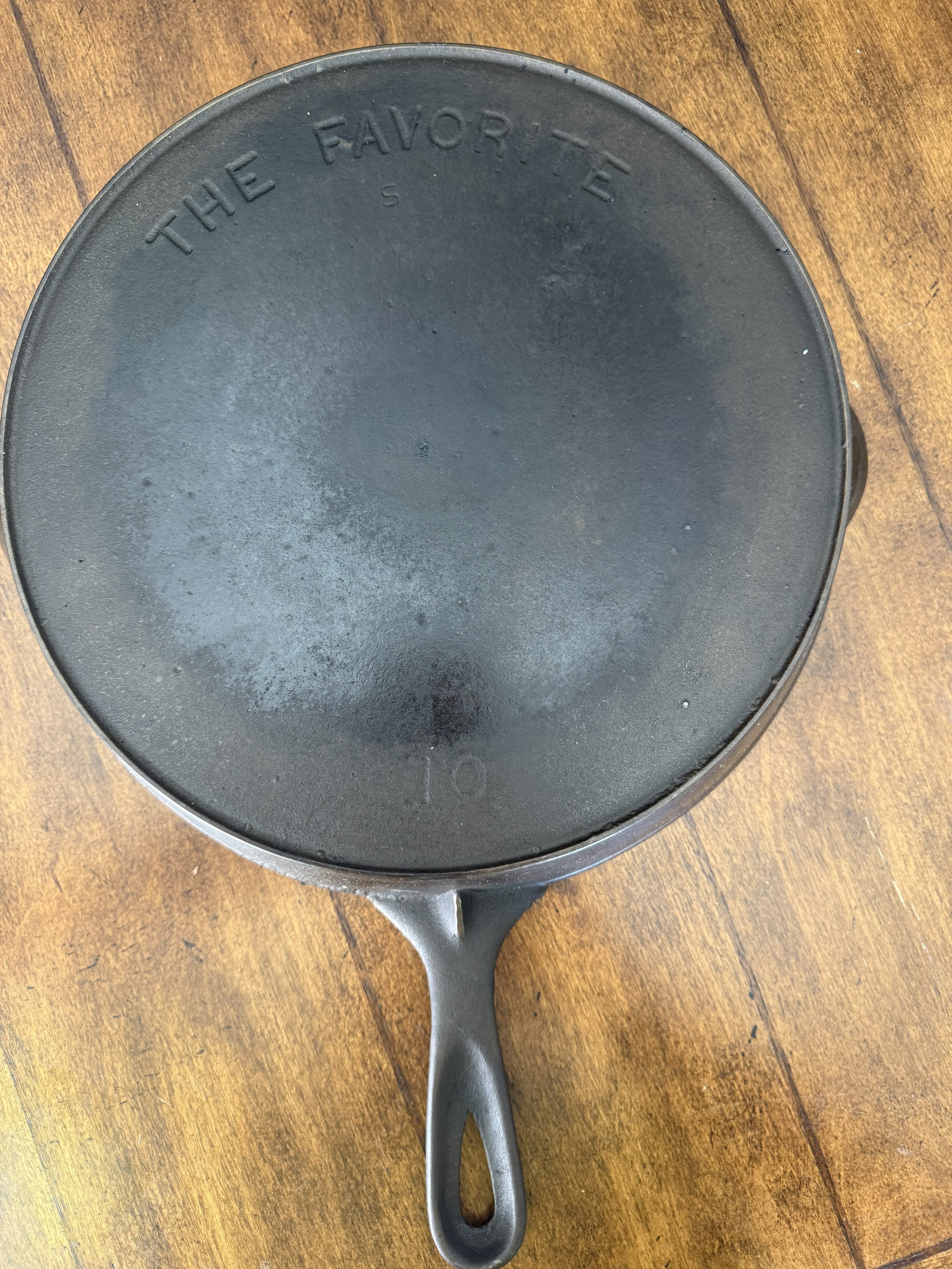
Bottom view showing “THE FAVORITE” logo arched at 12 o’clock, the subsidiary “S” mark below the arc, and size numeral “10” near the handle junction. The “S” reappears on this No. 10 after its absence on the No. 9, adding another data point to the set’s marking pattern research.
The No. 10 is where the Columbus Hollow Ware size run crosses a threshold. Below it, the skillets are domestic pans—capable, useful, sized for family cooking at scales that most households could relate to. At the No. 10 and above, the foundry was producing tools for a different kind of operation: the large farm household, the boarding house, the institutional kitchen that needed a vessel capable of serious volume. At roughly 12 inches across the cooking surface, the No. 10 occupies the entry point to large-format cast iron—large enough to command a full cooking eye on a wood range, heavy enough to require deliberate handling, and substantial enough that only a household with genuine need for its capacity would have purchased one.
This Columbus Hollow Ware No. 10 carries one of the most documentary-rich marking configurations in the five-piece matched set: “THE FAVORITE” arched at 12 o’clock, a clear subsidiary “S” mark positioned below the logo arc, and the size numeral “10” near the handle junction. The reappearance of the “S” on this specimen—present on the No. 8, absent on the No. 9, and now confirmed on the No. 10—is the single most significant documentation detail to emerge from the set as a whole. It establishes that the “S” is not a marking applied uniformly across all sizes, nor is it specific to a single size. It follows a pattern that SSC is now uniquely positioned to document across a five-piece sequential run from a single provenance, and that pattern cannot be established without exactly this kind of careful, size-by-size comparative record.
The No. 10 is also the middle piece of the set in pure numerical terms—Nos. 8 and 9 below it, Nos. 11 and 12 above it—and as such it anchors the transition from the mid-range workhorse sizes to the large-format commercial pieces. In the SSC collection narrative, the No. 10 is the pivot: the piece where the domestic cooking story gives way to the large-scale provisioning story, and where the physical scale of Columbus Hollow Ware’s production ambitions becomes impossible to ignore.
Piece Details

Close-up of the base markings: “THE FAVORITE” arched at 12 o’clock, the subsidiary “S” clearly visible below the arc, and size numeral “10” near the handle junction. This is the third piece in the five-piece set to be documented, and the second confirmed to carry the “S” mark.
Manufacturer
Columbus Hollow Ware Co.
Brand
The Favorite
Piece Type
Skillet
Size Number
No. 10
Base Marking
“THE FAVORITE” arched at 12 o’clock; “S” below arc; “10” near handle junction
Bottom Configuration
Smooth base, no heat ring; raised outer rim foot
Pour Spouts
Two opposing spouts at 3 o’clock and 9 o’clock positions
Handle Style
Long flat handle with teardrop/keyhole hanging loop
Handle Junction
Raised bilateral sprue flanges at body-handle join
Date of Manufacture
Circa 1882–1902
Place of Manufacture
Columbus, Franklin County, Ohio (Ohio State Penitentiary)
Condition
Good — legible markings including clear “S”; sits flat; no cracks or chips; well-seasoned cooking surface with visible use wear consistent with age
Acquisition Date
February 11, 2026
Acquisition Source
eBay — Seller: 4260doug
eBay Item Number
267517037106
Order Number
06-14230-47800
SSC Catalog Number
SSC-CHW-SKL-10-TF-001
The “S” Mark Pattern: New Evidence from the No. 10
With the documentation of this No. 10, the SSC collection has now established a three-piece comparative record for the subsidiary “S” mark across the five-piece set: present on the No. 8, absent on the No. 9, present on the No. 10. This alternating pattern—or more precisely, this size-selective pattern—is not what a uniform quality batch code or a production run identifier would produce. A mark applied to all pieces from a given casting session, or to all pieces of a given quality grade, would be expected to appear or not appear consistently across an entire production run regardless of size. The selective presence across specific sizes within a single matched set suggests something more structural: a mark tied to the pattern itself, or to the mold series for specific sizes, rather than to a batch-level production variable.
The most plausible interpretation—pending any primary source evidence to the contrary—is that the “S” was incorporated into certain size patterns and not others. If the No. 8 pattern and the No. 10 pattern were cut or revised by the same pattern maker, or designated for the same mold series, an “S” worked into those patterns would appear on every casting from those specific molds regardless of when it was produced. The No. 9 pattern, cut at a different time, by a different pattern maker, or designated for a different series, would not carry the mark. This interpretation is consistent with what is known about foundry marking practices of the period, where pattern-level marks served quality control and inventory management functions that were specific to individual patterns rather than to production batches.
SSC will document the presence or absence of the “S” on the No. 11 and No. 12 when those pieces are photographed and cataloged. The complete five-piece record—with confirmed presence or absence on all five sizes—will constitute the most detailed comparative documentation of this marking variable in the published Columbus Hollow Ware literature. If other SSC visitors or cast iron collectors have observed the “S” on their own CHW pieces, we encourage them to record the size and share their observations through the SSC website. Building a broader dataset is the only way to move from inference to conclusion on this question.
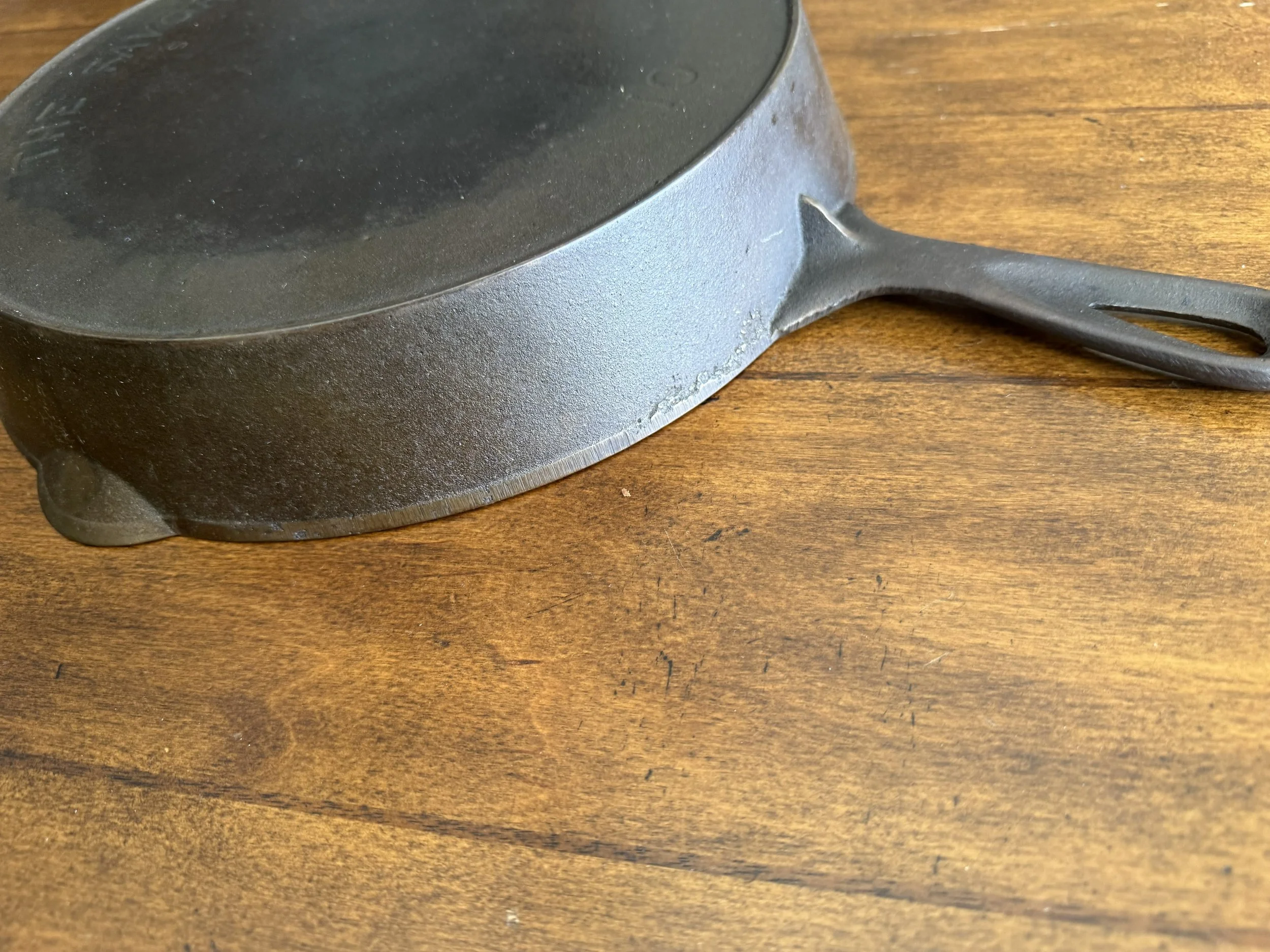
Profile view showing the substantial sidewall depth of the No. 10, the smooth base with raised outer rim foot, and the bilateral sprue flanges at the handle junction. The No. 10 marks the entry point into large-format Columbus Hollow Ware production.
The No. 10 in Context: Entry Point to Large-Format Cast Iron
At every major American foundry of the late 19th and early 20th centuries, the No. 10 represented a meaningful production decision. It was the smallest size that most foundry managers would have classified as a large-format skillet—a piece requiring more iron, more mold capacity, more careful handling during casting and finishing, and more robust packaging and shipping than the mid-range sizes. The economics of producing a No. 10 were different from the economics of producing a No. 8: higher material cost, lower volume, smaller market, and a customer base that was making a deliberate choice to invest in a large-capacity cooking tool rather than simply purchasing the most common size.
For Columbus Hollow Ware, the decision to produce through the No. 12—at least—indicates a genuine ambition to serve the full spectrum of domestic and semi-commercial cooking needs in its central Ohio market. A foundry serving only household cooks could have stopped at the No. 9 or No. 10 and met the needs of most of its customers. The presence of No. 11 and No. 12 production in the surviving material record suggests that Columbus Hollow Ware was also supplying boarding houses, institutional kitchens, farm operations with large hired workforces, and the other large-scale food preparation contexts that characterized central Ohio in the 1880s and 1890s. The No. 10 is the gateway to that part of the foundry’s business.
In the SSC collection, the No. 10 plays a specific narrative role: it is the piece that connects the domestic cooking story of the No. 8 and No. 9 to the large-scale provisioning story of the No. 11 and No. 12. Website visitors who follow the CHW collection in size order will encounter the No. 10 as the moment when the scale of production ambition becomes physically evident. Placed alongside its set companions, the No. 10 demonstrates the full span of what this twenty-year prison foundry was capable of producing—from the everyday kitchen pan to the large-scale cooking vessel that only a serious operation would need.
Physical Characteristics & Condition Assessment
The No. 10 is a substantial pan in every dimension. The cooking bowl is wide and deep, with a generous cooking surface and meaningful sidewall height that gives the piece real capacity for braising, deep frying, or large-batch rendering. Two opposing pour spouts interrupt the rim at the 3 o’clock and 9 o’clock positions. The base is smooth—no heat ring—consistent with the other pieces in this set. The raised outer rim foot provides stable contact with a flat cooking surface or display surface.
The handle is long and flat, terminating in a teardrop hanging loop, with bilateral sprue flanges at the body junction. The overall proportions are scaled up from the mid-range sizes but follow the same design language as the No. 8 and No. 9: a pan that could be managed with one hand on the handle but would benefit from a second point of contact for the larger movements required by a vessel of this capacity. The interior of this specimen shows the characteristic concentric ring pattern visible in the top view photograph—a beautiful record of foundry finishing work on the cooking surface, suggesting this piece received deliberate attention to the interior finish during production.
Condition is assessed as Good. The “THE FAVORITE” logo is legible and the “S” mark is clearly present and readable, providing clean documentation for the marking pattern research. The size numeral “10” reads clearly near the handle junction. The piece sits flat with no warping or wobble. No cracks, cold shuts, or structural repairs are present. The cooking surface shows visible use wear and seasoning variation consistent with genuine working life—this pan cooked real meals for real people over its working history, and the surface carries that record honestly. No active rust. Display ready.

Top view showing the wide cooking surface with visible finishing marks, dual pour spouts at opposing rim positions, and the generous interior depth that makes the No. 10 the entry point into Columbus Hollow Ware’s large-format production range.
The Company: Columbus Hollow Ware Co.
The Columbus Hollow Ware Company was founded in 1882 in Columbus, Franklin County, Ohio by Jesse F. Hatcher and E.B. Hatcher, who acquired an existing foundry from iron merchant John Harker. The “THE FAVORITE” brand predated the Hatcher era—surviving Harker-marked pieces establish the commercial identity’s earlier origins—and the Hatchers continued and expanded it through the company’s twenty-year operating history. The foundry’s documented relationship with the Ohio State Penitentiary—under which inmates were employed in foundry work and permitted to apply wages toward commissary purchases—is the feature of the company’s history most commonly cited in collector references, though the precise scope and timeline of prison involvement in “THE FAVORITE” marked production remains a subject of ongoing research. Columbus Hollow Ware ceased operations in 1902, leaving the iron as the only surviving record.
Collector’s Context
The No. 10 occupies an interesting position in the CHW collecting hierarchy. It is less commonly encountered than the No. 8 and No. 9—lower original production volume, greater physical demands on long-term survival—but it is not as dramatically scarce as the No. 11 and No. 12, which represent the extreme end of the size run. For a collector building a comprehensive CHW size documentation, the No. 10 is a meaningful acquisition: present enough to be findable with patience, scarce enough to represent a real accomplishment when found in sound condition.
Within the SSC five-piece set, the No. 10 is the piece that carries the greatest documentary weight relative to its position in the collection. The “S” mark reappearance after the No. 9 gap, the concentric finishing marks visible in the interior, and the clean condition of the base markings all make this a specimen that rewards close examination. At $318.40 allocated from the set total, it was acquired at efficient per-piece pricing that reflects the value of matched-set provenance—a No. 10 in comparable condition acquired as a standalone piece would likely command a similar or higher price on the secondary market.
Provenance & Acquisition
This No. 10 skillet was acquired on February 11, 2026, via eBay from seller 4260doug, under eBay item number 267517037106 (order 06-14230-47800). The listing offered a five-piece matched set described as “The Favorite Columbus Hollow Ware Cast Iron Skillet Set 8 9 10 11 12 Holloware.” The set was purchased at $1,400.00 plus $67.61 UPS Ground shipping and $124.38 in sales tax, for a total acquisition cost of $1,591.99. Cost is allocated at $318.40 per piece for individual catalog records.
Physical examination on receipt confirmed: no cracks, no chips, no active rust, flat base with no warping or wobble, legible markings including the clearly visible “S” mark, and a cooking surface with well-established seasoning and honest use wear. The “S” reappearance on the No. 10—documented here for the first time in SSC’s catalog records—was noted on receipt alongside its absence on the No. 9, establishing the comparative dataset that makes this set uniquely valuable for marking pattern research.
Corporate Timeline: Columbus Hollow Ware Co.
1870s
John Harker operates a Columbus foundry producing cast iron under an early “The Favorite” mark. Surviving Harker-stamped pieces document the brand’s pre-Hatcher origins.
1882
Jesse F. Hatcher and E.B. Hatcher purchase the Harker foundry and formally establish Columbus Hollow Ware Company in Columbus, Franklin County, Ohio. Full size run including large-format pieces enters production.
1882–86
Early in-house production period. The “THE FAVORITE” brand and its marking conventions—including the subsidiary “S” on certain sizes—are established during this period.
1886–87
Ohio labor reform legislation reshapes prison labor contracting in response to public opposition to goods manufactured by inmates competing with free-market labor.
c.1890s
Columbus Hollow Ware engages production arrangements with the Ohio State Penitentiary. Inmates employed in foundry work; wages applied toward commissary.
1902
Columbus Hollow Ware Company ceases operations. Production of “THE FAVORITE” brand cast iron ends permanently. No successor company.
2026
Steve’s Seasoned Classics acquires the five-piece matched set (Nos. 8–12). The No. 10 is documented as SSC-CHW-SKL-10-TF-001, with the “S” mark confirmed as the second size in the set to carry this marking.
Why This Piece Matters
The Columbus Hollow Ware No. 10 matters for two reasons that operate at different scales. At the individual piece level, it is a genuinely scarce survivor from a short-lived regional Ohio foundry—a large-format skillet in sound condition with clean markings that documents a size rarely encountered in collector circulation. At the collection level, it is the third data point in a marking pattern investigation that the SSC five-piece set makes possible for the first time in the documented collector literature. The “S” on the No. 8, its absence on the No. 9, and its reappearance here on the No. 10 constitute a pattern that demands explanation—and that explanation, when it is eventually found, will be a genuine contribution to the understanding of how Columbus Hollow Ware organized its production.
The interior finishing marks visible in the top view of this No. 10—concentric rings from the grinding or smoothing process applied to the cooking surface—are an additional documentary detail worth preserving. They are evidence of foundry craftsmanship: someone ran a tool across the interior of this pan before it left the foundry, working the surface to a condition suitable for the domestic market. That work happened more than 120 years ago, inside a prison in Columbus, Ohio, and the evidence of it is still visible in the iron today.
The iron endures. The markings tell the truth. The story deserves to be told.
Sources & Further Reading
CastIronCollector.com — Columbus Hollow Ware Co. reference page: operational dates, location, and brand name documentation.
BoonieHicks.com — “The Favorite, Vintage Cast Iron By The Columbus Hollow Ware Co.”: two-period theory and prison labor analysis.
WorthPoint.com — Historical auction records for Columbus Hollow Ware specimens including large-format size documentation.
CastIronCookwareCollectorsGuide.com — “The Columbus Hollow Ware Co., The Favorite”: photographic documentation and collector discussion.
BoonieHicks.com — “Guide to Favorite Piqua Ware”: reference for distinguishing CHW from Favorite Stove & Range productions.
About Steve’s Seasoned Classics
Steve’s Seasoned Classics is an online museum dedicated to preserving and documenting the heritage of American cast iron cookware, with a focus on Ohio foundry pieces from the 19th and early 20th centuries. The SSC collection features over 60 pieces with detailed provenance, historical research, and photography for each item.
