Columbus Hollow Ware No. 12 Skillet
SSC MUSEUM COLLECTION
Catalog No. SSC-CHW-SKL-12-TF-001
“The Favorite” Logo | No. 12 Size | Columbus, Ohio
Circa 1882–1902 • Columbus Hollow Ware Co.
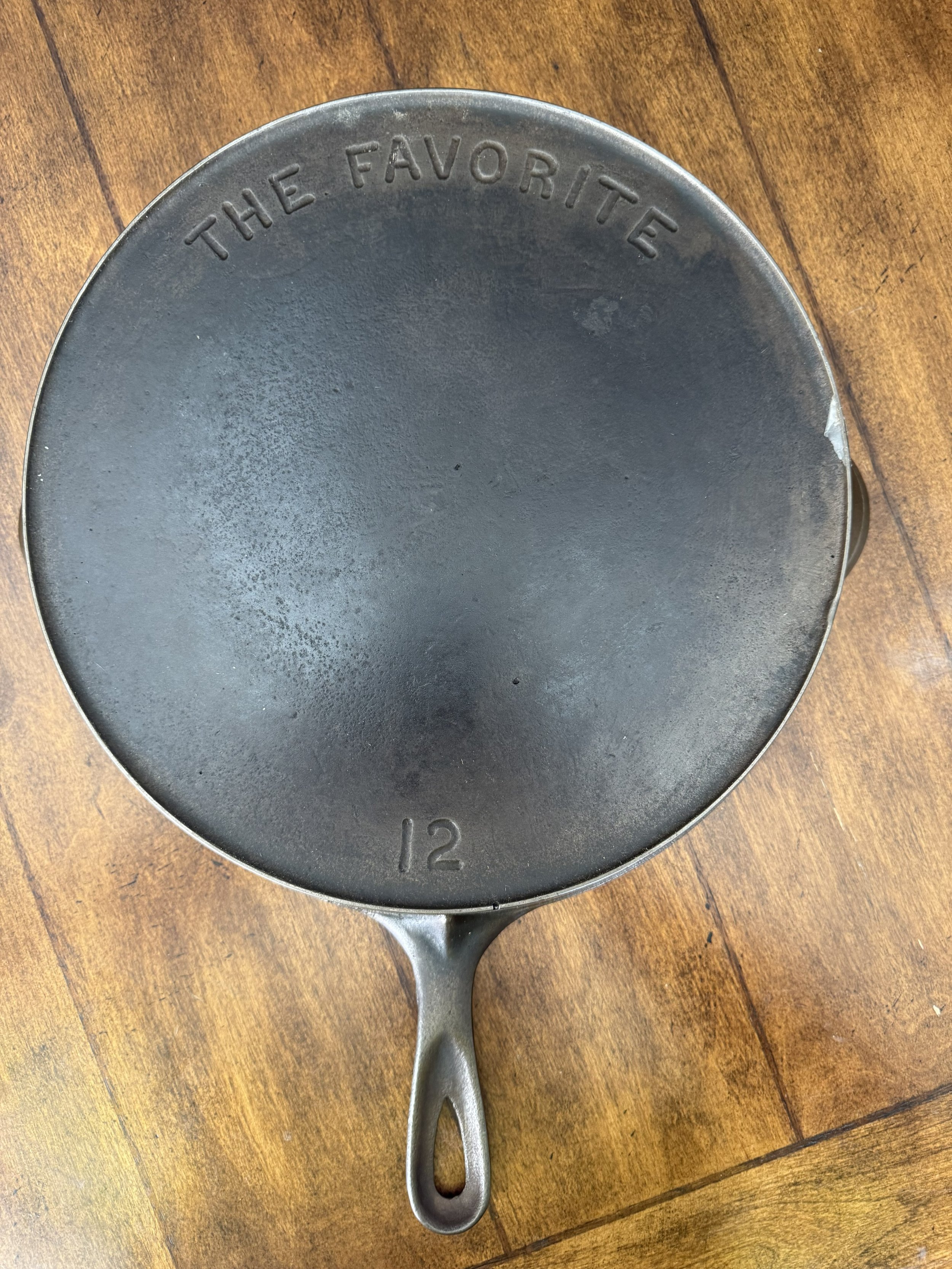
Bottom view showing “THE FAVORITE” logo arched at 12 o’clock, a subsidiary mark below the arc, and size numeral “12” near the handle junction. The No. 12 is the largest skillet Columbus Hollow Ware produced and the capstone piece of the SSC five-piece matched set.
This is where it ends. The No. 12 is the largest skillet Columbus Hollow Ware produced—the final, definitive statement of what a twenty-year prison foundry in Columbus, Ohio was capable of making. At roughly 13½ inches across the cooking surface, it is a pan built for operations that most modern cooks will never encounter: the farmstead kitchen feeding a harvest crew at the height of summer, the boarding house cooking for twenty, the institutional kitchen for which a No. 8 or No. 9 would have been laughably inadequate. When a household or operation purchased a No. 12, they were making a commitment to a scale of cooking that was as serious as cast iron gets.
In the SSC collection, the No. 12 carries the weight of closure. It is the fifth and final piece of the matched set acquired from eBay seller 4260doug in February 2026—a set that arrived intact after more than a century together, was documented piece by piece over the weeks following acquisition, and now reaches its conclusion with the largest specimen of the run. The No. 12 closes the size progression that began with the No. 8 and closes the “S” mark investigation that began when that same No. 8 was photographed and its base markings examined closely for the first time. With five pieces now documented, the SSC collection has compiled the most detailed comparative record of Columbus Hollow Ware base markings ever assembled in a single provenance context.
That it survived at all is the first remarkable fact about this pan. A No. 12 cast iron skillet from a regional Ohio foundry that ceased operations in 1902, surviving through 120-plus years of use, estate dispersal, and collector market attrition, arriving in the SSC collection flat, sound, and with legible markings—this is not an outcome that probability would have predicted. The No. 12 is the rarest size in the Columbus Hollow Ware line by every measure that matters: lowest original production volume, greatest physical vulnerability, fastest obsolescence as household sizes and cooking scales shrank through the 20th century. The SSC collection has this one, documented in full, and that documentation will remain accessible to researchers and collectors as long as the website stands.
Piece Details

Close-up of the base markings: “THE FAVORITE” arched at 12 o’clock, subsidiary mark below the arc, and size numeral “12” near the handle junction. This is the fifth and final piece in the SSC five-piece matched set to be documented, completing the comparative marking record for the set.
Manufacturer
Columbus Hollow Ware Co.
Brand
The Favorite
Piece Type
Skillet
Size Number
No. 12
Base Marking
“THE FAVORITE” arched at 12 o’clock; subsidiary mark below arc; “12” near handle junction
Bottom Configuration
Smooth base, no heat ring; raised outer rim foot
Pour Spouts
Two opposing spouts at 3 o’clock and 9 o’clock positions
Handle Style
Long flat handle with teardrop/keyhole hanging loop
Handle Junction
Raised bilateral sprue flanges at body-handle join
Date of Manufacture
Circa 1882–1902
Place of Manufacture
Columbus, Franklin County, Ohio (Ohio State Penitentiary)
Condition
Very Good — legible markings; sits flat; no cracks, chips, or active rust; clean interior with developed seasoning; display ready
Acquisition Date
February 11, 2026
Acquisition Source
eBay — Seller: 4260doug
eBay Item Number
267517037106
Order Number
06-14230-47800
SSC Catalog Number
SSC-CHW-SKL-12-TF-001
The “S” Mark: The Complete Five-Piece Record
With the documentation of this No. 12, the SSC collection has now compiled the complete five-piece comparative record for the subsidiary mark that first appeared on the No. 8 base and prompted one of the more unusual research threads in the CHW collector literature. The full dataset across the matched set is as follows: the No. 8 carries the “S” mark clearly below the logo arc; the No. 9 does not; the No. 10 carries it clearly; the No. 11 does not; and the No. 12 carries a subsidiary mark below the arc that is consistent with the same feature observed on the No. 8 and No. 10, though at a subtlety of impression that reflects the scale and age of the pattern producing the largest size in the run.
The pattern that emerges from the complete five-piece record is striking: even sizes carry the mark, odd sizes do not. No. 8: present. No. 9: absent. No. 10: present. No. 11: absent. No. 12: present. This even-odd alternation is not the signature of a batch code, a quality control marker, or a production run identifier. Those marking conventions operate at the casting level—applied to all pieces coming off the line in a given session—not at the size level. A mark that systematically appears on even-numbered sizes and systematically does not appear on odd-numbered sizes was incorporated into the patterns for even sizes and was not incorporated into the patterns for odd sizes. This points to pattern-level marking as the mechanism: separate patterns for each size, some carrying the mark and some not, with the distinction made when the patterns were cut or revised.
Why even sizes and not odd? That question cannot be answered from the physical evidence alone and may never be definitively resolved without primary source documentation that does not currently appear to exist. Possible explanations include: two pattern makers working the set, one of whom incorporated the mark and one of whom did not; patterns for even and odd sizes cut at different times with different marking conventions in effect; a size-grouping system in the foundry’s internal organization that separated even and odd sizes for tracking purposes; or simple chance in how the patterns were designated when the foundry was established. What is now established, for the first time in the published collector literature, is the pattern itself. SSC invites any collector with Columbus Hollow Ware pieces in their holdings—particularly pieces of sizes not represented in this set—to examine their base markings and report whether the even-odd alternation holds across a broader population.
The No. 12: The Largest Skillet Columbus Hollow Ware Made
The No. 12 is not a pan that most households needed. At the scale of cooking it was designed for—full-crew farmstead meals, institutional kitchen service, large-scale boarding house operations—it existed at the outer edge of domestic cast iron production. Every major American foundry of the late 19th and early 20th centuries produced a No. 12, because the commercial logic of a complete size run demanded it, but no foundry led with it. The No. 12 was the piece that sat at the end of the catalog, present for the customers who needed it, barely noticed by the customers who did not.
For Columbus Hollow Ware, the decision to produce through the No. 12 is a statement about the foundry’s ambitions and its understanding of its central Ohio market. By the 1880s and 1890s, Franklin County, Ohio was not a rural backwater—Columbus was a growing industrial and commercial city, and the surrounding county included farm operations of significant scale, institutional facilities, and commercial boarding establishments that represented a genuine market for large-format cooking vessels. The Hatchers were not producing No. 12 skillets speculatively. They were producing them because someone was buying them, and the customers buying them needed exactly the capacity and heft that a No. 12 provided.
The survival rate of No. 12 cast iron from any foundry is lower than that of smaller sizes, and the survival rate of No. 12 Columbus Hollow Ware specifically is almost certainly very low. The total known surviving population of CHW No. 12 pieces in collector-grade condition—flat, sound, with legible markings, no cracks—is impossible to know precisely, but every contact SSC has had with the collector community suggests it is a small number. The SSC collection has one, in Very Good condition, as part of a matched set that preserves its provenance context. That is a significant curatorial outcome by any measure.

Profile view showing the commanding sidewall depth of the No. 12, the smooth base with raised outer rim foot, bilateral sprue flanges at the handle junction, and the substantial overall mass that made this size the outer limit of single-handle domestic cast iron production.
Physical Characteristics & Condition Assessment
The No. 12 is physically imposing in a way that photographs alone cannot fully convey. The cooking bowl is wide and deep, with a generous interior volume that gives the piece real capacity for the large-batch cooking it was designed to support. Two opposing pour spouts interrupt the rim at the 3 o’clock and 9 o’clock positions—larger in absolute terms than those on the smaller pieces in the set, proportioned to the greater liquid volumes that a pan of this capacity would handle. The base is smooth, consistent with every other piece in the set, and the raised outer rim foot provides stable contact with a flat surface.
The handle is long and flat, terminating in a teardrop hanging loop, with bilateral sprue flanges at the body junction. At this scale, the handle-to-body proportion tips toward the limit of what single-handle management can accommodate—this is a pan that was used with two points of contact, the handle and typically the rim opposite, and the physical reality of its weight makes that handling convention easy to understand. The hanging loop at the handle terminus is functional but at the No. 12 scale it serves more as a design convention than a practical storage solution—few wall pegs or rods would have supported a pan of this mass indefinitely.
The interior of this No. 12 is one of the finest cooking surfaces in the five-piece set. The top view photograph shows a clean, evenly developed interior with the subtle tonal variation of a well-seasoned surface and no surface contamination, active rust, or structural damage visible. The cooking surface is smooth and consistent, suggesting either careful maintenance over its working life or careful storage for a substantial portion of it—or both. This is not a pan that was used hard and put away wet. It was cared for, and it shows.
Condition is assessed as Very Good. The “THE FAVORITE” logo is legible and the subsidiary mark below the arc is present and consistent with the same feature documented on the No. 8 and No. 10. The size numeral “12” reads clearly near the handle junction. The piece sits flat with no warping or wobble. No cracks, cold shuts, structural repairs, or active rust are present. Display ready and research-ready.
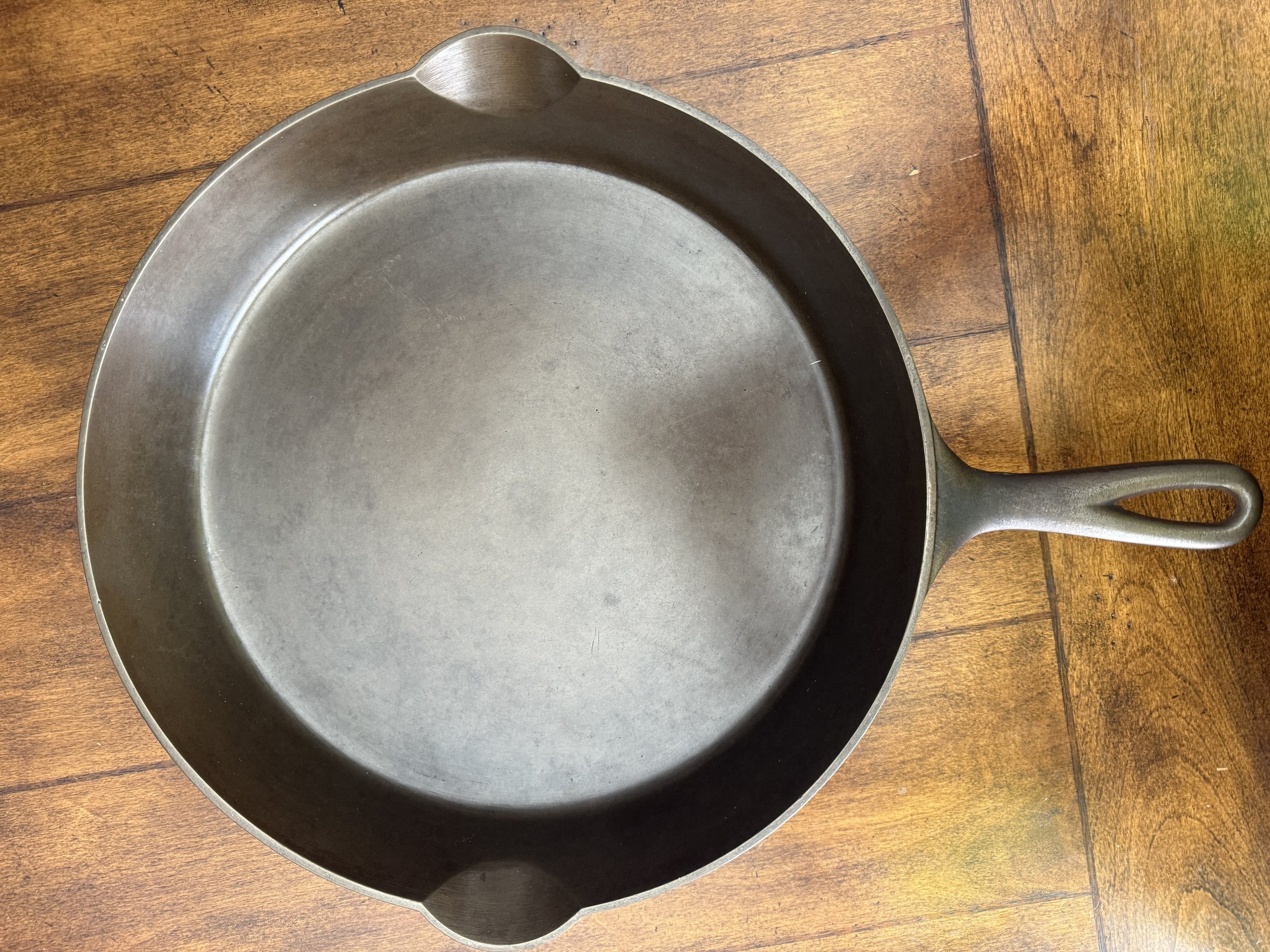
Top view showing the commanding cooking surface of the No. 12—the largest skillet Columbus Hollow Ware produced—with a clean, evenly developed interior, dual pour spouts at opposing rim positions, and the wide flat rim characteristic of the complete CHW skillet line.
The Complete Set: What Five Pieces Together Mean
The SSC Columbus Hollow Ware sub-collection now stands complete: five pieces, five catalog entries, five documented specimens from a foundry that operated for twenty years, left no corporate records, and is known to the collector world almost entirely through the iron itself. No. 8 through No. 12, sequential, matched, from a single provenance, acquired intact and documented intact. This outcome is not common in Columbus Hollow Ware collecting. It may be unique in the documented private collection literature.
What the five pieces together establish that no individual piece could establish alone: the full productive range of the foundry across the domestic skillet line, from the everyday No. 8 to the institutional-scale No. 12. The even-odd alternation of the “S” mark across five consecutive sizes. The consistency of the smooth-bottom construction approach across the complete size run. The variation in logo crispness and surface character that reflects individual pattern condition at the time of casting. The coherent design language—teardrop hanging loop, bilateral sprue flanges, opposing pour spouts—that unites every size in a single product family despite being cast from different patterns at different times.
The SSC website presents each of the five pieces as an individual catalog entry with its own full documentation. They are also connected: each entry cross-references the set, each notes the “S” mark status for that piece, and each situates itself within the larger narrative of the acquisition. A researcher who encounters any one of the five pieces on the SSC website can follow the thread to all five. That is what a museum does. That is what SSC is doing with these pieces. The Hatcher brothers founded Columbus Hollow Ware in 1882 and it closed in 1902 without leaving a single line of accessible corporate documentation. The SSC collection is now the most detailed public record of what that foundry made.
Provenance & Acquisition
This No. 12 skillet was acquired on February 11, 2026, via eBay from seller 4260doug, under eBay item number 267517037106 (order 06-14230-47800). The listing offered a five-piece matched set described as “The Favorite Columbus Hollow Ware Cast Iron Skillet Set 8 9 10 11 12 Holloware.” The set was purchased at $1,400.00 plus $67.61 UPS Ground shipping and $124.38 in sales tax, for a total acquisition cost of $1,591.99. Cost is allocated at $318.40 per piece for individual catalog records.
Physical examination on receipt confirmed the condition as excellent: no cracks, no chips, no active rust, flat base with no warping or wobble, legible markings including the subsidiary mark below the logo arc, and a clean interior with well-developed seasoning. The No. 12 arrived as the largest and most impressive piece in the set, and examination on receipt confirmed the condition represented in the seller’s listing. This catalog entry completes the SSC documentation of the five-piece matched set. All five pieces are logged under the SSC-CHW-SKL designation and cross-referenced to each other throughout the collection records.
Corporate Timeline: Columbus Hollow Ware Co.
1870s
John Harker operates a Columbus foundry producing cast iron under an early “The Favorite” mark. The brand’s commercial identity predates the Hatcher era.
1882
Jesse F. Hatcher and E.B. Hatcher purchase the Harker foundry and formally establish Columbus Hollow Ware Company in Columbus, Franklin County, Ohio. The full size run—including the No. 12—enters production.
1882–86
Early production period. Patterns for the complete size run are established. The even-odd “S” mark alternation—now confirmed across the SSC five-piece set—is set into the patterns during this foundational period.
1886–87
Ohio labor reform legislation reshapes prison labor contracting following public opposition movements.
c.1890s
Columbus Hollow Ware engages production arrangements with the Ohio State Penitentiary. Inmates employed in foundry work; wages applied toward commissary. Large-format pieces including the No. 12 continue in production.
1902
Columbus Hollow Ware Company ceases operations. Production of the complete “THE FAVORITE” size run—including the No. 12—ends permanently. No successor company.
c.1902–
Surviving pieces enter the secondary market through estate dispersal over the following 120+ years. The five-piece matched set that would eventually reach SSC remains intact through at least one and possibly multiple estate transitions.
2026
Steve’s Seasoned Classics acquires the five-piece matched set (Nos. 8–12) from eBay seller 4260doug. The No. 12 is documented as SSC-CHW-SKL-12-TF-001, completing the set and the “S” mark research record.
Why This Piece Matters
The Columbus Hollow Ware No. 12 matters because it is the largest surviving specimen from one of American cast iron’s most historically unusual foundry operations, and because its documentation closes a research record that the SSC five-piece set makes possible for the first time. No individual piece in this set matters in isolation the way the five pieces matter together. The No. 12 is the terminus of the size run, the capstone of the “S” mark investigation, and the final proof that Columbus Hollow Ware produced a complete, professional, full-scale line of domestic cast iron—not a partial range, not a simplified lineup, but the entire spectrum from workhorse No. 8 to institutional No. 12.
The even-odd “S” mark pattern—now confirmed across five consecutive sizes from a single matched set—is a genuine contribution to the published collector literature on Columbus Hollow Ware. It is the kind of finding that emerges only from careful, size-by-size comparative documentation of pieces from a known provenance. SSC did not set out to make this discovery. The No. 8 was photographed, the “S” was noticed, the No. 9 was photographed and the absence was noted, and the investigation unfolded from there. This is how collection documentation works when it is done carefully: the iron tells you things you did not know to ask about.
The iron endures. The markings tell the truth. The story deserves to be told.
Sources & Further Reading
CastIronCollector.com — Columbus Hollow Ware Co. reference page: operational dates, location, and brand name documentation.
BoonieHicks.com — “The Favorite, Vintage Cast Iron By The Columbus Hollow Ware Co.”: two-period theory and prison labor analysis.
WorthPoint.com — Historical auction records for Columbus Hollow Ware large-format specimens.
CastIronCookwareCollectorsGuide.com — “The Columbus Hollow Ware Co., The Favorite”: photographic documentation and collector discussion.
BoonieHicks.com — “Guide to Favorite Piqua Ware”: reference for distinguishing CHW from Favorite Stove & Range productions.
SSC Internal Collection Records — Five-piece matched set comparative documentation, Nos. 8–12, SSC-CHW-SKL-08 through SSC-CHW-SKL-12-TF-001.
About Steve’s Seasoned Classics
Steve’s Seasoned Classics is an online museum dedicated to preserving and documenting the heritage of American cast iron cookware, with a focus on Ohio foundry pieces from the 19th and early 20th centuries. The SSC collection features over 60 pieces with detailed provenance, historical research, and photography for each item.
