Columbus Hollow Ware Three-Legged Cauldron Kettle
SSC MUSEUM COLLECTION
Catalog No. SSC-CHW-POT-RM-TF-001
“The Favorite” Logo | Cauldron Kettle Form | Columbus, Ohio
Circa 1882–1902 • Columbus Hollow Ware Co.

Base exterior of the cauldron showing “THE FAVORITE” arched across the lower dome, a diamond-shaped raised mark at center, a small circular mark above it, and one of the three cast iron leg feet visible at top. These base markings are cast directly into the rounded bottom of the vessel.
The skillet is what most people picture when they think of Columbus Hollow Ware. It is the piece that surfaces most often in collector markets, the piece that anchors the SSC CHW sub-collection, and the piece that carries the “THE FAVORITE” mark in the configuration—arched over a smooth base—that experienced collectors have learned to recognize. But Columbus Hollow Ware was not a single-product foundry. It was a hollow ware manufacturer, and the word “hollow ware” describes exactly what it made: the full range of hollow, handled, and open cooking vessels that 19th-century American domestic life required. Cauldrons. Kettles. Pots. The skillet was part of the line, not the entirety of it.
This three-legged cauldron kettle—with its domed rounded base, three cast iron leg feet, and iron wire bail handle—is the first non-skillet Columbus Hollow Ware piece to enter the SSC collection, and its arrival changes the character of what SSC’s CHW documentation can say about the foundry. A collection of five skillets, however well-documented, tells only the flat-cooking story of a foundry that made a great deal more than flat-cooking vessels. This cauldron tells the open-fire boiling story: the vessel for rendering lard, for apple butter over a wood fire, for soap-making, for the kind of sustained large-volume heat work that belonged at the hearth rather than on the stovetop.
The cauldron form is one of the oldest cooking vessel designs in human history, and its presence in a Columbus Hollow Ware production context places this piece within a very long tradition of iron foundry work. The three cast leg feet that raise the vessel above the fire, the domed base that distributes heat efficiently across a rounded bottom, the wire bail that allows the vessel to be suspended from a crane or trammel—these are design elements refined over centuries of open-fire cooking and carried forward intact into the industrial cast iron era. That “THE FAVORITE” brand mark is cast into the base of this cauldron confirms that Columbus Hollow Ware treated its open-fire vessels with the same commercial seriousness as its stovetop skillets.
Piece Details

Detail of the base markings: “THE FAVORITE” arched across the lower dome exterior, raised diamond mark at center, small circular mark above it, and a leg foot visible at upper right. The arc of the brand follows the curve of the rounded base, consistent with the arched marking format used across the Columbus Hollow Ware skillet line.
Manufacturer
Columbus Hollow Ware Co.
Brand
The Favorite
Piece Type
Three-Legged Cauldron Kettle (open, no lid)
Base Configuration
Rounded/domed cauldron base; three cast iron leg feet for freestanding use over fire or coals
Leg Feet
Three cast iron legs in tripod configuration; allow vessel to stand directly over open flame or coals without trivet
Bail Handle
Iron wire bail with cast iron ring mounts at opposing pot body positions; for suspension from crane, trammel, or carrying
Base Markings
“THE FAVORITE” arched on dome base exterior; raised diamond mark at center; small circular mark; no size numeral identified
Lid
None — open vessel; no lid present or accounted for
Date of Manufacture
Circa 1882–1902
Place of Manufacture
Columbus, Franklin County, Ohio (Ohio State Penitentiary)
Condition
Good to Very Good — vessel body sound; three legs intact; bail intact and functional; base markings legible; interior clean with developed seasoning; surface patina consistent with age
Acquisition Date
November 28, 2025
Acquisition Source
eBay — Seller: chpal6805
eBay Item Number
177309764387
Order Number
21-13879-97852
SSC Catalog Number
SSC-CHW-POT-RM-TF-001
The Three-Legged Cauldron: Form, Function, and Open-Fire Cooking
The three-legged cauldron is one of the foundational forms of cast iron hollow ware—a vessel designed specifically for open-fire use, where the three cast leg feet raise the body above the coals or flame and allow air circulation beneath the vessel for even heating. Unlike stovetop pots and skillets, which require a flat surface and a flat base to function properly, the cauldron’s rounded base and leg feet made it independent of any cooking surface. It could be set directly into coals, placed over a wood fire on bare ground, or suspended from an iron crane or trammel arm—three configurations that covered virtually every open-fire cooking context encountered in 19th-century American domestic and farmstead life.
The three-leg tripod configuration is not arbitrary. Three points define a plane, meaning a three-legged vessel sits stably on any surface—level or not—without wobbling. Four legs can rock if the surface is uneven; three legs cannot. For a vessel used over an outdoor fire, on uneven hearth stones, or on a packed-earth kitchen floor, this stability was a practical requirement rather than an aesthetic preference. The tripod geometry also distributes the vessel’s weight and heat load evenly across the three contact points, reducing the risk of cracking from uneven thermal stress during rapid heating over an open fire.
The iron wire bail suspended from cast iron ring mounts at opposing positions on the vessel body is the primary carrying and hanging mechanism. In use, the bail allowed the cauldron to be hung from a crane arm or trammel hook over a hearth fire, raising or lowering the vessel to control heat without moving the fire itself. Off the fire, the bail allowed the heavy vessel—full of rendered lard, boiling apple butter, or scalding soap—to be lifted and moved without requiring a grip on the hot body. The bail is both a suspension device and a safety feature, and its presence on this cauldron confirms that the piece was designed for the full range of open-fire large-batch cooking tasks that characterized American farmstead kitchens of the late 19th century.
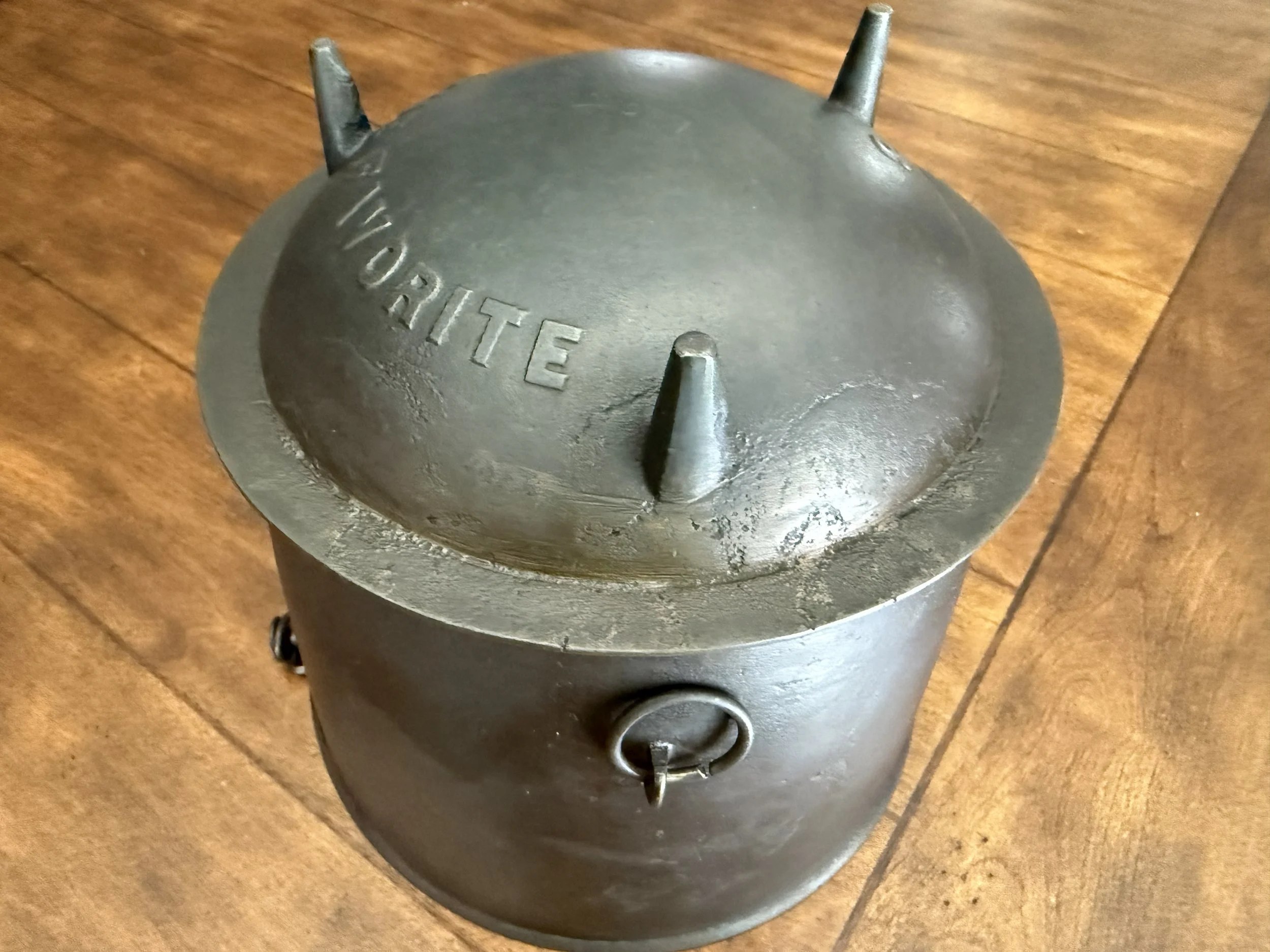
Side view showing the full cauldron profile: rounded domed base with three cast iron leg feet, cylindrical sidewall, wire bail with ring mounts at opposing positions, and the open rim of the vessel. The “VORITE” portion of the “THE FAVORITE” base arc is visible at lower left.
The Base Markings: “THE FAVORITE” on the Cauldron Dome
The decision to cast “THE FAVORITE” into the exterior of the cauldron’s domed base follows the same marking logic applied to the Columbus Hollow Ware skillet line. On a skillet, the base marking is positioned on the bottom exterior—the surface visible when the pan is stored bottom-up or examined by a buyer. On a cauldron with a rounded base, the equivalent surface is the dome of the base exterior, and the arc of the brand phrase follows the curve of that dome in the same way that the skillet mark follows the curve of the pan base. The four-word brand phrase in all capitals—“THE FAVORITE”—is the complete commercial identity of Columbus Hollow Ware, and its presence on this cauldron confirms that the foundry applied consistent brand marking across its full product range, not just the flat-cooking pieces.
The additional marks on the base—a raised diamond shape at center and a small circular mark above it—do not correspond to any marking convention documented in the published CHW collector literature known to SSC at the time of acquisition. They are not size numerals in the conventional sense, and their positioning relative to the brand arc is consistent with pattern-level marks rather than hand-applied stamps. Possible interpretations include mold series identifiers, pattern revision marks, or foundry quality control codes. These marks are documented here as observed; their precise meaning remains an open research question and joins the “S” mark investigation from the five-piece skillet set as an active item in SSC’s Columbus Hollow Ware documentation agenda.
The condition of the base markings reflects the piece’s overall history: legible and readable in good photographic light, carrying the honest patina of genuine age without surface damage that would compromise identification. The arc configuration of “THE FAVORITE” is consistent with the same mark documented across the SSC skillet collection. This cross-form consistency—the same four-word brand phrase in the same all-capitals arched format appearing on both skillets and an open-fire cauldron—confirms that the Columbus Hollow Ware marking system was foundry-wide, applied across product categories regardless of vessel type.
Columbus Hollow Ware Beyond the Skillet: Expanding the SSC Documentation
The five-piece matched skillet set (Nos. 8 through 12) that anchors the SSC Columbus Hollow Ware sub-collection established the foundry’s flat-cooking range with a completeness and provenance integrity that is rare in CHW collecting. This cauldron kettle extends the SSC documentation into the open-fire and large-batch cooking half of the Columbus Hollow Ware product line—the vessels that complemented the skillets in every well-equipped 19th-century kitchen and that represent an equally important dimension of what the Hatcher brothers’ foundry made.
Hollow ware manufacturers of the 1880s and 1890s competed on the completeness of their product lines as much as on the quality of individual pieces. A foundry that could supply a household’s entire cast iron cooking outfit—skillets, griddles, Dutch ovens, pots, and cauldrons—was a more valuable supplier than one that offered only part of the range. Columbus Hollow Ware’s production of both flat-cooking skillets and open-fire cauldron kettles is consistent with that competitive reality, even though no CHW catalog has surfaced to confirm the full product range in documented form. The iron itself provides the evidence.
The SSC museum’s acquisition of this cauldron is part of a deliberate strategy to document Columbus Hollow Ware as a complete hollow ware operation rather than a skillet-only curiosity. Future acquisitions of CHW Dutch ovens, griddles, or other non-skillet forms—if they surface in collector markets—will be pursued and documented on the same template. The goal is a CHW sub-collection that represents the breadth of what the foundry made, not just the depth of its most commonly surviving product category.
Physical Characteristics & Condition Assessment
The cauldron body is cylindrical with a straight sidewall rising from the domed rounded base to a wide open rim. The three cast iron leg feet are evenly spaced in a tripod configuration at the base of the vessel, each cast integrally with the body—not attached separately—and each providing a stable contact point for freestanding use over fire, coals, or a hearth surface. The legs are intact on all three positions with no cracking, bending, or loss.
The iron wire bail is intact and functional, seated in the cast iron ring mounts at opposing positions on the vessel body. The bail moves freely in its mounts, indicating the piece has been maintained or stored in conditions that did not subject the bail mechanism to sustained moisture exposure or corrosion freeze. The bail ring mounts are cast into the upper sidewall of the body and show no cracking or deformation at the junction points—a common failure mode in heavily used bail-handle vessels that this piece has avoided.
The interior is deep and open, as seen in the top view photograph: a clean, well-developed surface with the characteristic tonal depth of a genuinely seasoned cast iron interior. No pitting, active rust, or structural damage is visible in the interior. The open rim is even and consistent around its circumference with no chips or cracks. Condition is assessed as Good to Very Good. The vessel is structurally sound, the legs are intact, the bail is functional, the base markings are legible, and the interior is clean. Some surface patina and age-consistent tonal variation are present on the exterior and are appropriate to a piece of this age and use history. Display ready.
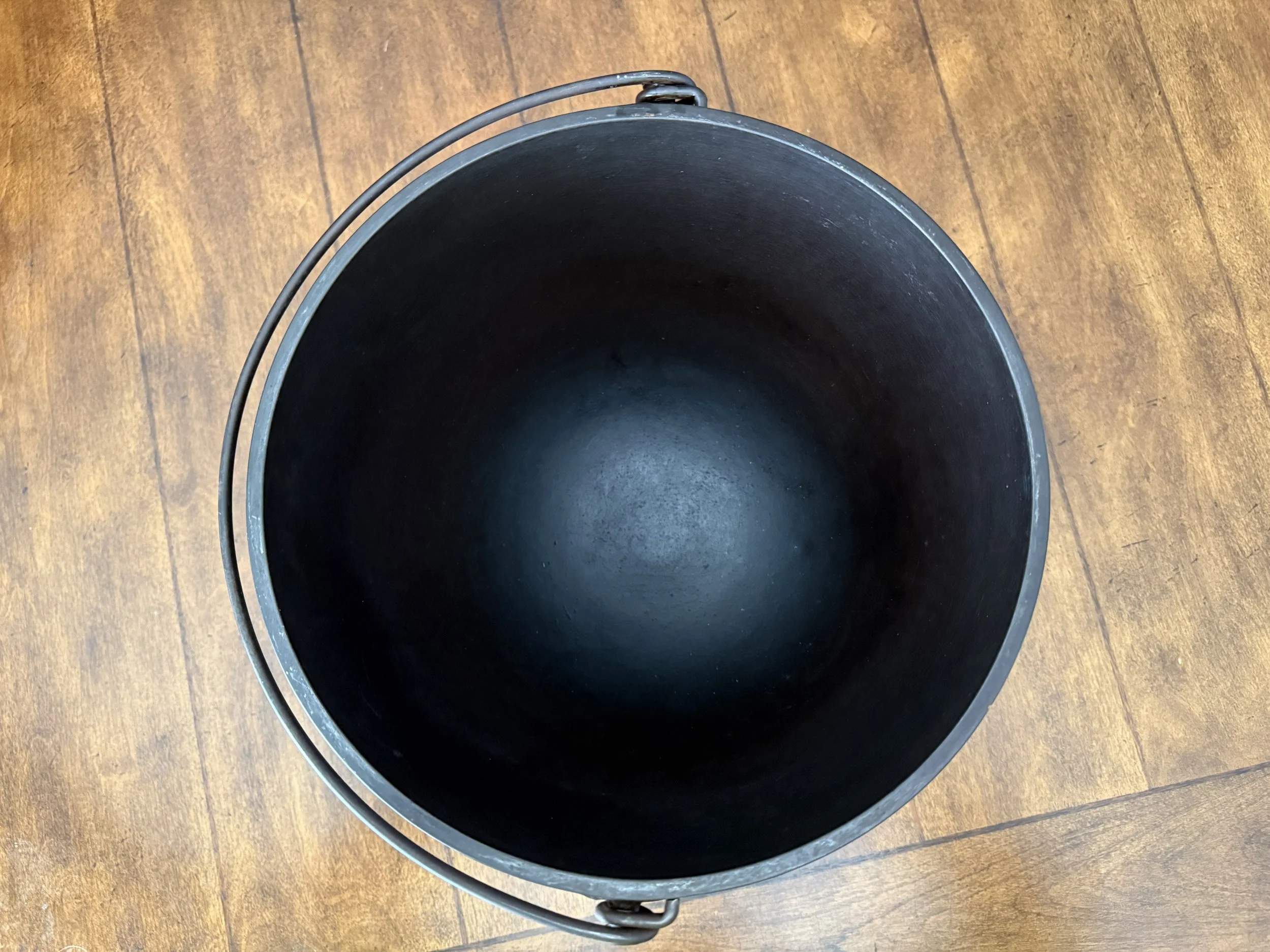
Top view showing the deep, open interior of the cauldron with a clean, well-developed seasoning and no active rust or structural damage. The iron wire bail and its ring mounts are visible at opposing positions on the rim. The generous interior capacity confirms this vessel’s design for large-batch rendering, boiling, and open-fire cooking operations.
The Company: Columbus Hollow Ware Co.
The Columbus Hollow Ware Company was founded in 1882 in Columbus, Franklin County, Ohio by Jesse F. Hatcher and E.B. Hatcher, who acquired an existing foundry from iron merchant John Harker. The “THE FAVORITE” brand predated the Hatcher era—surviving Harker-marked pieces document the brand’s earlier origins—and the Hatchers continued and expanded it through the company’s twenty-year operating history. The foundry’s documented relationship with the Ohio State Penitentiary, under which inmates were employed in foundry work and permitted to apply wages toward commissary, gave Columbus Hollow Ware its most distinctive historical character and its place in the broader narrative of 19th-century American prison labor reform. The company ceased operations in 1902, leaving no surviving corporate records. The iron is all that remains—and this pot kettle, like every piece of “THE FAVORITE” marked cast iron still in existence, is a primary source artifact of Ohio industrial history.
Collector’s Context
Columbus Hollow Ware non-skillet pieces are significantly rarer in collector markets than the skillet forms. This is a function of both original production distribution and survival rates: skillets were produced in higher volume, were used more frequently, and were more likely to be retained through estate transitions because their function remained obvious and relevant to later generations. Pots and kettles, by contrast, became obsolete more rapidly as kitchen technology changed—the open-fire and wood-stove cooking contexts for which a rimmed pot kettle was designed became less common through the early 20th century, and pieces that no longer served a clear purpose were more often discarded or melted.
Columbus Hollow Ware non-skillet pieces are significantly rarer in collector markets than the skillet forms, and this open cauldron kettle2014structurally complete, with all three legs intact, the bail functional, and the base markings legible2014is a meaningful acquisition at any price. The 42.76 total cost reflects fair secondary market value for a sound, marked CHW vessel in honest working condition.
In the SSC collection, this piece serves as the anchor for what will become the non-skillet CHW documentation thread. It establishes that the foundry’s product range extended well beyond flat-cooking vessels, that the “THE FAVORITE” brand marking was applied consistently across product categories, and that the SSC curatorial mission extends to the full scope of Columbus Hollow Ware’s production—not just the pieces most commonly encountered in today’s collector market.
Provenance & Acquisition
This three-legged cauldron kettle was acquired on November 28, 2025, via eBay from seller chpal6805, under eBay item number 177309764387 (order 21-13879-97852). The eBay listing described the piece as 201cColumbus Hollow Ware THE FAVORITE Cast Iron Rimmed Pot Kettle.201d The acquisition cost was $115.00 for the item plus $16.61 USPS Ground Advantage shipping and $11.15 in sales tax, for a total of $142.76.
Physical examination on receipt confirmed the condition as represented: vessel body sound, all three legs intact, bail functional, base markings legible. The diamond-shaped raised mark and small circular mark on the base exterior were noted on receipt as undocumented details requiring further research2014they do not correspond to any marking convention documented in the published CHW collector literature known to SSC at the time of acquisition. This piece was accessioned as the first non-skillet Columbus Hollow Ware entry and cataloged as SSC-CHW-POT-RM-TF-001.
Corporate Timeline: Columbus Hollow Ware Co.
1870s
John Harker operates a Columbus foundry producing cast iron under an early “The Favorite” mark. Hollow ware—including covered pots and kettles—is part of the product line from its earliest documented period.
1882
Jesse F. Hatcher and E.B. Hatcher purchase the Harker foundry and formally establish Columbus Hollow Ware Company. The full hollow ware line, including both flat-cooking and covered-cooking forms, enters production.
1882201386
Early production period. Open-fire hollow ware2014cauldrons, kettles, and bail-handle pots2014is among the vessel types produced alongside the skillet line under the 201cTHE FAVORITE201d brand.
1886–87
Ohio labor reform legislation reshapes prison labor contracting in response to public opposition movements.
c.1890s
Columbus Hollow Ware engages production arrangements with the Ohio State Penitentiary. The complete hollow ware line continues in production.
1902
Columbus Hollow Ware Company ceases operations. Production of all “THE FAVORITE” branded hollow ware—skillets, pots, kettles, and other forms—ends permanently.
2025
Steve’s Seasoned Classics acquires this rimmed pot kettle from eBay seller chpal6805. It is documented as SSC-CHW-POT-RM-TF-001, the first non-skillet CHW piece in the SSC collection.
Why This Piece Matters
The Columbus Hollow Ware cauldron kettle matters because it expands the SSC documentary record beyond the skillet and into the open-fire cooking vessel range that was equally central to 19th-century domestic life. Five documented skillets establish what Columbus Hollow Ware made for stovetop frying and searing. This cauldron begins to establish what the foundry made for open-fire large-batch work2014the other dimension of the cast iron kitchen that every well-equipped American household of the era required.
The unresolved diamond and circular marks on the cauldron base add a new research question to the SSC Columbus Hollow Ware documentation agenda2014companion questions to the 201cS201d mark investigation that the five-piece skillet set generated. Their meaning cannot be determined from the physical evidence alone, and they are documented here as observed, awaiting whatever comparative material the collector community may eventually surface.
The iron endures. The markings tell the truth. The story deserves to be told.
Sources & Further Reading
CastIronCollector.com — Columbus Hollow Ware Co. reference page: operational dates, location, and brand name documentation.
BoonieHicks.com — “The Favorite, Vintage Cast Iron By The Columbus Hollow Ware Co.”: two-period theory, prison labor analysis, and hollow ware product range discussion.
WorthPoint.com — Historical auction records for Columbus Hollow Ware non-skillet hollow ware specimens.
CastIronCookwareCollectorsGuide.com — “The Columbus Hollow Ware Co., The Favorite”: photographic documentation and collector discussion.
SSC Internal Collection Records — Five-piece matched skillet set documentation, Nos. 8–12, SSC-CHW-SKL-08 through SSC-CHW-SKL-12-TF-001; “S” mark comparative research.
About Steve’s Seasoned Classics
Steve’s Seasoned Classics is an online museum dedicated to preserving and documenting the heritage of American cast iron cookware, with a focus on Ohio foundry pieces from the 19th and early 20th centuries. The SSC collection features over 60 pieces with detailed provenance, historical research, and photography for each item.
