Columbus Hollow Ware No. 8 Skillet
SSC MUSEUM COLLECTION
Catalog No. SSC-CHW-SKL-08-TF-001
“The Favorite” Logo | No. 8 Size | Columbus, Ohio
Circa 1882–1902 • Columbus Hollow Ware Co.
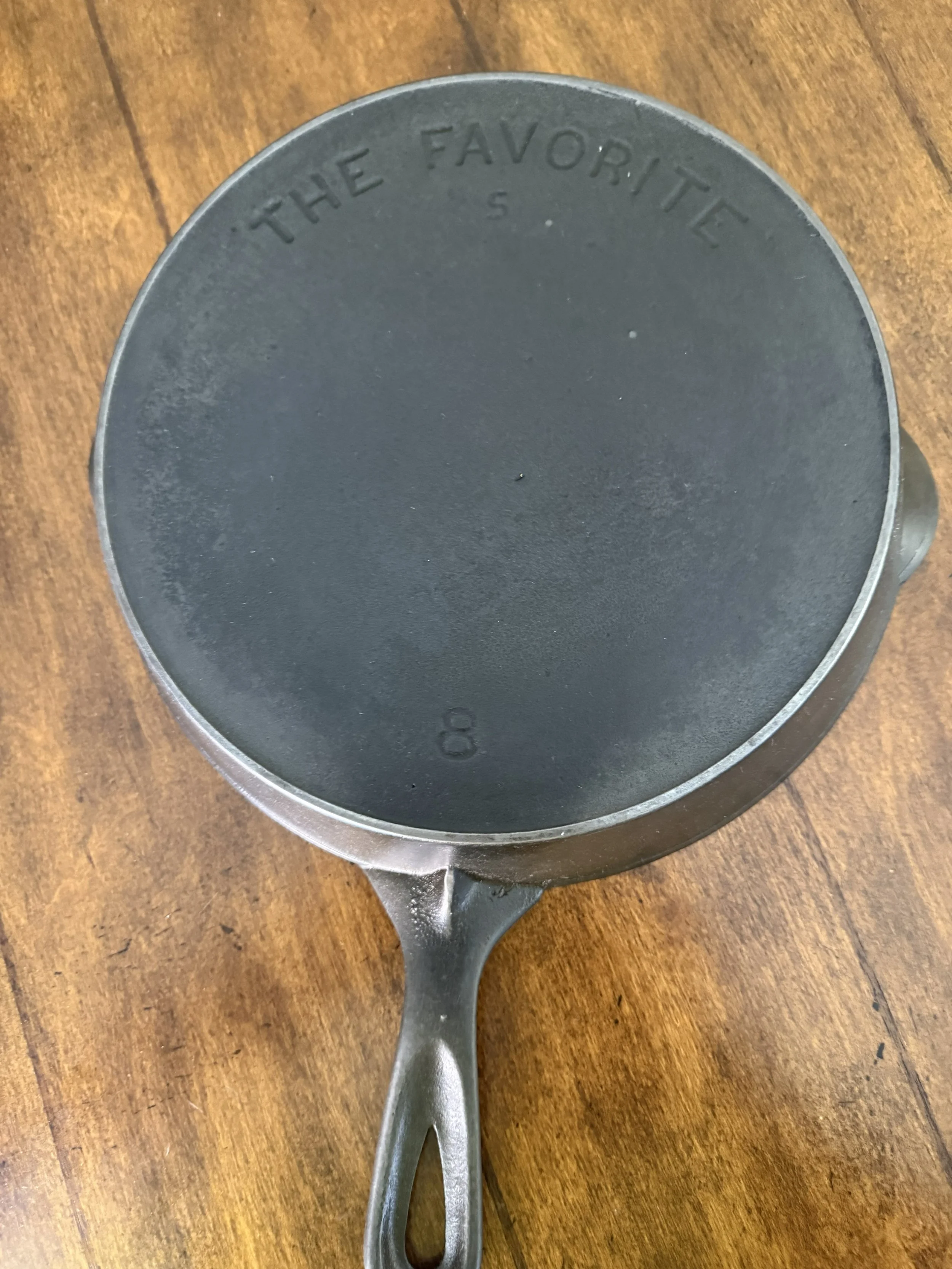
Bottom view showing “THE FAVORITE” logo arched at 12 o’clock, the subsidiary “S” below the arc, and size numeral “8” cast near the handle junction.
The No. 8 is the workhorse of American cast iron. Across every major foundry—Wagner, Griswold, Lodge, Wapak, and Favorite—the No. 8 was the bestselling size, the skillet that anchored the product line and earned its place in more American kitchens than any other. At approximately 10¾ inches across the cooking surface, it is the perfect family pan: large enough to fry a full chicken, sear four pork chops, or bake a proper skillet of cornbread, yet balanced enough to handle with one hand. Every foundry that ever aspired to compete in the American domestic market made a No. 8, and the quality of their No. 8 defined their reputation.
This Columbus Hollow Ware No. 8 carries the simple, unambiguous mark of one of American cast iron’s most historically distinctive operations: “THE FAVORITE,” arched in capital letters at the top of the base, with a subsidiary “S” positioned below the arc and the numeral “8” cast near the handle junction. That mark—three elements, each precisely placed—is the entire commercial identity of a foundry that operated for only twenty years, left no surviving catalog, no advertising archive, and no corporate records accessible to modern researchers. Every piece of Columbus Hollow Ware in existence is, in the most literal sense, a primary source document of Ohio industrial and social history.
The rarity of this piece cannot be overstated. Columbus Hollow Ware operated from 1882 to 1902—a span of two decades during which production volume was limited by the capacity of a prison foundry operating under the constraints of state labor contracting law. These skillets were never sold in the volume of Wagner or Griswold pieces. They were not distributed nationally through hardware chains or department stores. They entered American kitchens through regional commerce in central Ohio, and those that survived more than a century of daily use, estate dispersal, and collector ignorance are genuinely scarce. A No. 8 in this condition—crisp markings, no cracks, flat and sound—represents exactly the kind of surviving specimen that SSC exists to document and preserve.
Piece Details

Close-up of the base markings: “THE FAVORITE” arched at 12 o’clock, subsidiary “S” below the arc, and size numeral “8” near the handle junction. The “S” marking remains undocumented in published collector references and is an open research question for the SSC collection.
Manufacturer
Columbus Hollow Ware Co.
Brand
The Favorite
Piece Type
Skillet
Size Number
No. 8
Base Marking
“THE FAVORITE” arched at 12 o’clock; “S” below arc; “8” near handle junction
Bottom Configuration
Smooth base, no heat ring; raised outer rim foot
Pour Spouts
Two opposing spouts at 3 o’clock and 9 o’clock positions
Handle Style
Long flat handle with teardrop/keyhole hanging loop
Handle Junction
Raised bilateral sprue flanges at body-handle join
Date of Manufacture
Circa 1882–1902
Place of Manufacture
Columbus, Franklin County, Ohio (Ohio State Penitentiary)
Condition
Very Good — crisp markings; sits flat; no cracks, chips, or active rust; fully seasoned
Acquisition Date
February 11, 2026
Acquisition Source
eBay — Seller: 4260doug
eBay Item Number
267517037106
Order Number
06-14230-47800
SSC Catalog Number
SSC-CHW-SKL-08-TF-001
Understanding the Markings: “THE FAVORITE” and the Mystery “S”
Every piece of Columbus Hollow Ware carries the same base marking: “THE FAVORITE” arched in capital letters at 12 o’clock, the size numeral cast near the handle junction, and nothing else—no city name, no patent date, no trademark registration, no foundry address. For a commercial product manufactured over a twenty-year span, the mark is strikingly spare. Wagner was printing “SIDNEY, O.” and eventually a full city-and-state identifier. Griswold was building toward the iconic Erie logo and then the full cross with trademark notation. Columbus Hollow Ware put four words on the bottom of its pans and called it done.
This minimalism reflects the operating reality of the foundry. Columbus Hollow Ware was not competing on the national stage. It was a regional producer, selling into central Ohio markets, operating under the constraints of a state prison labor contract, and unlikely to attract the kind of trademark litigation from distant competitors that might have motivated more elaborate marking. “THE FAVORITE” was both brand name and complete commercial identity. For the buyers who knew the mark, it was enough. For historians and collectors today, it is the only physical evidence that most surviving pieces were made at this specific facility.
The “S” appearing below the main logo arc on this No. 8 is a detail that does not appear consistently across all documented Columbus Hollow Ware specimens and is not addressed in any published collector reference currently known to SSC. Its meaning is genuinely unknown. Possible interpretations include a mold series identifier (distinguishing this pattern from another running simultaneously), a foundry worker’s mark (a practice documented at other American foundries of the period), a pattern revision marker, or a batch or inspection code. The “S” does not appear to be a later addition—it is cast into the iron at the same depth and crispness as the primary lettering, indicating it was part of the original pattern. SSC will continue to monitor collector documentation and primary source research for any evidence that resolves this question, and welcomes contact from collectors who have observed this marking on other CHW specimens.

Profile view showing the smooth base (no heat ring), straight sidewall, raised outer rim foot, bilateral sprue flanges at the handle junction, and the characteristic teardrop hanging loop at the handle terminus.
The Company: From Harker’s Foundry to the Penitentiary Walls
The Columbus Hollow Ware Company was founded in 1882 by Jesse F. Hatcher and E.B. Hatcher, who acquired their foundry operation from a Columbus iron merchant and manufacturer named John Harker. Harker’s connection to “The Favorite” brand predates the Hatcher era: surviving artifacts include a waffle iron stamped “THE FAVORITE” alongside the Harker name, and a tea kettle carrying a February 13, 1883 patent date also marked with the brand. These pieces establish that the commercial identity of “The Favorite” had roots in the Harker operation before it passed to the Hatcher brothers, making the Columbus Hollow Ware timeline more layered than a simple founding date suggests.
Under the Hatchers, the company produced a full line of domestic cast iron cookware marketed under the “The Favorite” brand, operating from Columbus, Franklin County, Ohio. The foundry’s relationship with the Ohio State Penitentiary—which gave Columbus Hollow Ware its most distinctive historical characteristic—evolved over the company’s two-decade span in ways that remain incompletely documented. The penitentiary, located in Columbus, was one of several Ohio state institutions authorized under 19th-century prison labor contracting arrangements to provide inmate workforce to private businesses. Under these arrangements, the state contracted with a private firm, which paid the prison a set rate for inmate labor; the inmates received a portion of their wages for commissary use.
The political environment around prison labor contracting was turbulent throughout Columbus Hollow Ware’s operating period. Ohio labor reform movements of the mid-1880s, energized by the economic disruptions of 1886 and the election of reform-minded legislators in 1887, introduced new regulations on prison labor contracts. Public campaigns encouraged consumers to refuse prison-made goods and debated whether to require products manufactured by prison labor to be labeled as such. These pressures constrained the nature and scale of what prison foundry operations could do and for whom. By the early 1890s, the contractual landscape had shifted significantly from what it had been in 1882.
The Hatcher operation did not survive the new century. Columbus Hollow Ware ceased operations in 1902, leaving behind no surviving business records, no product catalogs, and no corporate archive. What survives is the iron itself: a limited number of skillets, kettles, griddles, and other domestic pieces carrying the “THE FAVORITE” mark, scattered across private collections, estate sales, and the occasional antique marketplace. The Cast Iron Collector reference database confirms the basic operational parameters—founded 1882, ceased 1902, Columbus, Franklin County, Ohio, brand name “The Favorite”—but the detailed internal history of the company remains largely unwritten.
“THE FAVORITE” Brand: Simple Mark, Unmistakable Identity
The marking system used by Columbus Hollow Ware is one of the most spare in American cast iron history. Where Griswold would eventually develop an elaborate cross-and-circle trademark with full company name, city, and patent information, and where Wagner would mark its pieces with precise location identifiers and size designations, Columbus Hollow Ware committed to a single brand phrase in four words: THE FAVORITE. No city. No foundry name. No patent. No address.
On skillets, the logo is positioned at 12 o’clock on the base exterior, with the arc of the letters following the curve of the pan’s rim. The lettering is in all capitals, cleanly spaced, and cast with the same precision as the functional features of the pan. The size numeral appears at 6 o’clock near the handle junction—a standard convention shared with most American foundries of the period. On this No. 8, both elements are crisp and fully legible, a condition that reflects either careful storage or limited heavy use over the past 120-plus years.
Identifying a Columbus Hollow Ware piece requires only finding “THE FAVORITE” in all capitals on the base. There is no other American foundry known to have used this exact phrasing in this exact format. The simplicity that might have seemed like a liability—no city, no brand extension, no legal notice—becomes, for the collector and historian, the definitive identifier. If your pan says THE FAVORITE in arched capitals at 12 o’clock, you have a Columbus Hollow Ware piece. The iron itself is the record.
Setting the Record Straight: Two “Favorites,” No Relation
One of the most persistent sources of confusion in American cast iron collecting involves two Ohio foundries that shared a word but had no corporate connection: Columbus Hollow Ware’s “The Favorite” and the Favorite Stove & Range Company of Piqua, Ohio, which produced “Favorite Piqua Ware.” The confusion is understandable. Both are Ohio foundries. Both use “Favorite” as their primary commercial identifier. Both produced domestic cast iron cookware in the same general era. In the online secondary market, pieces from both operations are routinely misdescribed as belonging to the other.
The companies were entirely separate entities with independent ownership, different locations, different operating histories, and different brand vocabularies. Favorite Stove & Range was founded in Cincinnati in 1848 by William C. Davis, relocated to Piqua in 1889 under William King Boal, and operated until 1935. It was a major industrial enterprise with hundreds of employees, a national distribution network, and multiple brand lines including Favorite Piqua Ware, Miami, and Puritan. Columbus Hollow Ware was a much smaller operation, founded in Columbus in 1882 and ceased by 1902, with no known surviving corporate documentation.
Distinguishing between the two requires only a look at the base marking. Columbus Hollow Ware uses “THE FAVORITE” in all capitals with no location qualifier, no product line name, and no company identifier—just the four-word brand phrase. Favorite Stove & Range always used qualified brand names: “Favorite Piqua Ware,” “Favorite Cook Ware,” or the Smiley logo spelling out FAVORITE / PIQUA / WARE in three stacked lines. If the base reads only “THE FAVORITE” in arched capitals, it is Columbus Hollow Ware. If the base reads anything else with the word “Favorite”—including a city name, product line, or any qualified phrasing—it is Favorite Stove & Range. The Steve’s Seasoned Classics collection holds documented pieces from both foundries and treats them as entirely distinct entries in the Ohio Foundry Corridor collection.
Physical Characteristics & Construction
The Columbus Hollow Ware No. 8 is a medium-to-large domestic skillet consistent in proportion with other confirmed specimens of the type. The cooking bowl is circular with a gently curved interior sidewall rising to a wide, flat rim. Two opposing pour spouts interrupt the rim at the 3 o’clock and 9 o’clock positions—a standard production feature that allows liquid to be drained from either side during cooking and serves as a useful centering guide when the pan is on the stovetop. The rim itself is finished to a smooth, even surface, suggesting foundry attention to the functional contact points of the piece.
The base exterior is smooth—no heat ring is present on this specimen. This is a noteworthy construction detail, as some documented CHW No. 8 examples carry a raised heat ring while others do not. Heat rings served to center the pan over the cooking eye of a wood- or coal-burning stove and to provide additional structural rigidity to the base. Their absence on this piece does not indicate a lower grade of manufacture; smooth-bottom configurations are well-documented across multiple American foundries of the late 19th century, and the transition away from heat rings accelerated as gas ranges became more prevalent in American kitchens after 1900.
The handle is long and flat, tapering slightly from the body junction toward the terminus, where a teardrop or keyhole-shaped hanging loop provides a storage hook point. This loop design is functional and practical—it allowed the pan to be stored on a wall peg or rod when not in use, a common practice in American kitchens of the period before cabinet storage became standard. The junction between handle and cooking body is marked by raised bilateral flanges—casting artifacts visible on both sides of the handle join that are characteristic of the sand-mold casting techniques used throughout the American hollow ware industry in this era. These flanges are not defects; they are evidence of original manufacture and can be seen on virtually all confirmed Columbus Hollow Ware specimens.
The cooking surface shows the texture characteristic of sand-mold cast iron: a slightly pebbly or grainy surface that, with proper seasoning and use, develops into an effective non-stick cooking surface. Unlike the machined cooking surfaces found on premium Wagner and Griswold pieces, Columbus Hollow Ware did not typically perform post-casting grinding of the interior. The cooking surface on this No. 8 has developed a well-established seasoning that fills and smooths the surface texture appropriately.

Top view showing the smooth cooking surface with established seasoning, dual pour spouts at opposing rim positions, and the characteristic wide flat rim of Columbus Hollow Ware No. 8 production.
Collector’s Context
Columbus Hollow Ware pieces are among the most genuinely rare items in American cast iron collecting—not rare in the way that an oversized specialty piece is rare (few were made because few were needed), but rare in the way that a short-lived regional operation is rare: the total surviving population is small, the pieces are not easily identified by casual collectors, and they almost never appear as matched sets. Individual CHW skillets surface occasionally in Midwest estate sales and on online platforms, typically mislabeled as generic “antique” or “prison iron,” and typically acquired by collectors who recognize the mark and understand what they have found.
The No. 8 is the most commonly encountered size in the CHW line—a reflection of the same market dynamics that made the No. 8 the bestselling size at every American foundry. This means the No. 8 is the most accessible entry point for collectors building CHW holdings, and pricing reflects that relative availability compared to the scarcer larger sizes (No. 11, No. 12) and the rarely seen smaller sizes. Even so, a clean, flat No. 8 with crisp markings is not a piece one encounters regularly.
The acquisition of this No. 8 as part of a five-piece set—Nos. 8, 9, 10, 11, and 12—is an event without precedent in SSC’s collection history. That the set remained intact through estate transition, was offered by a single knowledgeable seller, and reached SSC as a unit rather than being dispersed to five separate buyers is precisely the outcome that SSC’s acquisition strategy is designed to enable. In the Steve’s Seasoned Classics collection, this No. 8 is the anchor of the Columbus Hollow Ware sub-collection—the most commonly encountered size, the most likely to be recognized by website visitors encountering the brand for the first time, and the most useful point of entry for the educational narrative SSC is building around Ohio’s prison foundry heritage.
Provenance & Acquisition
This No. 8 skillet was acquired on February 11, 2026, via eBay from seller 4260doug, under eBay item number 267517037106 (order 06-14230-47800). The listing offered a five-piece matched set described as “The Favorite Columbus Hollow Ware Cast Iron Skillet Set 8 9 10 11 12 Holloware.” The set was purchased at $1,400.00 plus $67.61 UPS Ground shipping and $124.38 in sales tax, for a total acquisition cost of $1,591.99. Cost is allocated at $318.40 per piece ($1,591.99 ÷ 5) for individual catalog records.
The pieces arrived well-packed in individual wrapping within a larger box, consistent with the seller’s stated shipping method of UPS Ground. Physical examination on receipt confirmed the condition as represented: no cracks, no chips, no active rust, crisp markings on all five pieces, and flat bases with no warping or wobble. The subsidiary “S” marking below the main logo arc—visible on this No. 8—was noted on receipt as a detail requiring further documentation and research. All five pieces in the set have been logged into the SSC collection as individual catalog entries under the SSC-CHW-SKL designation.
Corporate Timeline: From Jesse Hatcher to Final Casting
1870s
John Harker operates a Columbus, Ohio foundry producing cast iron under an early “The Favorite” mark. A waffle iron stamped with the Harker name and “THE FAVORITE” and a tea kettle with a February 13, 1883 patent date survive as documentary evidence.
1882
Jesse F. Hatcher and E.B. Hatcher purchase the Harker foundry and formally establish the Columbus Hollow Ware Company. Production begins under “THE FAVORITE” brand. Foundry located in Columbus, Franklin County, Ohio.
1882–86
Early period of in-house production at the Columbus foundry. The “THE FAVORITE” mark is applied to a full line of domestic hollow ware including skillets, griddles, and kettles.
1882
Separately, in Piqua, Ohio, the Favorite Stove Works Company (no relation) is formally organized by William King Boal. The shared use of “Favorite” in both companies’ names will cause collector confusion for the next 140 years.
1886–87
Ohio labor reform legislation, driven by public opposition to prison-made goods competing with free-market labor, introduces new contracting regulations governing prison labor arrangements. The changes reshape the terms under which private businesses can engage state penitentiary inmates.
c.1890s
Columbus Hollow Ware enters into production arrangements involving the Ohio State Penitentiary in Columbus. Inmates are employed in foundry work and permitted to apply wages toward commissary purchases. The precise scope and duration of prison involvement in “THE FAVORITE” marked ware production remains a subject of collector research and debate.
1902
Columbus Hollow Ware Company ceases operations. The exact circumstances of closure—whether voluntary liquidation, competitive failure, or expiration of prison labor contract—are not documented in surviving records. Production of “THE FAVORITE” brand cast iron ends permanently.
Post-1902
Surviving Columbus Hollow Ware pieces enter the secondary market through estate dispersal over the following decades. No successor company continues the brand. “THE FAVORITE” mark passes out of commercial use and into collector documentation.
2026
Steve’s Seasoned Classics acquires a five-piece matched set (Nos. 8, 9, 10, 11, 12) from eBay seller 4260doug, establishing one of the most comprehensive Columbus Hollow Ware sub-collections in private hands and making the pieces accessible to researchers and enthusiasts through the SSC online museum.
Why This Piece Matters
The Columbus Hollow Ware No. 8 is the most common surviving specimen of one of American cast iron’s most historically unusual foundry operations. It is common only in relative terms—relative to the even scarcer larger sizes, not relative to the broader cast iron market, where a No. 8 Griswold or Wagner can be found at any antique mall in the country. As a piece of Ohio industrial heritage, a CHW No. 8 in this condition is genuinely significant. It is the product of a twenty-year operation that left no catalog, no corporate records, and no surviving business documentation beyond the iron itself.
This piece also carries an educational burden that goes beyond its own physical characteristics. It is the introduction that most SSC website visitors will have to Columbus Hollow Ware—the first piece they will encounter when they land on the CHW section of the collection, the piece that will either engage their curiosity or fail to. The SSC documentation for this No. 8 is therefore not simply a catalog entry; it is a gateway document to a story that most people interested in cast iron have never heard. The Ohio State Penitentiary. The prison labor contracting system. The labor reform movements of the 1880s. The two “Favorites” with no relation. The Hatcher brothers and John Harker and the foundry on the Columbus waterfront. That story lives in this iron, and the SSC museum’s job is to tell it.
The iron endures. The markings tell the truth. The story deserves to be told.
Sources & Further Reading
CastIronCollector.com — Columbus Hollow Ware Co. reference page: operational dates, location, and brand name documentation.
BoonieHicks.com — “The Favorite, Vintage Cast Iron By The Columbus Hollow Ware Co.”: collector analysis of the two-period theory and prison labor connections.
CastIronCookwareCollectorsGuide.com — “The Columbus Hollow Ware Co., The Favorite” forum thread: photographic documentation and collector discussion.
WorthPoint.com — Historical auction records for Columbus Hollow Ware pieces including No. 8, No. 11 specimens with condition documentation.
Ohio History Connection — Primary source materials on Ohio State Penitentiary labor contracting, 1882–1902.
BoonieHicks.com — “Guide to Favorite Piqua Ware: Favorite Stove and Range Co.”: reference for distinguishing CHW “The Favorite” from Favorite Stove & Range “Favorite Piqua Ware.”
About Steve’s Seasoned Classics
Steve’s Seasoned Classics is an online museum dedicated to preserving and documenting the heritage of American cast iron cookware, with a focus on Ohio foundry pieces from the 19th and early 20th centuries. The SSC collection features over 60 pieces with detailed provenance, historical research, and photography for each item.
