Wagner Block Logo No. 10 Cast Iron Skillet
SSC MUSEUM COLLECTION
Catalog No. SSC-WAG-SKL-10-BLK-001
“WAGNER” Block Logo | No. 10 Skillet | Sidney, Ohio
Circa 1891–1915 • Wagner Manufacturing Company • First-Generation Production
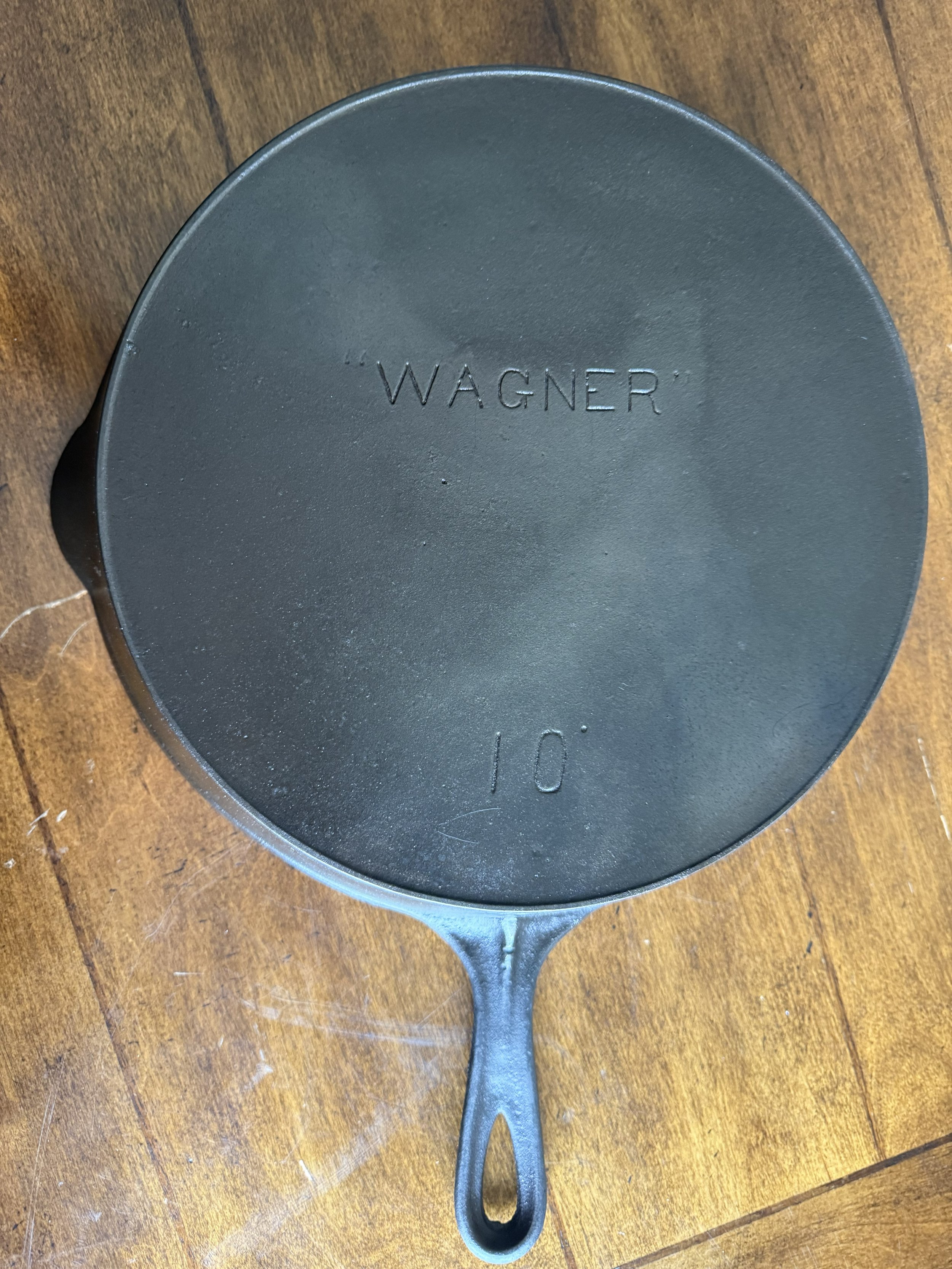
Bottom view showing the block “WAGNER” trademark in straight letters at 12 o’clock, flanked by cast quotation marks, with the “10” size number at 6 o’clock. No Sidney marking, no catalog number—characteristics of Wagner’s earliest production era. Heat ring intact on the base.
The block logo Wagner represents the very beginning of the Wagner Manufacturing Company’s identity in cast iron. Before the arc. Before “Wagner Ware.” Before “Sidney –O–.” Before the stylized logo that would become one of the most recognized trademarks in American cookware. There was this: the word “WAGNER” in plain, straight, block letters—flanked by quotation marks as if the foundry were introducing itself to the world for the first time. This No. 10 skillet carries that earliest form of the Wagner trademark, produced during the foundry’s first years of operation in Sidney, Ohio.
The Cast Iron Collector documents the Wagner Block logo as dating to the 1890s, placing it among the oldest—and possibly the oldest—trademark configuration that Wagner ever used. The block and arc logos overlapped in production during this period, and both predate any geographic identification on the iron. There is no “Sidney,” no “O.,” no catalog number on this skillet. What you see is the Wagner brothers’ first statement of identity: their family name, cast in straight letters into the bottom of a skillet, with nothing else to speak for the piece except the quality of the iron itself.
This No. 10 was acquired from Etsy in October 2025, professionally restored and seasoned by the seller. At 11¾ inches across, the No. 10 is a substantial skillet—a size that was a workhorse in late 19th-century American kitchens. Its placement in the SSC’s Pre-1905 Collection pairs it with the arc logo No. 8 to document both of Wagner’s earliest trademark styles within a single collection.
Piece Details
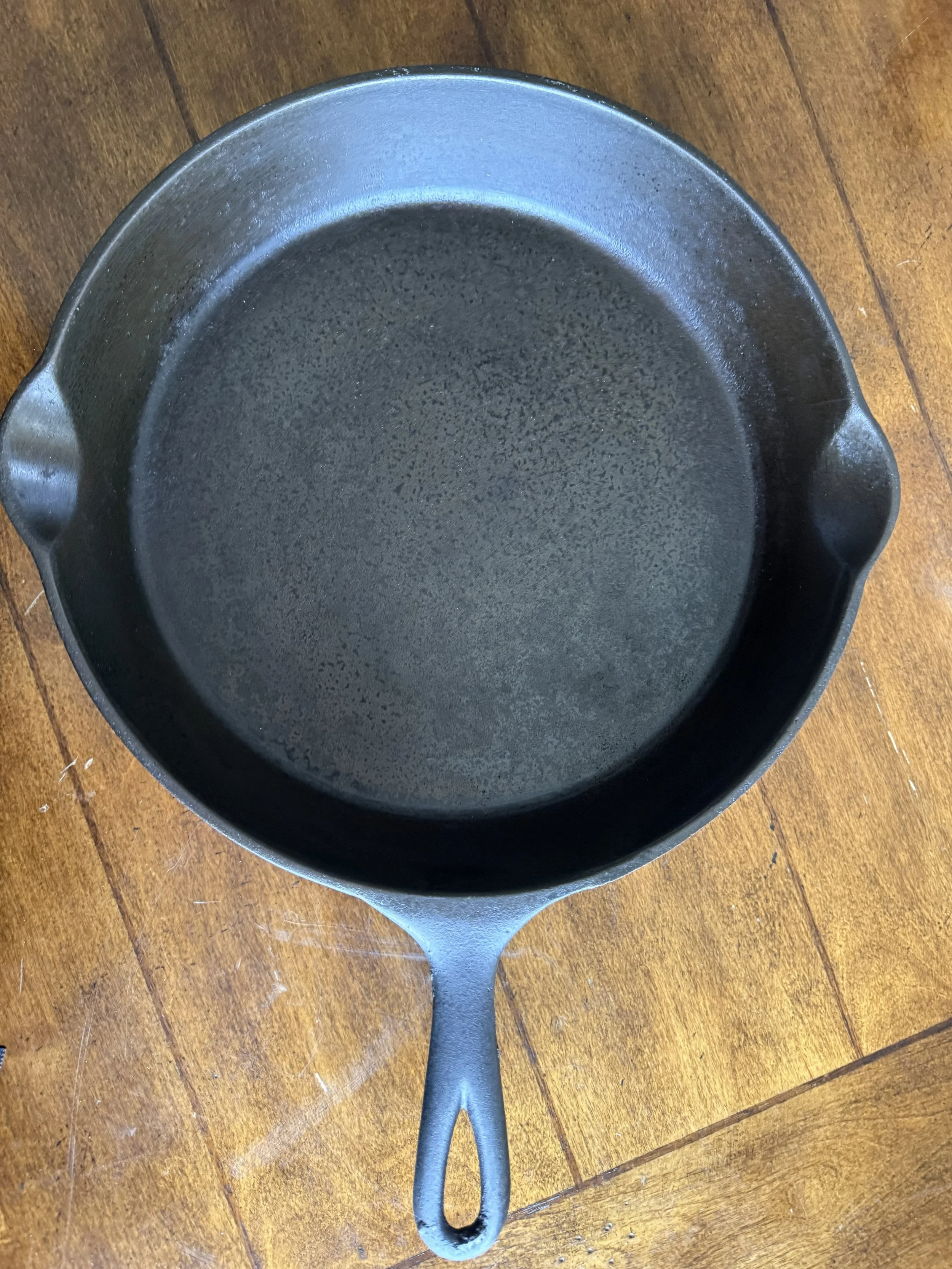
Interior cooking surface view showing smooth machined finish. The No. 10 size provided a generous cooking area for family meals. Dual pour spouts and teardrop handle visible.
Manufacturer
Wagner Manufacturing Company (Sidney, Ohio)
Brand
Wagner (pre-“Wagner Ware” branding)
Piece Type
Cast Iron Skillet
Size Number
No. 10
Catalog Number
None (predates Wagner’s catalog numbering system, adopted c. 1924)
Bottom Marking
“WAGNER” in straight block letters at 12 o’clock position, flanked by quotation marks; “10” size number at 6 o’clock position; no Sidney marking; no catalog number
Handle Marking
None visible
Bottom Configuration
Heat ring
Cooking Surface
Smooth machined interior
Pour Spouts
Dual opposing pour spouts
Diameter
Approximately 11¾ inches
Date of Manufacture
Circa 1891–1915
Place of Manufacture
Sidney, Shelby County, Ohio
Condition
Very Good to Excellent — block logo fully legible with quotation marks visible; size number clear; heat ring intact; smooth cooking surface; no cracks, warping, or repairs; restored and seasoned
Collection Placement
Pre-1905 Collection
Acquisition Date
October 21, 2025
Acquisition Source
Etsy — Seller: AStringorTwo
Etsy Order Number
3835457309
Transaction Number
4778900834
SSC Catalog Number
SSC-WAG-SKL-10-BLK-001
Historical Background
Block vs. Arc: Wagner’s First Two Trademarks
The Cast Iron Collector’s trademark dating chart lists two distinct first-generation Wagner trademarks: the “Wagner Block” from the 1890s and the “Wagner Arc” from 1891 to 1910. Both carry only the word “WAGNER” with no city, state, or brand suffix. The block logo uses straight, horizontal lettering, while the arc logo curves the name in a gentle arch. Both appear at the 12 o’clock position on the skillet base with the size number at 6 o’clock. The two styles overlapped in production and there is no firm consensus on which came first, though the block logo’s simpler execution suggests it may represent the foundry’s very first attempt at branding its products.
A distinctive feature of this block logo is the presence of quotation marks flanking the “WAGNER” name. This typographic convention—setting a brand name in quotes—was common in late 19th-century commercial practice. It signaled that “WAGNER” was a trade name rather than a generic description, serving a function similar to the ® or ™ symbols used today. The quotes disappeared as the Wagner name became established, but their presence on this skillet marks it as a product from the period when the foundry was still actively building name recognition in a competitive market.
The Foundry’s First Decade
The Wagner Manufacturing Company was incorporated in June 1891 by brothers Milton M. and Bernard P. Wagner. Their father Matthias Wagner had immigrated from Germany in 1838 and built a fortune in Sidney, Ohio through canal work, cattle, real estate, and a hotel. His sons chose a different path: manufacturing. Architect Joseph Altenbach began construction of the foundry at 440 Fair Road in 1890, and by September 1891 the operation had grown from 20 to 41 employees, melting over 9,000 pounds of iron daily.
The 1890s were a period of explosive growth. Wagner added nickel-plated ware in 1892 and became one of the first American companies to produce cast aluminum cookware in 1894. The acquisition of competitor Sidney Hollow Ware in 1897 eliminated a local rival and expanded Wagner’s production capacity. By the turn of the century, Wagner was well on its way to dominating the hollowware market—and the block logo skillets produced during this founding decade represent the iron that launched the enterprise.
Pattern Borrowing and the Erie Connection
Cast iron researchers have documented that early Wagner patterns were sometimes “borrowed” from competitor Erie (Griswold) pans. Ghost impressions of the Erie trademark appear on some early Wagner skillets, confirming the practice of using competitor products as pattern masters. This was a common foundry technique of the era—before modern intellectual property enforcement, manufacturers routinely used existing products as starting points for their own molds. The placement of the “WAGNER” name at the 12 o’clock position may have been designed to occupy a clean area of the base that would not overlap with any ghosted markings from borrowed patterns.
From Block Letters to a Global Brand
The block logo was Wagner’s simplest trademark—and its most humble. Within two decades of this skillet’s manufacture, Wagner would introduce the “Wagner Ware” brand name (c. 1914), the iconic stylized logo with the looped “W” (c. 1922), a systematic catalog numbering system (c. 1924), and the coveted “pie logo” variant. The Sidney plant would expand to 160,000 square feet with 300 employees and global distribution. But all of that growth traces back to the founding decade when two brothers put their name—in plain block letters, in quotation marks—on a piece of iron and asked the American market to trust it.
SSC Collection Context
This block logo No. 10 joins the SSC’s Pre-1905 Collection alongside the arc logo No. 8 (SSC-WAG-SKL-08-ARC-001), giving the museum examples of both of Wagner’s earliest trademark styles. Together, these two skillets document the foundational era of what would become Ohio’s most famous cast iron brand—before the stylized logo, before the catalog numbers, before the Sidney –O– mark that would define Wagner products for four decades.
The Pre-1905 Collection is anchored by the Shinnick Hattan & Co. No. 9 kettle from 1863, the oldest datable piece in the SSC. These early Wagner block and arc logo skillets extend the collection’s coverage into the 1890s—the decade when Sidney, Ohio began its transformation from a small county seat into one of America’s most important hollowware manufacturing centers. The block logo’s quotation marks are a particularly evocative detail: a foundry still introducing itself, still putting its name in quotes as if to say, “This is who we are. Remember the name.”
The iron endures. The markings tell the truth. The story deserves to be told.
Wagner Manufacturing Company — Early Trademark Timeline
1881
Milton and Bernard Wagner begin manufacturing light hardware castings in Sidney, Ohio.
1890
Construction begins on the Wagner foundry at 440 Fair Road, Sidney, under architect Joseph Altenbach.
1891
Wagner Manufacturing Company incorporated in June with 20 employees. Cast iron hollowware production begins. The earliest Wagner skillets carry the “WAGNER” name in block or arc lettering with no city or state identification.
1890s
The block logo—“WAGNER” in straight letters—appears on the earliest Wagner production. Block and arc logos overlap in usage during this period. No Sidney marking is present on the earliest pieces.
1897
Wagner acquires competitor Sidney Hollow Ware from Phillip Smith. Some pieces begin to carry “SIDNEY” markings.
c. 1895–1915
Combined “WAGNER / SIDNEY O.” markings begin appearing in various arc and straight configurations. The standalone block and arc “WAGNER” logos are gradually phased out.
c. 1914
Wagner begins branding products as “Wagner Ware” for the first time.
c. 1922
Iconic stylized “Wagner Ware” logo introduced with the distinctive looped “W” and “SIDNEY –O–” marking.
c. 1924
Catalog numbering system adopted.
1952
Randall Company of Cincinnati acquires Wagner Manufacturing Company.
1959
Last year of collectible Wagner production. “SIDNEY –O–” marking removed after this date.
1999
Sidney plant closes permanently.
2023
The original Wagner foundry building in Sidney demolished in June.
2025
Steve’s Seasoned Classics acquires this block logo No. 10 skillet from Etsy seller AStringorTwo. The piece is documented as SSC-WAG-SKL-10-BLK-001.
Why This Piece Matters
The block logo Wagner is arguably the rarest and most historically significant trademark configuration that Wagner Manufacturing Company ever produced. It represents the foundry at its most nascent—a new company in a competitive market, branding its products with nothing more than the family name in straight letters. No geographic identification, no brand suffix, no catalog system. Just “WAGNER”—in quotes—and a size number. The simplicity is the point. Before there was a brand strategy, there was a family name and a foundry.
The No. 10 size adds practical significance to the historical interest. This was a primary cooking skillet in late 19th-century American kitchens—large enough for a family meal, manageable enough for daily use. A block logo No. 10 in this condition, with legible markings and no structural issues, is a genuine find. It tells the story of Wagner Manufacturing Company not through the famous later logos that every collector recognizes, but through the quiet, unadorned beginning that made everything else possible.
Sources & Further Reading
Cast Iron Collector — Cast Iron Cookware Trademarks & Logos (castironcollector.com/trademarks.php): Wagner Block listed as 1890s production.
Cast Iron Collector — Evolution of the Wagner Trademark (castironcollector.com/wagnertm.php): documentation of block and arc logos as Wagner’s first trademarks.
Cast Iron Collector — Wagner Manufacturing Co. (castironcollector.com/wagner.php): corporate history and founding timeline.
Boonie Hicks — Wagner Cast Iron: History, Dates and Logos: block logo examples dated circa 1891–1915.
Wikipedia — Wagner Manufacturing Company: founding history and Matthias Wagner background.
Etsy listing and invoice documentation — Order 3835457309, Transaction 4778900834.
About Steve’s Seasoned Classics
Steve’s Seasoned Classics is an online museum dedicated to preserving and documenting the heritage of American cast iron, with a singular focus on the obscure, defunct foundries of Ohio from the 19th and early 20th centuries. The SSC collection spans 130+ pieces from 50+ confirmed Ohio makers — the majority absent from standard collector references. Makers were identified through physical artifacts exhibiting gate marks, patent dates, foundry traits, and documented regional provenance, cross-checked against surviving trade directories, census records, and existing collector guides. Makers lacking representation in published guides but supported by physical evidence were flagged for first-time documentation — a core function of the SSC research mission.
