Wagner Arc Logo No. 8 Cast Iron Skillet
SSC MUSEUM COLLECTION
Catalog No. SSC-WAG-SKL-08-ARC-001
“WAGNER” Arc Logo | No. 8 Skillet | Sidney, Ohio
Circa 1891–1910 • Wagner Manufacturing Company • First-Series Production

Bottom view showing the arc “WAGNER” trademark at 12 o’clock and the “8” size number at 6 o’clock. No Sidney marking, no catalog number—characteristics of Wagner’s earliest production era. Heat ring intact on the base.
Before “Wagner Ware.” Before “Sidney –O–.” Before the stylized logo that would become one of the most recognized trademarks in American cast iron. There was simply “WAGNER”—a single word in an arc, cast into the bottom of a skillet, with nothing else but a size number to identify it. This No. 8 skillet carries that earliest form of the Wagner trademark: the arc logo, produced during the foundry’s first two decades of operation in Sidney, Ohio. It is among the oldest identifiable patterns the Wagner Manufacturing Company ever made.
The arc logo Wagner predates the addition of any city or state marking. There is no “Sidney,” no “O.,” no catalog number. The company had not yet begun the practice of geographic branding that would later define its identity. What you see on this skillet is the Wagner brothers’ first attempt at putting their name on iron—a foundry just a few years old, still establishing its reputation, marking its products with nothing more than the family name in a simple curved line.
This piece was acquired in November 2025 for just $30.74 total—a remarkable price for a skillet that likely dates to the 1890s or early 1900s. It represents the very beginning of a company that would grow to become one of the largest hollowware manufacturers in the world, and its placement in the SSC’s Pre-1905 Collection connects it to the foundational era of Ohio’s cast iron heritage.
Piece Details
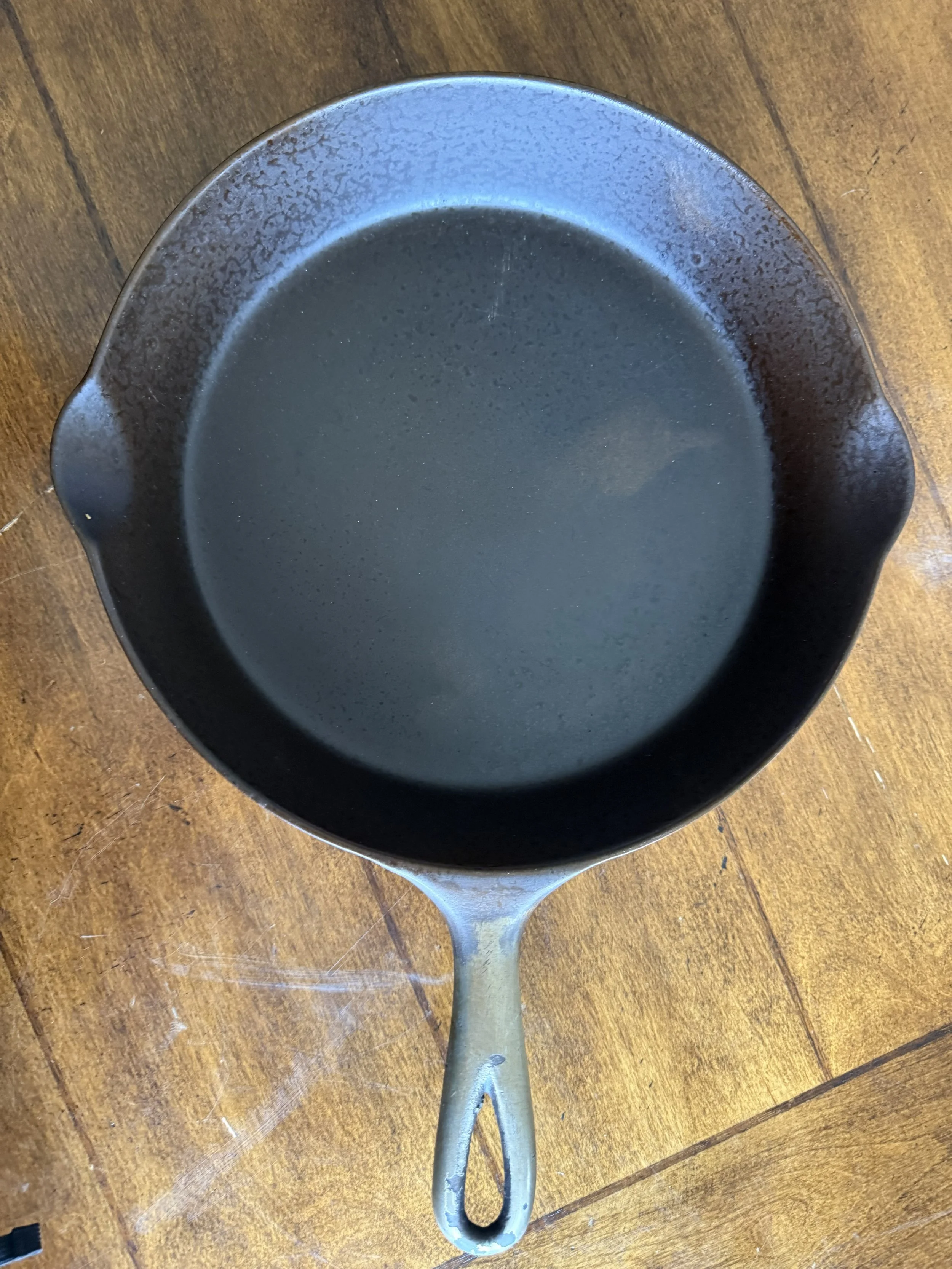
Interior cooking surface view showing smooth machined finish characteristic of early Wagner production. Dual pour spouts and teardrop handle visible.
Manufacturer
Wagner Manufacturing Company (Sidney, Ohio)
Brand
Wagner (pre-“Wagner Ware” branding)
Piece Type
Cast Iron Skillet
Size Number
No. 8
Catalog Number
None (predates Wagner’s catalog numbering system, adopted c. 1924)
Bottom Marking
“WAGNER” in arc at 12 o’clock position; “8” size number at 6 o’clock position; no Sidney marking; no catalog number
Handle Marking
None visible
Bottom Configuration
Heat ring
Cooking Surface
Smooth machined interior with concentric milling marks
Pour Spouts
Dual opposing pour spouts
Diameter
Approximately 10¼ inches
Date of Manufacture
Circa 1891–1910
Place of Manufacture
Sidney, Shelby County, Ohio
Condition
Very Good — legible arc logo; heat ring intact; smooth cooking surface; no cracks, warping, or repairs; seasoned surface with original patina
Collection Placement
Pre-1905 Collection
Acquisition Date
November 7, 2025
Acquisition Source
eBay — Seller: juniatageneralstore
eBay Item Number
397214988299
Order Number
26-13782-22560
SSC Catalog Number
SSC-WAG-SKL-08-ARC-001
Historical Background
The First Wagner Trademark
For the first thirty years of its history, the Wagner trademark consisted solely of the word “WAGNER,” incised either in a straight line (block) or in an arc. The Cast Iron Collector documents the Wagner arc logo as dating from approximately 1891 to 1910, placing it among the earliest trademarks used by the foundry. Various combinations of straight and curved lettering appeared during this period, and at some point the addition of “SIDNEY, O.” below the name began to appear—but the earliest pieces carry only the “WAGNER” name with no geographic identification.
This No. 8 skillet represents that first-generation production. The arc “WAGNER” at 12 o’clock, the size number at 6 o’clock, and the heat ring on the base are the only identifying features. There is no pattern letter, no catalog number, and no city marking. The skillet was produced before Wagner had developed the systematic marking conventions that would characterize its later output. For collectors, the arc logo without Sidney represents the foundry’s earliest commercially available product—a direct connection to the Wagner brothers’ original operation.
Borrowed Patterns and the Erie Ghost
Empirical observation by cast iron researchers has confirmed that early in its history, Wagner “borrowed” Erie pans from which to create their patterns. Ghost impressions of the Erie trademark are seen often enough on older Wagner skillets to confirm they engaged in the practice of using competitor pieces as pattern masters—a common foundry technique of the era. The placement of the “WAGNER” lettering just down from the 12 o’clock position may have been an effort to inscribe the Wagner name in a “clean” area that did not overlap with any ghost markings from the borrowed Erie originals.
The practice of pattern borrowing was not unusual in the 19th-century American foundry industry. Before modern intellectual property enforcement, foundries routinely used competitor products as starting points for their own patterns. The result was a generation of early American cast iron where subtle traces of one maker’s work can sometimes be detected beneath another maker’s name—a palimpsest in iron.
The Wagner Foundry in Its First Decade
The Wagner Manufacturing Company was incorporated in June 1891 by brothers Milton M. and Bernard P. Wagner in Sidney, Shelby County, Ohio. Their father Matthias Wagner, a German immigrant who arrived in 1838, had built a fortune in Sidney through real estate, cattle, and hotel ownership. His sons chose manufacturing. The foundry opened with 20 employees and within three months had more than doubled its workforce, melting over 9,000 pounds of iron daily.
The 1890s were a period of rapid growth and product expansion. Wagner added nickel-plated ware in 1892 and became one of the first American companies to manufacture cast aluminum cookware in 1894. The acquisition of competitor Sidney Hollow Ware in 1897 further strengthened their position. By the early 1900s, Wagner was well on its way to becoming the dominant hollowware manufacturer in Ohio—and the arc logo skillets produced during this period represent the iron that built that reputation.
From Arc to Empire
The arc logo was eventually superseded by a series of increasingly specific markings. By around 1910–1915, Wagner was using combined “WAGNER / SIDNEY O.” marks in various configurations. Around 1914, the “Wagner Ware” brand name appeared for the first time. By 1922, the iconic stylized logo with the looped “W” and “SIDNEY –O–” had been introduced—the mark that most collectors associate with the brand. But none of that later refinement would have been possible without the foundation laid during the arc logo years, when two brothers from Sidney put their name on iron and dared the market to judge them by it.
SSC Collection Context
This arc logo No. 8 joins the SSC’s Pre-1905 Collection, which documents Ohio cast iron from the earliest era of industrial hollowware production. The Pre-1905 Collection is anchored by the Shinnick Hattan & Co. No. 9 kettle from 1863—the oldest datable piece in the museum—and this Wagner arc logo skillet now extends the collection’s coverage into the formative years of what would become Ohio’s most famous cast iron brand.
The piece also tells a story of remarkable value. At $12.99 plus shipping—$30.74 total—this is one of the least expensive acquisitions in the SSC collection, yet it represents one of the oldest. The seller listed it simply as a “Wagner Cast Iron Frying Pan 10 1/4” Smoke Ring,” apparently unaware of the arc logo’s significance as a first-series Wagner trademark. This is the kind of find that makes the hunt worthwhile: an early piece of Ohio cast iron history, hiding in plain sight, priced as a common user skillet.
The iron endures. The markings tell the truth. The story deserves to be told.
Wagner Manufacturing Company — Corporate Timeline
1881
Milton and Bernard Wagner begin manufacturing light hardware castings in Sidney, Ohio.
1890
Construction begins on the Wagner foundry at 440 Fair Road, Sidney, under architect Joseph Altenbach.
1891
Wagner Manufacturing Company incorporated in June with 20 employees. Cast iron hollowware production begins. R.O. Bingham joins as superintendent. The earliest Wagner skillets carry only the “WAGNER” name in arc or block lettering with no city or state identification.
1892
Nickel-plated ware added to the product line.
1894
Wagner becomes one of the first American manufacturers to produce cast aluminum cookware.
1897
Wagner acquires competitor Sidney Hollow Ware from Phillip Smith. William H. Wagner joins to oversee the operation. Some pieces begin to carry “SIDNEY” markings.
1903
Sidney Hollow Ware sold back to Phillip Smith, who does not resume production.
c. 1910–1915
Transition to combined “WAGNER / SIDNEY O.” markings in various configurations. The standalone arc “WAGNER” logo is phased out.
c. 1914
Wagner begins branding products as “Wagner Ware” for the first time, modifying existing patterns to insert the word “Ware.”
c. 1922
Iconic stylized “Wagner Ware” logo introduced with the distinctive looped “W” and “SIDNEY –O–” marking.
c. 1924
Catalog numbering system adopted. Skillet catalog numbers follow the pattern 1050 (No. 0) through 1064 (No. 14).
1952
Randall Company of Cincinnati, Ohio acquires Wagner Manufacturing Company.
1957
Randall’s Wagner division acquires Griswold Manufacturing from McGraw-Edison.
1959
Last year of production considered collectible. “SIDNEY –O–” marking removed after this date.
1999
Sidney plant closes permanently.
2023
The original Wagner foundry building in Sidney demolished in June.
2025
Steve’s Seasoned Classics acquires this arc logo No. 8 skillet from eBay seller juniatageneralstore. The piece is documented as SSC-WAG-SKL-08-ARC-001.
Why This Piece Matters
The arc logo Wagner is the beginning of the story. Before the stylized logo, before the catalog numbers, before the Sidney –O– mark that would identify Wagner products for four decades, there was this: a single word in a curve, cast into the bottom of a skillet by a foundry that was still figuring out what it would become. This No. 8 represents Wagner Manufacturing Company at its most elemental—a family name on a piece of iron, offered to the American market with nothing but the quality of the casting to speak for it.
That the Wagner brothers chose to mark their earliest products at all is significant. Many small foundries of the 1890s produced unmarked hollowware, leaving no trace of their identity on the iron they cast. Wagner’s decision to put its name on every piece from the very beginning was both a statement of pride and a bet on the future. The bet paid off. The name survived. And more than 130 years later, that arced “WAGNER” on the bottom of a No. 8 skillet still identifies its maker as clearly as the day it was cast in Sidney, Ohio.
Sources & Further Reading
Cast Iron Collector — Evolution of the Wagner Trademark (castironcollector.com/wagnertm.php): detailed visual guide to Wagner logo changes from arc and block through stylized and pie logos.
Cast Iron Collector — Cast Iron Cookware Trademarks & Logos (castironcollector.com/trademarks.php): comprehensive trademark dating chart listing Wagner Arc at 1891–1910.
Cast Iron Collector — Wagner Manufacturing Co. (castironcollector.com/wagner.php): corporate history and production timeline.
Boonie Hicks — Wagner Cast Iron: History, Dates and Logos: visual identification guide with arc logo examples dated circa 1891–1910.
Wikipedia — Wagner Manufacturing Company: corporate history including founding, acquisitions, and closure.
eBay listing and invoice documentation — Item 397214988299, Order 26-13782-22560.
About Steve’s Seasoned Classics
Steve’s Seasoned Classics is an online museum dedicated to preserving and documenting the heritage of American cast iron, with a singular focus on the obscure, defunct foundries of Ohio from the 19th and early 20th centuries. The SSC collection spans 130+ pieces from 50+ confirmed Ohio makers — the majority absent from standard collector references. Makers were identified through physical artifacts exhibiting gate marks, patent dates, foundry traits, and documented regional provenance, cross-checked against surviving trade directories, census records, and existing collector guides. Makers lacking representation in published guides but supported by physical evidence were flagged for first-time documentation — a core function of the SSC research mission.
