Shinnick & Co. — Zanesville, Ohio
SSC MUSEUM COLLECTION
Catalog No. SSC-SHINNICK-CO-KTL-8-001
A No. 8 Cast Iron Tea Kettle from the Civil War Summer of 1863
From the Steve’s Seasoned Classics Museum Collection — Cataloged April 2026
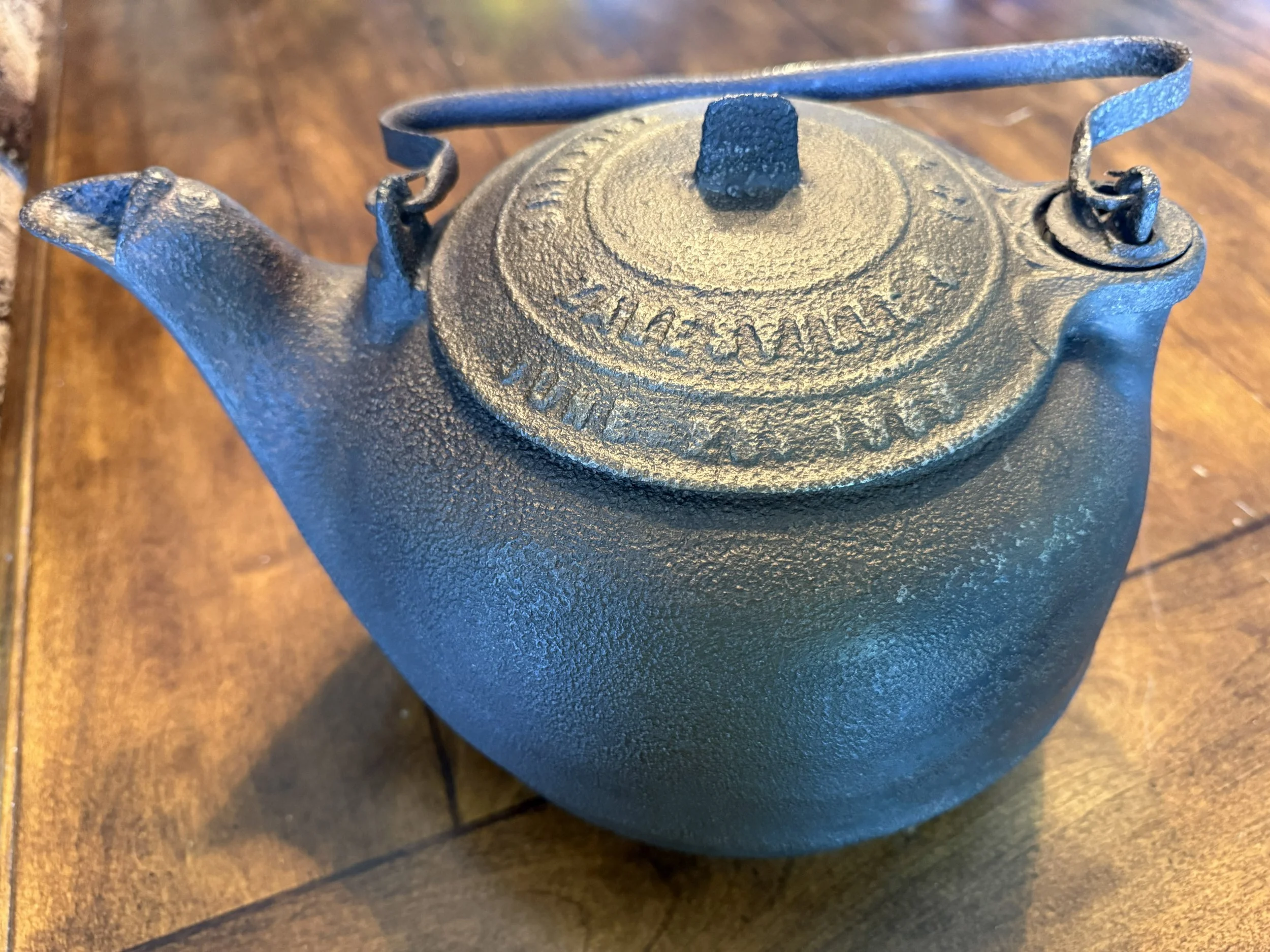
Shinnick & Co., Zanesville, Ohio. No. 8 cast iron tea kettle bearing the June 23, 1863 patent date — the same Civil War–era Menke patent that anchors The Crown Jewel of the SSC collection.
The piece arrived in Monett, Missouri at the end of April 2026, after a long route from a Zanesville post office through Columbus, Indianapolis, Kansas City, and Springfield. The shipping log read like a tour of the American Midwest’s industrial spine — the same corridor of railroads and river towns that, more than 160 years earlier, carried Ohio iron from foundry floors to kitchens across the country.
This kettle came home. It was cast in Zanesville. It belongs to a Zanesville story. And it now joins the small but growing body of Civil War–era hollow ware in the SSC Museum Collection — the second Shinnick-marked piece to enter the archive, and the earliest corporate identity in the Shinnick foundry lineage now documented at SSC.
A Sibling to The Crown Jewel
The emotional anchor of the SSC Museum Collection is the Shinnick Hattan & Co. No. 9 tea kettle — known here as The Crown Jewel. That piece carries the June 23, 1863 date cast into its lid: U.S. Patent No. 38,972, granted to Barney H. Menke of Cincinnati. It is the inspiration for the forthcoming SSC Press title The Kettle and the War: A Civil War Tea Kettle and the Industrial Story of Ohio.
The piece now cataloged — marked SHINNICK & CO. / ZANESVILLE, O. / PATENT JUNE 23, 1863 / No. 8 in concentric rings around the lid knob — is not The Crown Jewel. It is its sibling. The corporate name on the iron is different. The patent date is identical. The size drops by one. The story is the same one, told from a slightly different page of the Shinnick foundry’s history.
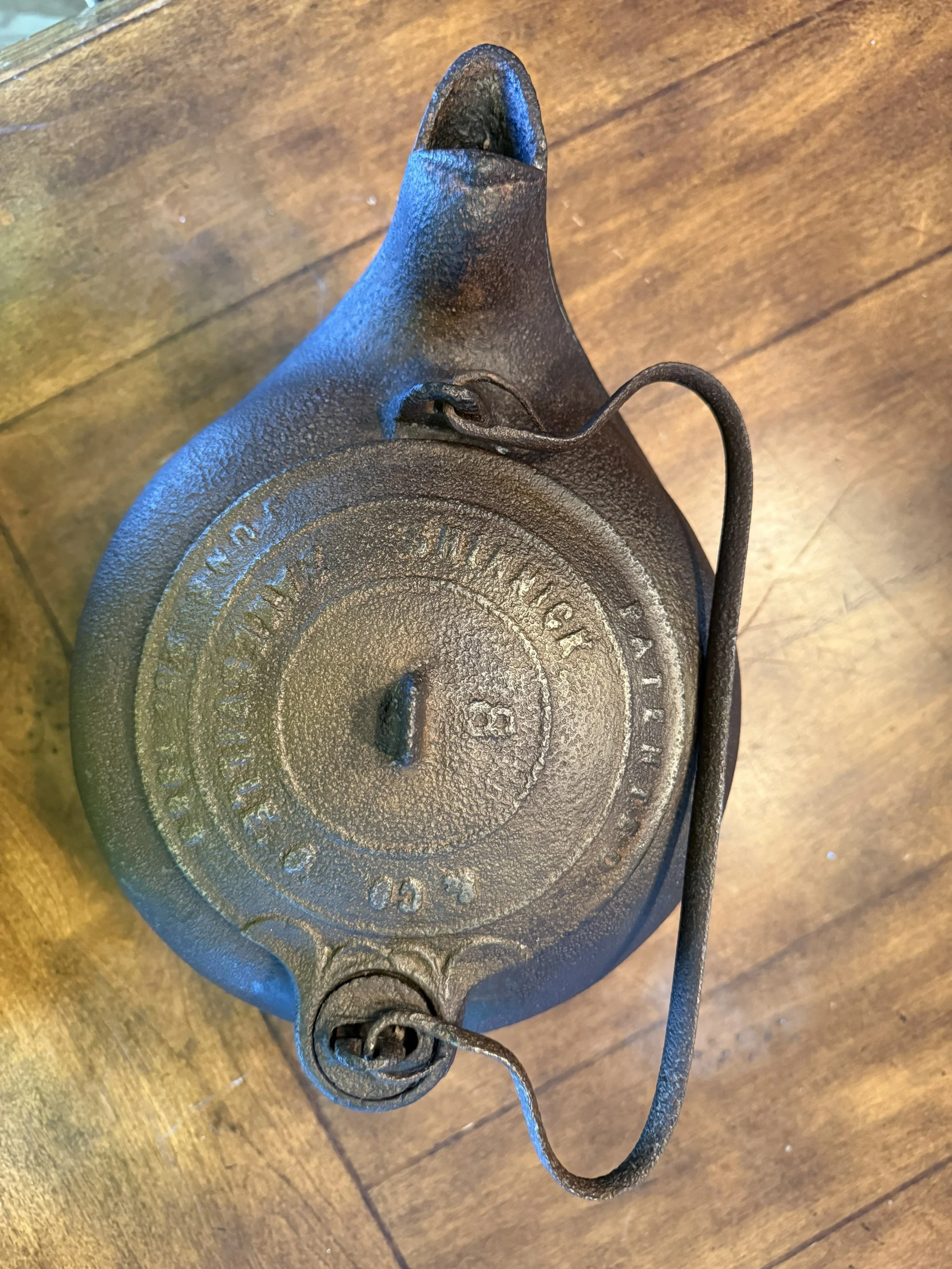
The lid in full: SHINNICK & CO. / ZANESVILLE, O. / PATENT JUNE 23, 1863, cast in concentric rings around the central lifting handle, with the size No. 8 in the inner field.
Three Shinnick-name firms are now documented operating in Zanesville during the second half of the 19th century. Shinnick & Co. — the firm that cast this kettle. Shinnick Hattan & Co. — the firm that cast The Crown Jewel. And Shinnick Woodside & Gibbons — the successor firm, active through at least the mid-1870s.
Whether Shinnick & Co. ran concurrently with the Hattan partnership or preceded it remains an active research question. What is certain is that the Shinnick name was a fixed point in Zanesville’s iron trade during the Civil War decade — and that the same Cincinnati patent linked all three firms to a tea kettle design that traveled the Ohio River valley. The Shinnick name carried weight in Zanesville long after the foundry years; a Shinnick Street still runs through the heart of downtown Zanesville today, and the Shinnick name remains attached to several of the city’s most enduring civic institutions.
The Menke Patent and the Network It Created
On June 23, 1863, the United States Patent Office issued Patent No. 38,972 to Barney H. Menke of Cincinnati for an “Improvement in Tea-Kettles.” It was Menke’s second tea kettle patent in less than six months — the first, No. 37,423, had been granted on January 13, 1863, and assigned to Chamberlain & Co. of Cincinnati. Together, those two patents form what SSC research has identified as the Menke Patent Network: a documented system of manufacturers across three states, all casting tea kettles under the June 23, 1863 date.
The firms now confirmed in the network are:
• Chamberlain & Co. — Cincinnati, Ohio (in SSC collection — The Cornerstone)
• Shinnick Hattan & Co. — Zanesville, Ohio (in SSC collection — The Crown Jewel)
• Shinnick & Co. — Zanesville, Ohio (in SSC collection — this piece)
• Sullivan & Herdman — Zanesville, Ohio
• Brinkmeyer & Co. — Evansville, Indiana
• Baxter Kyle & Co. — Louisville, Kentucky
Three of the six are now physically represented at SSC. Three of the six are Zanesville firms, confirming that Zanesville — not Cincinnati — was the principal production hub for the Menke kettle pattern, even though the inventor and the original patent assignee were Cincinnati firms. Iron flowed from Cincinnati’s patent office to Zanesville’s foundries to American kitchens by way of the Muskingum, the Ohio, and the railroads that stitched them together.
This piece is the third confirmed Zanesville link in that network. It is the second physical piece bearing the Shinnick surname to enter the SSC archive. And it is the first size No. 8 Menke-network kettle in the collection — the Crown Jewel is a No. 9, The Cornerstone a No. 8 Chamberlain, and the Shinnick & Co. No. 8 now sits between them as the Zanesville-cast counterpart to the Cincinnati piece.
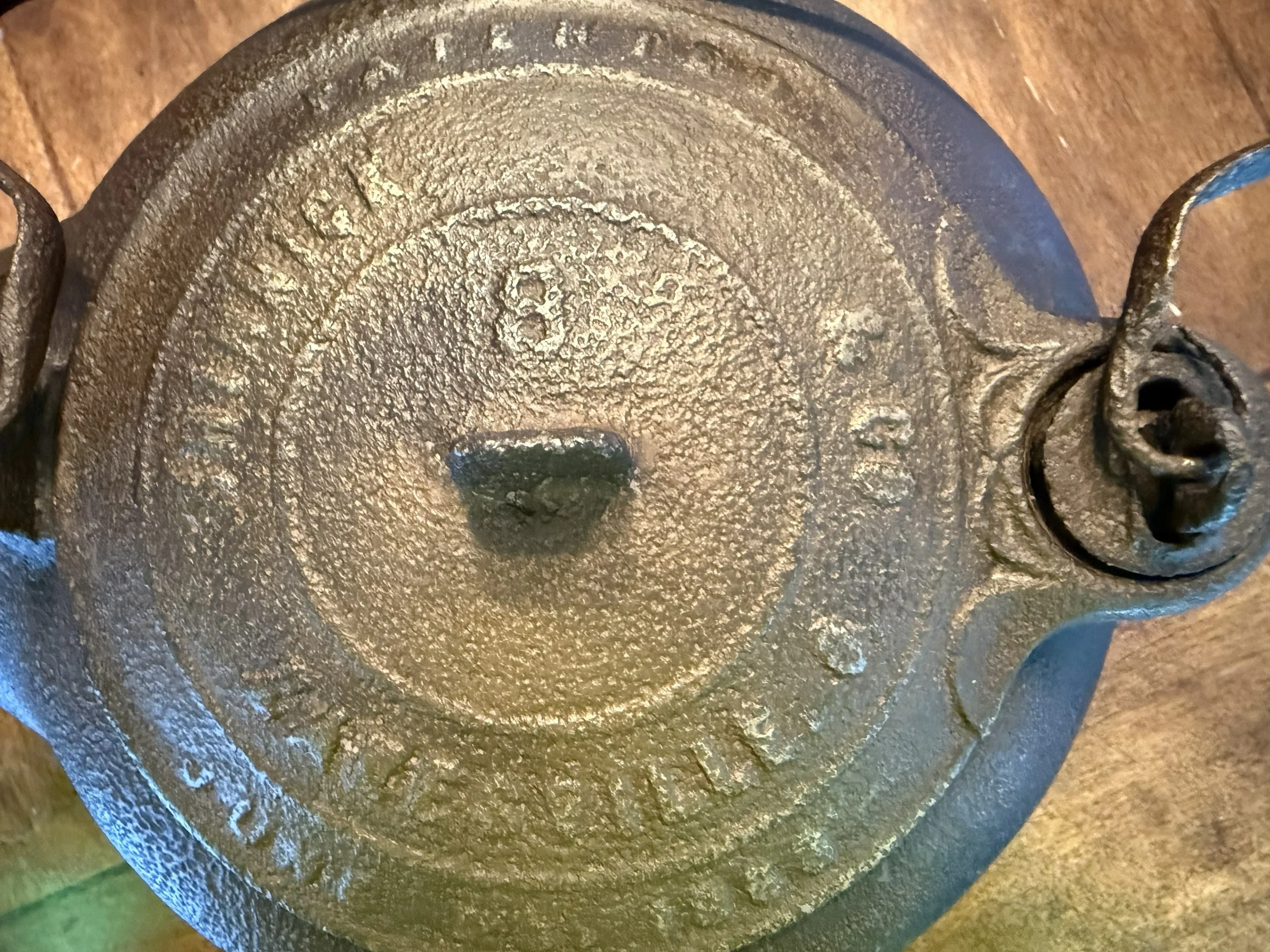
The size — No. 8 — cast in the center field of the lid, with the lifting handle pad and the inner ring of the patent inscription wrapping around it.
The Piece Itself
The kettle conforms in form to the Menke patent pattern: a broad-shouldered cast iron vessel with a tapered drawn spout, an iron bail handle pinned at the shoulders, and a removable lid bearing the maker mark and patent date in raised letters cast in concentric rings around the central lifting handle. The pattern is unmistakable — once you have seen the Crown Jewel and The Cornerstone side by side, every Menke-network kettle reads from the same architectural vocabulary.
The lid carries the full inscription: SHINNICK & CO. along the upper arc, ZANESVILLE, O. along the lower arc, PATENT JUNE 23, 1863 wrapping the inner ring, and the size No. 8 cast in the center field beside the lifting handle. The body is a pleasing tea-kettle profile — wider at the shoulder than the base, with the gentle taper that distinguishes the Menke pattern from earlier flat-bottomed Ohio kettles. The bail ears are integral cast hooks; the bail itself is an original drawn iron rod, still articulating freely after more than a century and a half of service.

Decorative detail of the lid edge and the cast pad where the lifting handle joins the lid — the foundry’s attention to ornament visible even in a working kitchen object.
The piece was acquired in April 2026 from a Zanesville-area seller, returning the iron to within the same Muskingum County radius where it was originally cast. That detail matters. It is uncommon for a Civil War–era Zanesville tea kettle to remain in Muskingum County for more than 160 years; most surviving examples have scattered to distant estate sales and dealer chains. This one stayed close to home until it crossed the Ohio River for the first time in its working life, on its way to the SSC archive.
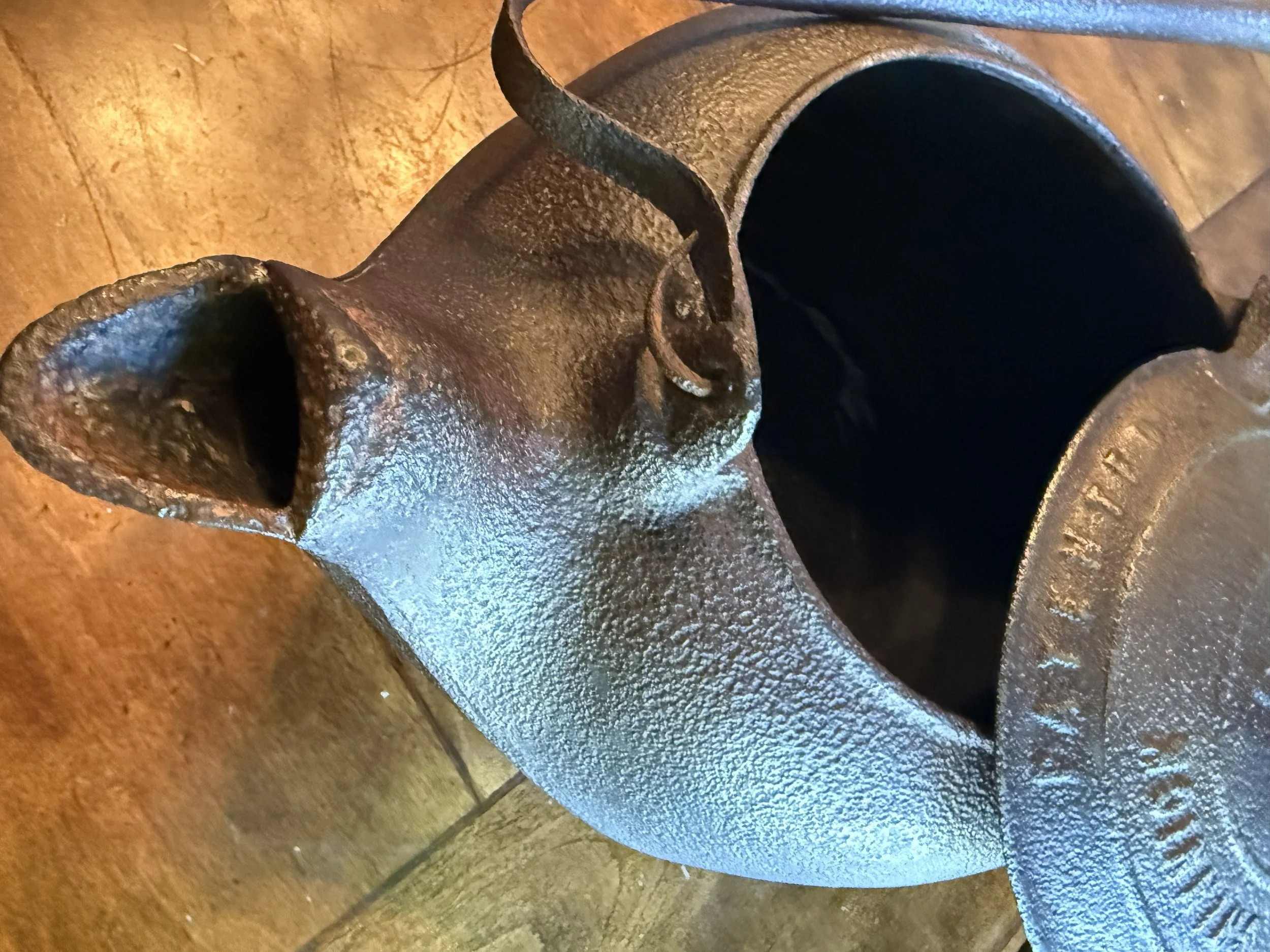
Spout, bail ear, and the open mouth of the kettle. The drawn spout shows the characteristic Menke-pattern taper; the bail ear is an integral cast hook, original to the foundry.
Preservation Approach
The piece entered the SSC collection in stable, intact condition with the maker mark fully legible and the lid, bail, and body all original to the piece. Conservation will follow SSC’s standard cookware-era hollow ware protocol: assessment, controlled cleaning, and seasoning with SSC Archival Black™ — the museum-display finish reserved for collector presentation and museum pieces.
Per SSC’s published finishing system, Archival Black™ is a museum display finish only. It is not food-safe and is not applied to functional cookware. This piece is a museum artifact, not a kitchen tool, and will be treated accordingly.
The original cast iron surface, including the raised letters and the patent date, will be preserved as the historical record they are. No grinding, no aggressive abrasion, no alteration of the markings. The iron tells the truth. The job of the curator is to listen.
Why This Piece Matters
The Crown Jewel earned its title for what it represents emotionally and narratively — the Civil War date, the Zanesville foundry, the story that became a book. This piece, the Shinnick & Co. No. 8 kettle, earns its place for what it represents evidentiarily. It is the third Zanesville piece in the Menke Patent Network. It is the second Shinnick-name firm physically documented in the SSC archive. And it expands the corporate map of mid-19th-century Zanesville iron from a single partnership to a multi-firm network operating across the same decade, casting from the same patent, serving the same continental market.
Every confirmed piece tightens the network. Every Zanesville mark in the archive draws the picture of that city’s iron trade in sharper focus. The Crown Jewel told us the story existed. This kettle tells us the story was bigger than we knew.
The iron endures. The markings tell the truth. The story deserves to be told.
Piece Details
Catalog Number
SSC-SHINNICK-CO-KTL-8-001
Maker
Shinnick & Co.
Location
Zanesville, Muskingum County, Ohio
Form
Cast Iron Tea Kettle, Size No. 8
Maker Mark (lid)
SHINNICK & CO. / ZANESVILLE, O. / PATENT JUNE 23, 1863 / No. 8 (cast in concentric rings)
Patent Cast
June 23, 1863 — U.S. Patent No. 38,972 (Barney H. Menke, Cincinnati)
Period
Pre-1905 — Civil War era
Acquisition
April 2026, Zanesville, Ohio source
Condition Notes
Body, spout, lid, bail handle, and bail ears all present and original. Working-life repair to the underside in JB Weld, period of repair unknown. Maker mark fully legible.
Conservation Plan
SSC Archival Black™ museum display finish (not food-safe; museum presentation only)
Network Designation
Menke Patent Network — Zanesville Region
Related SSC Pieces
SSC-SHINNICK-KTL-9-1863-001 (The Crown Jewel); SSC-CHAM-KTL-8-001 (The Cornerstone); SSC-SWG-KTL-1875-001
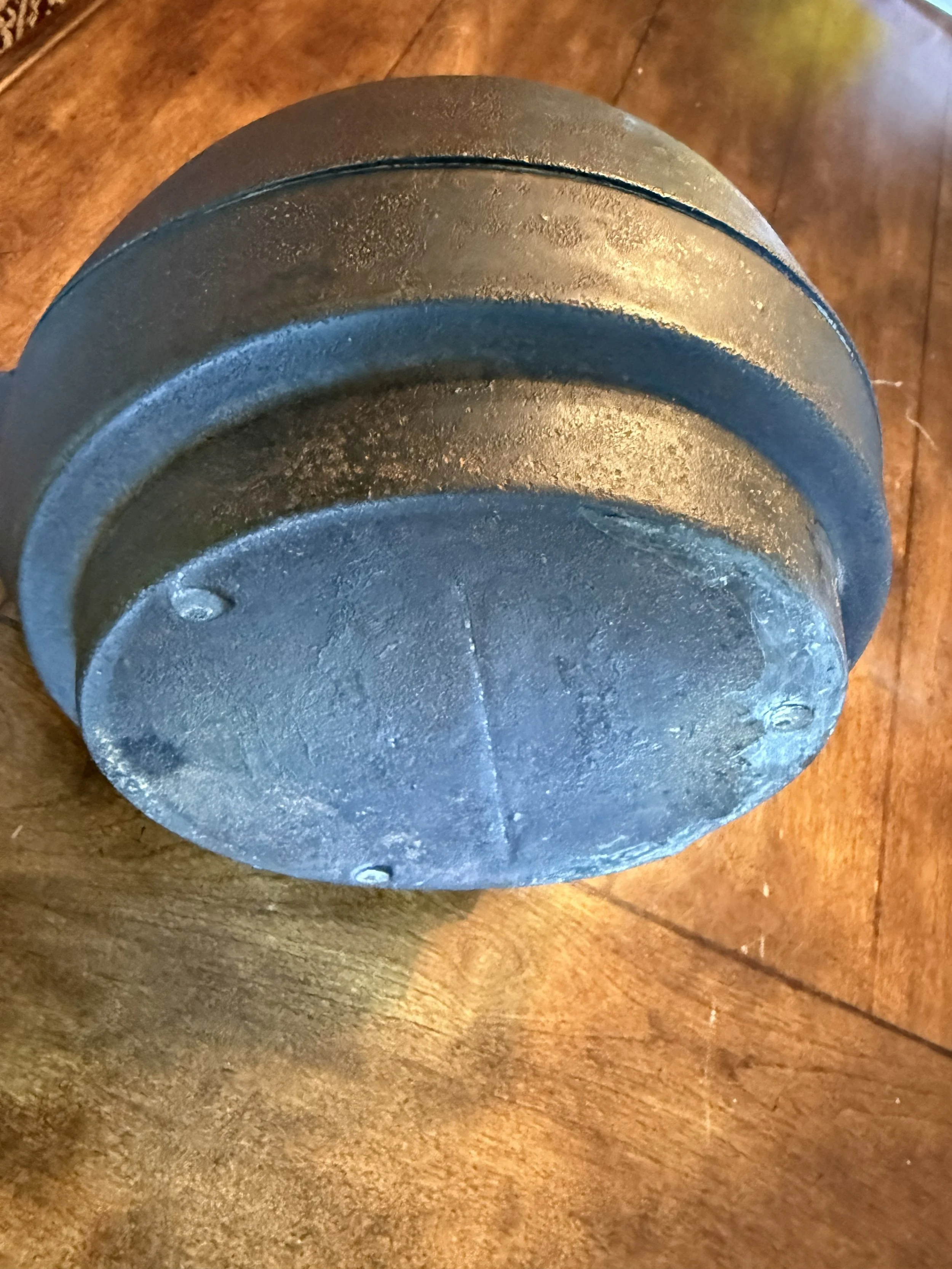
Underside of the kettle, showing the original cast foundry surface and the working-life repair noted in the condition record.
Sources & Further Reading
U.S. Patent No. 38,972 — Barney H. Menke, Cincinnati, Ohio — “Improvement in Tea-Kettles” — June 23, 1863. Patent document examined and transcribed in the SSC archive in connection with the Chamberlain & Co. and Shinnick Hattan & Co. research files.
Physical examination of piece: Shinnick & Co. cast iron tea kettle, size No. 8. Maker mark cast in raised letters in concentric rings around the lid knob: SHINNICK & CO. / ZANESVILLE, O. / PATENT JUNE 23, 1863, with the size number cast in the center field. Body, bail handle, bail ears, spout, and lid all present and original. Underside bears a working-life JB Weld repair of unknown date. Acquired April 2026 from a Zanesville, Ohio seller.
SSC Internal Collection Records — The Crown Jewel: Shinnick Hattan & Co. No. 9 tea kettle, Zanesville, Ohio (SSC-SHINNICK-KTL-9-1863-001) — emotional anchor of the SSC Museum Collection and the inspiration for The Kettle and the War (SSC Press, forthcoming October 2026).
SSC Internal Collection Records — The Cornerstone: Chamberlain & Co. No. 8 tea kettle (SSC-CHAM-KTL-8-001) — Cincinnati firm formally assigned U.S. Patent No. 37,423 (January 13, 1863) and casting the June 23, 1863 Menke patent date on its kettle lids.
Background context on the Shinnick family in Zanesville history drawn from public records of the William M. Shinnick Educational Fund and Muskingum County historical sources; further research into Shinnick & Co.’s foundry partnership structure and active years is ongoing as part of The Kettle and the War manuscript research.
About SSC
Steve’s Seasoned Classics is an online museum dedicated to preserving, documenting, and sharing the heritage of American cast iron — with a singular focus on the obscure, defunct foundries of Ohio that shaped the state’s industrial identity in the 19th and early 20th centuries. The collection currently documents 117 pieces from 50+ confirmed Ohio makers, the vast majority absent from standard collector references. SSC’s research methodology pairs physical artifacts with primary-source patent, directory, and archival investigation. The collection is dedicated to the memory of Henry J. and Cecilia Brandewei Thaman.
