Unknown Wapakoneta Foundry No. 258 Camp Waffle Iron
SSC MUSEUM COLLECTION
Catalog No. SSC-WAPAKO-WFL-258-001
Camp/Hearth Waffle Iron | Rectangular Diamond Pattern | Long-Handle Form | Wapakoneta, Ohio
1858 • Unknown Maker, Wapakoneta, O. • Ohio Foundry Corridor

Detail of the interior casting on the lower paddle, showing “Wapakoneta O” and “No 258” cast into the central diamond fields amid a dense crosshatch pattern with decorative star and rosette motifs in each diamond cell. No company name appears—only the town and pattern number, a marking convention typical of small antebellum foundries that identified themselves by location rather than brand.
Before Wapak Hollow Ware. Before Ahrens and Arnold. Before the Indian Head logo became one of the most sought-after marks in cast iron collecting. Before any of it—there was a foundry in Wapakoneta, Ohio, casting iron in 1858. This waffle iron is the proof.
The piece carries no company name. It identifies itself the way small-town foundries did in the years before the Civil War: by location and pattern number. “Wapakoneta O” is cast into the interior of one paddle. “No 258” appears alongside it. The opposite paddle carries the date “1858.” That is all. No trademark. No logo. No brand. Just a town, a number, and a year—the minimum information a foundry needed to mark its work in an era when your reputation traveled by word of mouth and your castings spoke for themselves.
Wapakoneta was platted in 1833 and designated the seat of Auglaize County in 1848. By 1858, it was a small but established agricultural town on the Auglaize River, connected to regional markets by the Miami and Erie Canal that ran along the northern edge of the county. The canal brought raw materials in and finished goods out, enabling exactly the kind of small-scale manufacturing that this waffle iron represents: a local foundry producing household and farm implements for the surrounding community. The town would not see its famous cast iron era—the one collectors know—until 1903, when Wapak Hollow Ware opened its doors. This waffle iron predates that moment by forty-five years.
The Antebellum Waffle Iron

Detail of the upper paddle interior showing the date “1858” cast prominently in the central diamond field, flanked by rows of decorative rosette motifs within the crosshatch grid. The hinge mechanism connecting the two paddles is visible at the bottom of frame. The 1858 date establishes this as one of the earliest known marked castings from Wapakoneta—forty-five years before the Wapak Hollow Ware Company was founded.
This is a camp-style or hearth-style waffle iron: two rectangular cast iron paddles hinged together, each with a long iron rod handle extending outward, designed to be held over an open fire or placed directly on a wood-burning stove. The total length is approximately twenty-one inches. The paddles feature a dense diamond crosshatch pattern with decorative star and rosette motifs cast into each diamond cell—a level of ornamental detail that speaks to both the foundry’s casting skill and the aesthetic expectations of mid-nineteenth-century consumers. This was not a utilitarian slab of iron. This was a piece meant to be admired as well as used.
The diamond-and-star waffle pattern was one of the most popular designs of the antebellum period. Manufacturers prided themselves on waffle iron design and innovation, creating patterns that ranged from simple grids to elaborate hearts, diamonds, hexagons, and playing-card suits. The pattern on this piece—tightly spaced diamonds with alternating star and rosette fills—produces a waffle with a distinctive geometric surface, each cell creating a small pocket for butter and syrup. It is a pattern seen across multiple foundries in the mid-1800s, but each foundry’s version was subtly different, reflecting its own pattern maker’s hand.
The long rod handles are characteristic of hearth cooking: the iron needed to be positioned over coals or in a fireplace opening, and the cook needed enough distance from the heat to avoid burns. The hinge between the paddles allows them to be opened flat for pouring batter and closed for cooking, then flipped to cook the opposite side. This is a tool designed for daily use in a farmhouse kitchen in western Ohio in 1858—three years before the Civil War, in a county that had only been organized for a decade.
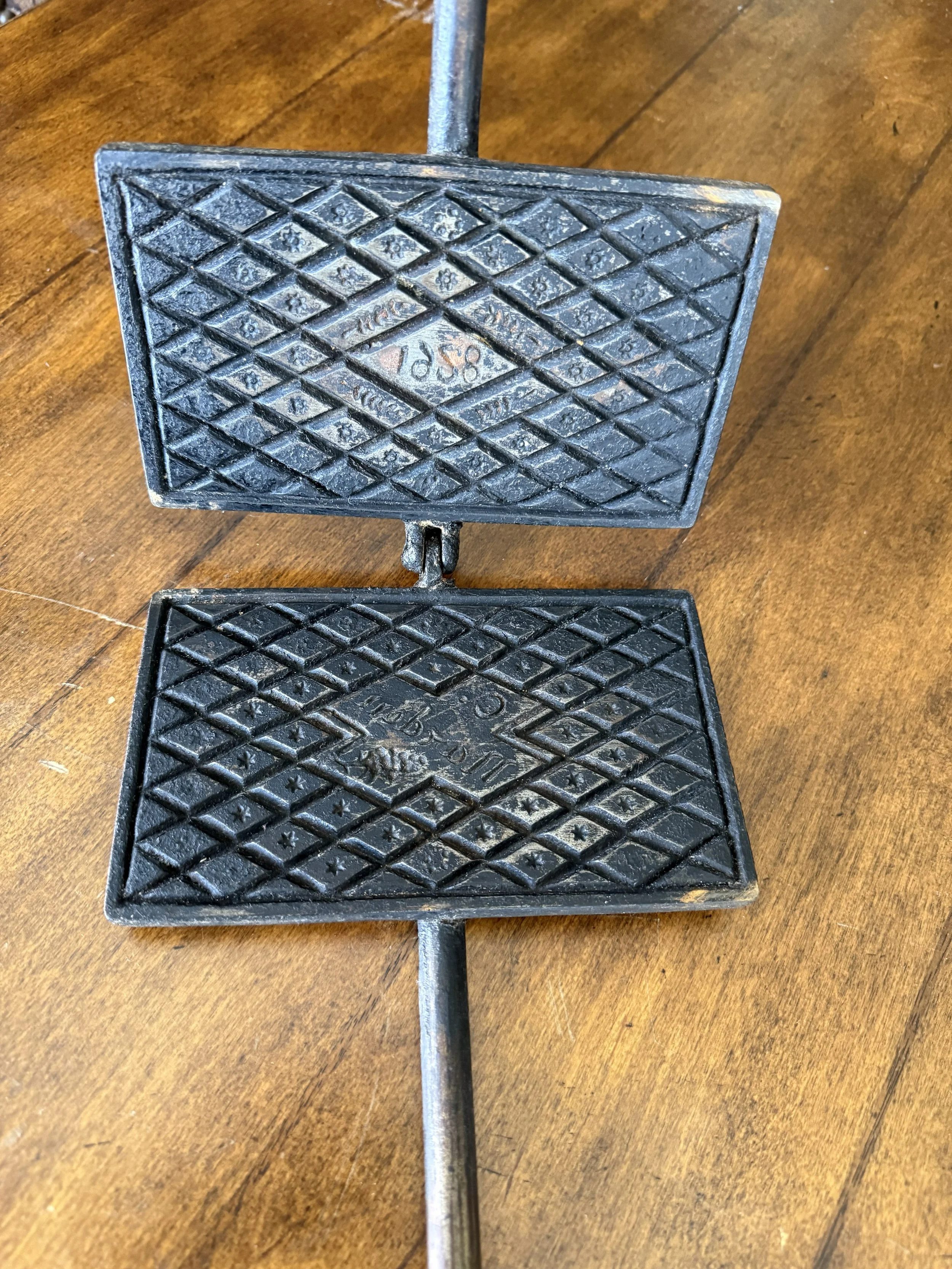
Both paddles shown open, interior surfaces facing up, displaying the full diamond crosshatch pattern with star and rosette motifs on each paddle. The upper paddle carries the “1858” date marking; the lower paddle carries the “Wapakoneta O” and “No 258” markings. The cast iron hinge and twin rod handles are visible. This camp-style form was designed to be held over an open fire or placed on a wood-burning stove.
Piece Details
Manufacturer
Unknown — marked “Wapakoneta O” only (no company name)
Piece Type
Camp / Hearth Waffle Iron
Form
Rectangular hinged paddles with long iron rod handles; diamond crosshatch pattern with star and rosette motifs
Material
Cast Iron
Marking
“Wapakoneta O” and “No 258” on one paddle interior; “1858” on opposite paddle interior
Pattern Number
No. 258
Date of Manufacture
1858
Place of Manufacture
Wapakoneta, Auglaize County, Ohio
Condition
Good — legible markings on both paddles; crosshatch pattern intact; hinge functional; rod handles intact; surface wear consistent with age and use; no cracks
Acquisition Date
March 12, 2026
Acquisition Source
eBay — Seller: pre5434
eBay Item Number
227213673735
Order Number
26-14333-17470
SSC Catalog Number
SSC-WAPAKO-WFL-258-001
Collection Designation
Ohio Foundry Corridor
The Ghost Foundry: Wapakoneta Before Wapak
No company name. No trademark. No advertisement. No entry in any known foundry database. The maker of this waffle iron left behind only two pieces of identifying information: the town where it was cast and the number assigned to this pattern. That is the reality of antebellum foundry documentation—or rather, the lack of it. In the 1850s, hundreds of small foundries operated across Ohio, most of them serving local communities with stoves, plows, kettles, sad irons, waffle irons, and other household and agricultural castings. The vast majority of these foundries were never documented in the reference sources that modern collectors rely on. They existed, they cast iron, they served their communities, and they disappeared without leaving a corporate record behind.
Auglaize County was established in 1848, just ten years before this waffle iron was cast. Wapakoneta, the county seat, was a growing agricultural center connected to markets in Cincinnati and Toledo by the Miami and Erie Canal. The canal system enabled small manufacturers to receive pig iron and foundry sand and to ship finished goods to regional customers. A foundry operating in Wapakoneta in 1858 would have served the surrounding farm communities of Auglaize County—producing the cookware, tools, and hardware that settlers needed in a region still being cleared and developed. The diamond-pattern waffle iron was a standard offering for such a foundry: a practical cooking implement that demonstrated the caster’s skill and sold at the local hardware store or general merchandise shop.
The pattern number “No 258” suggests this was not a tiny one-man operation. A foundry with at least 258 cataloged patterns was producing a meaningful range of products—stoves, cookware, farm implements, and possibly architectural castings. This was a real foundry, with a real catalog, serving a real market. It simply did not survive into the era of published directories, trade journals, and collector reference books. What survives is the iron itself.
Wapakoneta’s Cast Iron Timeline
1833
Wapakoneta platted as a settlement along the Auglaize River in western Ohio, on lands formerly occupied by the Shawnee.
1848
Auglaize County established; Wapakoneta designated as county seat. Miami and Erie Canal connects the region to Cincinnati and Toledo markets.
1858
This waffle iron cast by an unknown foundry in Wapakoneta, marked “Wapakoneta O / No 258.” Earliest known marked cast iron artifact from the town. The pattern number suggests a foundry with a substantial product catalog.
1861–1865
Civil War disrupts Ohio manufacturing. Many foundries shift to war production or close. The fate of Wapakoneta’s antebellum foundry is unknown.
1903
Wapak Hollow Ware Co. established in Wapakoneta by Milton Bennett, Marion Stephenson, Harry Bennett, Charles Stephenson, and S.P. Hick. The first known named foundry in the town to appear in collector reference databases.
1903–1926
Wapak Hollow Ware produces full lines of cast iron cookware including skillets, Dutch ovens, waffle irons, sad irons, and bean pots. Known for the Indian Head logo and lightweight “thin wall” construction.
1926
Wapak Hollow Ware files for bankruptcy and closes.
c. late 1920s
Former Wapak employees Ahrens and Arnold establish their own foundry in Wapakoneta, producing skillets with a distinctive double-A and arrow logo. Production is limited and short-lived.
Wapakoneta’s Five Makers: The Deepest Bench in the SSC Collection
With this acquisition, the SSC collection now documents five distinct makers from a single small Ohio town—a depth of representation unmatched by any other city in the collection. Wapakoneta, a community of fewer than ten thousand people in Auglaize County, produced cast iron across nearly a century of American manufacturing history, and the SSC collection now holds evidence of every known phase of that production.
The timeline begins here, in 1858, with an unnamed foundry casting household implements for the surrounding agricultural community. It continues with the Wapak Hollow Ware Company (1903–1926), the town’s most famous foundry, which produced the Indian Head skillets and Oneta economy line that collectors prize today. It extends to Ahrens and Arnold, the short-lived successor operation founded by former Wapak employees in the late 1920s, whose double-A arrow logo marks some of the rarest Wapakoneta castings in existence. Together, these makers trace Wapakoneta’s arc from frontier settlement to industrial town to post-industrial footnote—and the SSC collection tells that story through the iron itself.
No other Wapakoneta collector resource tells this story. CastIronCollector.com documents Wapak Hollow Ware. Boonie Hicks covers the Indian Head and logo variations. But no existing resource places these makers in a continuous narrative that begins in 1858—because until this waffle iron surfaced, there was no physical evidence that cast iron manufacturing in Wapakoneta predated Wapak Hollow Ware by nearly half a century. This piece changes that. It pushes the Wapakoneta iron story back to the antebellum period and establishes the town’s foundry heritage as older and deeper than the collector community has previously documented.

Side view of the waffle iron closed, showing the full approximately twenty-one-inch length from handle tip to handle tip. The rectangular paddles sit flush when closed, with the cast iron hinge visible at center. The long rod handles were designed to keep the cook at a safe distance from hearth coals or a wood-burning stove—a standard camp-style form for mid-nineteenth-century waffle irons.
Why This Piece Matters
The unknown Wapakoneta foundry No. 258 camp waffle iron matters because it is the oldest marked piece in the SSC collection from a town that most collectors associate only with Wapak Hollow Ware. It pushes Wapakoneta’s documented cast iron heritage back to 1858—three years before the Civil War, ten years after Auglaize County was organized, and forty-five years before the foundry that put “Wapak” on the collecting map. It is physical evidence of a ghost foundry: a manufacturer that existed, that produced a meaningful catalog of products (at least 258 patterns), that served the agricultural communities of western Ohio, and that left no trace in any known directory, database, or reference book. The only record it left behind is the iron itself.
For the SSC collection, this waffle iron fills two gaps simultaneously. It adds another Wapakoneta maker to a roster that already runs deeper here than in any other city. And it extends the collection’s timeline into the antebellum period—the oldest era of Ohio foundry production, when iron was cast by hand in small-town foundries that served their neighbors and asked nothing more than the name of their town cast into the iron as identification. “Wapakoneta O. No 258. 1858.” That is enough. That is the whole story, written in iron, waiting 168 years to be read.
The iron endures. The markings tell the truth. The story deserves to be told.
Sources & Further Reading
CastIronCollector.com — Wapak Hollow Ware Co. foundry entry: Location, founders, period of production (1903–1926), brand names (Wapak, Oneta). Foundry Database compiled by Steve Stephens.
CastIronCollector.com — Waffle Irons reference page: History of waffle iron design, pattern types, and manufacturing conventions including patent date inscriptions.
Boonie Hicks (booniehicks.com) — “Your Complete Guide to Wapak Cast Iron”: Identification of Ahrens and Arnold as former Wapak employees producing skillets with double-AA arrow logo, late 1920s.
Wikipedia — Wapakoneta, Ohio: Settlement history, platting (1833), designation as Auglaize County seat (1848), population data.
Countryaah.com — History of Auglaize County, Ohio: Canal system development, early agricultural economy, emergence of mills, factories, and foundries in the late 1800s.
SSC Internal Collection Records — Wapakoneta foundry pieces in the SSC collection.
About Steve’s Seasoned Classics
Steve’s Seasoned Classics is an online museum dedicated to preserving and documenting the heritage of American cast iron, with a focus on Ohio foundry pieces from the 19th and early 20th centuries. The SSC collection features over 130 pieces with detailed provenance, historical research, and photography for each item.
