The W. Resor & Co. Cincinnati Cast Iron Waffle Iron
SSC MUSEUM COLLECTION
Catalog No. SSC-RESOR-WAF-1880-001
Stove-Top Waffle Iron | High Handle | Radial Fan Pattern | Ring Base | Cincinnati, Ohio
Circa 1860–1890 • Wm. Resor & Co. • Ohio Foundry Corridor

Top view showing “W. RESOR & CO.” and “CINCINNATI.” cast in raised letters in a circular arc on the upper plate, with a teardrop-shaped finial at center. The high loop handle rises above the hinge. The waffle iron sits in a separate ring base (visible at the bottom of the frame) designed to rest in a stove-eye opening. This piece was received by SSC in museum-quality professional restoration—the finest condition of any piece in the collection. The casting surfaces are flawless, the seasoning is uniform and deep black, and there is not a single defect, crack, pit, or wear mark visible anywhere on the piece.
There are pieces in a collection that document a foundry. And then there are pieces that define a collection. This waffle iron is the latter. It arrived at SSC in a state of professional restoration so perfect that it looks as though it left the Resor foundry yesterday—not a hundred and forty years ago. The casting is flawless. The seasoning is uniform, deep, and lustrous. The hinge operates smoothly. The radial fan waffle pattern on both plates is crisp and sharp, with every pyramid and every grid line intact. The ring base is complete and undamaged. The high loop handle rises above the iron in a graceful arc. There is not a single flaw anywhere on this piece—no cracks, no pits, no chips, no warping, no repairs. It is, without qualification, museum quality.
And the name on its face—W. Resor & Co., Cincinnati—connects it to one of the most important families in the history of Cincinnati manufacturing. The Resors did not merely make stoves. They opened Cincinnati’s first stove factory. They held the patent for the Resor cooking stove. They built a mansion that is now on the National Register of Historic Places. They helped found the Cincinnati Zoo and the Cincinnati Art Museum. And they manufactured this waffle iron—along with tea kettles, parlor stoves, ranges, and hollow ware—from their foundry in a city that they helped build.
The Resor Dynasty: Cincinnati’s First Stove Factory

Detail view of the top plate markings: “W. RESOR & CO.” arcing above and “CINCINNATI.” arcing below, with a teardrop finial at center for lifting the upper plate. The raised letters are crisp and fully legible—a hallmark of the museum-quality restoration this piece received before entering the SSC collection. The Resor name on a piece of Cincinnati cast iron carries the weight of a family that helped define the city’s manufacturing identity.
The Resor story begins in 1811, when Jacob Resor arrived in Cincinnati by flatboat from Mercersburg, Pennsylvania. He established a tin and copper-smithing business—one of the essential trades in a frontier river town that was growing rapidly as the gateway to the American West. By 1819, Jacob and his sons William and Reuben had expanded from tinsmithing into stove manufacturing. In 1835, they received the patent for the Resor cooking stove and opened what is documented as Cincinnati’s first stove factory.
William Resor (1810–1874) became the driving force behind the company’s growth. Under his leadership, Wm. Resor & Co. became one of Cincinnati’s premier stove manufacturers, producing the Monitor line of stoves and ranges and the Peerless line of parlor stoves. By the time of the Civil War, Resor stoves were considered, in the words of period sources, “unequaled for economy in fuel consumption, durability, quality, and elegance.” William Resor received patents for the majority of his stove designs in 1854, and the company’s products were distributed across the Midwest and beyond.
The prosperity of the stove factory made William Resor one of Cincinnati’s wealthiest and most prominent citizens. In 1843, he built a Greek Revival home on thirty acres of land in the Clifton neighborhood—a property described by Sidney D. Maxwell in his 1870 book The Suburbs of Cincinnati as the “most desirable place in Clifton.” After the Civil War, the house was extensively renovated by Isaiah Rogers—the architect known as “the father of the American hotel”—who added Italianate interior alterations, a Mansard roof, and cast iron exterior details. The William Resor House was listed on the National Register of Historic Places in 1973 and remains standing at 254 Greendale Avenue, Cincinnati.
In his later years, William Resor became a civic leader. He participated in the establishment of the Cincinnati Zoo—one of the oldest zoos in the United States, opened in 1875—and in the creation of the Cincinnati Art Museum, which opened in 1886. The Resor family’s connection to Cincinnati’s cultural institutions is as significant as their contribution to its manufacturing base: they built the stoves that heated Cincinnati’s homes, and they helped build the institutions that defined its cultural life.
The Waffle Iron: Form and Function

Open view showing both waffle plates and the high loop handle. The lower plate displays the radial fan waffle pattern divided into four quadrants by crossed divider bars, with concentric arcs of diamond-shaped pyramids radiating from a central hub. The upper plate shows the matching pattern from its interior face. The hinge mechanism connecting the two plates is visible at top. The ring base—a separate piece—holds the lower plate in position over a stove eye. The restoration quality is evident: both cooking surfaces are uniformly seasoned with no pitting, rust, or wear.
This is a high-handle stove-top waffle iron—a form designed for use on a wood-burning or coal-burning cast iron cooking stove. The waffle iron consists of three components: a lower plate with the waffle grid pattern, an upper plate hinged to the lower with a high loop handle for lifting and flipping, and a separate ring base that sits in a stove-eye opening to hold the iron over direct heat. The cook would heat the iron in the ring base, pour batter onto the lower plate, close the upper plate, and flip the entire assembly to cook both sides evenly.
The waffle pattern on this Resor iron is a radial fan design—one of the most visually striking patterns in American waffle iron production. The cooking surface is divided into four quadrants by crossed divider bars. Within each quadrant, concentric arcs of diamond-shaped pyramids radiate from a central hub, creating a pattern that produces waffles with a distinctive fan-shaped grid rather than the rectangular grid pattern familiar from modern waffle makers. This radial pattern is characteristic of mid-to-late nineteenth-century stove-top waffle irons and is found on pieces from several manufacturers, but each foundry’s execution of the pattern was unique to its own casting patterns.
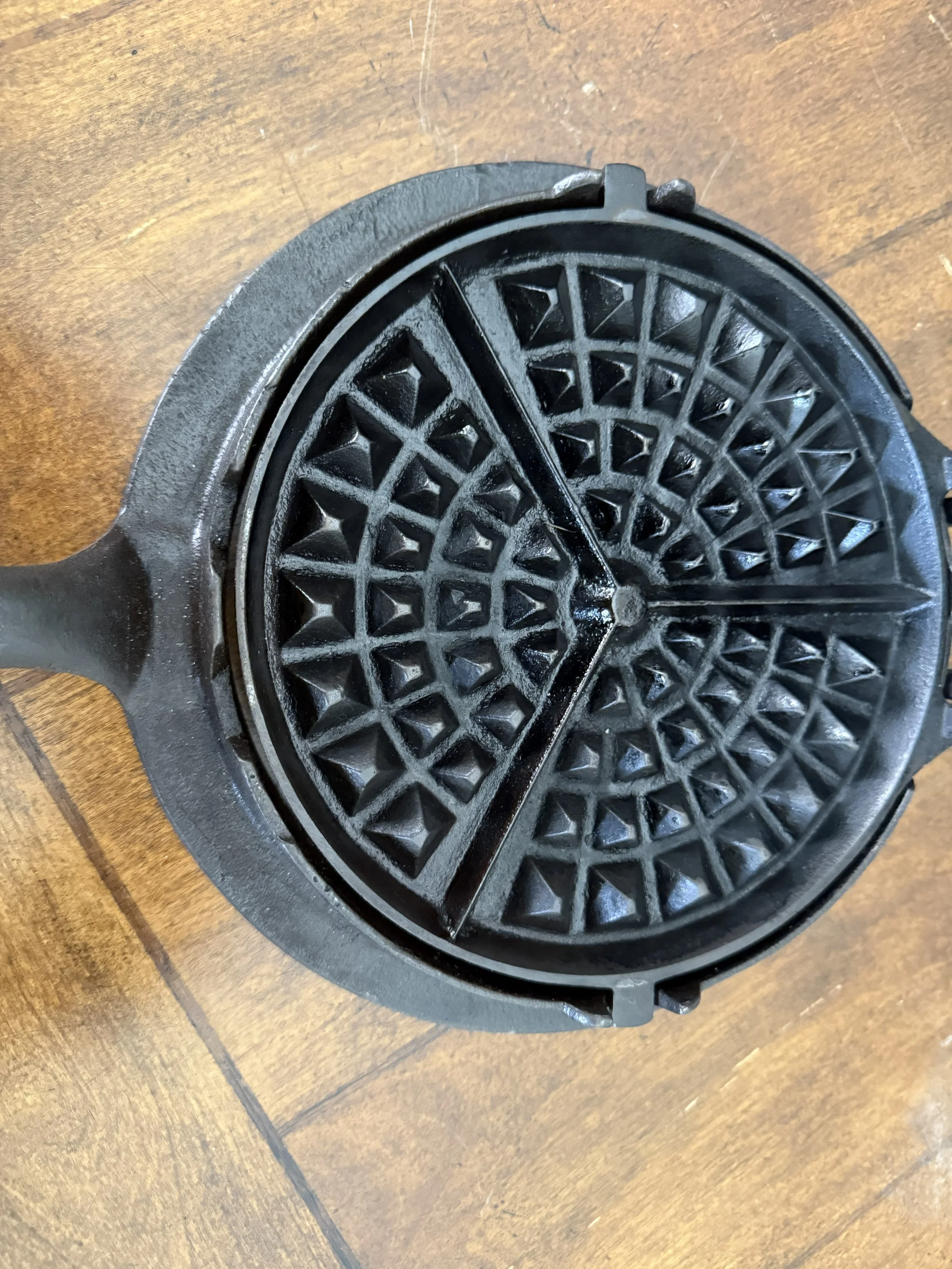
Detail of the lower waffle plate showing the radial fan pattern: diamond-shaped pyramids arranged in concentric arcs within each of the four quadrants. The depth and crispness of the casting are exceptional—every pyramid is sharply defined, every grid line is clean, and the divider bars are perfectly straight. This level of casting quality, combined with the flawless restoration, makes this piece a definitive example of the Resor foundry’s work.
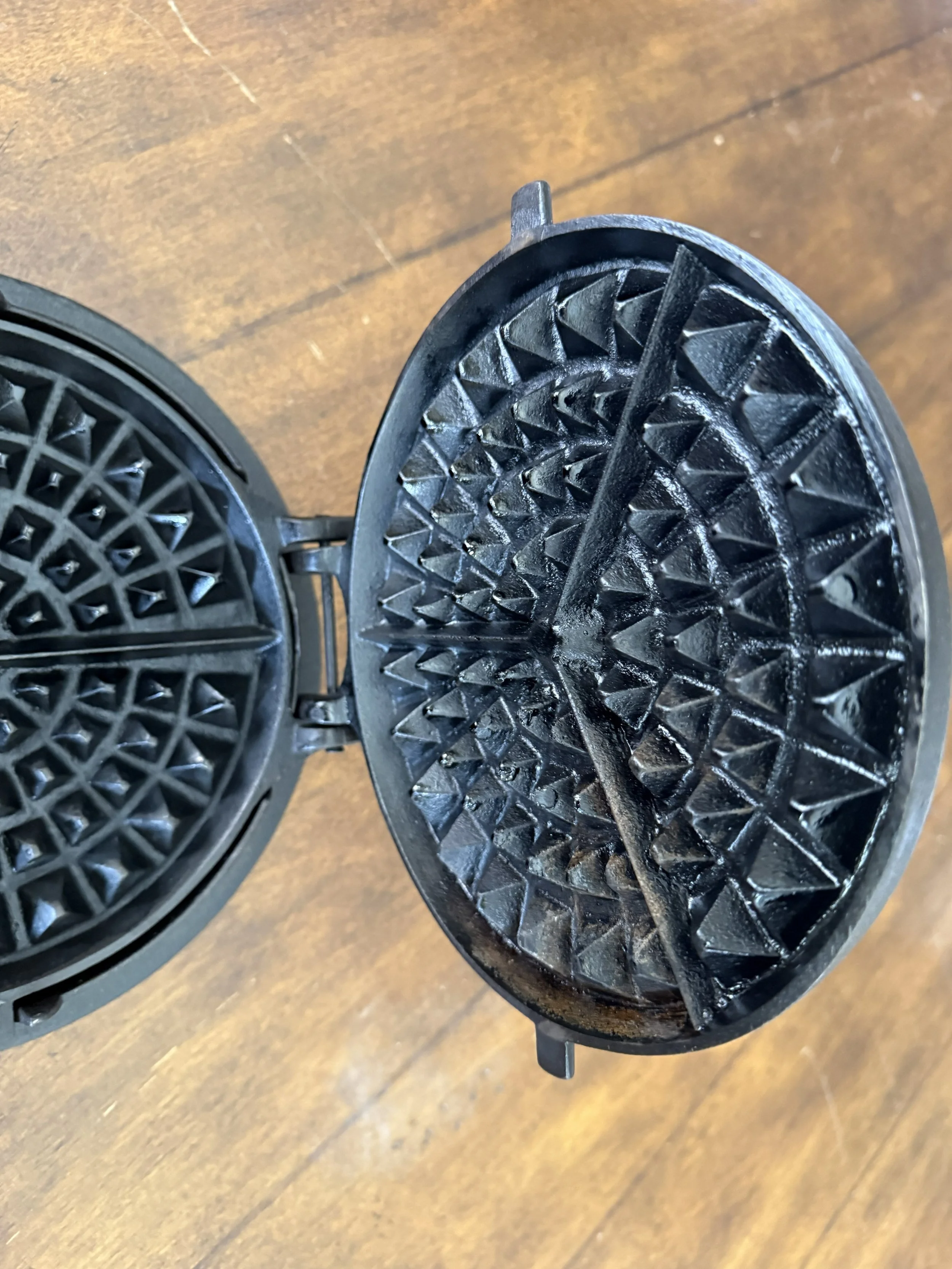
Detail of the upper plate interior showing the matching radial fan pattern. The upper plate’s pyramids are slightly different in proportion from the lower—a common feature in waffle irons, where the two plates create interlocking patterns that produce uniform waffle depth on both sides. The seasoning on the interior cooking surface is uniform and shows no evidence of pitting, corrosion, or prior damage.
The Ring Base: A Three-Part System

The waffle iron removed from its ring base, showing the three-part system: the waffle iron paddle (lower plate with handle and hinged upper plate) and the separate ring base with its own loop handle. The ring base sits in a stove-eye opening; the waffle iron paddle drops into the ring, resting on tabs or notches that hold it at the correct height over the fire. The base markings—“W. RESOR & CO.” and “CINCINNATI.”—are visible on the waffle iron’s lower plate. The ring base is unmarked but original to the piece. Note that the ring base handle and the waffle iron handle are different designs: the ring base has a simple loop, while the waffle iron has the high arched handle for lifting and flipping.
Piece Details
Manufacturer
Wm. Resor & Co., Cincinnati, Ohio
Piece Type
Cast Iron Stove-Top Waffle Iron with Ring Base
Form
High-handle hinged waffle iron with radial fan pattern, four-quadrant grid, separate ring base for stove-eye mounting; three-part system (upper plate, lower plate, ring base)
Material
Cast Iron
Marking
“W. RESOR & CO.” and “CINCINNATI.” in raised letters on upper plate
Waffle Pattern
Radial fan design with diamond-shaped pyramids in concentric arcs, divided into four quadrants by crossed divider bars
Purpose
Domestic stove-top waffle iron for wood-burning or coal-burning cooking stoves
Date of Manufacture
Circa 1860–1890
Place of Manufacture
Cincinnati, Hamilton County, Ohio
Condition
Museum quality — professional restoration to flawless condition; all markings crisp and fully legible; both waffle plates intact with sharp, undamaged grid patterns; hinge functional; ring base complete and undamaged; uniform deep black seasoning throughout; no cracks, chips, pitting, warping, rust, or repairs of any kind; the finest condition piece in the SSC collection
Acquisition Date
March 14, 2026
Acquisition Source
eBay — Seller: brfo_7838
eBay Item Number
147194510792
Order Number
03-14375-01378
SSC Catalog Number
SSC-RESOR-WAF-1880-001
Collection Designation
Ohio Foundry Corridor
Corporate Timeline: Wm. Resor & Co.
1811
Jacob Resor arrives in Cincinnati by flatboat from Mercersburg, Pennsylvania. He establishes a tin and copper-smithing business in the growing river town.
c. 1819
Jacob Resor and his sons William and Reuben expand from tinsmithing into stove manufacturing, becoming among the earliest stove makers in Cincinnati.
1835
The Resors receive the patent for the Resor cooking stove and open what is documented as Cincinnati’s first stove factory.
1843
William Resor builds a Greek Revival home on thirty acres in the Clifton neighborhood of Cincinnati—later described as “the most desirable place in Clifton.”
1854
William Resor receives patents for the majority of his stove designs. The company manufactures and sells the Monitor line of stoves and ranges and the Peerless line of parlor stoves.
c. 1860–1890
Wm. Resor & Co. produces a full line of stoves, ranges, and hollow ware including waffle irons and tea kettles from its Cincinnati foundry. Products are distributed across the Midwest.
c. 1865–1870
After the Civil War, architect Isaiah Rogers—“the father of the American hotel”—renovates the William Resor House with Italianate alterations, a Mansard roof, and cast iron exterior details.
1874
William Resor dies. The company continues under the Resor name.
1875
The Cincinnati Zoo opens—one of the oldest zoos in the United States. William Resor was among those who participated in its establishment.
1878
An annual catalog of Wm. Resor & Co. is published and survives at the Cincinnati Public Library—a primary source document for the company’s product line.
1886
The Cincinnati Art Museum opens. William Resor participated in its creation before his death.
1973
The William Resor House at 254 Greendale Avenue, Clifton, Cincinnati, is listed on the National Register of Historic Places.
Cincinnati’s Stove Capital: The Resor Legacy in Context
The SSC collection now documents six Cincinnati manufacturers, and W. Resor & Co. stands apart from all of them. Perin & Gaff was a general hardware manufacturer. Kingery made food-service equipment. Adams & Britt was a small hollow ware partnership. John David Browne was an individual inventor. But Wm. Resor & Co. was Cincinnati’s foundational stove manufacturer—the company that opened the city’s first stove factory in 1835 and helped establish Cincinnati as a center of the American stove industry in the decades before the Civil War.
The Resor family’s story parallels the story of Cincinnati itself. Jacob Resor arrived in 1811, when Cincinnati was a frontier town. By 1835, his family was manufacturing stoves—the essential heating and cooking appliance of nineteenth-century American life. By the 1860s, Resor stoves were distributed across the Midwest, and William Resor was one of Cincinnati’s most prominent citizens. By the 1870s and 1880s, the family was helping to build the cultural institutions—the zoo, the art museum—that transformed Cincinnati from a manufacturing city into a cultural capital. The waffle iron in the SSC collection is a product of the same foundry that made all of this possible: a piece of domestic cookware from a company whose prosperity built mansions, founded museums, and shaped the identity of a city.
Why This Piece Matters
The W. Resor & Co. Cincinnati cast iron waffle iron matters because of what it is and because of how it arrived. What it is: a marked piece of hollow ware from Cincinnati’s first stove factory, a company founded in 1835 by a family that helped build the city’s manufacturing base and its cultural institutions. How it arrived: in a state of professional museum-quality restoration so perfect that it sets the standard for the entire SSC collection. There is not a single flaw on this piece. Every marking is legible. Every grid line is sharp. Every surface is uniformly seasoned. It is the piece that visitors will see first, and it is the piece that will represent the SSC collection’s commitment to preserving Ohio cast iron at the highest possible standard.
It matters because the Resor name deserves to be remembered. Jacob Resor arrived by flatboat in 1811 and built a tin shop. His son William opened Cincinnati’s first stove factory and built a mansion that still stands on the National Register. His stoves heated homes across the Midwest. His philanthropy helped create the Cincinnati Zoo and the Cincinnati Art Museum. And his foundry cast this waffle iron—a piece of domestic technology so beautifully restored that it looks like it was made this morning.
One hundred and eighty dollars on eBay. A perfect waffle iron from a perfect foundry, in perfect condition. It is the finest piece in the SSC collection, and it carries the name of a family that built Cincinnati.
The iron endures. The markings tell the truth. The story deserves to be told.
Sources & Further Reading
Physical examination of piece: W. Resor & Co. Cincinnati cast iron waffle iron. Museum-quality professional restoration. Marked “W. RESOR & CO.” and “CINCINNATI.” in raised letters on upper plate. High-handle hinged design with radial fan waffle pattern and separate ring base.
Cincinnati Refined (cincinnatirefined.com) — “The William Resor House Was Once Considered The Most Desirable Place To Live In Cincy.” Documents the Resor family history: Jacob Resor’s 1811 arrival, the tin and copper-smithing business, the 1819 expansion into stoves, the 1835 Resor cooking stove patent, Cincinnati’s first stove factory, and William Resor’s civic contributions to the Cincinnati Zoo and Art Museum. History researched by Walter E. Langsam.
Wikipedia — “William Resor House.” Documents the 1843 construction, Isaiah Rogers renovation, and 1973 listing on the National Register of Historic Places.
Geni.com — Genealogy profile for William Resor (1810–1874). Confirms 1854 stove patents and Monitor Stoves and Ranges product line.
Cast Iron Historical Society (cihist.wordpress.com) — “United States Stove Industry” finding aid. Documents “1 annual catalogue, Wm. Resor & Co, Cincinnati, Ohio. 1878. Cincinnati Public Library.”
WAGS Society Foundry Database (wag-society.org) — “RESOR- W. RESOR & CO. CINCINNATI — waffle irons, tea kettles.”
McLeod County Historical Society (pastperfectonline.com) — Catalog record for Wm. Resor & Co. Peerless Model 14 parlor stove in museum collection.
SSC Internal Collection Records — Cincinnati manufacturer pieces: Perin & Gaff Mfg. Co. (SSC-PG-FLT-KNOX-001, SSC-PG-PLY-1876-001), Kingery Mfg. Co. (SSC-KINGERY-SCP-1894-001), Adams & Britt (SSC-ADAMSBRITT-KTL-1872-001), John David Browne (SSC-BROWNE-BRM-1865-001).
About Steve’s Seasoned Classics
Steve’s Seasoned Classics is an online museum dedicated to preserving and documenting the heritage of American cast iron, with a focus on Ohio foundry pieces from the 19th and early 20th centuries. The SSC collection features over 130 pieces with detailed provenance, historical research, and photography for each item.
