The H.S. Pease Enameled Three-Leg Safety Kettle
SSC MUSEUM COLLECTION
Catalog No. SSC-PEASE-KTL-1874-001
Enameled Safety Kettle | Three Legs | Bail Handle | Pour Spout | Porcelain Interior | Cincinnati, Ohio
Circa 1874–1890 • H.S. Pease • Ohio Foundry Corridor
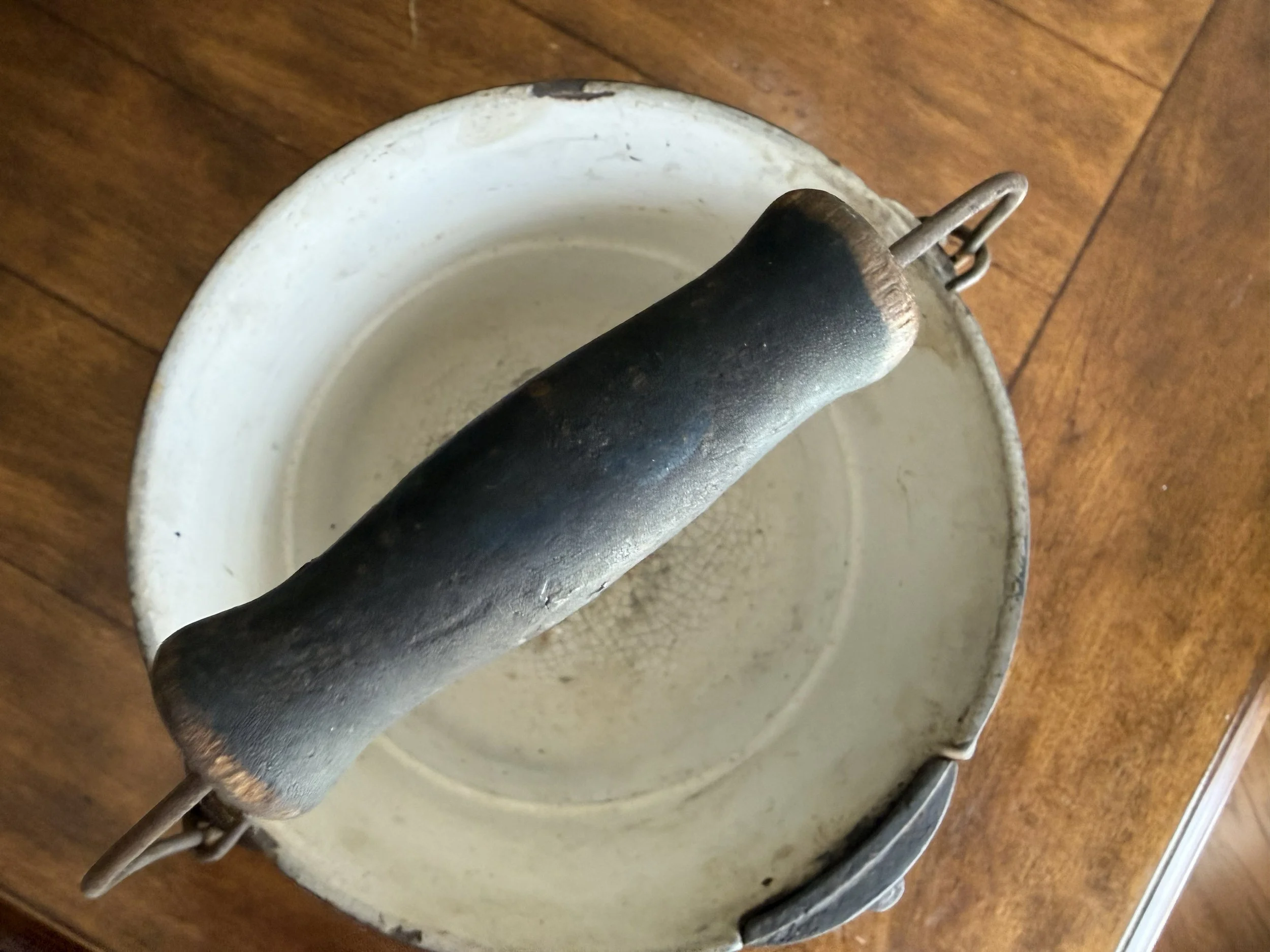
Interior view showing the white porcelain enamel lining—a feature that distinguishes this piece from virtually every other kettle in the SSC collection. The enamel surface shows the fine crazing pattern characteristic of nineteenth-century porcelain enamel that has survived more than a century of thermal cycling. The bail handle with turned wooden grip crosses the opening. The pour spout is visible at the rim. The enamel is substantially intact with no chips exposing bare iron on the interior cooking surface. This piece is preserved in its original found condition—no restoration has been performed, and none will be. The patina, the wear, and the enamel are all irreplaceable original evidence.
There are pieces that are rare, and then there are pieces that are singular. This is the latter. In more than a year of building the SSC collection—acquiring pieces from dozens of Ohio foundries, studying thousands of listings, and documenting hundreds of markings—nothing like this has appeared before. A three-leg cast iron safety kettle with a complete porcelain enamel interior, manufactured by H.S. Pease of Cincinnati, Ohio, carrying the maker’s mark on the bottom, with the original japanned exterior and enamel intact. It is, as the eBay seller accurately described it, one of a kind.
H.S. Pease—Horace S. Pease of Cincinnati—was a prolific inventor and manufacturer of specialized cast iron household implements in the second half of the nineteenth century. The WAGS Society foundry database lists him as a maker of patented safety kettles. Patent records document his work from at least 1874 through 1907, with patents covering safety kettles, charcoal-heated sad irons with integral fluting capability, combination ironing and fluting devices, and sad iron stands. His products were marked “H.S. PEASE CIN’TI. O.” and carried various patent dates. He was not a general hardware manufacturer like Perin & Gaff, nor a stove company like Resor. He was a specialist—an inventor-manufacturer who designed and produced a specific category of patented household devices from his Cincinnati operation.
This kettle represents a form that has almost entirely vanished from the collector record. Enameled cast iron from the nineteenth century is rare in any form—the enamel was fragile, the thermal stresses of stove-top use caused chips and cracks, and most enameled pieces were discarded when the coating failed. An enameled three-leg kettle from an obscure Cincinnati manufacturer, with the enamel substantially intact, is a survival that borders on the miraculous. SSC has chosen to preserve this piece exactly as found—no restoration, no cleaning beyond stabilization, no attempt to improve or alter its appearance. The original patina, the original enamel, the original wear patterns—these are all primary evidence that cannot be recreated, and they will not be disturbed.
Horace S. Pease: Cincinnati’s Specialist Inventor

Rear profile view showing the kettle’s bulged body form, the bail handle attachment lugs, and the original japanned (lacquered black) exterior with age-appropriate wear, patina, and surface loss. The white porcelain enamel interior is visible at the rim. The overall form is consistent with a mid-to-late nineteenth-century safety kettle designed for stove-top use—the bulged body maximizes volume while the three legs provide stable support on a stove plate or hearth.
Horace S. Pease operated from Cincinnati, Hamilton County, Ohio, during the second half of the nineteenth century and into the early twentieth century. Unlike the general hardware manufacturers and stove companies that dominated Cincinnati’s foundry district, Pease occupied a specialized niche: he designed and manufactured patented household implements—primarily kettles and irons—that incorporated specific engineering innovations protected by U.S. patents.
The earliest documented Pease patent is referenced as “Pat. 74” (1874) on surviving charcoal irons and safety kettles, indicating a patent granted in that year. Later patents include designs for charcoal-heated sad irons with removable fluting handles (patent dates of 1885 and 1888), a fluting device and stand (U.S. Patent No. 768,072, August 23, 1904), and an improved sad iron stand (U.S. Patent No. 873,779, December 17, 1907). The 1904 patent specification identifies the inventor as “Horace S. Pease of Cincinnati, Ohio” and describes a charcoal iron that served double duty as a fluting iron—a design that combined two household tools into one.
The range of Pease’s surviving products documented in auction records and collector references includes safety kettles (like this piece), charcoal-heated sad irons, combination charcoal iron and fluter devices, matching trivets and stands, and three-gallon footed kettles with double handles. Every known piece carries the “H.S. PEASE CIN’TI. O.” mark and one or more patent dates. Pease was not a mass-production foundry—he was an inventor who manufactured his own patented designs, each one a specific solution to a specific household problem.
Porcelain Enamel on Cast Iron: A Fragile Technology
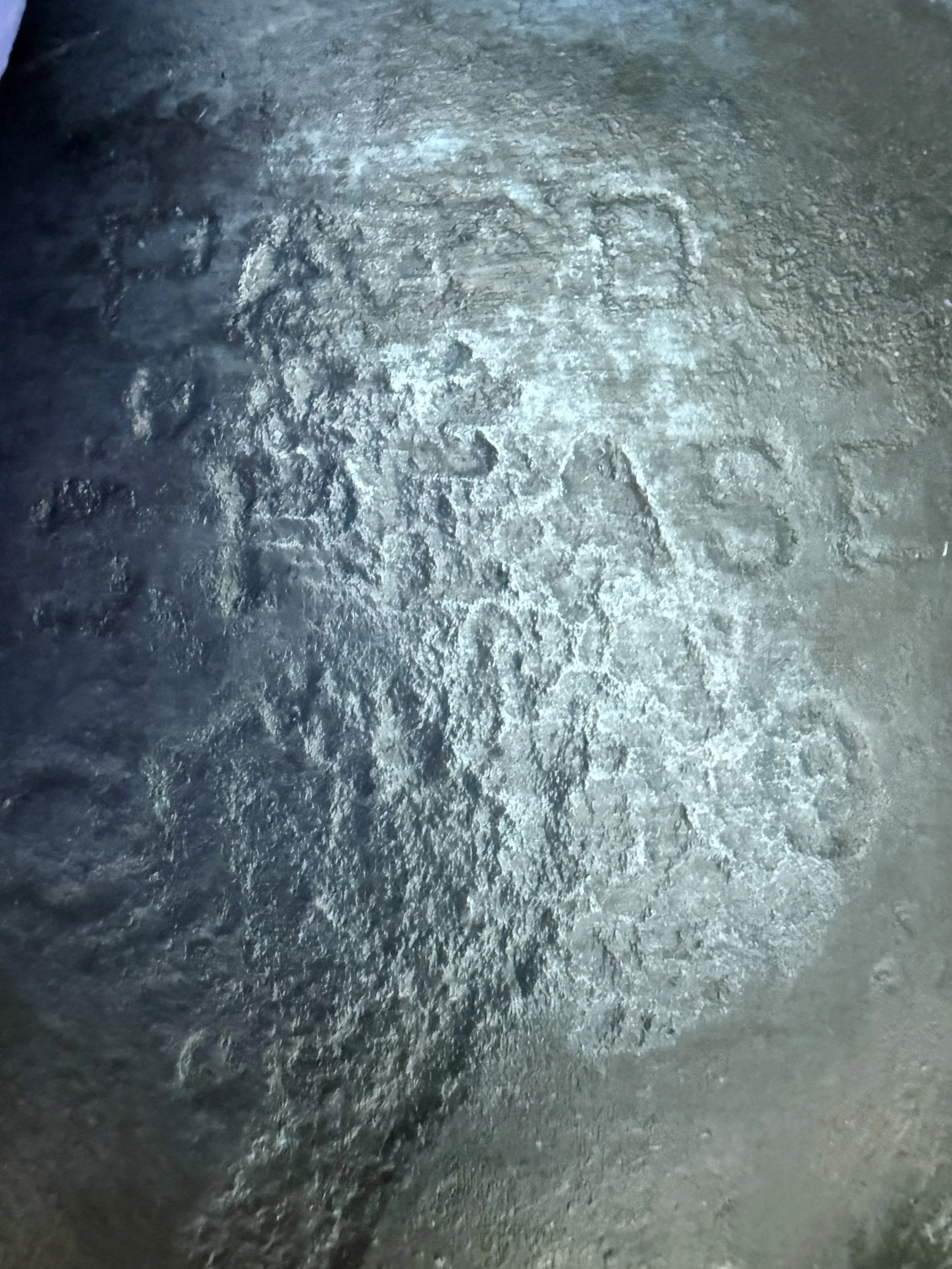
Bottom detail showing the maker’s mark cast into the underside of the kettle. The markings, though worn from age and use, are consistent with “H.S. PEASE” and “CIN’TI O.” visible in raised letters. A gate mark or casting seam may be present. The three leg stubs are visible around the perimeter. The surface shows the heavy patina and mineral deposits of a piece that has been in use and in storage for well over a century without restoration.
The white porcelain enamel interior of this kettle is its most extraordinary feature. Porcelain enamel—a glass-based coating fused to cast iron at high temperatures—was used on cast iron cookware and hollow ware beginning in the mid-nineteenth century. The coating provided a non-reactive, easy-to-clean cooking surface that prevented iron from leaching into acidic foods and eliminated the metallic taste that bare cast iron could impart to water and beverages. It was the premium finish of its era—more expensive to produce than bare or japanned iron, and more fragile.
The fragility is why so few nineteenth-century enameled pieces survive intact. Porcelain enamel is rigid glass bonded to a substrate that expands and contracts with temperature changes. Every heating and cooling cycle stressed the bond between the enamel and the iron. Over time, the enamel crazed—developing the fine network of surface cracks visible in this kettle’s interior—and eventually chips would form, exposing bare iron to moisture and beginning the corrosion process that destroyed most enameled pieces. A three-leg kettle that sat directly over fire or on a stove plate experienced more extreme thermal cycling than almost any other kitchen vessel, making the survival of this enamel interior all the more remarkable.
The crazing visible in this piece’s enamel is not damage—it is evidence. It documents more than a century of thermal cycling, each fine line in the glass surface recording another heating and cooling event. The enamel has not chipped through to bare iron on the interior cooking surface, which means the protective coating fulfilled its function for the entire working life of the kettle. This is what intact nineteenth-century porcelain enamel looks like after 130 or more years: crazed but unbroken, worn but still whole.
The Three-Leg Form: Hearth to Stove Transition

Side view showing the three-leg profile, the bulged kettle body, the bail handle lug, and the pour spout. The three cast legs are short and pointed—designed to support the kettle on a stove plate, hearth, or trivet rather than for freestanding hearth use like the taller-legged camp kettles and bean pots of earlier eras. The exterior shows original japanned finish with extensive wear and patina consistent with decades of stove-top service.
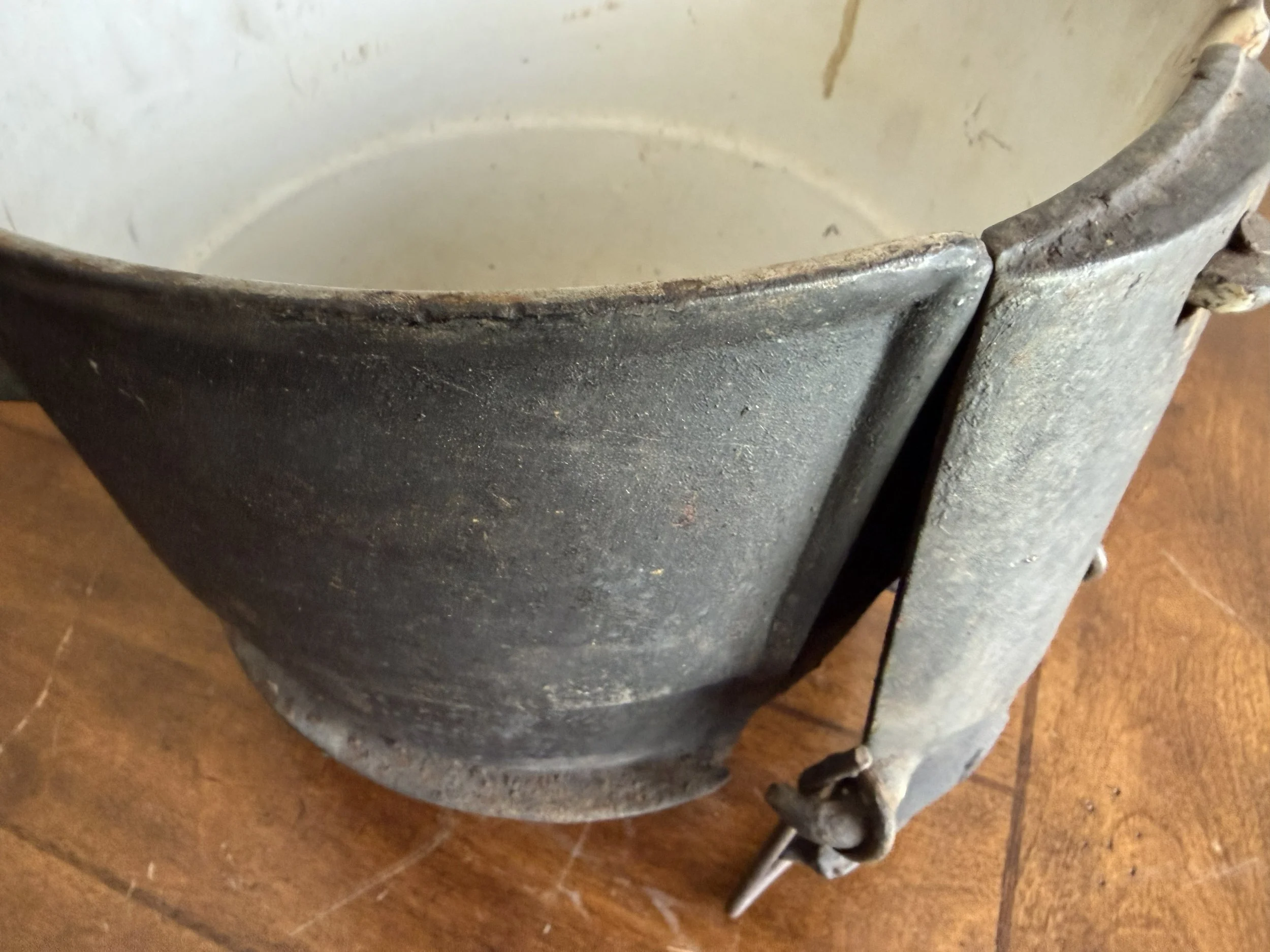
Opposite side view showing the second bail handle lug and the kettle’s overall proportions. The pour spout extends from the rim at approximately the two o’clock position. The body tapers slightly from the widest point toward the base, giving the kettle its characteristic bulged profile. The three legs are evenly spaced around the base circumference.
The three-leg kettle is one of the oldest forms in cast iron cookware—a direct descendant of the hearth-era cooking pots that hung from cranes or stood on legs over open fires. By the 1870s, the three-leg form was transitioning from hearth use to stove-top use: the legs were shorter, designed to stand on a stove plate rather than in a bed of coals, and the overall form was more refined. This Pease kettle represents that transitional period—a form rooted in the hearth tradition but adapted for the cast iron cooking stove that was rapidly becoming the standard in American kitchens.
The “safety” designation in the WAGS foundry database entry for Pease kettles likely refers to the pour spout design—a feature that allowed controlled pouring without the risk of scalding that came from tipping a lidless kettle. The J.H. Day & Company of Cincinnati produced similar “safety kettles” during the same period, with documented patent dates of 1874 and 1878. Pease and Day were contemporaries in Cincinnati’s hollow ware industry, both manufacturing patented kettle designs from the same city during the same era. The 1874 patent date on Pease products aligns with this safety-kettle design period.
Piece Details
Manufacturer
H.S. Pease (Horace S. Pease), Cincinnati, Ohio
Piece Type
Enameled Three-Leg Safety Kettle / Cooking Pot
Form
Three-leg bulged kettle with pour spout, wire bail handle with turned wooden grip, porcelain enamel interior, japanned exterior
Material
Cast Iron with porcelain enamel interior lining and japanned (lacquered black) exterior
Marking
“H.S. PEASE” and “CIN’TI O.” on bottom (worn but legible under examination)
Purpose
Stove-top cooking kettle / water boiler with non-reactive enameled interior for clean-tasting water and safe cooking of acidic foods
Date of Manufacture
Circa 1874–1890
Place of Manufacture
Cincinnati, Hamilton County, Ohio
Condition
Original found condition — no restoration performed; porcelain enamel interior substantially intact with period-appropriate crazing; no chips exposing bare iron on interior cooking surface; japanned exterior with heavy wear and patina; bail handle with original turned wooden grip; three legs intact; pour spout intact; maker’s marks legible under examination. Preserved as found — too rare and historically significant for any restoration that would disturb original surfaces.
Acquisition Date
March 18, 2026
Acquisition Source
eBay — Seller: browerville
eBay Item Number
331615794847
Order Number
14-14376-73417
SSC Catalog Number
SSC-PEASE-KTL-1874-001
Collection Designation
Ohio Foundry Corridor
Inventor Timeline: H.S. Pease (Horace S. Pease)
c. 1870s
H.S. Pease establishes operations in Cincinnati, Hamilton County, Ohio, as a manufacturer of patented cast iron household implements, specializing in safety kettles and heating irons.
1874
Earliest documented Pease patent (“Pat. 74”), referenced on surviving charcoal irons and safety kettles. This date aligns with the broader Cincinnati safety-kettle design period, contemporary with J.H. Day & Company’s similar patented kettles.
c. 1874–1890
Pease manufactures enameled and unenameled safety kettles, footed cooking pots, and charcoal-heated irons from his Cincinnati operation. Products are marked “H.S. PEASE CIN’TI. O.” with patent dates.
1885–1888
Additional patents granted for charcoal-heated sad irons with removable fluting handles—combination devices that served as both pressing irons and fabric fluters. Patent dates of August 1886 and August 14, 1888 appear on surviving examples.
Aug. 23, 1904
U.S. Patent No. 768,072 granted to Horace S. Pease of Cincinnati for a “Fluting Device & Stand”—a charcoal iron that served double duty as a fluting iron, with a stand designed to support both functions.
Dec. 17, 1907
U.S. Patent No. 873,779 granted to Horace S. Pease of Cincinnati for an improved sad iron stand. This is the latest known Pease patent, indicating active invention spanning more than three decades.
Conservation Decision: Preserved As Found

Bottom view showing the three legs, the maker’s mark area, and the overall condition of the base. The surface shows heavy patina, mineral deposits, and the accumulated evidence of more than a century of use and storage. This is what SSC has chosen to preserve—not a cleaned and seasoned reproduction of the piece’s original appearance, but the actual artifact as it survived, with every layer of its history intact.
Every other piece in the SSC collection has been conserved under the Archival Black™ protocol—lye degreasing, electrolysis, and hand finishing. This piece will not be. The decision was made at the moment of acquisition: this kettle is too rare, too old, and too historically significant to subject to any process that might disturb its original surfaces. The porcelain enamel interior is irreplaceable. The japanned exterior, with its wear patterns and patina, is primary evidence of how and where the kettle was used. The maker’s marks on the bottom, though worn, are legible under examination and would not benefit from cleaning that might remove surrounding material.
This is the SSC conservation philosophy taken to its logical conclusion. The Archival Black™ protocol exists to preserve original evidence. When the original evidence is best preserved by doing nothing—by leaving the piece exactly as found—then doing nothing is the correct conservation decision. This kettle will be photographed, cataloged, documented, and displayed exactly as it arrived. Its story is written in its surfaces, and SSC will not edit that story.
Cincinnati’s Ninth Maker: The Collection Grows
H.S. Pease is the ninth Cincinnati manufacturer documented in the SSC collection, joining Wm. Resor & Co., Perin & Gaff Manufacturing Co., Adams & Britt, Kingery Manufacturing Co., John David Browne, Prase, Peck Williamson & Company, and Century Machine Company. The Cincinnati Foundry Collection is now the largest single-city grouping in the museum, and each new maker adds a different dimension to the city’s manufacturing story. Resor made stoves. Perin & Gaff made general hardware. Adams & Britt made tea kettles. Kingery made food-service equipment. Browne patented broom heads. And now Pease adds the specialist inventor-manufacturer: a man who designed and produced his own patented safety kettles and combination irons from a Cincinnati workshop, holding patents across more than thirty years of continuous innovation.
Why This Piece Matters
The H.S. Pease enameled three-leg safety kettle matters because nothing else like it exists in the SSC collection—and nothing like it may exist in any collection that has been documented online. An enameled three-leg cast iron kettle from an obscure Cincinnati inventor-manufacturer, with the porcelain interior intact after more than 130 years, carrying the maker’s mark on its base, in its original unrestore condition—this is not a piece that appears in reference books or collector guides. It is not a form that the major foundry databases illustrate or describe. It exists in a space between the documented and the unknown, and it carries on its surfaces the evidence of a Cincinnati manufacturer whose story has never been told.
It matters because the enamel survived. Cast iron endures for centuries. Porcelain enamel does not. The fact that this coating—applied to this iron by a Cincinnati craftsman sometime between 1874 and 1890—has survived intact through 130 years of use, storage, neglect, and market circulation is extraordinary. It is the only enameled piece in the SSC collection, and it may remain the only one. When the enamel on a nineteenth-century kettle chips, the piece is discarded. This one did not chip. This one survived.
Two hundred dollars on eBay. A heavy iron pot with a white interior and a name on its bottom that almost nobody recognizes. It is the rarest piece in the SSC collection, and it will be preserved exactly as the Cincinnati craftsman who enameled it left it—untouched, unrestored, and undisturbed.
The iron endures. The markings tell the truth. The story deserves to be told.
Sources & Further Reading
Physical examination of piece: H.S. Pease enameled three-leg safety kettle. Porcelain enamel interior with period crazing; japanned exterior with heavy original patina; three legs; pour spout; bail handle with turned wooden grip. Bottom markings consistent with “H.S. PEASE” and “CIN’TI O.” Preserved in original found condition without restoration.
WAGS (Wagner and Griswold Society) Foundry Database (wag-society.org) — “PEASE- PAT’D, H.S. PEASE CIN’TI. O. — safety kettles.”
U.S. Patent No. 768,072 (August 23, 1904), “Fluting Device & Stand,” granted to Horace S. Pease of Cincinnati, Ohio. Documented in Trivetology.com patent research.
U.S. Patent No. 873,779 (December 17, 1907), “Sad Iron Stand,” granted to Horace S. Pease of Cincinnati, Ohio.
WorthPoint (worthpoint.com) — Multiple auction records for H.S. Pease products: coal-fired charcoal irons (patent dates 1885/1888), three-gallon footed kettles, combination charcoal iron/fluter devices. All marked “H.S. PEASE CINCINNATI, O.”
Trivetology.com — “Trivets and Stands with Patents” entry. Documents Horace S. Pease patents of 1904 and 1907 for fluting devices and sad iron stands.
SSC Internal Collection Records — Cincinnati manufacturer pieces: Wm. Resor & Co. (SSC-RESOR-WAF-1880-001), Perin & Gaff Mfg. Co. (SSC-PG-FLT-KNOX-001, SSC-PG-PLY-1876-001), Adams & Britt (SSC-ADAMSBRITT-KTL-1872-001), Kingery Mfg. Co. (SSC-KINGERY-SCP-1894-001), John David Browne (SSC-BROWNE-BRM-1865-001). H.S. Pease is the ninth Cincinnati maker in the SSC collection.
About Steve’s Seasoned Classics
Steve’s Seasoned Classics is an online museum dedicated to preserving and documenting the heritage of American cast iron, with a focus on Ohio foundry pieces from the 19th and early 20th centuries. The SSC collection features over 130 pieces with detailed provenance, historical research, and photography for each item.
