The Perin & Gaff Mfg. Co. Susan R. Knox Patent Crank Fluting Iron
SSC MUSEUM COLLECTION
Catalog No. SSC-PG-FLT-KNOX-001
Crank Fluting Machine | Knox 1866 Patent | Brass Corrugated Rollers | Japanned Cast Iron | Cincinnati, Ohio
Circa 1866–1880 • Perin & Gaff Manufacturing Co. • Ohio Foundry Corridor

Bottom of the cast iron base showing the full manufacturer’s mark in raised letters: “PERIN & GAFF MF’G CO / CIN O” above “MRS SUSAN R KNOX / PATENTED / NOV 20 66.” This is the most information-dense marking in the SSC collection: it identifies the manufacturer (Perin & Gaff Manufacturing Company), the city (Cincinnati, Ohio), the inventor (Mrs. Susan R. Knox), and the exact patent date (November 20, 1866, corresponding to U.S. Patent No. 59,913). A mounting screw is visible at left, used for securing the machine to a table or countertop.
In the fashionable parlors and laundry rooms of Victorian America, a woman’s reputation could rest on the quality of her ruffles. The pleated trimmings on dresses, collars, cuffs, and children’s clothing required precise, uniform creases—called flutes or plaitings—that could only be achieved by pressing dampened fabric between heated corrugated surfaces. Before the invention of the mechanical fluting iron, this was done by hand with a goffering iron: wrapping each individual crease around a heated rod, one pleat at a time. It was slow, tedious, and imperfect work. A well-dressed woman in 1865 might have yards of fluted trim on a single outfit, and every crease had to be re-pressed after every washing.
Susan R. Knox of New York changed that. On November 20, 1866, the U.S. Patent Office granted her Letters Patent No. 59,913 for an “Improvement in Fluting-Machines”—a crank-operated device with a pair of hollow corrugated brass rollers that could pleat fabric in a single pass. The rollers were heated by inserting iron rods into their hollow centers, and when the crank was turned, fabric fed between the intermeshing corrugations emerged perfectly fluted. Knox’s three specific innovations—a repositioned standard that cleared the fabric path, a detachable bearing for easy roller changes, and a spring-loaded pressure mechanism that adapted to different fabric thicknesses—made her machine faster, more versatile, and more practical than anything that had come before.
The machine you are looking at was manufactured by the Perin & Gaff Manufacturing Company of Cincinnati, Ohio, under license from Knox. It carries the full manufacturer’s mark on its base—“PERIN & GAFF MF’G CO / CIN O”—along with the inventor’s name and the exact patent date: “MRS SUSAN R KNOX / PATENTED / NOV 20 66.” It retains its original japanned (lacquered black) finish with decorative Greek key border and floral decal, its pair of brass corrugated rollers, its crank handle, and its pressure-adjustment mechanism. It is one of the most thoroughly documented pieces in the SSC collection, supported by the original patent specification, a Smithsonian Institution catalog entry for a comparable Knox fluter, and the federal court case Knox et al. v. Loweree et al. (1874) that documented Perin & Gaff’s role as a licensed manufacturer.
Susan R. Knox: A Woman’s Patent in the Victorian Age

Rear view showing the pressure-adjustment screw mechanism at top, the arched spring bar, and the upper corrugated brass roller in its bearing frame. The crank handle extends to the right. The japanned cast iron frame retains its original black lacquer finish with age-appropriate wear. The brass rollers show the corrugated ridges that create the fluting effect when fabric is fed between them.
Susan R. Knox of New York City was one of a small number of women who held U.S. patents in the years immediately following the Civil War. Her patent for the fluting machine was granted on November 20, 1866—at a time when fewer than one percent of all U.S. patents were held by women. The patent was reissued as Reissue No. 3,938 on April 26, 1870, with broader claims. Knox did not merely invent the machine—she aggressively defended her patent rights in federal court, suing infringers who manufactured unauthorized copies of her design.
The Smithsonian Institution’s National Museum of American History holds at least two Knox fluting machines in its permanent collection, cataloged under the designation “KNOX Fluting Machine.” The Smithsonian records confirm that Knox’s patent was licensed to multiple manufacturers: H. Sauerbier & Son of Newark, New Jersey (a cutler and edged-tool maker who had produced infantry swords during the Civil War); Perin & Gaff Manufacturing Company of Cincinnati, Ohio; and later the American Machine Company of Philadelphia. Each manufacturer produced the Knox fluter under its own name, but all carried the Knox patent attribution on the base.
Knox was not the only woman inventing household devices in this period, but her machine had an outsized commercial impact. The crank fluting iron became a standard piece of Victorian laundry equipment, found in middle-class and upper-class households across the country. The Knox fluter and its successors remained in production through the 1890s, evolving through several design iterations—including the later “Original Knox” model with a table clamp, patented July 3, 1877—before the decline of fluted fashion trimmings in the early twentieth century made the machines obsolete.
U.S. Patent No. 59,913: How the Knox Fluting Machine Works
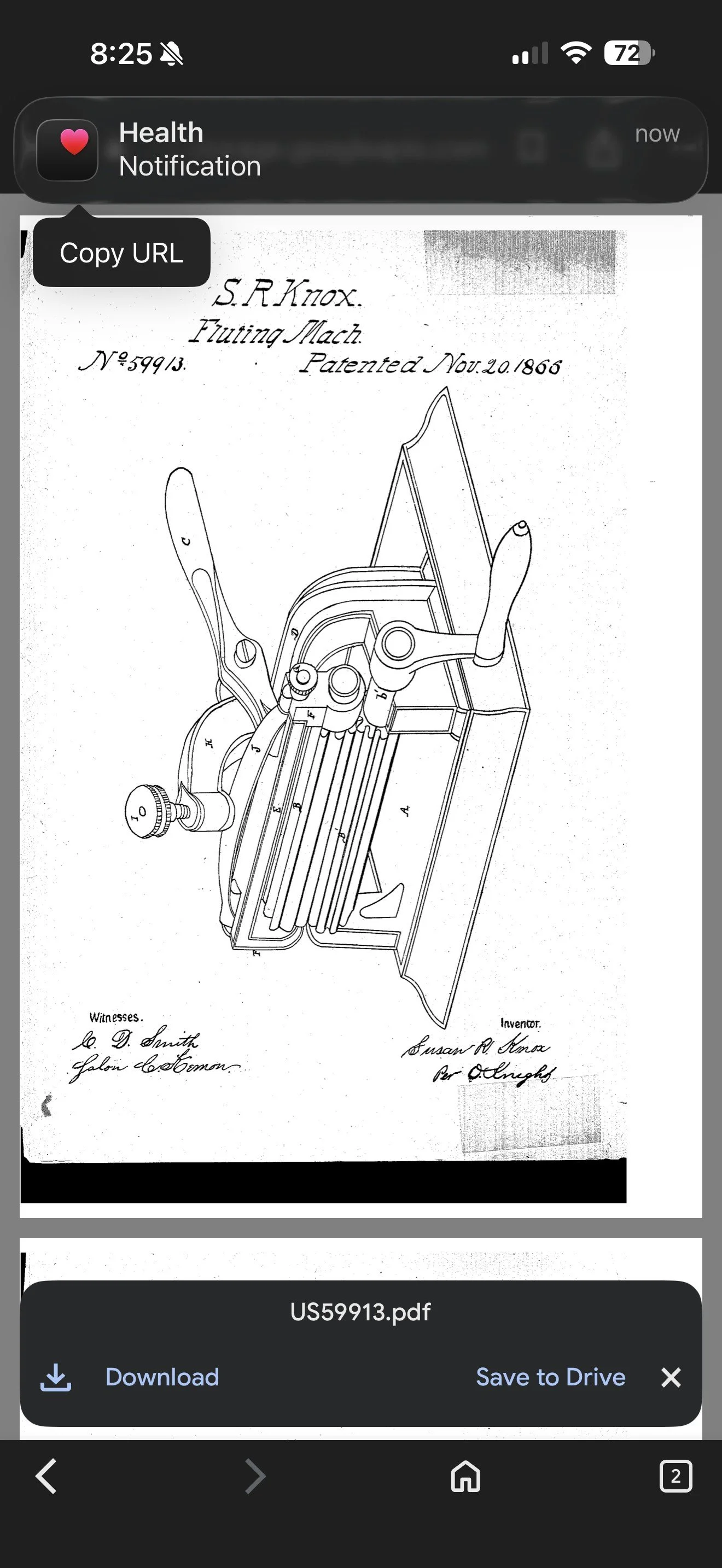
U.S. Patent No. 59,913, “Improvement in Fluting-Machines,” patented November 20, 1866, by Susan R. Knox of New York. The patent drawing shows a perspective view of the complete machine. Key components visible in the drawing: A = the base frame; B, B’ = the pair of corrugated rollers (upper and lower); C = the lever for elevating the upper roller to admit fabric; D = the repositioned standard, rising from one end of the base rather than from between the rollers; E = the horizontal bar carrying the upper roller bearings; F = the detachable bearing, removable via thumb-screw G; H = the curved arm supporting the pressure screw I; J = the arched spring that provides yielding pressure on the upper roller. The inventor’s signature “Susan R. Knox” and the signatures of witnesses C.D. Smith and Solon C. Kemon appear at the bottom of the drawing.
Knox’s patent describes a machine built around a pair of corrugated rollers mounted horizontally, one above the other, in a cast iron frame. The rollers are hollow, allowing heated iron rods to be inserted to warm the corrugated surfaces. When the crank is turned, the lower roller rotates, and the intermeshing corrugations of the upper roller cause it to rotate simultaneously in the opposite direction. Fabric fed between the rollers is compressed into the grooves, emerging with uniform parallel pleats—the “fluting” effect that gave the machine its name.
Knox’s patent specification identified three specific innovations that distinguished her machine from earlier designs. First, she relocated the standard (the vertical support that holds the lever mechanism) from a position between the ends of the rollers—where it obstructed the fabric path—to a position beyond one end, with a horizontal arm extending back over the upper roller. This cleared both sides of the rollers for unobstructed fabric feeding. Second, she designed the upper roller bearing (designated F in the patent drawing) to be detachable via a thumb-screw, allowing the rollers to be quickly removed and replaced with different sizes for different fluting widths. Third, she added a spring (designated J) mounted on a curved arm above the upper roller, regulated by a screw (designated I), which caused the upper roller to exert yielding pressure on the fabric—automatically adjusting to different fabric thicknesses without requiring manual pressure adjustment.
The patent specification notes that these rollers and lever mechanisms were “common in machines of this character” and were “not directly involved in the present invention.” Knox was claiming only the three improvements listed above—not the basic concept of corrugated-roller fluting. Her genius was in the engineering refinements that made a known technology faster, more versatile, and more user-friendly.
The Perin & Gaff Version: A Cincinnati Manufacturer’s Execution

Front view showing the pair of brass corrugated rollers mounted in the japanned cast iron frame, the crank handle at right, and the decorative base with Greek key border pattern in red and gold. The floral decal—a chromolithographic transfer common on Victorian household machinery—is visible on the base platform between the frame supports. The pressure-adjustment screw and arched spring bar are visible at top. Faint remnants of decorative stenciling or lettering are visible on the frame above the rollers.
The Perin & Gaff Manufacturing Company of Cincinnati was one of several foundries licensed to manufacture the Knox fluting machine. Perin & Gaff was a general hardware manufacturer whose circa 1876 catalog—a hardbound volume of approximately four hundred pages—documented an extraordinary range of cast iron products including bells, sad irons, traps, door hardware, bellows, pulleys, drills, and agricultural implements. The Knox fluting iron represented the domestic-equipment side of their product line: a patented household device manufactured under license from the inventor.
The Perin & Gaff version of the Knox fluter is distinguished from other manufacturers’ versions by its base markings. Where the H. Sauerbier & Son version carried the Newark manufacturer’s name, and the American Machine Company version carried the Philadelphia maker’s mark, this piece carries “PERIN & GAFF MF’G CO / CIN O”—placing it squarely in Cincinnati’s foundry ecosystem. The japanned finish with decorative Greek key border and floral transfer is consistent with the decorative standards of mid-to-late Victorian household machinery: these were not hidden utility items but display-worthy pieces of domestic technology that sat on laundry-room countertops and were meant to be seen.
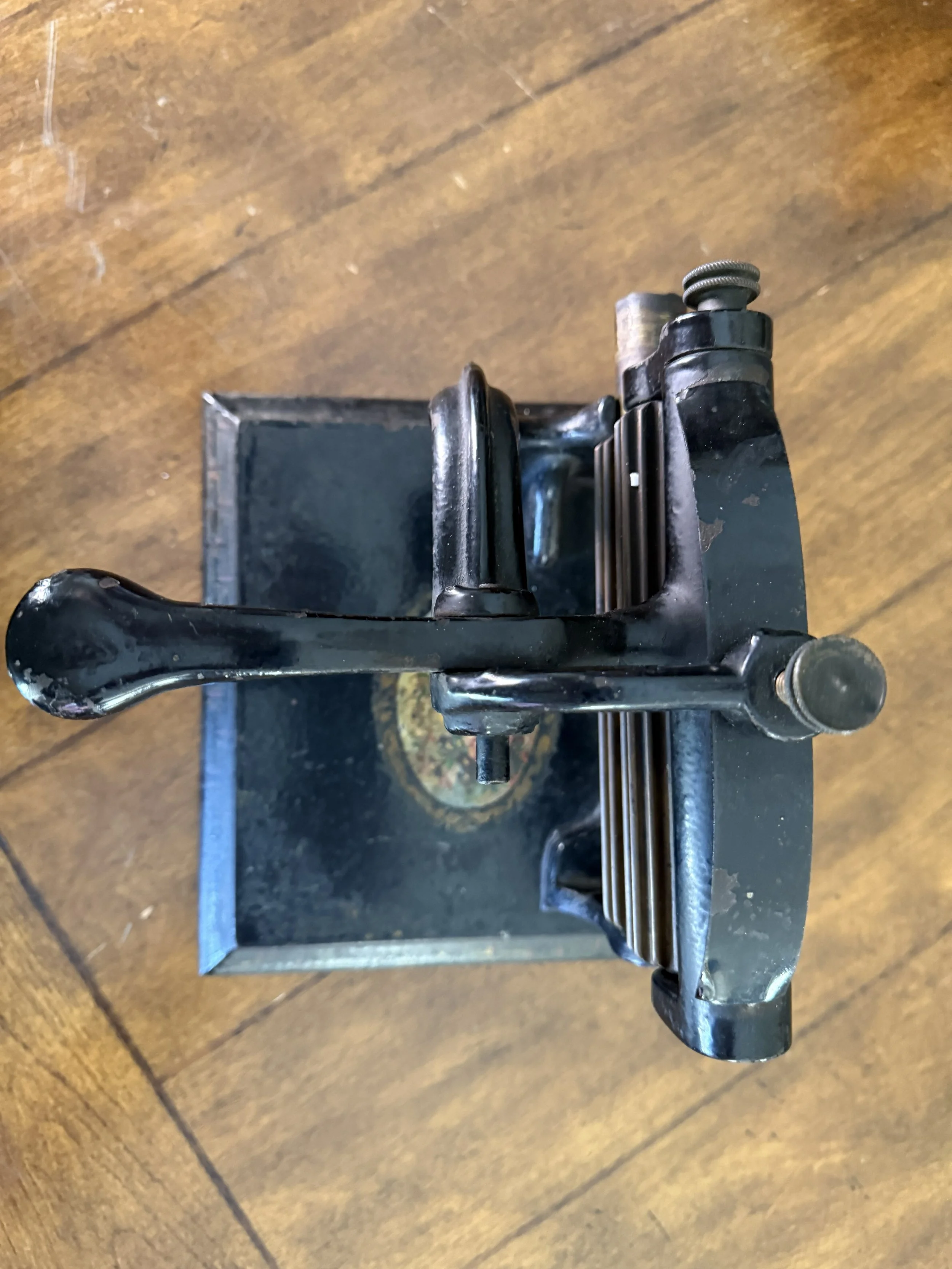
Top view showing the crank handle, corrugated roller assembly, and the floral chromolithographic decal on the japanned base. The decal—a small oval transfer depicting roses and foliage—is a period-appropriate decorative element found on Knox fluters and other Victorian household machinery. The overall form matches the patent drawing exactly: base frame with repositioned standard, lever mechanism, and spring-loaded pressure bar.
Piece Details
Manufacturer
Perin & Gaff Manufacturing Co., Cincinnati, Ohio
Inventor / Patentee
Mrs. Susan R. Knox, New York, N.Y.
Piece Type
Crank Fluting Iron / Fluting Machine
Form
Cast iron japanned base with pair of hollow corrugated brass rollers, crank handle, lever mechanism, spring-loaded pressure bar with adjustment screw, and detachable upper roller bearing
Material
Cast Iron (frame/base, japanned finish), Brass (corrugated rollers), Steel (crank mechanism, springs, screws)
Marking
“PERIN & GAFF MF’G CO / CIN O” and “MRS SUSAN R KNOX / PATENTED / NOV 20 66” on base
Decoration
Japanned (lacquered black) finish with Greek key border in red/gold; floral chromolithographic transfer decal on base
Patent
U.S. Patent No. 59,913, November 20, 1866, “Improvement in Fluting-Machines”; Reissue No. 3,938, April 26, 1870
Purpose
Domestic laundry device for pressing pleated (fluted) trimmings on clothing using heated corrugated rollers
Date of Manufacture
Circa 1866–1880
Place of Manufacture
Cincinnati, Hamilton County, Ohio
Condition
Very good — all markings legible; japanned finish substantially intact with age-appropriate wear; brass rollers present and functional; crank mechanism operational; floral decal partially intact; Greek key border visible; pressure spring and screw present
Acquisition Date
March 17, 2026
Acquisition Source
eBay — Seller: tiquetrader
eBay Item Number
298104147507
Order Number
13-14375-49129
SSC Catalog Number
SSC-PG-FLT-KNOX-001
Collection Designation
Ohio Foundry Corridor
Timeline: The Knox Patent and Perin & Gaff
Nov. 20, 1866
U.S. Patent No. 59,913 granted to Susan R. Knox of New York for “Improvement in Fluting-Machines.” The patent describes a crank-operated machine with corrugated rollers, repositioned standard, detachable bearing, and spring-loaded pressure mechanism.
c. 1866–1870
Perin & Gaff Manufacturing Co. of Cincinnati, Ohio, begins manufacturing the Knox fluting machine under license. Machines are marked “PERIN & GAFF MF’G CO / CIN O / MRS SUSAN R KNOX / PATENTED NOV 20 66.” H. Sauerbier & Son of Newark, NJ, also manufactures the Knox fluter under license during this period.
Apr. 26, 1870
Knox’s patent is reissued as Reissue No. 3,938 with broader claims, extending her protection over the fluting machine design.
c. 1870–1874
Multiple licensed manufacturers produce the Knox fluter. The Smithsonian Institution’s National Museum of American History later acquires examples by both Sauerbier and other makers for its permanent collection.
1874
Knox et al. v. Loweree et al. is heard in federal court, involving patent infringement of the Knox fluting machine design. The case documents Perin & Gaff’s role as a licensed manufacturer and Knox’s aggressive defense of her patent rights.
1876
Perin & Gaff publishes its “Illustrated Catalogue and Price List of General Hardware and Agricultural Implements,” approximately 400 pages. The firm also introduces the Royal 80 Fluting Machine under its own 1876 patent—a distinct product from the Knox-licensed fluter.
c. 1877–1890s
Later versions of the Knox fluter are produced by the American Machine Company of Philadelphia as “The Original Knox,” with a table clamp (patented July 3, 1877) and updated mechanism. Knox’s fluting machines remain in production through the decline of fluted fashion trimmings.
The Knox Fluter in Museum Collections
The Smithsonian Institution’s National Museum of American History holds at least two Knox fluting machines in its permanent collection. One example, cataloged as a “KNOX Fluting Machine” made by H. Sauerbier & Son of Newark, NJ, is dated circa 1870–1874 and carries both the original 1866 patent date and the 1870 reissue date. The Smithsonian’s catalog entry identifies Sauerbier as “one of several foundries that produced fluters under Knox’s patent.” A second example, cataloged as “THE ORIGINAL KNOX Fluting Machine,” is a later model made by the American Machine Company, dated after 1892, featuring a table clamp and updated mechanism.
The presence of Knox fluting machines in the Smithsonian’s collection confirms the historical significance of the design and its inventor. The SSC piece—manufactured by Perin & Gaff of Cincinnati rather than by the Newark or Philadelphia makers represented at the Smithsonian—adds a Cincinnati-manufactured example to the documented record of Knox fluter production. No Perin & Gaff version is known to be held by the Smithsonian, making this SSC piece a potentially unique documented example of the Cincinnati variant.
Three Pieces, One Foundry: The Perin & Gaff Story Grows
This fluting iron is the first Perin & Gaff piece acquired for the SSC collection, and it anchors the growing documentation of this Cincinnati general hardware manufacturer. The collection now holds three Perin & Gaff pieces: this Knox Patent Crank Fluting Iron (SSC-PG-FLT-KNOX-001), a cast iron chain pulley (SSC-PG-PLY-1876-001), and the documented record of the company’s four-hundred-page 1876 catalog. Together, these pieces span the range of Perin & Gaff’s production—from a delicate patented household device with brass rollers and a japanned finish, to a heavy utilitarian barn pulley with a chain and swivel eye. The same Cincinnati foundry that cast this elegant laundry machine also cast the working hardware that hung in Ohio barns.
Why This Piece Matters
The Perin & Gaff Susan R. Knox Patent Crank Fluting Iron matters on multiple levels. It is a physical artifact of a U.S. patent held by a woman in 1866—a rarity in an era when fewer than one percent of patents were granted to female inventors. It is a manufactured product from a documented Cincinnati hardware company, carrying both the manufacturer’s name and the inventor’s name on its base. It is a piece of Victorian domestic technology that connects the fashion industry’s demand for fluted trimmings to the cast iron foundries of Ohio. And it is supported by primary sources that few pieces in any collection can match: the original patent specification, a Smithsonian catalog entry for a comparable piece, and a federal court case that documents the manufacturer’s licensed production.
It matters because it tells a story that crosses boundaries—between a woman inventor in New York and a hardware foundry in Cincinnati, between the patent office and the laundry room, between the fashion pages and the foundry floor. Susan R. Knox invented a machine. Perin & Gaff of Cincinnati cast it in iron and brass. And someone in a Victorian household used it to press the pleats in her family’s clothing, one crank turn at a time.
One hundred and fifty dollars on eBay. A japanned iron machine with brass rollers and a floral decal, carrying the name of a woman who patented it and a foundry that built it. It is the most thoroughly documented piece in the SSC collection, and it belongs here.
The iron endures. The markings tell the truth. The story deserves to be told.
Sources & Further Reading
Physical examination of piece: Perin & Gaff Mfg. Co. Susan R. Knox Patent Crank Fluting Iron. Marked “PERIN & GAFF MF’G CO / CIN O / MRS SUSAN R KNOX / PATENTED / NOV 20 66” on base. Japanned cast iron with brass corrugated rollers, crank handle, and spring-loaded pressure mechanism.
U.S. Patent No. 59,913 (November 20, 1866), “Improvement in Fluting-Machines,” granted to Susan R. Knox of New York. Full specification available at Google Patents (patents.google.com/patent/US59913A/en). Reissue No. 3,938, April 26, 1870.
Smithsonian Institution, National Museum of American History — “KNOX Fluting Machine” (catalog object nmah_311782). Made by H. Sauerbier & Son, Newark, NJ, c. 1870–1874. Identifies Knox’s patent and confirms multiple licensed manufacturers. Gift of W.B. Lincoln, Jr.
Smithsonian Institution, National Museum of American History — “THE ORIGINAL KNOX Fluting Machine” (catalog object nmah_311779). Made by American Machine Co., Philadelphia, after 1892. Later model with table clamp (patented July 3, 1877).
Knox et al. v. Loweree et al. (1874) — Federal court case involving patent infringement of the Knox fluting machine design. Documents Perin & Gaff’s role as a licensed manufacturer.
Lyon v. Perin & Gaff Mfg. Co., 125 U.S. 698 (1888) — U.S. Supreme Court case confirming Perin & Gaff’s operations in Cincinnati.
Perin & Gaff Manufacturing Co., Illustrated Catalogue and Price List of General Hardware and Agricultural Implements (Cincinnati, Ohio, c. 1876). Approximately 400-page catalog.
A Fine Collection (afinecollection.wordpress.com) — “Fluting iron, 1866” entry. Detailed description of the Knox fluting machine and its operation.
SSC Internal Collection Records — Perin & Gaff pieces: SSC-PG-PLY-1876-001 (cast iron chain pulley). This is the first Perin & Gaff piece and the anchor of the SSC’s Cincinnati manufacturer documentation.
About Steve’s Seasoned Classics
Steve’s Seasoned Classics is an online museum dedicated to preserving and documenting the heritage of American cast iron, with a focus on Ohio foundry pieces from the 19th and early 20th centuries. The SSC collection features over 130 pieces with detailed provenance, historical research, and photography for each item.
