Browne’s Patent Cast Iron Broom Head
SSC MUSEUM COLLECTION
Catalog No. SSC-BROWNE-BRM-1865-001
Patented Broom Clamp | Cast Iron | Oct. 24, 1865 | Cincinnati, Ohio
Circa 1865–1880 • John David Browne • Ohio Foundry Corridor
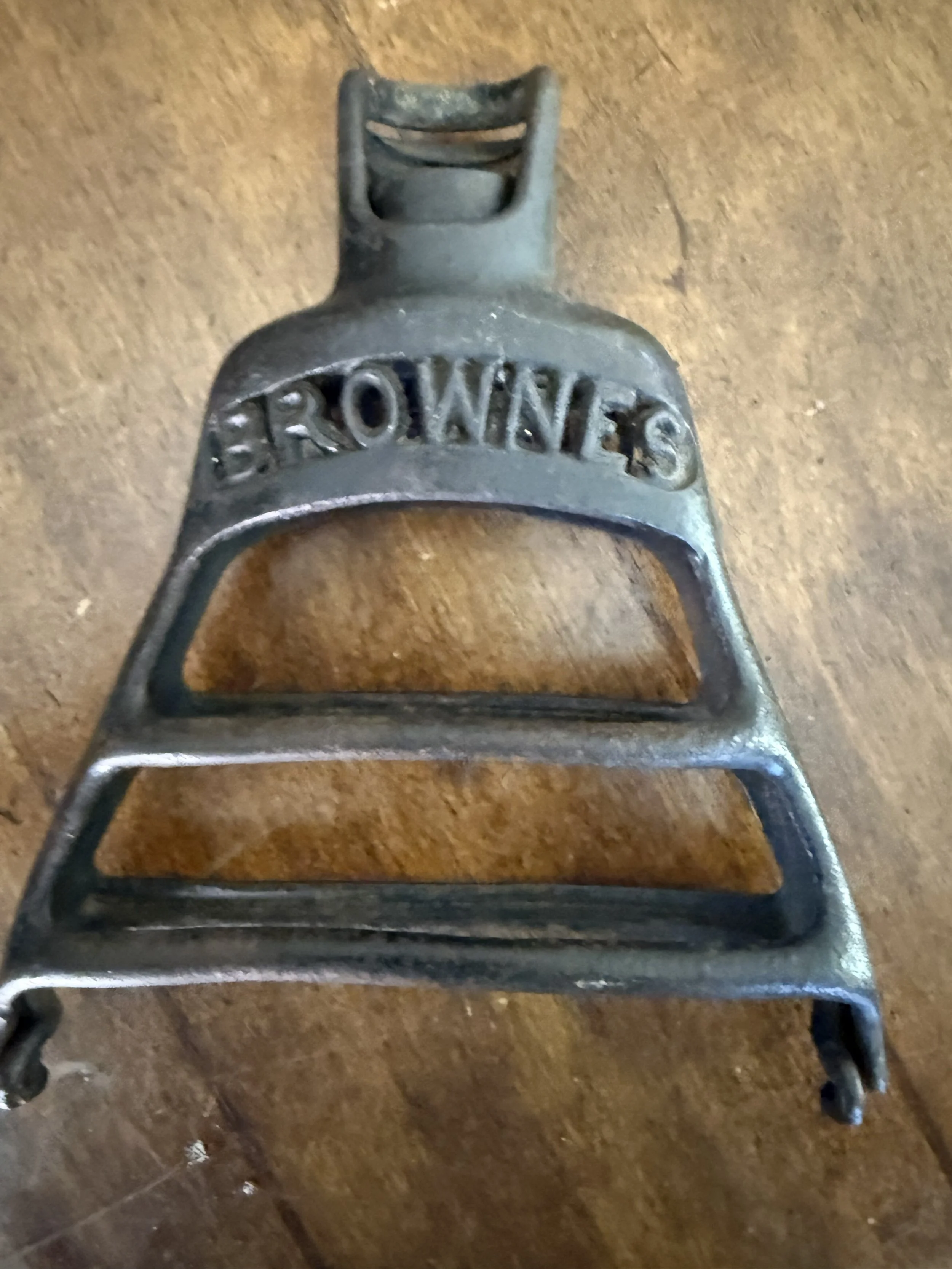
Manufacturer’s side showing “BROWNE’S” cast in raised letters across the arched upper frame of the broom head. The trapezoid-shaped cast iron clamp features two horizontal crossbars that compress and hold broom straw or filling material. A cylindrical socket at top receives the broom handle, which threads into an internal screw cast into the socket—Browne’s key innovation that eliminated the need for separate screws, nuts, pins, or ferrules. The hooked tips at the bottom of the clamp frame secure the straw bundle. Surface shows original casting with age-appropriate patina.
The broom is one of the oldest tools in human history, and one of the simplest. A bundle of straw or grass, bound to a stick, swept the floor. For centuries, the binding was the weak point: twine or wire wrapped around the straw eventually loosened, the handle worked free, and the broom fell apart. By the mid-nineteenth century, American inventors were attacking this problem with cast iron—designing metal clamps and heads that could grip broom straw permanently, accept a standard handle, and be manufactured at scale. Between 1860 and 1870, dozens of broom-head patents were filed at the U.S. Patent Office, each offering a slightly different solution to the same ancient problem.
John David Browne of Cincinnati, Ohio, filed one of those patents. On October 24, 1865—less than six months after the end of the Civil War—the U.S. Patent Office granted Letters Patent No. 50,554 for Browne’s “Broom-Head,” a two-part cast iron clamp with a built-in threaded screw socket that simultaneously attached the handle and compressed the filling. No separate hardware was needed. You opened the clamp, laid in the broom straw, closed it, inserted the handle, and turned. The screw inside the socket cut threads into the wooden handle as it was twisted, locking everything together in a single motion. It was elegant, it was simple, and it was patented by a man who had already proven himself one of Cincinnati’s most inventive minds.
This is Browne’s Patent Cast Iron Broom Head, marked “BROWNE’S” on one side and “PATENT OCT. 24 1865” on the other—a direct physical artifact of the patent itself, manufactured in Cincinnati and carrying the inventor’s name and the exact date of his grant. It is the kind of piece that belongs in a museum—not because it is beautiful, but because it documents an Ohio inventor, an Ohio patent, and the industrial ingenuity of a city that was solving everyday problems with cast iron at a scale that changed American life.
John David Browne: A Cincinnati Inventor’s Life in Patents

Patent side showing “PATENT” and “OCT. 24 1865” cast in raised letters across the arched upper frame. The cylindrical handle socket with its oval through-hole is visible at top. The internal threaded screw—Browne’s patented innovation—is cast inside this socket, allowing a pointed wooden handle to be screwed directly into the clamp without any separate fasteners. This is U.S. Patent No. 50,554, granted to John David Browne of Cincinnati, Hamilton County, Ohio.
John David Browne (1807–1891) was born in Great Britain and immigrated to the United States, where he established himself as an inventor and maker of mechanical devices. By the mid-1850s, Browne was working in Cincinnati, Hamilton County, Ohio, and his name began appearing in the records of the U.S. Patent Office with a regularity that marks him as a serial inventor—a man who saw problems in everyday objects and engineered cast iron solutions.
Browne’s earliest known patents were for apple parers—the mechanical kitchen devices that peeled apples by cranking them against a blade. His first patent for an apple-paring machine was granted on May 6, 1856 (U.S. Patent No. 14,800), followed by a second apple-parer patent on September 9, 1856 (U.S. Patent No. 15,683). These machines were marketed as “Browne’s Nonpareil Apple Parer,” and his inventive claim was for a quick-return mechanism that improved the speed and efficiency of the paring arm. The Nonpareil parer is documented in the Apple Parer Museum and is recognized by collectors of antique kitchen mechanical devices.
Nine years later, in the closing months of the Civil War, Browne turned his attention from the kitchen to the broom closet. His broom-head patent, No. 50,554, was granted October 24, 1865. The patent describes a two-part clamp of “malleable iron or other suitable material,” jointed at a hinge, with one part carrying an internal threaded screw socket and the other forming a ring or yoke through which the handle passes. The handle is made with a pointed end that enters the broom filling when inserted, further compressing and securing the straw. Browne’s specification proudly notes that his method “dispenses with the use of separate screws, nuts, pins, buttons, ferrules, &c., as hitherto used.”
Later in life, Browne appears to have relocated to New York, where he was granted a patent for a combined rocking and caster chair (U.S. Patent No. 964, October 5, 1888), identifying himself as “of the city, county, and State of New York, cabinet and chair maker, a native of Great Britain.” This final patent confirms his British origins and suggests a man who spent his entire American career inventing—from apple parers in 1850s Cincinnati, to broom heads during the Civil War, to furniture in 1880s New York. He died in 1891, having held patents spanning more than three decades of American ingenuity.
U.S. Patent No. 50,554: How the Browne Broom Head Works
The Browne broom head is a two-part hinged clamp cast in iron. Part A carries a cylindrical socket with an internal threaded screw—a sharp-threaded spiral cast directly into the inside of the socket, either formed in the mold or with a dry sand core. Part B extends up and over the socket, forming a ring or yoke through which the broom handle passes.
To assemble a broom: the user opens the clamp at approximately a right angle, places the broom straw or filling material into the open clamp with Part A (the screw side) facing downward, then closes the clamp so the yoke of Part B snaps over the socket of Part A. The user then inserts a pointed wooden handle through the yoke and into the socket. As the handle is twisted, the internal screw cuts threads into the wood, pulling the handle down into the socket, compressing the clamp tighter against the filling, and locking everything together. The pointed end of the handle penetrates into the broom straw itself, further securing the bundle.
The genius of this design is its simplicity. One moving part—the hinged clamp—and one action—turning the handle—accomplishes three things simultaneously: it fastens the handle, compresses the clamp, and secures the filling. No tools are required. No separate hardware is needed. A farmer, a housewife, or a merchant could assemble or repair a broom on the spot, using only the clamp and a length of straw. When the broom wore out, the clamp could be opened, the old straw removed, new straw inserted, and the handle re-threaded—an indefinitely reusable piece of hardware in an era when most broom bindings were disposable.
Piece Details
Inventor / Patentee
John David Browne (1807–1891)
Piece Type
Patented Cast Iron Broom Head / Broom Clamp
Form
Two-part hinged cast iron clamp with internal threaded screw socket, cylindrical handle receiver with yoke, two horizontal crossbars, and hooked straw-retention tips
Material
Cast Iron (malleable iron per patent specification)
Marking
“BROWNE’S” on one side; “PATENT OCT. 24 1865” on reverse
Patent
U.S. Patent No. 50,554, dated October 24, 1865, “Broom-Head,” granted to John David Browne of Cincinnati, Ohio
Purpose
Reusable cast iron broom head clamp for securing broom straw and handle without separate fasteners
Date of Manufacture
Circa 1865–1880
Place of Manufacture
Cincinnati, Hamilton County, Ohio
Condition
Very good — crisp legible markings on both sides; hinge intact; internal screw socket present; no cracks or breaks; dark casting patina consistent with age
Acquisition Date
March 14, 2026
Acquisition Source
eBay — Seller: diverse.nurse
eBay Item Number
365591847898
Order Number
17-14355-44006
SSC Catalog Number
SSC-BROWNE-BRM-1865-001
Collection Designation
Ohio Foundry Corridor
Inventor Timeline: John David Browne
1807
John David Browne born in Great Britain.
Pre-1854
Browne immigrates to the United States and settles in Cincinnati, Hamilton County, Ohio. He is listed as a maker of mechanical devices and household implements.
May 6, 1856
Granted U.S. Patent No. 14,800 for an improvement in machines for paring apples. This is his first known patent, filed from Cincinnati.
Sept. 9, 1856
Granted U.S. Patent No. 15,683 for a second apple-parer improvement. The device is marketed as “Browne’s Nonpareil Apple Parer” and features a quick-return mechanism for the paring arm.
Oct. 24, 1865
Granted U.S. Patent No. 50,554 for a “Broom-Head”—a two-part hinged cast iron clamp with internal threaded screw socket. Filed from Cincinnati, Ohio. The patent is granted less than six months after the end of the Civil War.
c. 1865–1880
Browne’s Patent Broom Head manufactured and sold, marked “BROWNE’S” and “PATENT OCT. 24 1865.”
Oct. 5, 1888
Granted U.S. Patent No. 964 for a “Combined Rocking and Caster Chair,” filed from New York, N.Y. Browne identifies himself as “a native of Great Britain” and “cabinet and chair maker.”
1891
John David Browne dies. His patents span more than three decades of American invention, from apple parers to broom heads to furniture.
Cincinnati’s Post-War Patent Boom
The date on this broom head—October 24, 1865—places it in one of the most inventive moments in American history. The Civil War had ended just five months earlier, in April 1865. The U.S. Patent Office, which had issued approximately 60,000 patents in the entire period from 1790 to 1860, would issue nearly 450,000 more between 1860 and 1890. The war itself had accelerated American manufacturing and invention at an extraordinary pace, and the returning peace unleashed a flood of new patents for everything from weapons to kitchen gadgets to household tools.
Cincinnati was at the center of this wave. The city’s position as a manufacturing hub—with foundries, machine shops, and metalworkers already in place to serve the war effort—made it a natural incubator for post-war invention. John David Browne was one of many Cincinnati inventors filing patents in 1865, applying the city’s casting and metalworking infrastructure to solve everyday problems. His broom head joined a crowded field of similar patents: at least half a dozen broom-head patents were granted in 1865 alone, each offering a different cast iron solution to the problem of binding straw to a handle. But Browne’s design—with its elegant self-threading socket—was distinctive enough to carry his name in raised letters on every piece produced.
The broom head also represents a category of cast iron objects that is almost entirely absent from collector databases and foundry lists. The major collector references—the Cast Iron Collector foundry database, the WAGS Society foundry list, the standard cookware and hardware references—document skillets, kettles, sad irons, and stoves. They do not typically list broom heads. This is an object that falls between the cracks of collecting categories: it is not cookware, not hardware in the traditional sense, not a tool. It is a household implement—a piece of domestic infrastructure so mundane that it was invisible even to the people who used it every day. That invisibility is exactly what makes a surviving marked example significant.
Why This Piece Matters
Browne’s Patent Cast Iron Broom Head matters because it is a direct physical artifact of a U.S. patent—not a reproduction, not an illustration, but the actual manufactured product described in Letters Patent No. 50,554, carrying the inventor’s name and the exact date of grant cast into the iron itself. It connects a documented Cincinnati inventor—John David Browne, born in Great Britain, holder of patents from 1856 to 1888—to the physical world of nineteenth-century Ohio manufacturing. The patent drawing shows the clamp. This piece is the clamp.
It matters because it was patented on October 24, 1865, in the first autumn after the Civil War—a date that places it at the very beginning of America’s great post-war industrial expansion. It matters because it was invented in Cincinnati, by a man who had already patented apple parers in the same city a decade earlier. And it matters because nobody collects broom heads. This is not a category that has a collector community, a reference book, or a museum display. There is no “broom head” section in the antique hardware guides. The piece exists in a space that has no institutional memory—and that is precisely the space where the SSC collection operates.
Eighty-five dollars on eBay. A small iron clamp with a hinge and a name. It is the physical evidence that John David Browne of Cincinnati, Ohio, solved a problem in 1865, and that someone in Cincinnati cast his solution in iron and stamped his name on it. The SSC collection exists to make sure that evidence does not disappear.
The iron endures. The markings tell the truth. The story deserves to be told.
Sources & Further Reading
Physical examination of piece: Browne’s Patent Cast Iron Broom Head. Marked “BROWNE’S” on one side; “PATENT OCT. 24 1865” on reverse. Two-part hinged cast iron clamp with internal threaded screw socket, two crossbars, and hooked straw-retention tips.
U.S. Patent No. 50,554 (October 24, 1865), “Broom-Head,” granted to John David Browne of Cincinnati, Hamilton County, Ohio. Available at Google Patents (patents.google.com/patent/US50554A/en). Full specification describes two-part malleable iron clamp with internal threaded screw for handle attachment.
U.S. Patent No. 14,800 (May 6, 1856), “Machine for Paring Apples,” granted to John D. Browne of Cincinnati, Ohio. Browne’s first known patent.
U.S. Patent No. 15,683 (September 9, 1856), “Apple-Parer,” granted to John D. Browne of Cincinnati, Ohio. Marketed as “Browne’s Nonpareil Apple Parer.”
U.S. Patent No. 964 (October 5, 1888), “Combined Rocking and Caster Chair,” granted to John David Browne of New York, N.Y. Identifies Browne as “a native of Great Britain.”
Apple Parer Museum (appleparermuseum.com) — “Browne’s Nonpareil Apple Parer” entry. Documents John David Browne (1807–1891) of Cincinnati, Ohio, and his apple-parer patents.
SSC Internal Collection Records — Cincinnati manufacturer pieces: Perin & Gaff Mfg. Co. (SSC-PG-FLT-KNOX-001, SSC-PG-PLY-1876-001), W. Resor & Co. (SSC-RESOR-WAF-1880-001), Kingery Mfg. Co. (SSC-KINGERY-SCP-1894-001).
About Steve’s Seasoned Classics
Steve’s Seasoned Classics is an online museum dedicated to preserving and documenting the heritage of American cast iron, with a focus on Ohio foundry pieces from the 19th and early 20th centuries. The SSC collection features over 130 pieces with detailed provenance, historical research, and photography for each item.
